


How to Become a Lawyer After 12th in 2027-28 - Courses, Eligibility, Fees, Exams, Top Colleges


Students who want to become a lawyer after Class 12 can enrol in a five-year integrated LLB programme. BA LLB, BBA LLB, BCom LLB and BSc LLB are some of the popular law courses offered by law schools in India. For admission to the 2027-28 academic session, candidates can appear for national-level law entrance exams such as CLAT, AILET, SLAT, or state-level exams such as MH CET Law, TS/AP LAWCET and KLEE.
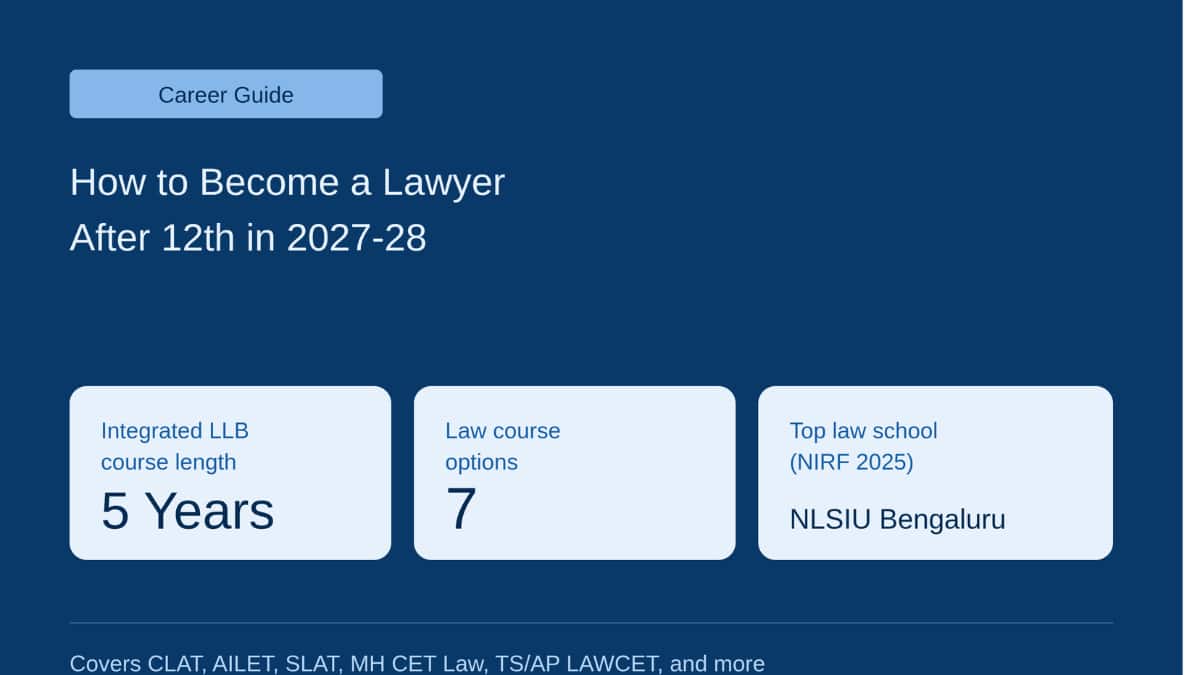
After completing the integrated 5-year LLB, candidates can practise law by qualifying for the All India Bar Examination (AIBE), enrolling with a State Bar Council and obtaining a Certificate of Practice. Various universities (govt and private) also conduct university-specific law entrance exams or offer law admissions without entrance exams, based on Class 12 marks or other selection criteria.
Law Courses to Apply For After Class 12
Law course | Subjects/area of study |
BA LLB | Arts and humanities subjects such as political science, history, sociology and economics with law subjects including constitutional law, criminal law, contract law, torts, family law and jurisprudence |
BBA LLB | Business administration, management and commerce with corporate law, taxation, intellectual property rights, mergers and acquisitions and commercial law |
BCom LLB | Commerce, accounting, economics and taxation with commercial law |
Science subjects such as biotechnology, technology law, intellectual property and science-related regulation with law | |
Social legislation, human rights, legal aid, public policy, labour law and social welfare | |
BLS LLB | A law-focused integrated programme offered by select institutions |
Technology law, intellectual property, data and other techno-legal fields; offered as a six-year integrated programme |
The five-year integrated LLB course combines an undergraduate degree with legal education, allowing students to complete both qualifications in five years. The availability of each law programme depends on the college and university.
Eligibility Criteria
Though eligibility varies based on the university and the entrance exam the candidate is applying for, the general requirements are:
Educational qualification: Candidates must have passed 12th class or an equivalent examination from a recognised board. Students appearing for their Class 12 examination can also apply for most law entrance exams.
Minimum marks: A minimum of 45% marks is commonly required for General category candidates. Reserved category candidates get relaxation as per the rules of the respective institution.
Stream: Students from arts, commerce and science streams can apply for most integrated LLB programmes. Some specialised courses, including certain BSc LLB programmes, require science subjects.
Age limit: There is no upper age limit for undergraduate admission through major exams such as CLAT, AILET and SLAT.
Step-by-Step Admission Process to Becoming a Lawyer
The complete admission process can be divided into the following steps:
1. Complete Class 12 from a recognised board with the marks required in the chosen course and entrance exam.
2. Choose law courses (BA LLB, BBA LLB, BCom LLB, BSc LLB or any other course) according to interests and career plans.
3. Fill in the application form for CLAT, AILET, SLAT, or state-level exams like MH CET Law, TS LAWCET, AP LAWCET, KLEE, etc.
4. Appear for the entrance exam and check the result.
5. After the exam results, participate in counselling, fill in college choices, accept the allotted seat, verify documents, pay the admission fee and report to the college.
6. Complete a 5-year integrated LLB program (attend lectures, internships, engage in moot courts, legal research and other practical activities).
7. Enrol with the State Bar Council upon completion of the law degree.
8. Clear the AIBE (All India Bar Examination), conducted by the Bar Council of India. Candidates who qualify are issued a Certificate of Practice.
9. Once qualified as a lawyer, candidates can work as advocates or pursue other careers in the legal field according to their interest.
There are also private universities and colleges that do not conduct any entrance exams. Candidates get selected based on their marks obtained in Class 12 or based on the University’s own selection process.
Law Entrance Exams for the 2026-27 Admission Cycle
The major law entrance exams in India for students seeking admission to five-year LLB are:
CLAT (Common Law Admission Test)
CLAT is the primary entrance exam for admission to participating National Law Universities in India. CLAT 2027 registration started on August 3, 2026, and the last date to apply is October 31, 2026. Candidate can submit their application through the Consortium of National Law Universities’ website - consortiumofnlus.ac.in. The exam will be offline from 2 pm to 4 pm on December 6, 2026.
The CLAT UG paper will have 120 questions carrying 1 mark each. Candidates will get two hours to complete the paper. There will be a negative marking of 0.25 marks for every incorrect answer.
CLAT 2027 Syllabus
Section
Questions
English Language
22-26
Current Affairs including GK
28-32
Legal Reasoning
28-32
Logical Reasoning
22-26
Quantitative Techniques
10-14
Section | Questions |
English Language | 22-26 |
Current Affairs including GK | 28-32 |
Legal Reasoning | 28-32 |
Logical Reasoning | 22-26 |
Quantitative Techniques | 10-14 |
CLAT scores are accepted by 25 NLUs, one off-campus of GNLU Gandhinagar in Silvassa and IIULER Goa, and several other law colleges. NLU Delhi conduct their separate exam and is not part of the CLAT NLU admission process.
AILET (All India Law Entrance Test)
AILET is an entrance test held by National Law University Delhi for admission in its BA LLB course. The university is not associated with the CLAT counselling, and therefore students willing to apply for admission in the University will have to appear for AILET.
AILET 2027 registration began on August 7, 2026. Candidates have until November 10 to register for the exam. Candidates can register on the NLU Delhi’s website - nationallawuniversitydelhi.in. The exam will be held on December 13, 2026, from 2 pm to 4 pm. The examination will be conducted in offline mode. The AILET UG exam has a negative marking of 0.25 marks for each incorrect answer.
AILET (NLU Delhi BA LLB) 2027 Exam Syllabus
Section | Questions |
English language | 50 |
Current affairs & general knowledge | 30 |
Logical reasoning | 70 |
Total | 150 |
MH CET Law (Maharashtra Common Entrance Test - Law)
Maharashtra State CET Cell conducts MH CET Law entrance for admission to 5-year and 3-year LLB courses in Maharashtra’s law colleges. Students who have completed Class 12 have to appear for the five-year LLB examination. Registrations can be done on the official State CET Cell Maharashtra portal, cetcell.mahacet.org.
The five-year MH CET Law exam is conducted in computer-based mode. It includes questions from legal aptitude and logical reasoning, general knowledge and current affairs, English and basic mathematics. No marks are deducted for incorrect answers. The 2027 admission schedule is yet to be announced.
SLAT (Symbiosis Law Admission Test)
SLAT is conducted by Symbiosis International (Deemed University) for admission to the UG law programmes at Symbiosis Law Schools (SLS). There are four SLSs - SLS Pune, SLS Noida, SLS Hyderabad, and SLS Nagpur. The SLAT offers two types of law programmes: BA LLB and BBA LLB; and is conducted in two phases.
SLAT 2027 registration is open, and the last date to apply is December 4, 2026. Candidates can apply at the SLAT 2027 registration portal, slat-test.org. The phase 1 exam will be conducted on December 19 and phase 2 on December 26, 2026. Candidates can sit in both tests, and the higher score between the two will be considered. The SLAT paper duration is one hour, and there is no negative marking.
SLAT 2027 Syllabus
Section | Questions |
Logical reasoning | 12 |
Legal reasoning | 12 |
Analytical reasoning | 12 |
Reading comprehension | 12 |
General knowledge | 12 |
Total | 60 |
Other Popular Law Entrance Exams After 12th
Apart from CLAT, AILET, MH CET Law and SLAT, students have several state and university-level options for five-year LLB admissions.
TS LAWCET: Telangana Law Aptitude cum Admission Test conducted for admission to law schools in Telangana.
AP LAWCET: For admission to law schools in Andhra Pradesh.
KLEE: Kerala state-level law entrance exam.
CUET BA LLB: Accepted by participating universities for admission in UG law courses.
PU BA LLB entrance exam: It is conducted by Panjab University for their 5-year integrated UG law course.
AMU Law entrance exam: For admission to law programmes at Aligarh Muslim University.
CUSAT CAT: For admission to Cochin University of Science and Technology (CUSAT) law programmes through CUSAT CAT.
University-level exams: There are several private universities that conduct their own entrance exams or use scores achieved in other national law exams.
Top 10 Law Colleges in India Based on NIRF 2025 Law Ranking
NIRF 2025 Rank | Law School | City | NIRF Score |
1 | Bengaluru | 82.97 | |
2 | New Delhi | 80.00 | |
3 | Hyderabad | 79.50 | |
4 | Kolkata | 79.39 | |
5 | Gujarat National Law University | Gandhinagar | 76.23 |
6 | Kharagpur | 74.09 | |
7 | Pune | 74.07 | |
8 | New Delhi | 66.39 | |
9 | Aligarh | 65.82 | |
10 | Bhubaneswar | 65.36 |
Fees Structure
Type of college | Approximate five-year LLB fee |
Government/public colleges | Rs 50,000 to Rs 7 lakh |
NLUs | Around Rs 9-11 lakh |
Private law universities | Around Rs 12-21 lakh or more |
The fees for law courses vary from college to college. Government colleges generally have lower fees, while private law universities charge higher tuition fees.
Career Scope After Law
A five-year LLB opens up several career options. Becoming a courtroom lawyer is only one of the choices available to law graduates. After completing law, candidates can also work as:
Lawyers and advocates
Corporate lawyers
Law firm associates
In-house legal counsel
Legal researchers
Policy researchers
Judicial officers, subject to the eligibility criteria of judicial service examinations
Legal journalists
Legal consultants
Law teachers and academics
Government and public-sector professionals
Entrepreneurs
The salary after LLB depends on the college, employer, area of practice and experience. Graduates who enter into top law firms are offered a higher starting salary. Those who enter into entering litigation may earn less in the beginning, but eventually grow higher through experience and practice.
Questions related to
On Question asked by student community
At 16, you have plenty of time to build a strong foundation for a career in law. Focus on English, reading comprehension, current affairs, logical reasoning and basic legal awareness.
If you plan to pursue a 5-year integrated law course after Class 12, you can prepare for law entrance exams
Yes, aap BA LLB karne ke baad aap lawyer ban sakte hain. Iske liye aapko BA LLB kisi recognised university se complete karna hoga. Course complete hone ke baad State Bar Council mein enrolment karke aap law practice shuru kar sakte hain.
For more information about BA LLB course you
Hi,
You can check out this detailed guide on How to become a Human Rights Lawyer and the career prospects .
Yes,
BBA LLB
can be pursued even if you are weak in Mathematics. BBA LLB require basic understanding of mathematical concepts.
Yes, LLM is a good option if you want to deepen your legal knowledge, specialize in a particular area of law, and improve career opportunities in academics, corporate law, or research.
Delhi
Recommended:
National Law University Delhi, Placement rating 4.8/5
Fee: Moderate
Affordable:
Faculty of Law, University of Delhi, Placement