
Search Colleges, Exams, Schools & more


Login
Why Manan Kumar Mishra Should Step Down as BCI Chairman
Switch to

Switch to
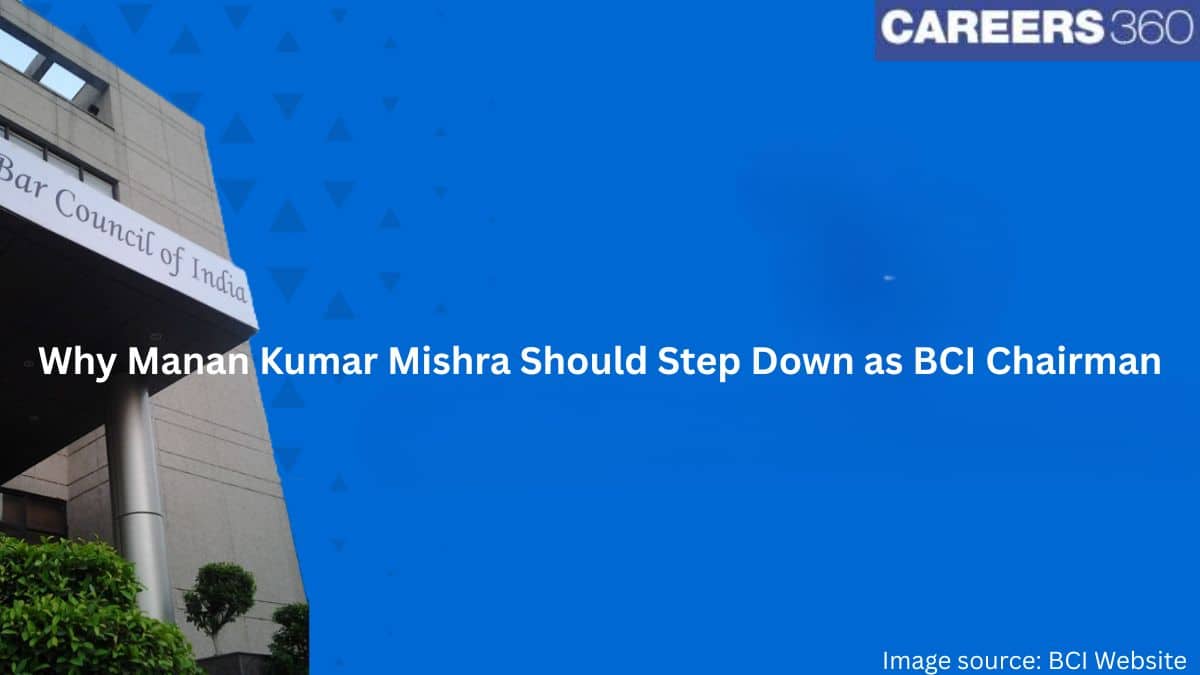
Manan Kumar Mishra first became Chairman of the Bar Council of India in April 2012. Except for a brief period in 2014, he has been the Chairman of BCI since November 2014; a total of 12 years. In comparison, his predecessors mostly served for one to four years.
Longevity by itself cannot be a reason for resignation. But long tenure inevitably concentrates institutional influence and, more importantly, raises questions of governance, accountability and succession. It also stagnates thinking and ideas. And if the person is an active politician, these factors become more important.
Mr Mishra is now a BJP Member of the Rajya Sabha. Nothing new, as many distinguished members of the Bar were and are active politicians too. The issue here is whether a person should simultaneously hold the chairmanship of the statutory regulator of India's legal profession and an elected political position representing the ruling party. There is a huge distinction between having political views and holding political office while exercising regulatory authority, and this matters enormously for the Bar.
Lawyers routinely appear against governments. They challenge legislation, defend political opponents, represent protesters, question executive decisions and act for citizens alleging abuse of state power. The institution regulating those lawyers must therefore be free from any perception of bias based on their political affiliations. Even the appearance that the regulator is closely identified with the political executive can weaken that confidence in them.
The other concerns stem from Mr Mishra's own public statements. In a letter written to Prime Minister Narendra Modi while serving as BCI Chairman, he used unusually deferential language, describing the Prime Minister as a guardian and guide and reportedly stating that the "Bar Council of India is your institution."
The concern is therefore not whom the Chairman admires politically. It is the message conveyed when the head of an independent regulator publicly identifies it so closely with the country's political leadership. It becomes an issue when the Chairman himself becomes a member of the ruling party in Parliament. Currently, the conflict is structural rather than merely rhetorical.
The Bar Council of India cannot be the institution of any Prime Minister, government or political party. It is a statutory institution created under law to serve the legal profession and, ultimately, the administration of justice.
The Bar Council of India regulates the legal profession, influences standards of legal education and exercises powers that directly affect advocates, universities and law students and lastly the conduct of a pillar of Indian Democracy. Therefore, it must not only act independently of political power but be truly independent.
Other areas of concern stem from the fact that Mr Mishra has himself spoken in the past about the fake law degrees; at one stage suggesting that a remarkably high proportion of persons appearing in court complexes could possess fraudulent qualifications.
If the head of the BCI believes this, it raises important questions about BCI’s achievements under a decade of substantially continuous leadership. Questions that come to mind include
How many degrees were verified?
How many fraudulent enrolments were cancelled?
How many institutions responsible for such degrees have faced action?
What measurable improvement has taken place in the quality and integrity of legal education?
Public election affidavits indicate that Mr Mishra declared assets of approximately ₹1.65 crore while contesting the Bihar Assembly election in 2010 and approximately ₹14.94 crore in his 2024 Rajya Sabha affidavit. For someone occupying a powerful statutory position for more than a decade while pursuing a political career, comprehensive transparency is imperative.
India has repeatedly witnessed difficulties when regulatory bodies, associations and federations become excessively dependent upon individual office-holders or closely intertwined with political power. Our sports federations are good examples of this. They have shown the vulnerability arising in governance structures when institutional authority, personal influence and political power overlap. Some of our sports, like football, have suffered from political leadership running sports federations.
We should learn from our lessons and ensure that an education regulatory body does not fail on the same lines as sports federations. The Bar Council of India is far too important to be identified with one individual or one political establishment.
This is especially important because of the powers it exercises over young lawyers and law schools. Regulatory decisions can determine whether students are eligible to practise, whether institutions can continue offering legal education and whether advocates face disciplinary consequences.
Such powers require exceptional institutional restraint. Recent controversies involving the BCI and law universities have further demonstrated why the relationship between regulatory authority and personal leadership deserves greater scrutiny.
The question to ask therefore is not whether Manan Kumar Mishra has performed well or poorly as Chairman but whether the current combination of offices is appropriate for the institution. A healthy governance framework should make the answer relatively straightforward.
A Member of Parliament belonging to the ruling political party should not simultaneously head the statutory regulator of India's legal profession. This principle should apply irrespective of the individual concerned or the party in power.
Mishra has had a decade-long opportunity to shape BCI. Considering that his political career has now entered a different phase, it would only be appropriate for him to relinquish the Chairmanship of the Bar Council of India.
He can continue his political career, practise law and continue participating in public debate. But the regulatory institution should move forward under leadership whose independence from party politics is beyond reasonable question. The argument for resignation is therefore preventive but not meant to set a precedent.
We have to ensure that every regulating body is independent and autonomous and not held by an active politician. Bar Council of India should remain an institution of the Bar and the law, and not belong to any government, political party or individual. For a profession whose defining responsibility is to stand independently between the citizen and the State, that distinction is fundamental.
Therefore, Manan Kumar must resign. Or, the people of India must force him to resign. Either voluntarily or under pressure, he needs to go!
Articles
Upcoming Law Exams

Top Ranked Law Colleges
Browse Law Colleges by State

Study Resources, Applications and Opportunities
Law Admissions 2026 Open | Avail Merit-Based Scholarships
Global Institute of Business Studies, Bengaluru
ApplyBBA/MBA/PGDM Early Bird Applications Deadline 06th Nov'26. Apply now using coupon code CAREER250 and get ₹250 off the application fee
School of Business, UPES, Dehradun
ApplyRanked #36 amongst institutions in Management by NIRF | 100% Placement
Great Lakes Institute of Management, Chennai
ApplyGlobally Recognized by AACSB (US) & AMBA (UK) | 18 LPA Avg. CTC for PGPM 2026
NEET PG College Predictor
ExploreNEET PG All India & State College Predictor with Admission Process Guide
Management Development Institute, Gurgaon
ApplyTop B-School: Ranked #9 in NIRF Management Rankings 2025.