School of Law, UPES, Dehradun
Ranked #18 amongst Institutions in India by NIRF | Get Upto 100% Scholarships | Spot Admissions via CUET


The Supreme Court of India has reduced the 3-year bar practice requirement for the Civil Judge (Junior Division) exam to 1 year. The Court modified its May 20, 2025 judgment in All India Judges Association & Ors. v. Union of India & Ors., W.P. (C) No. 1022 of 1989. The May 2025 judgment had made 3 years of practice mandatory for appointment as a civil judge.
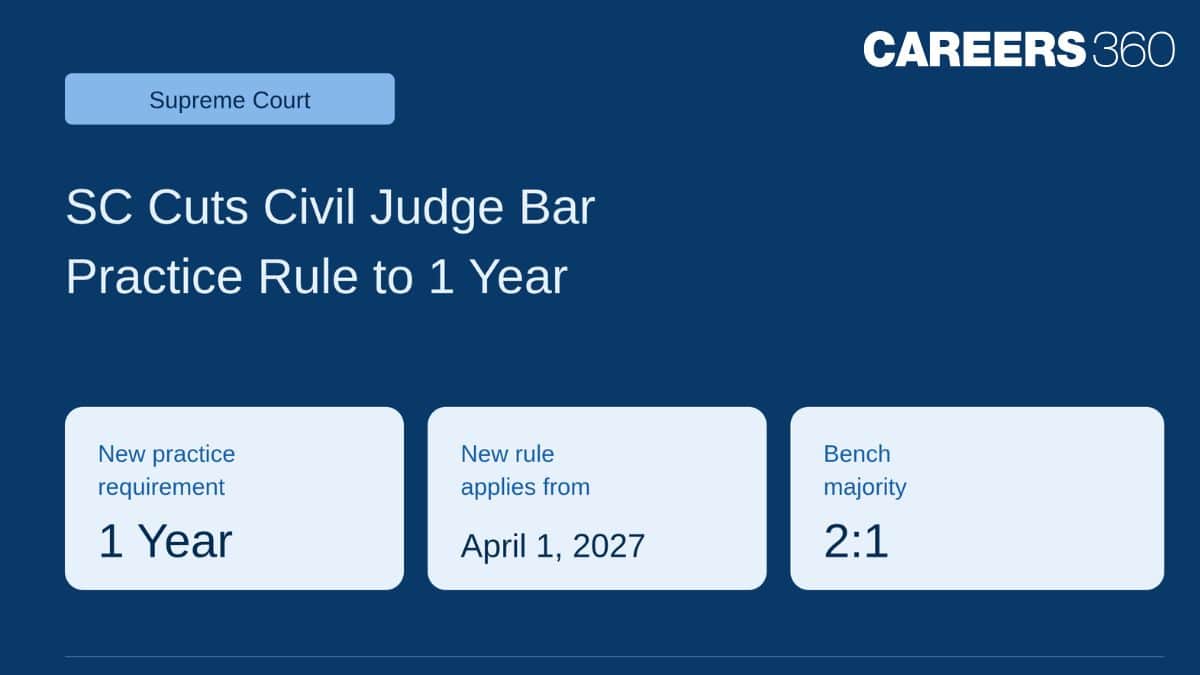
The latest judgment was delivered by a three-judge Bench, comprising CJI Surya Kant, Justice Augustine George Masih, and Justice K. Vinod Chandran, on August 21. This landmark ruling was passed by a 2:1 majority, with Justice K. Vinod Chandran dissenting. This one-year practice requirement will apply to judicial service notifications issued on or after April 1, 2027.
The Supreme Court has provided a transition period till March 31, 2027. Candidates covered by judicial service notifications issued between May 20, 2025 and March 31, 2027 can appear for the Civil Judge exam without prior practice.
These candidates will be considered as completing one year of active practice and will not be required to submit a practice certificate. However, selected candidates will initially be appointed as Trainee Judicial Officers. They will be required to complete one year of training at the State Judicial Academy followed by one year of structured clerkship.
The clerkship will comprise six months under the Principal District Judge or members of the Higher Judicial Service and six months under sitting High Court judges. The clerkship will be completed through a satisfactory evaluation report, which will be required for regular appointment as a Civil Judge.
For judicial service examinations notified on or after April 1, 2027, candidates will need to complete at least one year of active legal practice to apply for the examination.
After selection, they will still have to complete:
One year of intensive training at the State Judicial Academy.
Six months of law clerkship under a District and Sessions Judge or member of the Higher Judicial Service.
Six months of law clerkship under sitting judges of the concerned High Court.
A satisfactory evaluation report before regular appointment.
Background
In May 2025, the Supreme Court had restored the requirement of three years of practice at the Bar for candidates seeking direct recruitment as Civil Judges (Junior Division).
The decision had overturned the earlier position under which fresh law graduates could directly appear for entry-level judicial service examinations without prior practice.
The 2025 ruling directed High Courts and State governments to amend their judicial service rules accordingly. Several review petitions were subsequently filed challenging the requirement.
The petitions raised concerns that the rule could disadvantage fresh law graduates and candidates from economically weaker backgrounds who had prepared for judicial examinations under the earlier eligibility system.
The Supreme Court did not reject the reasoning behind its 2025 decision that entry-level judges should have exposure to legal practice. Instead, the majority found that the three-year requirement could be modified to reduce hardship caused by its sudden implementation.
The Court observed that the objective of practical exposure could also be achieved through a combination of limited prior practice, institutional training and supervised clerkship.
The majority also said that the new arrangement is not permanent. The scheme will operate for five years, after which its effectiveness can be assessed based on factors such as the quality of recruitment, performance of trainees and the adequacy of training and clerkship.
In his minority opinion, Justice K. Vinod Chandran favoured the 3-year practice requirement without modification. He emphasised the importance of courtroom experience in preparing a person for judicial office.
He observed that “the courtroom is the most profound classroom” for a developing judge. He further said that institutional training and clerkships cannot fully replace the independent legal grounding and professional experience gained through sustained practice at the Bar.


Ranked #18 amongst Institutions in India by NIRF | Get Upto 100% Scholarships | Spot Admissions via CUET
NAAC A+ Accredited University
Scholars’ Round Deadline: 14th Nov’26 | Earn upto 50% merit Scholarship + 10% for top performers | EFMD Accredited | AACSB (USA) & AMDISA Member | Highest CTC 28 LPA
Grade 'A+' Accredited by NAAC | Ranked 33rd in India by NIRF
Moot Court | Mock trials | Legal Aid Clinic | Recruiting Partners: FICCI, TCS, Adani, Trilegal, and many others
BA LLB, BBA LLB, or BCom LLB and LLB | LLM 1 Year – 4 Specializations | Approved by BCI | Highest CTC 9 LPA