School of Law, UPES, Dehradun
Ranked #18 amongst Institutions in India by NIRF | Get Upto 100% Scholarships | Spot Admissions via CUET


After completing a 3-year LLB or 5-year integrated law course, a graduate can pursue government jobs beyond litigation and court practice. Options include the Supreme Court Law Clerk-cum-Research Associate programme, CLAT PG-based PSU recruitment, State Judiciary (PCS-J), UPSC Civil Services and law officer posts through IBPS, RBI and SEBI. Monthly pay ranges from Rs 70,000 to Rs 1.1 lakh for PSU legal roles, while Supreme Court law clerks receive Rs 1 lakh per month.
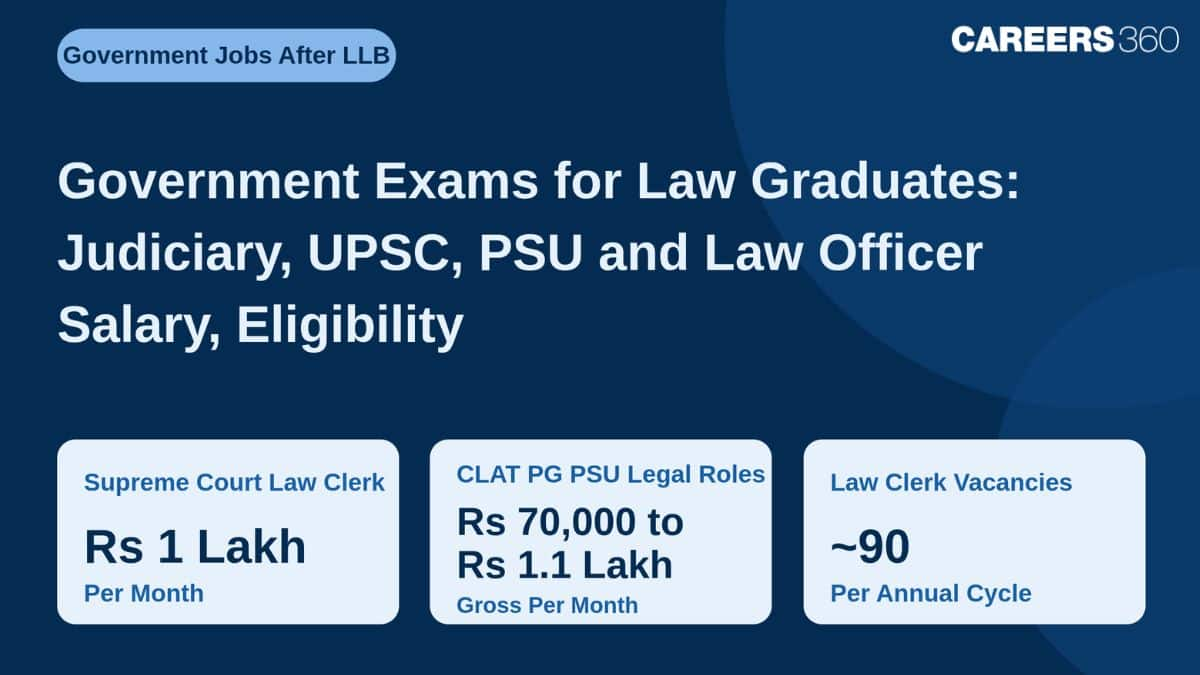
The Supreme Court Law Clerk-cum-Research Associate is a short-term contractual role that involves legal research for Supreme Court judges. This job position is an opportunity for exposure to constitutional law, judgment drafting and the workings of the court. The experience can strengthen a candidate's CV for litigation, law firms and higher studies abroad.
Parameter | Details |
Educational qualification | Three-year or five-year LLB from a Bar Council of India-recognised institution |
Final-year students | Eligible, subject to providing proof of graduation before joining |
Age limit | 20 to 32 years |
Monthly salary | Rs 1 lakh (consolidated) |
Vacancies | Approximately 90 per annual recruitment cycle |
Nature of employment and tenure | Contractual, generally one year (extendable by the Registry based on performance and requirement) |
The Supreme Court typically releases the recruitment notification in January or February on its official website, sci.gov.in. The selection process has three stages:
Part I: Objective multiple-choice questions (testing English comprehension, legal aptitude, and recent legal developments)
Part II: Written test (including case synopsis preparation, research memo writing, and an analytical essay)
Part III: Interview round
CLAT PG scores can help law graduates secure legal positions in Public Sector Undertakings (PSUs). PSUs use these scores to shortlist law graduates for legal positions, often followed by a personal interview and group discussion (GD). These PSUs include:
Oil and Natural Gas Corporation (ONGC)
Indian Oil Corporation Limited (IOCL)
National Thermal Power Corporation (NTPC)
Bharat Heavy Electricals Limited (BHEL)
Power Grid Corporation of India Limited (PGCIL)
Oil India Limited (OIL)
GAIL
National Hydroelectric Power Corporation (NHPC)
Parameter | Details |
Educational qualification | Three-year or five-year LLB |
Minimum marks | Generally 55% to 60%; relaxation may apply to SC/ST candidates |
Age limit | Commonly around 30 years; some PSUs allow up to 36 or 40 years depending on reservations |
Monthly salary range | Basic pay of Rs 40,000 to Rs 60,000 (E-1/E-2 Scale), with gross monthly pay ranging from Rs 70,000 to Rs 1,10,000 including IDA and HRA |
Selection process | CLAT PG-based shortlisting followed by an interview and/or group discussion, as specified by the PSU |
Each PSU releases its own recruitment notification. Legal roles here involve contracts, corporate law, compliance and other legal matters. Postings can be available in major cities such as Delhi, Mumbai, Kolkata, Bengaluru, Hyderabad and Ahmedabad, depending on the organisation and vacancy.
For law graduates who want to become judges, State Judicial Service examinations, commonly known as PCS-J or Civil Judge exams, offer a direct route into the judiciary. Recruitment is done state-wise, and selection is based on performance in prelims, mains and an interview.
Stage | Details |
Prelims | Objective screening examination |
Mains | Written examination with law-focused papers (now extensively adding the new criminal law codes: BNS, BNSS, and BSA |
Interview or viva-voce | Personality assessment |
Parameter | Details |
Educational qualification | LLB degree |
Age limit | Generally 21 to 35 years, though states like Uttar Pradesh, Bihar, and Madhya Pradesh extend the upper limit to 38 or 40 years for various categories |
Conducting authority | State Public Service Commission or High Court |
Other requirements | Language proficiency and legal practice requirements depending on the state |
The career growth is: Civil Judge (Junior Division) to Senior Civil Judge to District Judge, subject to service rules and promotion requirements.
A law degree can also lead to the civil services, including the IAS, IPS and IFS. An LLB is not compulsory for UPSC CSE, but legal studies can provide a foundation for choosing Law as an optional subject.
Additionally, UPSC periodically conducts separate direct recruitments for dedicated legal cadres, such as the Indian Legal Service (ILS), Assistant Legal Advisors in enforcement directorates, and Public Prosecutors in investigative agencies.
Parameter | Details |
Educational qualification | Any recognised bachelor's degree, including LLB |
General category age limit | 21 to 32 years |
General category attempts | Six |
Selection process | Prelims, Mains and Interview |
Conducting body | Union Public Service Commission |
The preliminary exam has two objective papers: General Studies Paper I and the qualifying Civil Services Aptitude Test (CSAT). The Mains exam includes nine descriptive papers, including an optional subject, which is followed by the personality test or interview round.
Law graduates can choose law as their optional subject. Their LLB coursework can be of great help with parts of the syllabus, but UPSC preparation also requires general studies, current affairs and answer writing. The eligibility rules and exam schedule are available at upsc.gov.in.
Law graduates can also pursue specialist legal roles in banking and financial regulation through IBPS, RBI and SEBI. These positions focus on legal documentation, compliance, banking laws and securities-market regulation, with separate eligibility criteria and selection processes for each organisation.
Parameter | Details |
Post | Law Officer (Scale I) |
Educational qualification | LLB |
Additional requirement | Bar Council enrolment as an advocate |
Age limit | 20 to 30 years |
Selection process | Prelims, Mains and Interview |
Key subjects | Constitutional law, Contract Act, Banking Regulation Act, SARFAESI Act and Insolvency and Bankruptcy Code |
RBI recruits legal officers through a separate process from its general Grade B recruitment. This includes:
Age limit: Generally 21 to 32 years (upper age limit is relaxable for LLM and PhD holders).
Relevant subjects: Banking, company, labour and constitutional law.
Mandatory requirement: Candidates must possess a minimum of 2 years of post-enrolment professional experience as an advocate, law officer in a financial institution, or as a full-time law teacher.
Scholars’ Round Deadline: 14th Nov’26 | Earn upto 50% merit Scholarship + 10% for top performers | EFMD Accredited | AACSB (USA) & AMDISA Member | Highest CTC 28 LPA
Grade 'A+' Accredited by NAAC | Ranked 33rd in India by NIRF
The Securities and Exchange Board of India recruits law graduates for legal officer positions, specifically as Grade A officers. Its examination is separate from RBI and IBPS recruitment. The work relates to legal and regulatory matters in the securities market, heavily testing Corporate Laws, Securities Laws, and capital market regulations.
The exam is conducted in three phases. Phase I is an online screening test with general aptitude and legal MCQs. Phase II is a descriptive test that involves deep legal evaluation via MCQs and long passages. Phase III is a personal interview test or viva.
Exam or recruitment route | Main career | Key selection stages | Monthly pay or remuneration |
Supreme Court Law Clerk-cum-Research Associate | Legal research with Supreme Court judges | Objective test, written test, interview | Rs 1 lakh (Consolidated) |
CLAT PG-based PSU | PSU legal roles | CLAT PG shortlisting, interview/GD | Approx. Rs 70,000 to Rs 1,10,000 starting gross (CTC ranges between Rs 12-18 Lakhs per annum) |
PCS-J / State Judiciary | Civil Judge | Prelims, Mains, interview | Varies by state (Revised under 2nd National Judicial Pay Commission) |
UPSC Civil Services | IAS, IPS, IFS and other services | Prelims, Mains, interview | Pay Level 10 (Starting Basic Rs 56,100 + Allowances) |
IBPS SO Law Officer | Bank legal officer | Prelims, Mains, interview | Scale I officer pay structure (Approx. gross Rs 60,000-Rs 75,000) |
RBI Legal Officer | Central bank legal role | Written exam (Paper I & II), interview | Grade B scale (Starting gross salary approx. Rs 85,000-Rs 1,00,000+ per month along with premium housing benefits) |
SEBI Legal Officer | Securities-market regulatory role | Phase I, Phase II, interview | Grade A scale (Highly competitive corporate-equivalent package, grossing approx. Rs 1,40,000+ per month) |

On Question asked by student community
Hello Shab Salim
Please check the link below:
https://law.careers360.com/download/sample-papers/kashmir-university-ba-llb-2021-question-paper
Hope it helps.
Dear Student, the availability of management quota seats in a 3-year LLB program depends on the rules of each college and university. Please share the state and college/university name, so I can clearly explain the eligibility, admission route, and management-seat options available.
Hello Student,
The BBA-LLB is a 5-year integrated course after Class 12. For the 2026–27 session, admission dates and fees depend on the university. For example, ICFAI University Jaipur scheduled classes to begin on 11 August 2026, with a total programme fee of Rs. 4.15 lakh for domicile students or
Bilkul, BBA LLB mein admission mil sakta hai, lekin eligibility aur admission process college aur university ke rules par depend karega. Aap apni 12th ki percentage, category, state aur jis college mein admission lena chahte hain uska naam bata dijiye, phir main aapko eligibility aur admission options ke baare mein
Hello Student,
Could you please mention the name of the college or university you are referring to? Also, let me know whether you are asking about BA LL.B. or BBA LL.B. admission for 2026–27.
Then I can guide you regarding the admission status and process. Looking forward to your response.

Ranked #18 amongst Institutions in India by NIRF | Get Upto 100% Scholarships | Spot Admissions via CUET
NAAC A+ Accredited University
Scholars’ Round Deadline: 14th Nov’26 | Earn upto 50% merit Scholarship + 10% for top performers | EFMD Accredited | AACSB (USA) & AMDISA Member | Highest CTC 28 LPA
Grade 'A+' Accredited by NAAC | Ranked 33rd in India by NIRF
Moot Court | Mock trials | Legal Aid Clinic | Recruiting Partners: FICCI, TCS, Adani, Trilegal, and many others
BA LLB, BBA LLB, or BCom LLB and LLB | LLM 1 Year – 4 Specializations | Approved by BCI | Highest CTC 9 LPA