School of Law, UPES, Dehradun
Ranked #18 amongst Institutions in India by NIRF | Get Upto 100% Scholarships | Spot Admissions via CUET


Preparation for the AILET 2027 Exam is not only about completing the entire syllabus but also about ensuring that one is proficient in being precise, fast, and accurate. This exam is organised by National Law University, Delhi and is one of the toughest law entrance exams in India because of the great difficulty level and limited availability of seats. The subjects covered in the AILET 2027 include English language ability, logical reasoning, current affairs and legal aptitude. Thus, strategic and well-organised preparation for this test becomes extremely important. In this article “How to Prepare for AILET 2027 Exam”, we will be discussing how to prepare for the AILET 2027 Exam with smart planning of studies.

Important Update: The AILET 2027 exam is scheduled for December 13, 2026, and will take place from 2 PM to 4 PM.
AILET examination conducted by NLU Delhi is comparatively more difficult than other law entrance examinations because of the higher level of difficulty, fewer seats, and special exam pattern & AILET Syllabus 2027. For more details regarding the differences between AILET and SLAT, read our post AILET v/s SLAT - Differences.
Admission to One University Only: AILET takes place for NLU Delhi alone while CLAT is the entrance test for many NLUs.
High-Level Questions: The questions have been seen tough and tricky and sometimes concept-based especially in English and Logical Reasoning.
Legal Reasoning Not Included: AILET for UG doesn’t consist of Legal Reasoning questions like CLAT and concentrates on English, Logical Reasoning, and GK.
High-Level Logical Reasoning: Comprises difficult logical reasoning, analytical reasoning and critical reasoning.
Advanced Level English Section: Consists of questions from grammar, vocabulary, sentence correction and comprehension at a high-level difficulty.
Questions Format: Direct questions rather than passage-based questions like CLAT.
Less Number of Seats: Few seats in one of the best law schools increase the difficulty.
Difficult Paper Trend: Changes every time hence requires regular practice with mock tests.
Ranked #18 amongst Institutions in India by NIRF | Get Upto 100% Scholarships | Spot Admissions via CUET
Scholars’ Round Deadline: 14th Nov’26 | Earn upto 50% merit Scholarship + 10% for top performers | EFMD Accredited | AACSB (USA) & AMDISA Member | Highest CTC 28 LPA
You can also refer - Preparation Tips for CLAT and AILET 2027 Together
Below are given some useful tips of a smart study plan for AILET 2027 that will be helpful for the aspirants to get prepared strategically, effectively manage time and get good marks in the exam
Preparation Step | Detailed Action Plan | Why It Matters |
Understand Exam Pattern & Syllabus | Begin by thoroughly reviewing the AILET 2027 exam structure. Know the number of questions, marking scheme, and topics under English, Logical Reasoning, and Current Affairs & GK. Identify section-wise weightage. | Prevents wasting time on irrelevant topics and helps in prioritising important areas. |
Assess Your Current Level | Take an initial diagnostic mock test without preparation. Evaluate your accuracy, speed, and topic-wise performance. | Helps identify strengths to maintain and weak areas that need extra focus. |
Create a Daily Study Schedule | Design a daily timetable allocating specific hours for each section — English, Logical Reasoning, GK, and revision. Keep time slots realistic and consistent. | Builds discipline, ensures balanced coverage, and avoids last-minute rush. |
Set Weekly Preparation Targets | Define weekly goals such as completing certain grammar topics, solving reasoning puzzle sets, or revising monthly current affairs. | Keeps preparation measurable and progress-oriented. |
Focus on High-Scoring Sections | Spend extra practice time on Logical Reasoning and English, especially reading comprehension, grammar rules, para-jumbles, and analytical puzzles. | These sections carry high weightage and can significantly boost overall score. |
Take Regular Mock Tests | Start with one mock test per week and gradually increase frequency. After each test, analyze mistakes, time spent per section, and question selection strategy. | Improves speed, accuracy, time management, and exam-day confidence. |
Develop a Daily Current Affairs Habit | Read a reliable newspaper or monthly GK magazine daily. Make short notes on national and international events, legal news, and important dates. | Ensures strong retention of GK, a section that requires consistent memory-based preparation. |
Schedule Weekly Revision | Reserve at least one day every week to revise completed topics, reattempt incorrect mock questions, and review notes. | Strengthens long-term retention and reduces forgetting. |
Maintain Balance & Avoid Burnout | Take short breaks between study sessions, get proper sleep, and include light physical activity. | Keeps your mind fresh and improves concentration during study hours. |
To get through AILET 2027, aspirants should adopt a section-wise preparation strategy. Since English Language, Current Affairs & General Knowledge, and Logical Reasoning are the sections that have major weightage in the exam, understanding the nature of the sections and preparing accordingly can make the aspirants score well in AILET 2027.
AILET English Language section is known for its difficulty level and has high scoring capacity since it tests both comprehension and basics of the English language, including reading comprehension, grammar, vocabulary, sentence correction, and para jumbles.
Preparation Strategy:
Read newspapers, editorials and quality articles to develop the habit of regular reading for comprehension and speed.
Learn grammar basics like sentence correction, subject-verb agreement, tenses, and modifiers.
Do sectional mock tests to enhance your performance.
Important Sections: Reading Comprehension, Grammar Rules, Vocabulary, Para-Jumbles, and Error Spotting.
The AILET 2027 GK section checks the knowledge of the aspirant regarding national and international incidents, law, awards, sports, and schemes of the government. This section is based on memory scoring and needs regular preparation.
Strategy of Preparation:
Read a reliable newspaper daily and follow monthly current affairs magazines.
Make short notes of important events, dates, and legal developments.
Weekly/Monthly revision of GK notes is essential for improving retention.
Concentrate on the past 10-12 months’ Current Affairs before the exam.
Practice GK tests and old question papers on a regular basis.
Key Focus Areas: National & International News, Legal Affairs, Government Policies, Awards, Sports, Important Dates.
The most important and highest weighted section of AILET is AILET 2027 Logical Reasoning, which includes puzzles, Analytical Reasoning, Critical Reasoning, Statement-Conclusion, Syllogisms, and Arrangements.
Preparation Strategy:
Solve a variety of reasoning questions every day to increase speed.
Be careful about the questions based on analytical reasoning such as Seating Arrangement, Blood Relation and Ordering.
Improve your skills of critical reasoning by solving the questions based on arguments.
Acquire techniques and approaches for solving the problems quickly
Regularly solve sectional and complete mock tests for this section.
Important Topics: Seating Arrangement, Blood Relations, Syllogisms, Statement-Conclusion, Critical Reasoning, Puzzles.
As Logical Reasoning and English Language both form a substantial part of AILET, the candidates should devote the maximum possible time in practicing these two sections along with consistent preparation of GK.
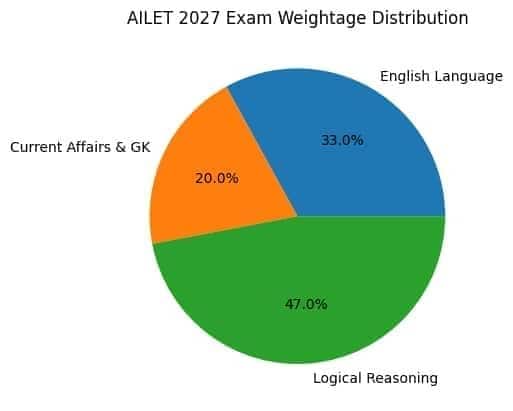
All India Law Entrance Test (AILET) 2027 is the entrance test organised by National Law University, Delhi to test the competency of the candidate in English Language, Logical Reasoning and Current Affairs & GK. The examination will consist of 150 questions worth 150 marks, where every section will have different weightage. The aspirant needs to understand the section-wise weightage of the AILET 2027 Exam Pattern
Section-wise weightage of AILET 2027 Exam is as follows:
Below are the preparation Tips For the AILET 2027 Exam.
Know the Syllabus: Familiarise yourself with all three sections – English, Logical Reasoning, and Current Affairs & GK – and focus on weaker areas.
Timetable: Prepare a timetable of daily studies and allocate more time to difficult topics and revision.
Practice Papers of Previous Year: Practice AILET papers of previous years to understand the kind of questions that can be asked, speed, and confidence.
Current Affairs: Study newspapers, magazines and online resources about current affairs of the nation and the world.
Legal Reasoning: Solving Sample papers and Mock tests will prove beneficial.
English Improvement: Vocabulary, grammar, comprehension and verbal ability need to be concentrated upon.
Logical Reasoning: Solve puzzles, syllogisms, analogies, and other logical reasoning questions.
Mock Tests: Taking mock tests will definitely improve time management skills.
Speed and Accuracy: Learn to manage time, be accurate and attempt tough questions.
On the day of the AILET 2027 time management is the way to go. Here’s how:
Approach for Each Section: Dedicate around 20 minutes to each of the English, Legal Reasoning and General Knowledge sections. Dedicate about 15 minutes to Logical Reasoning and around 5 minutes to Mathematics.
Approach for the First Round: Start with those sections where you are very sure of yourself and keep the difficult ones for later
Given below are the AILET 2027 Exam Best Recommended Books for AILET 2027 Aspirants.
Subject | Books and study material |
English |
|
Mathematics |
|
General knowledge (Static) |
|
General knowledge (Current affairs) |
|
Legal aptitude |
|
Reasoning |
|
Also Check: AILET Mock Test 2027 by Careers360 - Download Free PDF
Frequently Asked Questions (FAQs)
Prepare for the AILET 2027 as soon as possible. Preparing 8-12 months before the examination would give you sufficient time to cover your entire AILET syllabus, revision and mock tests.
There is no such thing as a set number of hours. Studying 3 to 5 hours every day with full concentration is more fruitful than studying for long hours without planning.
First, understand the pattern and syllabus of the AILET 2027 exam. After that, prepare a schedule and cover English, Logical Reasoning and Current Affairs together rather than preparing only one topic.
Practice AILET logical reasoning questions on a daily basis, read passages very carefully, and take as many mock tests as possible. Analysing mistakes is equally important as solving questions
Yes. Practice of AILET 2027 mock tests is required as they help you to improve your speed and accuracy. Moreover, they make you familiar with the real pattern of the exam.
Yes, the AILET previous year question papers help one to know about the nature of questions being asked and the level of difficulty involved.

On Question asked by student community
Hello Dear Student,
For Commerce stream entrance exam question papers, you can refer to the following resources:
CSEET Previous Year Question Papers:
https://www.careers360.com/commerce/articles/cseet-previous-year-question-papers
AILET Previous Year Question Papers:
https://law.careers360.com/articles/ailet-previous-year-question-papers
CUET PG Commerce Question Paper:
https://university.careers360.com/articles/cuet-pg-commerce-question-paper
These pages provide previous year papers, exam patterns, important topics, and preparation tips to help
Hi,
Here is a detailed guide on How to prepare for AILET 2027 with proper study plan, strategy, mock test, PYQs and other resources.
hello,
Yes, with 110 score and in SC Category your chances of getting seat is high. You can get more details about the cutoof by following the link attached.
LINK: https://law.careers360.com/articles/ailet-cutoff
I hope it helps!
Hello,
With your score of 110, the chance for AILET is high for the SC category because approximately the expected cut-offs are often 48 to above 55. If you do not recive an invitation try to check the NLU Delhi portal for your rank and email.
I will attach the
HELLO,
Below i am attaching the link to download ALIET PG previous year question papers from 2018 to 2024 with solutions.
Here is the link below :-
https://law.careers360.com/articles/ailet-pg-previous-year-question-papers
Hope this will help you!

Ranked #18 amongst Institutions in India by NIRF | Get Upto 100% Scholarships | Spot Admissions via CUET
Scholars’ Round Deadline: 14th Nov’26 | Earn upto 50% merit Scholarship + 10% for top performers | EFMD Accredited | AACSB (USA) & AMDISA Member | Highest CTC 28 LPA
Moot Court | Mock trials | Legal Aid Clinic | Recruiting Partners: FICCI, TCS, Adani, Trilegal, and many others
Law Admissions 2026 Open | Avail Merit-Based Scholarships
NAAC A++ Accredited | Ranked #11 by NIRF
Law Admissions Open 2026 | #2nd in India by The World University Rankings for Innovation | 200+ Collaborations | 700+ Industry Recruiters