
Search Colleges, Exams, Schools & more


Login
Meaning and Ingredients of Unlawful Assembly for CLAT - Practice Questions & MCQ
Edited By admin | Updated on Sep 25, 2023 25:26 PM | #CLAT
Quick Facts
-

14 Questions around this concept.
Solve by difficulty
 EASY
EASYRead the following passage and answer the question.
The Preamble is an introductory statement to the Constitution of a country that outlines the fundamental principles and objectives of the governing document. In the case of India, the Preamble to the Indian Constitution serves as a guiding light for the interpretation and application of its provisions. It was adopted on 26th November 1949 and reflects the aspirations of the people of India.The Preamble starts with the famous words, "We, the people of India," emphasizing that the Indian Constitution derives its authority from the people. It goes on to proclaim that India is a sovereign, socialist, secular, and democratic republic, securing to all its citizens justice, liberty, equality, and fraternity.The term "sovereign" signifies India's independent status, free from any external control or domination. By declaring itself "socialist," the Preamble highlights the country's commitment to achieving social and economic justice and reducing inequalities. The term "secular" reflects India's policy of non-interference in matters of religion and ensures equal respect for all religions. The term "democratic" signifies that the power to govern is vested in the hands of the people, exercised through their elected representatives.Furthermore, the Preamble emphasizes the objective of securing justice, which includes social, economic, and political justice. It also refers to liberty, ensuring individual freedom and safeguarding the rights of all citizens. Equality, another crucial aspect, aims to eliminate any form of discrimination and provide equal opportunities to every individual. Lastly, fraternity emphasizes the need for harmony, unity, and a sense of brotherhood among the diverse people of India.The 42nd Amendment to the Indian Constitution was enacted in 1976 under the leadership of the then Prime Minister, Indira Gandhi. It brought significant changes to various aspects of the Constitution.One of the key changes introduced by the 42nd Amendment was the addition of three words to the Preamble - "socialist," "secular," and "integrity." These words were incorporated to explicitly emphasize the values and goals of the Indian state. By including "socialist," the Amendment aimed to reinforce the commitment of the Indian state to achieving socialism through democratic means. The term "secular" was added to highlight the principle of state neutrality towards religion and equal treatment of all religious communities. Additionally, "integrity" was included to emphasize the importance of maintaining the territorial integrity of India.The 42nd Amendment also introduced several changes to fundamental rights, making them subject to the principle of reasonable restrictions. It expanded the power of the executive and restricted judicial review. Several amendments were made to the distribution of powers between the central and state governments.Moreover, this amendment enhanced the powers of the Parliament by making certain provisions non-amendable. It also curtailed the power of the judiciary to review constitutional amendments. The 42nd Amendment brought about significant changes to the balance of power between different branches of the government, leading to debates and controversies over its constitutionality.In conclusion, the Preamble sets the tone and provides the foundation for the Indian Constitution, reflecting the ideals and aspirations of the people. The 42nd Amendment, on the other hand, brought about substantial changes to various aspects of the Constitution, including the Preamble itself, sparking significant debates and discussions regarding its impact on the democratic fabric of the nation.
Question :
The words 'We, the people of India,' signify that the power of the constitution rests with?
Read the following passage and answer the question.
Nuisance could be defined as unlawful interference in the peaceful enjoyment of one’s property, or any right associated with it. There is a significant difference between trespass and nuisance. In the former, there occurs a physical interference in the plaintiff’s possession of the land. Whereas in the latter, there is more of an indirect interference with the plaintiff’s right to property. For instance, flinging pebbles at the plaintiff’s property would constitute trespass, whereas hindering the plaintiff’s peaceful possession of the property by playing your radio at an unusually high volume would result in a nuisance. Nuisance could occur either with respect to a particular individual’s property rights or in the context of the general public’s property rights.
Public nuisance
Section 3(48) of the General Clauses Act, 1897 declares public nuisance to be as defined by the Indian Penal Code. According to Section 268 of the Indian Penal Code, public nuisance comes into the picture when a person commits an act that causes common injury, danger, or annoyance to the general public. Basically, any act that hinders either the property rights of the general public or any other right. For instance, in Malton Board of Health v. Malton Manure Co., (1879), it was declared that carrying on a trade/business that causes deafening noises is impermissible, as it would cause a public nuisance. In order to avoid multiplicity of proceedings, a public nuisance is unconcerned with individual rights. However, a person could sue the wrongdoer in his private capacity, if the following conditions are satisfied- -The person needs to show that the injury he faced was substantially greater than what the rest of the public faced.-The injury he faced must essentially have been direct, not merely consequential.
Private Nuisance
When there is an unlawful interference with respect to a particular individual’s property rights, the act constitutes a private nuisance. Thus, for private nuisance to occur, the following two conditions must be satisfied-
- There must be an interference with the ‘peaceful possession’ of the plaintiff’s property.-The interference must be unlawful, i.e., it must not satisfy any of the defences to the tort of nuisance. A private nuisance may occur in two modes. The first one is an injury to the plaintiff’s property, and the second one is physical discomfort.
Question :
Palash owns the land under which there is oil. Isaac owns neighbouring land and decides to drill for oil, drilling a well diagonally from his land to under Palash's land. The well entered Palash's land at a depth of 1000 feet. No harm was caused to Palash's land on the surface, nor was his use or enjoyment of the land interfered with. Palash brings an action in trespass against Isaac, will he be successful?
Read the following passage and answer the question.
Bombay High Court held that the plea of not being armed would not absolve an accused from liability under Section 149 (every member of unlawful assembly guilty of the offence committed in prosecution of common object) of the IPC.
A division bench of Justice Vibha Kankanwadi and Justice Abhay S Waghwase sitting at Aurangabad dismissed an appeal filed by five persons who were convicted for offences punishable under Sections 144 (joining unlawful assembly armed with a deadly weapon), 148 (rioting, armed with a deadly weapon), and 302 (punishment for murder) read with 149 of the IPC.
“ Once the case of a person falls within the ingredients of Section 149 IPC, the question that he did nothing on his own, would be immaterial, as everybody is considered to be aware of the probable and natural outcome of the acts with which they have formed unlawful assembly. Mere plea ‘not being armed’ would not absolve a person from liability. Once their gathering has been demonstrated to have indulged in an unlawful act, sharing of common intention comes into play”, the court held.
Section 149 IPC makes every person who is a member of unlawful assembly at the time of committing the offence, guilty of that offence.
The case originated from a dispute between the informant, Devidas Bhujbal, and three men over a field for cultivation. Deceased Sudhakar, who was the brother of the informant, was assisting him in cultivating the field, leading to frequent quarrels between Sudhakar and the accused. On the morning of August 19, 2011, a quarrel ensued between Sudhakar and the five accused, and the informant intervened and took Sudhakar back home. However, later in the day, another quarrel erupted.
According to the prosecution's case, at around 12:30 p.m., Sudhakar and the accused were engaged in a heated argument in front of Bhaskar's house. The informant received a phone call from another witness, Ganesh Bhujbal, who informed him about the ongoing quarrel. The informant rushed to the scene and witnessed the accused brutally assaulting Sudhakar. Accused Dattarao, armed with a sickle, and accused Digambar, carrying a knife, were the main assailants. When his wife tried to intervene accused Meenabai and another accused Sojarbai indulged in a scuffle with her. Sudhakar succumbed to the injuries on the spot. The accused were arrested and charged. The trial Judge found the accused guilty and convicted them.
The appellants, represented by Advocates Mahesh P Kale and Sharda P Chate, argued that the prosecution's evidence, particularly that of the eyewitnesses, was untrustworthy due to contradictions and inconsistencies. They also argued that accused Hanuman, Meenabai and Sojarbai are wrongly held guilty as no overt act is attributed to them and no injury is caused at their instance, and thus, they could not be held guilty under Section 149 of IPC.
Assistant Public Prosecutor AV Deshmukh submitted that the eyewitness accounts were consistent, and the occurrence of the assault was not doubtful. He maintained that the charges against all the appellants were proven beyond a reasonable doubt, and the common object of the unlawful assembly justified their conviction under Section 149 of IPC.
The court clarified that under Section 149 of IPC, a person could be held guilty if they were part of an unlawful assembly and shared the common object, even if they did not commit an overt act.
Question :- What are the main essentials of section 149 of IPC according to the passage?
New: CLAT Previous Year Question Paper with Solutions
CLAT 2027: Mock Test | Sample Papers | Legal Current Affairs (March)
Admission Alert: Law Applications Open at Jindal Global Law School
Read the following passage and answer the question.
Bombay High Court held that the plea of not being armed would not absolve an accused from liability under Section 149 (every member of unlawful assembly guilty of the offence committed in prosecution of common object) of the IPC.
A division bench of Justice Vibha Kankanwadi and Justice Abhay S Waghwase sitting at Aurangabad dismissed an appeal filed by five persons who were convicted for offences punishable under Sections 144 (joining unlawful assembly armed with a deadly weapon), 148 (rioting, armed with a deadly weapon), and 302 (punishment for murder) read with 149 of the IPC.
“ Once the case of a person falls within the ingredients of Section 149 IPC, the question that he did nothing on his own, would be immaterial, as everybody is considered to be aware of the probable and natural outcome of the acts with which they have formed unlawful assembly. Mere plea ‘not being armed’ would not absolve a person from liability. Once their gathering has been demonstrated to have indulged in an unlawful act, sharing of common intention comes into play”, the court held.
Section 149 IPC makes every person who is a member of unlawful assembly at the time of committing the offence, guilty of that offence.
The case originated from a dispute between the informant, Devidas Bhujbal, and three men over a field for cultivation. Deceased Sudhakar, who was the brother of the informant, was assisting him in cultivating the field, leading to frequent quarrels between Sudhakar and the accused. On the morning of August 19, 2011, a quarrel ensued between Sudhakar and the five accused, and the informant intervened and took Sudhakar back home. However, later in the day, another quarrel erupted.
According to the prosecution's case, at around 12:30 p.m., Sudhakar and the accused were engaged in a heated argument in front of Bhaskar's house. The informant received a phone call from another witness, Ganesh Bhujbal, who informed him about the ongoing quarrel. The informant rushed to the scene and witnessed the accused brutally assaulting Sudhakar. Accused Dattarao, armed with a sickle, and accused Digambar, carrying a knife, were the main assailants. When his wife tried to intervene accused Meenabai and another accused Sojarbai indulged in a scuffle with her. Sudhakar succumbed to the injuries on the spot. The accused were arrested and charged. The trial Judge found the accused guilty and convicted them.
The appellants, represented by Advocates Mahesh P Kale and Sharda P Chate, argued that the prosecution's evidence, particularly that of the eyewitnesses, was untrustworthy due to contradictions and inconsistencies. They also argued that accused Hanuman, Meenabai and Sojarbai are wrongly held guilty as no overt act is attributed to them and no injury is caused at their instance, and thus, they could not be held guilty under Section 149 of IPC.
Assistant Public Prosecutor AV Deshmukh submitted that the eyewitness accounts were consistent, and the occurrence of the assault was not doubtful. He maintained that the charges against all the appellants were proven beyond a reasonable doubt, and the common object of the unlawful assembly justified their conviction under Section 149 of IPC.
The court clarified that under Section 149 of IPC, a person could be held guilty if they were part of an unlawful assembly and shared the common object, even if they did not commit an overt act.
Question :- If In the aforementioned case, only one of the accused is found to be innocent by SC. Will others still be convicted for unlawful assembly?
Concepts Covered - 1
Meaning and Ingredients
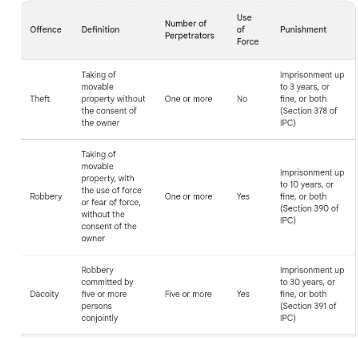
1.Theft:
- Theft is a criminal offense where a person unlawfully takes someone else's movable property without their consent and with the intention of permanently depriving them of it.
Ingredients:
- Dishonest intention: This refers to the mental state of the accused at the time of taking the property. It means that the accused must have the intention to keep the property for themselves and not give it back to the rightful owner. For example, if someone borrows a friend's laptop with the intention of returning it later, it is not theft.
- Moving of Property: This element requires that there must be a physical movement of the property from its original location. Even a slight change in position is enough to satisfy this requirement. For instance, if A takes B's watch from the table and places it in their pocket, the property has been moved.
- Without Consent: The property must be taken without the owner's permission or consent. If the owner willingly hands over their property to the accused, it does not constitute theft. For example, if X lends their car to Y for the weekend, and Y takes it, it is not theft.
- Permanently Deprive: The accused's intention must be to keep the property permanently and not return it to the owner. Borrowing with the intent to give back is not theft. However, intending to keep the property even temporarily amounts to theft.
- Example: A sees B's bicycle unlocked outside B's house. A takes the bicycle and hides it in his garage, planning to keep it for himself. A's actions fulfill all the elements of theft.
Case Law:
- In the case of Vishnu v. State of Maharashtra (2006), the accused took the complainant's money and did not repay it. The court held that the accused had a dishonest intention to permanently deprive the complainant of his money, thus constituting theft.
2. Robbery:
- Robbery involves theft but with the use of force, intimidation, or the threat of injury. It is considered a more serious offense than simple theft.
Ingredients:
- Dishonest intention: Similar to theft, the intention to permanently deprive the owner is crucial.
- Taking Property: This element requires that the property must be taken directly from the victim's immediate possession or control. It is the act of physically removing the property from the victim's person or presence.
- Use of Force/Intimidation: The accused must use force, intimidation, or threaten the victim with injury to commit the theft. This distinguishes robbery from theft. If a person takes someone's wallet from their hand without using force or fear, it would be considered theft, not robbery.
- Example: A approaches B on the street, pulls out a knife, and demands B's wallet. B, in fear of getting hurt, hands over his wallet. A has committed robbery.
3. Dacoity:
- Dacoity refers to a group robbery committed by five or more persons with the intention of committing theft, extortion, or mischief.
Ingredients:
- Group Involvement: At least five individuals must be part of the group. The presence of a group enhances the seriousness of the offense.
- Criminal Intention: The group must have a common intention to commit theft, extortion, or mischief. This element emphasizes the preplanned nature of the crime.
- Example: A gang of seven people plan to rob a jewelry store. They carry weapons and intend to steal valuable items. If they execute the plan, they commit dacoity.
4. Criminal Breach of Trust:
- Criminal Breach of Trust occurs when a person entrusted with property misappropriates or dishonestly uses it.
Ingredients:
- Entrustment: The property must be given to the accused in a position of trust. This implies a fiduciary relationship between the accused and the owner.
- Misappropriation: The accused misuses or appropriates the property for their own benefit. The accused uses the property in a manner inconsistent with the terms of the trust.
- Example: A, a cashier, diverts funds from the company's account to his personal account. A has committed criminal breach of trust.
5. Cheating:
Cheating involves deceiving someone with the intent to gain an unfair advantage or cause financial or other loss.
Ingredients:
- Deception: The accused must deceive the victim through false representation or concealment of facts. The deception can be through words, actions, or even silence.
- Fraudulent Intention: The accused must have a dishonest or fraudulent intention. This means they intend to gain something unfairly through their actions.
- Victim's Belief: The victim must believe the deception and act upon it. The victim's actions or decisions are influenced by the accused's deceptive conduct.
- Example: A sells B a fake gold necklace, claiming it's genuine. A's intention was to deceive B, and B suffered a financial loss as a result.
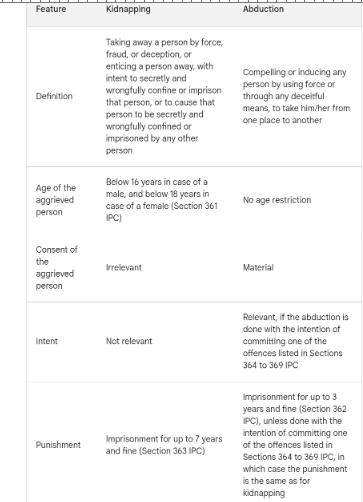
6. Kidnapping and Abduction:
- Kidnapping involves forcibly taking a person away, while abduction is luring a person away using deceit.
Ingredients:
- Taking Away: Kidnapping involves physically removing a person against their will. It can involve restraint, confinement, or transporting the person to another location.
- Against Will: The act is done against the person's consent or without their agreement. The victim's lack of free will is essential.
- Example: A physically restrains B and takes her away without her consent. A has committed kidnapping. Alternatively, if A deceives B into leaving her home and takes her away, it constitutes abduction.
Case laws:
- State of Haryana v Raja Ram (1967): The accused kidnapped a girl who was below the age of 18 years. He was convicted of kidnapping under Section 361 IPC.
- Bahadur Ali v King Emperor (1914): The accused abducted a woman by force. He was convicted of abduction under Section 362 IPC.
"Stay in the loop. Receive exam news, study resources, and expert advice!"
Get Answer to all your questions

Start a career in Law. Admissions Open for LLB courses for
Among top 100 Universities Globally in the Times Higher Education (THE) Interdisciplinary Science Rankings 2026
Jindal Global Law School Admissions 2026
ApplyRanked #1 Law School in India & South Asia by QS- World University Rankings | Merit cum means scholarships | Applications Closing Soon
Reva University Law Admissions 2026
ApplyQS I-Gauge Diamond Rated | NAAC A+ Accredited | 621 Recruitment Partners | INR 40 LPA Highest CTC | 4482 Job offers
UPES Integrated LLB Admissions 2026
ApplyLast Date to Apply: 28th May | Ranked #18 amongst Institutions in India by NIRF | Ranked #1 in India for Academic Reputation by QS Rankings | 16 LPA Highest CTC
Manav Rachna University Law Admissions 2026
ApplyAdmissions open for B.A. LL.B. (Hons.), B.B.A. LL.B. (Hons.) and LL.B Program (3 Years) | School of Law, MRU ranked No. 1 in Law Schools of Excellence in India by GHRDC (2023)
Chandigarh University Admissions 2026
ApplyNAAC A+ Accredited | Among top 2% Universities Globally (QS World University Rankings 2026)