School of Law, UPES, Dehradun
Ranked #18 amongst Institutions in India by NIRF | Get Upto 100% Scholarships | Spot Admissions via CUET


क्लैट 2027 (CLAT 2027 in hindi) : कॉमन लॉ एडमिशन टेस्ट (CLAT) 2027 का आयोजन कंसोर्टियम ऑफ नेशनल लॉ यूनिवर्सिटीज (NLUs) द्वारा 6 दिसंबर 2026 को दोपहर 2:00 बजे से शाम 4:00 बजे तक किया जाएगा। CLAT 2027 के लिए आवेदन प्रक्रिया 3 अगस्त 2026 से शुरू हो गई। इच्छुक उम्मीदवार अंतिम तिथि 31 अक्टूबर 2026 तक ऑनलाइन आवेदन पत्र भर सकते हैं। क्लैट एक राष्ट्रीय स्तर की ऑफलाइन प्रवेश परीक्षा है, जिसका आयोजन कंसोर्टियम ऑफ नेशनल लॉ यूनिवर्सिटीज (NLUs) द्वारा किया जाता है। यह परीक्षा देश के 24 नेशनल लॉ यूनिवर्सिटीज (NLUs) में प्रवेश का प्रमुख माध्यम है। इनमें गुजरात नेशनल लॉ यूनिवर्सिटी (GNLU), सिलवासा (GNLU गांधीनगर का ऑफ-कैंपस केंद्र) तथा IIULER गोवा (गैर-NLU संस्थान) भी शामिल हैं। CLAT स्कोर के आधार पर उम्मीदवारों को 5 वर्षीय एकीकृत एलएलबी (UG) और एलएलएम (PG) पाठ्यक्रमों में प्रवेश दिया जाता है। इस लेख में CLAT 2027 से जुड़ी सभी महत्वपूर्ण जानकारी जैसे परीक्षा तिथि, पात्रता मानदंड, परीक्षा पैटर्न, सिलेबस, आवेदन शुल्क और काउंसलिंग प्रक्रिया की विस्तृत जानकारी दी गई है।
क्लैट 2027 आवेदन करने का डायरेक्ट लिंक
This Story also Contains

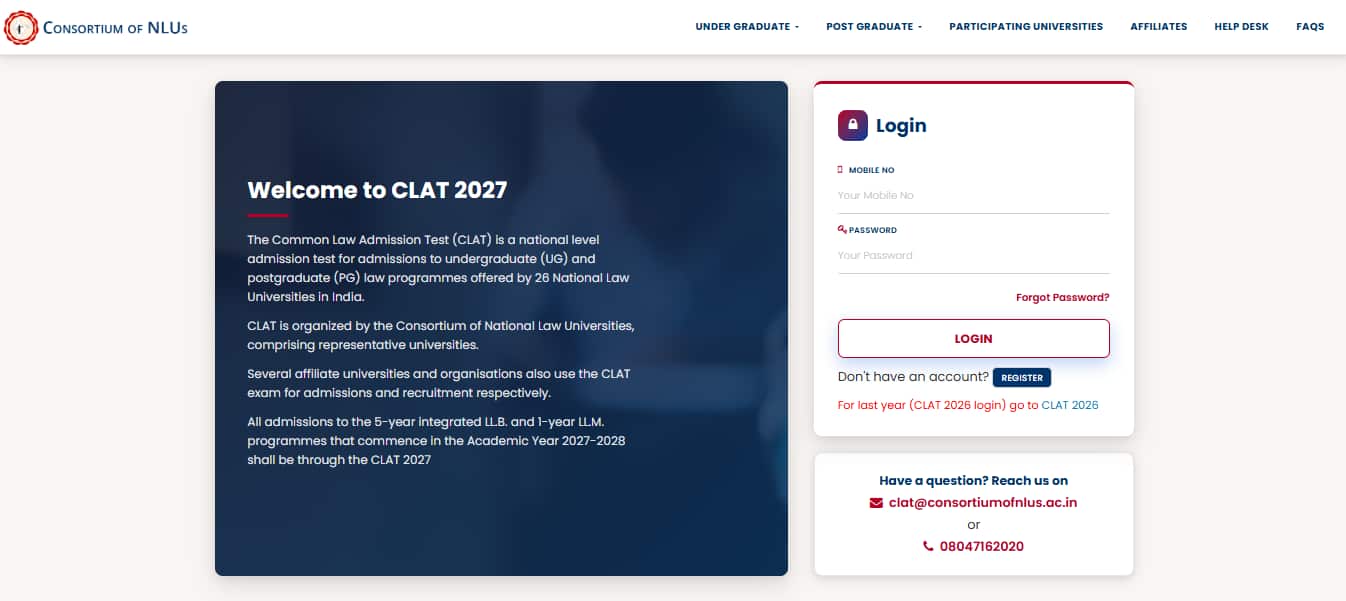
परीक्षा 130 से अधिक परीक्षा केंद्रों पर ऑफलाइन मोड में आयोजित की जाती है। क्लैट यूजी उम्मीदवारों से सामान्य ज्ञान, वर्तमान मामलों, कानूनी योग्यता, अंग्रेजी, गणित और तार्किक योग्यता पर प्रश्न पूछे जाते हैं। जबकि क्लैट एलएलएम प्रश्न पत्र उम्मीदवारों की कानूनी ज्ञान का आकलन करने के लिए डिज़ाइन किए जाते हैं। उम्मीदवार कॉमन लॉ एडमिशन टेस्ट में भाग लेकर 5-वर्षीय LLB कार्यक्रमों में प्रवेश प्राप्त कर सकते हैं। दूसरी ओर, वे कॉमन लॉ एडमिशन टेस्ट-PG में भाग लेकर LLM कार्यक्रमों में प्रवेश प्राप्त कर सकते हैं।
परीक्षा का नाम | कॉमन लॉ एडमिशन टेस्ट (क्लैट) |
संचालक निकाय | कंसोर्टियम ऑफ नेशनल लॉ यूनिवर्सिटीज (सीएनएलयू) |
उद्देश्य | 5 वर्षीय एलएलबी और एलएलएम प्रवेश भारतीय सेना के लिए भर्ती पीएसयू में भर्ती |
भाग लेने वाले महाविद्यालय | 24 राष्ट्रीय विधि विश्वविद्यालय (एनएलयू) और 60+ संबद्ध कॉलेज |
प्रस्तावित सीटें | 5-वर्ष एलएलबी - 3,400+ एलएलएम - 12,00+ |
NLUs के संघ ने क्लैट परीक्षा की तारीख अपनी आधिकारिक वेबसाइट consortiumofnlus.ac.in पर जारी की है। क्लैट 2027 6 दिसंबर 2026 को आयोजित की जाएगी। इच्छुक उम्मीदवारों को क्लैट 2027 के लिए महत्वपूर्ण तारीखों पर नज़र रखनी चाहिए ताकि वे सफलतापूर्वक पंजीकरण कर सकें और परीक्षा में शामिल हो सकें। नीचे दी गई तालिका क्लैट 2027 के लिए महत्वपूर्ण तारीखें प्रदान करती है।
इवेंट | डेट |
क्लैट 2027 आवेदन प्रक्रिया नोटिफिकेशन | 22 जुलाई (जारी) |
CLAT 2027 एप्लीकेशन प्रक्रिया | 3 अगस्त, 2026 (जारी) |
क्लैट 2027 रजिस्ट्रेशन लास्ट डेट | 31 अक्टूबर 2026 |
क्लैट 2027 एडमिट कार्ड | नवंबर 2026 |
क्लैट 2027 परीक्षा तिथि | 6 दिसंबर, 2026 दोपहर 2 बजे से 4 बजे तक |
क्लैट 2027 प्रोविजनल आंसर की | दिसंबर 2026 |
क्लैट 2027 प्रोविजनल आंसर की चुनौती तिथि | दिसंबर 2026 |
क्लैट 2027 फाइनल आंसर की जारी | दिसंबर 2026 |
क्लैट 2027 रिजल्ट | दिसंबर 2026 |
क्लैट एडमिशन काउंसलिंग के लिए रजिस्ट्रेशन आरंभ | दिसंबर 2026 |
संदर्भ के लिए पिछले वर्ष की तिथियां देखें
इवेंट | डेट |
क्लैट 2026 आवेदन प्रक्रिया नोटिफिकेशन | 20 जुलाई (जारी) |
CLAT 2026 एप्लीकेशन प्रक्रिया | 1 अगस्त, 2025 (शुरू) |
क्लैट 2026 रजिस्ट्रेशन लास्ट डेट |
7 नवंबर 2025 |
क्लैट 2026 एडमिट कार्ड | 22 नवंबर 2025 |
क्लैट 2026 परीक्षा तिथि | 7 दिसंबर, 2025 दोपहर 2 बजे से 4 बजे तक |
क्लैट 2026 प्रोविजनल आंसर की | 10 दिसंबर 2025 को शाम 5:00 बजे (जारी) |
क्लैट 2026 प्रोविजनल आंसर की चुनौती तिथि | 10 दिसंबर 2025 को शाम 5:00 बजे से 12 दिसंबर 2025 को शाम 5:00 बजे तक |
क्लैट 2026 फाइनल आंसर की जारी | 16 दिसंबर 2025 |
क्लैट 2026 रिजल्ट | 16 दिसंबर 2025 |
क्लैट एडमिशन काउंसलिंग के लिए रजिस्ट्रेशन आरंभ | 16 दिसंबर 2025 |
क्लैट 2027 के लिए क्लैट 2027 आवेदन (CLAT 2027 application in hindi) पंजीकरण 3 अगस्त 2026 से शुरू हो गया। क्लैट 2026 रजिस्ट्रेशन लास्ट डेट 31 अक्टूबर 2026 है। उम्मीदवार संघ की आधिकारिक वेबसाइट से ऑनलाइन आवेदन कर सकते हैं।
क्लैट 2027 के लिए उपस्थित होने के इच्छुक उम्मीदवारों को एनएलयू कंसोर्टियम द्वारा निर्धारित परीक्षा पात्रता मानदंडों को पूरा करना होगा। एनएलयू और क्लैट के लिए प्रवेश मानदंड काफी हद तक समान हैं। क्लैट 2027 के लिए पात्रता मानदंड इस प्रकार हैं;
शैक्षिक योग्यता - उम्मीदवारों को किसी मान्यता प्राप्त बोर्ड और संस्थान से 12वीं कक्षा उत्तीर्ण होना चाहिए। उम्मीदवारों को 12वीं कक्षा में कम से कम 45% अंक प्राप्त होने चाहिए, एससी, एसटी उम्मीदवार 12वीं कक्षा में 40% अंक प्राप्त करने के पात्र हैं।
पीजी-क्लैट पात्रता मानदंड 2027 (PG—CLAT Eligibility Criteria 2027)
एलएलएम क्लैट एक स्नातकोत्तर पाठ्यक्रम है। उम्मीदवारों को बार काउंसिल ऑफ इंडिया (बीसीआई) द्वारा मान्यता प्राप्त विश्वविद्यालय से एलएलबी स्नातक पूरा करना होगा। उन्हें अपने स्नातक स्तर पर कम से कम 50% (एससी और एसटी उम्मीदवारों के मामले में 45%) अंक प्राप्त करने चाहिए।
क्लैट आयु सीमा (CLAT age limit)
कंसोर्टियम ने क्लैट परीक्षा में बैठने के लिए कोई आयु सीमा निर्धारित नहीं की है। किसी भी उम्र के उम्मीदवार या कितनी भी बार क्लैट परीक्षा दे सकते हैं।
यदि आप यह ढूंढ रहे हैं कि क्लैट का फॉर्म कब आएगा 2027 (Clat ka form kab aayega 2027) या Clat 2027 ka form kab niklega तो हम आपको बता दें कि क्लैट 2027 के लिए आवेदन 3 अगस्त 2026 से शुरू हो गया। क्लैट 2027 पंजीकरण कंसोर्टियम की आधिकारिक वेबसाइट consortiumofnlus.ac.in से ऑनलाइन किया जा सकेगा। क्लैट पंजीकरण शुल्क सामान्य उम्मीदवारों के लिए 4,000 रुपये और एससी और एसटी उम्मीदवारों के लिए 3,500 रुपये है। जिन उम्मीदवारों को आधिकारिक क्लैट पिछले वर्ष के प्रश्नपत्रों की आवश्यकता है, उन्हें आवेदन शुल्क के अतिरिक्त 500 रुपये का भुगतान करना होगा। हालाँकि, पिछले वर्ष के क्लैट प्रश्न पत्र भी Careers360 द्वारा निःशुल्क उपलब्ध कराए जाते हैं। क्लैट 2027 के लिए आवेदन प्रक्रिया इस प्रकार है;
आधिकारिक क्लैट 2027 वेबसाइट पर जाएं।
नए पंजीकरण लिंक पर क्लिक करें।
ईमेल आईडी और मोबाइल नंबर का उपयोग करके पंजीकरण करें।
व्यक्तिगत जानकारी, संचार विवरण, शैक्षणिक विवरण, परीक्षा केंद्र प्राथमिकता और एनएलयू प्राथमिकता प्रदान करके आवेदन पत्र भरें।
क्लैट आवेदन पत्र जमा करें और पंजीकरण शुल्क का भुगतान करें।
Ranked #18 amongst Institutions in India by NIRF | Get Upto 100% Scholarships | Spot Admissions via CUET
Scholars’ Round Deadline: 14th Nov’26 | Earn upto 50% merit Scholarship + 10% for top performers | EFMD Accredited | AACSB (USA) & AMDISA Member | Highest CTC 28 LPA
क्लैट परीक्षा की तैयारी करने वाले उम्मीदवारों को परीक्षा की आवश्यकताओं को पूरा करने के लिए आधिकारिक पाठ्यक्रम और पैटर्न का पालन करना होगा। क्लैट सिलेबस 2027 को मोटे तौर पर पांच खंडों में विभाजित किया गया है। क्लैट 2027 के प्रश्न पत्र में भी पांच खंड होंगे। ये अनुभाग नीचे सूचीबद्ध हैं
अंग्रेजी भाषा और समझ
लीगल रीज़निंग और एप्टिट्यूड
प्राथमिक गणित
लॉजिकल रीज़निंग
करंट अफेयर और सामान्य ज्ञान
विषय | अंक |
अंग्रेजी भाषा | 22-26 प्रश्न, या पेपर का लगभग 20% |
सामान्य ज्ञान सहित करेंट अफेयर्स | 28-32 प्रश्न, या पेपर का लगभग 25% |
लीगल रीज़निंग | 28-32 प्रश्न, या पेपर का लगभग 25% |
लॉजिकल रीज़निंग | 22-26 प्रश्न, या पेपर का लगभग 20% |
क्वॉंटिटेटिव तकनीक | 10-14 प्रश्न, या पेपर का लगभग 10% |
क्लैट परीक्षा पैटर्न और क्लैट सिलेबस सभी प्रासंगिक जानकारी प्रदान करता है कि प्रश्न पत्र कैसे तैयार किया जाएगा तथा समय अवधि और अंकन योजना क्या होगी। क्लैट परीक्षा के नियमों और संरचना से परिचित होने के लिए उम्मीदवारों को क्लैट 2027 परीक्षा पैटर्न की जांच करनी चाहिए।
श्रेणी | विवरण |
समय अवधि | 2 घंटे |
मोड | ऑफ़लाइन मोड (पेन पेपर-आधारित मोड) |
प्रश्नों के प्रकार | वस्तुनिष्ठ प्रकार के प्रश्न |
प्रश्नों की संख्या | 120 प्रश्न |
कुल अंक | 120 अंक |
क्लैट यूजी अंकन योजना | सही उत्तर - 1 अंक ग़लत उत्तर - 0.25 अंक का नकारात्मक अंकन अनुत्तरित प्रश्न - नकारात्मक अंकन नहीं है |
क्लैट पेपर की भाषा | अंग्रेजी |
क्लैट 2027 की तैयारी करने वाले उम्मीदवारों को जल्दी शुरुआत करने की आवश्यकता है। परीक्षा प्रतिस्पर्धी है और प्रतिष्ठित एनएलयू द्वारा दी जाने वाली सीटें सीमित हैं, इसलिए परीक्षा में अच्छी रैंक हासिल करने के लिए एक अच्छी क्लैट तैयारी की आवश्यकता होती है। क्लैट परीक्षा भारत की सबसे लंबी कानून प्रवेश परीक्षाओं में से एक है, जो उम्मीदवारों के उच्च स्तरीय पढ़ने, महत्वपूर्ण सोच और विश्लेषणात्मक कौशल का परीक्षण करती है।
क्लैट लीगल रीज़निंग (CLAT Legal Reasoning)
क्लैट में सबसे महत्वपूर्ण अनुभागों में से एक, लीगल रीज़निंग एवं एप्टिट्यूड अनुभाग में उम्मीदवारों को महत्वपूर्ण विचार क्षमताओं के साथ-साथ कानून की बुनियादी स्तर की समझ प्रदर्शित करने की आवश्यकता होती है। क्लैट लीगल रीज़निंग की तैयारी करने वाले उम्मीदवारों को राजनीति विज्ञान, संविधान और कानून के बुनियादी स्तर से शुरुआत करनी चाहिए। तथ्यों और नियमों को समझने की तुलना में अवधारणाओं को समझना अधिक महत्वपूर्ण है।
अपनी तैयारी के बाद के चरणों में, उन्हें कानूनी पत्रिकाएँ, समाचार लेख और संपादकीय और कानूनी निर्णय पढ़ना चाहिए। चूँकि अधिकांश प्रश्न कानूनी परिदृश्यों या समाचार पत्रों और पत्रिकाओं में चर्चा किए गए मामलों से लिए जाते हैं, ऐसी सामग्री को पढ़ने और समझने से उम्मीदवारों को इस खंड के लिए तैयारी करने में मदद मिलेगी। अंत में, यह समझने के लिए पिछले वर्षों के क्लैट प्रश्न पत्रों को देखें कि कानूनी तर्क वाले प्रश्न किस तरीके से तैयार किए गए हैं और कौन से विषय अक्सर आते हैं।
क्लैट अंग्रेजी भाषा (CLAT English Language)
अगर आपके मन में यह जिज्ञासा है कि क्लैट का आयोजन किस भाषा में किया जाता है तो जान लें कि क्लैट पेपर का आयोजन केवल अंग्रेजी भाषा में किया जाता है। क्लैट पेपर में एक सेक्शन अंग्रेजी को समर्पित है। इस लिहाज से अंग्रेजी भाषा इसलिए भी महत्वपूर्ण है क्योंकि क्योंकि क्लैट का पूरा प्रश्न पत्र अंग्रेजी में ही होता है और इसके लिए उच्च स्तर की अंग्रेजी पढ़ने और समझने की आवश्यकता होती है। अंग्रेजी भाषा अनुभाग के बारे में बात करते हुए, बोधगम्य अंशों से प्रश्न पूछे जाएंगे जो हाल के समाचार लेखों, पत्रिकाओं और जरनल से लिए जा सकते हैं।
उम्मीदवारों को सलाह दी जाती है कि वे तैयारी के प्रारंभिक चरण में अपने बुनियादी व्याकरण कौशल पर काम करें। पढ़ने और समझने की गति में सुधार के लिए उन्हें समाचार पत्र और पत्रिकाएँ पढ़नी चाहिए। क्लैट के सभी अनुभागों के लिए एक मजबूत शब्दावली का होना बहुत महत्वपूर्ण है। इसके अतिरिक्त, क्लैट परीक्षा में सिनोनिम्स एवं एंटोनिम्स शब्द, वन वर्ड सब्सिट्यूट और इडियम और फ्रेज से सीधे प्रश्न पूछे जा सकते हैं। इसलिए, उम्मीदवारों को इन्हें करने के लिए पर्याप्त समय देना चाहिए। अंतिम लेकिन महत्वपूर्ण बात, परीक्षा की स्थिति में फिट होने के लिए समझ-आधारित प्रश्नों का अभ्यास करना बहुत महत्वपूर्ण है।
क्लैट एग्जाम एनालिसिस | क्लैट प्रश्न पत्र | क्लैट आंसर की 2027 | क्लैट कटऑफ 2027
यह अनुभाग उम्मीदवारों की आलोचनात्मक विचार और समस्या-समाधान क्षमताओं का परीक्षण करने पर केंद्रित है। वन लाइनर स्टेटमेंट तथा निष्कर्ष पर आधारित कुछ प्रश्नों के अलावा, क्लैट के अधिकांश लीगल रीज़निंग अनुभाग में कॉम्प्रिहेन्शन पैराग्राफ से प्रश्न भी शामिल हैं और उम्मीदवार को तर्कों को पढ़ने और उनके उत्तरों में निष्कर्ष, संबंध या समानताएं निकालने की आवश्यकता होती है। लीगल रीज़निंग की तैयारी केवल नियमित अभ्यास से ही की जा सकती है। हालांकि, छात्रों को सलाह दी जाती है कि वे सीधे अभ्यास पेपरों पर न जाएं, इसके बजाय एक मूलभूत समझ बनाएं और फिर पिछले पेपरों से अभ्यास करें और उसके बाद मॉक टेस्ट से अभ्यास करें।
क्लैट गणित (CLAT Maths)
यह भाग केवल 10% महत्व रखता है लेकिन क्लैट उम्मीदवारों के लिए एक निर्णायक कारक हो सकता है। हालाँकि यह बुनियादी गणित कौशल का परीक्षण करता है, लेकिन प्रश्नों की रूपरेखा को मोड़कर इसे संख्याओं वाले पैराग्राफ जैसा बनाया जा सकता है। हालाँकि, छात्रों के लिए ये प्रश्न कठिन नहीं है। एक सलाह यह होगी कि प्रश्नों को ध्यान से पढ़ने में कुछ समय लगाएं।
क्लैट गणित के प्रश्नों में बीजगणित, लाभ और हानि, समय और दूरी, समुच्चय, एचसीएफ और एलसीएम आदि जैसे विषय शामिल होंगे। इनमें से अधिकांश विषयों पर कक्षा 10 में ही विस्तार से चर्चा की गई है। इसलिए, उम्मीदवारों को सलाह दी जाती है कि वे प्रारंभिक गणित की बुनियादी पुस्तकों से जुड़े रहें और नियमित आधार पर प्रश्नों को हल करने का अभ्यास करें। अच्छे गणितीय कौशल वाले उम्मीदवारों के पास इस अनुभाग का लाभ उठाने और पूरे 10% अंक प्राप्त करने का अच्छा मौका है जो उनके परिणामों पर निर्णायक प्रभाव डाल सकता है।
You may also check - Daily CLAT FREE Practice Test
क्लैट 2027 परीक्षा में सबसे महत्वपूर्ण अनुभागों में से एक, सामान्य ज्ञान और करंट अफेयर्स की तैयारी का कानूनी योग्यता और अंग्रेजी पर प्रमुख प्रभाव पड़ता है। ऐसा इसलिए नहीं है क्योंकि इन अनुभागों में पाठ्यक्रम ओवरलैप होता है, बल्कि इसलिए कि इनमें परीक्षण किए गए कौशल काफी हद तक ओवरलैप होंगे। क्लैट जीके और करंट अफेयर्स के लिए तेजी से पढ़ना आवश्यक है, और यह अंग्रेजी और कानूनी तर्क के लिए भी एक बहुत जरूरी कौशल है। क्लैट करंट अवेयरनेस में सामाजिक, राजनीतिक और आर्थिक महत्व के विषयों पर कुछ सीधे प्रश्न हो सकते हैं, लेकिन कुछ प्रश्न वर्तमान कानूनी मामलों के बारे में भी पूछे जाएंगे।
जब संदर्भ के लिए मानक अध्ययन सामग्री उपलब्ध होती है तो सामान्य ज्ञान और समसामयिक मामलों की तैयारी करना काफी आसान हो जाता है। ल्यूसेंट सामान्य ज्ञान पुस्तक आधार बनाने के लिए सहायक है, जबकि द हिंदू, या द इंडियन एक्सप्रेस जैसे दैनिक समाचार पत्र वर्तमान मामलों के लिए बहुत अच्छे हैं। विषय पर मासिक पत्रिकाओं का उपयोग करके करेंट अफेयर्स की तैयारी को और अधिक बेहतर किया जा सकता है।
क्लैट 2027 के स्कोर 24 राष्ट्रीय कानून विश्वविद्यालयों (एनएलयू) द्वारा स्वीकार किए जाएंगे। केवल एनएलयू दिल्ली तथा एनएलयू मेघालय क्लैट 2027 फ्रेमवर्क में समाहित नहीं होते हैं। इसके अलावा 60 से अधिक विभिन्न निजी विधि कॉलेज क्लैट 2027 स्कोर को स्वीकार करते हैं। उम्मीदवार इनमें से किसी भी कॉलेज में प्रवेश ले सकते हैं, बशर्ते वे पात्रता मानदंड और प्रवेश कट-ऑफ को पूरा करते हों। निम्नलिखित राष्ट्रीय कानून विश्वविद्यालयों (एनएलयू) की सूची दी गई है जो परीक्षा में भाग लेंगे।
एनएलयू | क्लैट सीटें | राज्य कोटा (डोमिसाइल और श्रेणी) |
240 | 25% | |
147 | 25% | |
125 | 50% | |
पश्चिम बंगाल नेशनल यूनिवर्सिटी ऑफ़ ज्यूडिशियल साइंसेज, कोलकाता | 132 | 36% |
120 | 27.5% | |
180 | 50% | |
172 | 25% | |
176 | 52% | |
180 | 10% | |
138 | 66% | |
60 | 51% | |
180 | 25% | |
120 | 50% | |
60 | 48% | |
दामोदरम संजीवय्या राष्ट्रीय विधि विश्वविद्यालय, विशाखापत्तनम | 120 | 40% |
120 | 50% | |
100 | 63% | |
120 | 62% | |
120 | 62% | |
180 | 25% | |
धर्मशास्त्र राष्ट्रीय विधि विश्वविद्यालय, जबलपुर (एमपीडीएनएलयू) | 120 | 40% |
120 | 25% | |
जीएनएलयू सिलवासा परिसर | 49 | 35% |
60 |
उम्मीदवार करियर360 द्वारा विकसित क्लैट कॉलेज प्रेडिक्टर नामक निःशुल्क टूल का उपयोग कर सकते हैं, जो उन एनएलयू की भविष्यवाणी करता है जिनमें उम्मीदवार के क्लैट कट-ऑफ 2027 को पास करने और प्रवेश पाने की अच्छी संभावना है। यह टूल एनएलयू की सूची देने के लिए इनपुट के रूप में उम्मीदवार की समग्र रैंक, राज्य, सीट प्रकार और श्रेणी जैसे विवरणों का उपयोग करता है। कॉलेज प्रेडिक्टर लिंक तक पहुँचने के लिए नीचे दिए गए लिंक पर क्लिक करें।
Careers360 का क्लैट 2027 कॉलेज प्रेडिक्टर
विवरण | लिंक |
एक्सेस लिंक |
क्लैट पीजी कट-ऑफ 2027 किसी विशेष श्रेणी में प्रवेश पाने वाले अंतिम उम्मीदवार की रैंक के आधार पर व्यक्त किया जाता है। केवल वे उम्मीदवार जो क्लैट एलएलएम कट-ऑफ 2027 को पास कर लेंगे, वे काउंसलिंग प्रक्रिया में भाग लेने और सीट आवंटन प्राप्त करने के पात्र होंगे। क्लैट पीजी 2027 का आयोजन 6 दिसंबर, 2026 को किया जाएगा। कॉमन लॉ एडमिशन टेस्ट के माध्यम से PG उम्मीदवार भाग लेने वाले NLU और अन्य संबद्ध निजी लॉ कॉलेजों के एलएलएम कार्यक्रम में प्रवेश प्राप्त कर सकते हैं। वर्तमान में, क्लैट पीजी 2027 में 24 NLU और 60 से अधिक संबद्ध कॉलेज भाग लेंगे।
नीचे दिए गए कारक एलएलएम के लिए क्लैट कट-ऑफ 2027 को प्रभावित करते हैं:
आवेदकों की संख्या
उम्मीदवारों द्वारा दी गई प्राथमिकताएं
विशेष एनएलयू में सीट की उपलब्धता
प्रत्येक एनएलयू द्वारा अपनाई गई आरक्षण नीति
कंसोर्टियम ऑफ़ नेशनल लॉ यूनिवर्सिटीज़ ने 22 जनवरी, 2026 को क्लैट 2026 की दूसरी मेरिट लिस्ट जारी की। क्लैट 2026 की दूसरी मेरिट लिस्ट में शामिल उम्मीदवार क्लैट 2026 के दूसरे काउंसलिंग राउंड में हिस्सा लेने के लिए एलिजिबल हैं। ऐसे उम्मीदवारों को 29 जनवरी, 2026 को दोपहर 1:00 बजे से पहले अलॉट की गई सीट स्वीकार करनी होगी और एडमिशन के लिए कन्फर्मेशन फीस जमा करनी होगी। इससे पहले, क्लैट 2026 काउंसलिंग के रजिस्ट्रेशन 27 दिसंबर, 2025 को रात 10 बजे बंद हो गए थे। जिन उम्मीदवारों को काउंसलिंग के लिए बुलाया गया था, उन्होंने ऑफिशियल वेबसाइट consortiumofnlus.ac.in पर खुद को रजिस्टर किया था। उन्हें अपनी पर्सनल और एकेडमिक डिटेल्स भरनी थीं, बताए गए डॉक्यूमेंट्स अपलोड करने थे, काउंसलिंग फीस जमा करनी थी और 2026 के लिए अपनी एनएलयू प्रेफरेंस लिस्ट सबमिट करनी थी। जो लोग मेरिट लिस्ट में शामिल हैं, वे 24 एनएलयू और 60 से ज़्यादा एफिलिएटेड कॉलेजों के 5-साल के एलएलबी और एलएलएम प्रोग्राम में एडमिशन के लिए क्लैट 2026 एडमिशन प्रोसेस में शामिल हैं। क्लैट 2026 परीक्षा 7 दिसंबर, 2025 (रविवार) को दोपहर 2 बजे से 4 बजे तक हुई थी।
क्लैट राउंट 2 एलॉटमेंट लिस्ट ऑफिशियल चेक करने का सीधा लिंक
इससे पहले राष्ट्रीय विधि विश्वविद्यालयों के संघ ने 7 जनवरी, 2026 को क्लैट 2026 की पहली मेरिट सूची प्रकाशित की। जो लोग मेरिट लिस्ट में शामिल हैं, उन्हें 24 NLUs और 60 से ज़्यादा एफिलिएटेड कॉलेजों के 5-साल के LLB और LLM प्रोग्राम में एडमिशन के लिए क्लैट 2026 एडमिशन प्रोसेस में शामिल किया गया है।
क्लैट राउंट 1 एलॉटमेंट लिस्ट ऑफिशियल चेक करने का सीधा लिंक
इससे पहले कंसोर्टियम ऑफ़ नेशनल लॉ यूनिवर्सिटीज़ (NLUs) ने 16 दिसंबर 2025 को क्लैट फाइनल आंसर की और स्कोर कार्ड के रूप में रिजल्ट जारी कर दिया। कंसोर्टियम ने अपनी ऑफिशियल वेबसाइट consortiumofnlus.ac.in पर रिजल्ट जारी किया। उम्मीदवार कंसोर्टियम की वेबसाइट के माध्यम से CLAT 2026 पोर्टल पर अपने अकाउंट में लॉग इन करके अपने आधिकारिक CLAT 2026 स्कोरकार्ड डाउनलोड कर सकते हैं। उम्मीदवार अपने आधिकारिक CLAT 2026 स्कोरकार्ड मिरर साइट https://result1.consortiumofnlus.ac.in/ पर भी डाउनलोड कर सकते हैं।
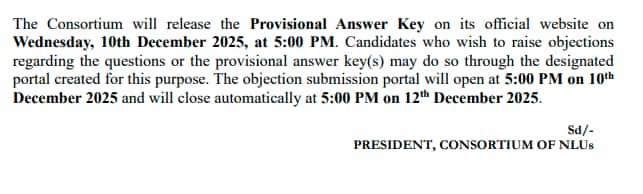
इससे पहले 7 दिसंबर, 2025 को कॉमन लॉ एडमिशन टेस्ट (CLAT) 2026 परीक्षा आयोजित की गई। कंसोर्टियम ने 10 दिसंबर 2025 को शाम 5:00 बजे प्रोविजनल आंसर की जारी किया। जो उम्मीदवार सवालों या क्लैट आंसर की के बारे में आपत्ति उठाना चाहते थे, वे पोर्टल पर अपने लॉगिन के ज़रिए ऐसा कर सकते थे। आपत्ति सबमिट करने वाला पोर्टल 10 दिसंबर 2025 को शाम 5:00 बजे ख्रुला और 12 दिसंबर 2025 को शाम 5:00 बजे अपने आप बंद हो गया। हर आपत्ति के लिए 500/- रुपये (केवल पाँच सौ रुपये) की फीस देनी थी। अगर आपत्ति सही पाई जाती है और उसे मान लिया जाता है, तो यह फीस उसी अकाउंट में वापस कर दी जाएगी जिससे इसका पेमेंट किया गया था। किसी दूसरे अकाउंट में पैसे जमा करने की कोई भी रिक्वेस्ट स्वीकार नहीं की जाएगी।
क्लैट फाइनल आंसर की यूजी और पीजी 2026 पीडीएफ डाउनलोड करें
क्लैट ऑफिशियल प्रोविजनल आंसर की 2026 पीडीएफ डाउनलोड करें
क्लैट प्रोविजनल आंसर की 2026 पर आपत्ति दर्ज कराने का विंडो लॉगिन
क्लैट कटऑफ 2026 चेक करें
Careers360 द्वारा क्लैट 2026 की अनऑफिशियल आंसर की उपलब्ध कराई गई है। परीक्षा में शामिल होने वाले उम्मीदवार क्लैट 2026 आंसर की का उपयोग करके अपने संभावित स्कोर देख पाएंगे। क्लैट परीक्षा देश भर में 156 टेस्ट सेंटरों पर ऑफलाइन, पेन-एंड-पेपर मोड में आयोजित की गई। क्लैट 2026 एंट्रेंस एग्जाम भाग लेने वाली नेशनल लॉ यूनिवर्सिटीज़ (NLUs) में एडमिशन के लिए आयोजित किया जाता है। NLUs के अलावा, 60 से ज़्यादा लॉ स्कूल भी क्लैट स्कोर स्वीकार करते हैं। क्लैट 2026 परीक्षा विश्लेषण, आंसर की अपडेट और बहुत कुछ के लिए पूरा लेख पढ़ें।
क्लैट 2026 अनऑफिशियल आंसर की 2025 पीडीएफ जारी
कंसोर्टियम ऑफ़ नेशनल लॉ यूनिवर्सिटीज़ (CNLUs) ने कॉमन लॉ एडमिशन टेस्ट (CLAT) 2026 का सफलतापूर्वक आयोजन किया, जिसमें 25 राज्यों, 93 शहरों और 4 केंद्र शासित प्रदेशों के 156 केंद्रों पर परीक्षा ली गई। क्लैट 2026 के लिए कुल 92,344 उम्मीदवारों ने परीक्षा के लिए आवेदन किया और इस साल आवेदनों में 17% की वृद्धि हुई है। इनमें से 75,009 उम्मीदवारों ने अंडरग्रेजुएट (UG) प्रोग्राम के लिए रजिस्ट्रेशन कराया, जबकि 17,335 उम्मीदवारों ने पोस्टग्रेजुएट (PG) प्रोग्राम के लिए आवेदन किया। कुल मिलाकर पुरुष-महिला अनुपात लगभग 0.72:1 है। परीक्षा में काफी संख्या में छात्र शामिल हुए, जिसमें अंडरग्रेजुएट आवेदकों में से 96.83% और पोस्टग्रेजुएट आवेदकों में से 92.45% टेस्ट में शामिल हुए। क्लैट 2026 में PwD कैटेगरी के तहत 548 उम्मीदवारों ने भी हिस्सा लिया।
स्टूडेंट्स के रिव्यू के अनुसार, क्लैट 2026 का एग्जाम मॉडरेट से मुश्किल था। क्लैट 2026 पेपर एनालिसिस और हर सेक्शन का डिफिकल्टी लेवल स्टूडेंट्स के इवैल्यूएशन के लिए सब्जेक्ट एक्सपर्ट्स द्वारा जल्द ही उपलब्ध कराया जाएगा।
छात्रों को परीक्षा की तैयारी में मदद करने के लिए क्लैट 2026 परीक्षा का समग्र विश्लेषण नीचे दिया गया है:
सेक्शन | अच्छे प्रयास | कठिनाई स्तर |
अंग्रेजी भाषा | 18-22 | आसान से मध्यम |
समसामयिक मामलों सहित सामान्य ज्ञान | 15-20 | मध्यम |
कानूनी तर्क | 18-22 | मध्यम |
तार्किक तर्क | 16-20 | मध्यम |
मात्रात्मक तकनीकें | 12-16 | मध्यम |
कुल मिलाकर | 80-90 | मध्यम |
कंसोर्टियम ऑफ़ नेशनल लॉ यूनिवर्सिटीज़ (NLUs) ने 27 नवंबर, 2025 को क्लैट 2026 के ऑफिशियल सैंपल पेपर्स जारी कर दिए हैं। कैंडिडेट्स ऑफिशियल वेबसाइट consortiumofnlus.ac.in से ऑफिशियल क्लैट 2026 सैंपल पेपर देख सकते हैं। कंसोर्टियम ने 22 नवंबर, 2025 को क्लैट 2026 एडमिट कार्ड भी जारी कर दिया है। जिन कैंडिडेट्स ने क्लैट 2026 एप्लीकेशन प्रोसेस पूरा कर लिया है, वे अपने लॉगिन क्रेडेंशियल्स, यानी रजिस्टर्ड मोबाइल नंबर और पासवर्ड का इस्तेमाल करके ऑफिशियल वेबसाइट से क्लैट एडमिट कार्ड 2026 डाउनलोड कर सकते हैं।
क्लैट 2026 रजिस्ट्रेशन विंडो 7 नवंबर, 2025 को बंद हो गई थी। कैंडिडेट 9 नवंबर, 2025 तक अपने एग्जाम सेंटर की पसंद और दूसरी डिटेल्स अपडेट कर सकते थे। क्लैट फॉर्म भरने के लिए, कैंडिडेट को जनरल और ओबीसी कैटेगरी के लिए क्लैट 2026 रजिस्ट्रेशन फीस Rs. 4,000 और SC/ST/BPL/PwD कैटेगरी के कैंडिडेट के लिए Rs. 3,500 देनी थी। इससे पहले, क्लैट 2026 रजिस्ट्रेशन 1 अगस्त, 2025 को शुरू हुआ था।
क्लैट 2026 आवेदन करने का सीधा लिंक
कंसोर्टियम ऑफ नेशनल लॉ यूनिवर्सिटी (सीएनएलयू) द्वारा 7 दिसंबर 2025 को दोपहर 2 बजे से 4 बजे तक कॉमन लॉ एडमिशन टेस्ट (क्लैट) 2026 का आयोजन किया गया। क्लैट 2026 की परीक्षा 24 NLUs और IIULER गोवा में एडमिशन के लिए आयोजित की जाएगी। इसके अतिरिक्त, देशभर में 60 से अधिक संबद्ध विधि कॉलेज क्लैट स्कोर को एलएलबी और एलएलएम पाठ्यक्रमों में एडमिशन के लिए स्वीकार करते हैं।
नीचे दी गई तालिकाएं प्रत्येक भाग लेने वाले एनएलयू के लिए श्रेणी-वार क्लैट 2026 कट-ऑफ प्रदान करती हैं।
आयोजन | महत्वपूर्ण तिथि और समय |
दूसरी आवंटन सूची रिलीज | 22 जनवरी 2026, सुबह 10:00 बजे (जारी) |
पुष्टिकरण शुल्क का भुगतान (दूसरा चरण) | 22 जनवरी 2026 से 29 जनवरी 2026 (दोपहर 1:00 बजे) तक |
दस्तावेज़ अपलोड विंडो | शुल्क भुगतान के साथ ही 29 जनवरी, 2026 को प्रक्रिया पूरी हो जाएगी। |
विश्वविद्यालय शुल्क जमा करने की अंतिम तिथि (राउंड 1-3) | 24 अप्रैल, 2026 (शाम 5:00 बजे) |
एन एल यू | सामान्य | अन्य पिछड़ा वर्ग | ईडब्ल्यूएस | अनुसूचित जाति | अनुसूचित जनजाति |
एनएलएसआईयू बेंगलुरु | 108 | 1071 | 740 | 3142* | 5227* |
नालसर हैदराबाद | 161 | 1366* | 713 | 3335* | 5716 |
डब्ल्यूबीएनयूजेएस कोलकाता (बीए एलएलबी) | 327 | 6624* | - | - | 7624 |
डब्ल्यूबीएनयूजेएस कोलकाता (बीएससी एलएलबी) | 582 | 10560* | - | 6980 | 9937 |
एनएलआईयू भोपाल (बीए एलएलबी) | 451 | 1894 | 1380 | 5541 | 9595 |
एनएलआईयू भोपाल (बीएससी एलएलबी) | 695* | 2382 | 2283 | 8400 | 11025* |
एनएलयू जोधपुर (बीए एलएलबी) | 340 | 1401 | 942 | 4072 | 6042 |
एनएलयू जोधपुर (बीबीए एलएलबी) | 405 | 1493 | 1167 | 7589* | 9220 |
जीएनएलयू गांधीनगर | 392 | 1944* | 1261 | 5343 | 8797 |
जीएनएलयू सिलवासा | 1264 | 2607 | 1817 | - | - |
एचएनएलयू रायपुर | 766 | 2110 | - | 7051* | 11738 |
एमएनएलयू मुंबई | 495 | 6085* | 6334* | 11386* | 32607* |
आरएमएलएनएलयू लखनऊ | 776 | - | 2381* | 10445* | - |
पटियाला आरजीएनयूएल | 1094 | - | - | 9650 | 13806 |
सीएनएलयू पटना (बीए एलएलबी) | 1398 | 7359* | 1950* | 11590* | - |
सीएनएलयू पटना (बीबीए एलएलबी) | 1339 | - | 2470* | 17550* | - |
एनयूएएलएस कोच्चि | 1154 | - | - | - | - |
एनएलयू ओडिशा (बीए एलएलबी) | 832 | - | - | 8232 | 15462 |
एनएलयू ओडिशा (बीबीए एलएलबी) | 866 | - | - | 9556 | 19327 |
एनयूएसआरएल रांची (बीए एलएलबी) | 1353 | 2669 | 2193 | 10623 | 17433 |
एनयूएसआरएल रांची (बीबीए एलएलबी) | 1437 | 2761 | 2217 | 11301 | 20246 |
एनएलयूजेए असम | 1862 | 3669 | 2717 | 11777 | 17814 |
डीएसएनएलयू विशाखापत्तनम | 1351 | 2731 | 2343 | 10641 | 28015* |
टीएनएनएलयू तिरुचिरापल्ली (बीए एलएलबी) | 1477 | 3110 | - | 11825 | - |
टीएनएनएलयू तिरुचिरापल्ली (बीकॉम एलएलबी) | 1647 | 3543 | - | 12144 | - |
एमएनएलयू नागपुर (बीए एलएलबी) | 1299 | 13527* | - | 18815* | 55543* |
एमएनएलयू नागपुर (बीबीए एलएलबी) | 1399 | 17589* | 10802* | 23042* | - |
एमएनएलयू छत्रपति संभाजीनगर- बी.ए. एल.एल.बी. (ऑनर्स) | 1573 | 16290* | 17108* | 24370* | - |
एमएनएलयू छत्रपति संभाजीनगर-बी.बी.ए. एल.एल.बी. (ऑनर्स) | 1784 | 17856* | - | 24729* | - |
एचपीएनएलयू शिमला (बीए एलएलबी) | 1972 | - | 2845 | 11422 | 20346 |
एचपीएनएलयू शिमला (बीबीए एलएलबी) | 2048 | - | 3083 | 13130 | 22580 |
एमपीडीएनएलयू जबलपुर | 1789 | - | 2937 | 11941 | 21999 |
आरपीएनएलयूपी, प्रयागराज | 2032 | 4456* | 3088* | 13825* | - |
IIULER गोवा (BA LLB) | 2351 | 4224 | 3492 | 13849 | 23793 |
IIULER गोवा (BBA LLB) | 2448 | 4561 | 3510 | 14164 | 25138 |
DBRANLU सोनीपत | 1720 | 3658 | 3208* | 14789* | 20400 |
एनएलयूटी, अगरतला | 2221 | - | - | 65214* | 68937* |
*राज्य आरक्षण
एन एल यू | सामान्य समापन रैंक | ओबीसी समापन रैंक | ईडब्ल्यूएस क्लोजिंग रैंक | एससी समापन रैंक | एसटी समापन रैंक |
एनएलएसआईयू बेंगलुरु | 112 | 1396 | 703 | - | - |
159 | 546 | 3251 | |||
एनएलआईयू भोपाल (बीए एलएलबी) | 480 | - | 1377 | - | - |
NLIU Bhopal (बीएससी एलएलबी) | 915 | 2464 | 1997 | 8625 | |
डब्ल्यूबीएनयूजेएस कोलकाता (बीए एलएलबी) | 327 | 4168* | - | 4753 | - |
डब्ल्यूबीएनयूजेएस कोलकाता (बीएससी.एलएलबी ऑनर्स) | 692 | 4596* | - | 6987 | - |
367 | 1761 | 986 | 5445 | 5955 | |
807 | 2408 | 7660 | 10507 | ||
443 | 2230 | - | 5934 | 8568 | |
1372 | 2620 | 2620 | 8826 | 15112 | |
755 | 3769* | 2088* | 11228* | - | |
1260 | - | - | 8785 | 11901 | |
सीएनएलयू पटना (बीए एलएलबी) | 1398 | 7359* | 1950* | 11590* | - |
सीएनएलयू पटना (बीबीए एलएलबी) | 1547 | 8139* | 2316* | 12662* | - |
1341 | - | - | - | - | |
एनएलयू ओडिशा बीए एलएलबी | 1007 | - | - | 7247 | 12211 |
एनएलयू ओडिशा बीबीए एलएलबी | 1170 | - | - | 7891 | 13134 |
एनयूएसआरएल रांची बीए एलएलबी | 1643 | 3445 | 2446 | 9716 | 15006 |
एनयूएसआरएल रांची बीबीए एलएलबी | 1729 | 3855 | 2551 | 11351 | - |
2051 | 40275* | - | 25783* | 39689* | |
1623 | 3398 | 2180 | 9330 | 15023 | |
टीएनएनएलयू तिरुचिरापल्ली बीए एलएलबी | 1736 | 4081 | - | 10327 | 15384 |
टीएनएनएलयू तिरुचिरापल्ली बीकॉम एलएलबी | 1838 | 4866 | - | 12470 | - |
558 | - | - | - | - | |
एमएनएलयू नागपुर - बीए एलएलबी | 1473 | 14830* | 16868* | 21810* | - |
एमएनएलयू नागपुर- बीबीए एलएलबी | 1555 | 15059* | 19846* | 26619* | 58982* |
एमएनएलयू औरंगाबाद - बीए एलएलबी | 1831 | - | 23203* | 26434* | 58389* |
एमएनएलयू औरंगाबाद- बीबीए एलएलबी | 1555 | 15059* | 19846* | 26619* | 58,982* |
एचपीएनएलयू शिमला - बीए एलएलबी | 2320 | - | - | 11597 | 17192 |
एचपीएनएलयू शिमला- बीबीए एलएलबी | 2395 | - | - | 13181 | 18531 |
2215 | 4228 | 2714 | 12539 | 20038 | |
1886 | 4186 | 2669 | 12802 | 19698 | |
2518 | - | - | 51553* | - | |
2326 | 5097* | - | 21354* | - | |
IIULER गोवा BA LLB | 2541 | 5350 | 3257 | 13346 | 20461 |
IIULER गोवा बीए एलएलबी | 2562 | 5444 | 3448 | 13793 | 20846 |
*राज्य आरक्षण
एनएलयू / कार्यक्रम | सामान्य | अन्य पिछड़ा वर्ग | ईडब्ल्यूएस | अनुसूचित जाति | अनुसूचित जनजाति |
एनएलएसआईयू बेंगलुरु | 101 | 1018 | 702 | 3072 | 5000 |
नालसर हैदराबाद | 148 | 915 | 630 | 3259 | 5200 |
एनएलआईयू भोपाल (बीए एलएलबी ऑनर्स) | 432 | 1714 | 1315 | 5407 | 9461 |
एनएलआईयू भोपाल (बीएससी एलएलबी ऑनर्स साइबर सुरक्षा) | 684 | 2326 | 2056 | 7996 | 10429 |
डब्ल्यूबीएनयूजेएस कोलकाता (बीए एलएलबी ऑनर्स) | 284 | - | - | 3833 | 6010 |
डब्ल्यूबीएनयूजेएस कोलकाता (बीएससी एलएलबी ऑनर्स) | 550 | - | - | 6186 | 9615 |
एनएलयू जोधपुर (बीए एलएलबी ऑनर्स) | 310 | 1273 | 868 | 4042 | 5907 |
एनएलयू जोधपुर (बीबीए एलएलबी ऑनर्स) | 386 | 1427 | 970 | 4985 | 8113 |
एचएनएलयू रायपुर | 736 | 1994 | - | 6464 | 11239 |
जीएनएलयू गांधीनगर | 376 | 1834 | 1167 | 5340 | 7913 |
जीएनएलयू सिलवासा | 1259 | 2541 | 1836 | 9215 | 14278 |
आरएमएलएनएलयू लखनऊ | 747 | - | - | - | - |
आरजीएनयूएल पंजाब | 1059 | - | - | 9118 | 13152 |
सीएनएलयू पटना (बीए एलएलबी ऑनर्स) | 1141 | - | - | - | - |
सीएनएलयू पटना (बीबीए एलएलबी ऑनर्स) | 1287 | - | - | - | - |
एनुआल्स कोच्चि | 1076 | - | - | - | - |
एनएलयूओ कटक (बीए एलएलबी) | 800 | - | - | 7833 | 14196 |
एनएलयूओ कटक (बीबीए एलएलबी) | 828 | - | - | 9202 | 17986 |
एनयूएसआरएल रांची (बीए एलएलबी ऑनर्स) | 1297 | 2585 | 2000 | 9826 | 15765 |
एनयूएसआरएल रांची (बीबीए एलएलबी ऑनर्स) | 1356 | 2653 | 2189 | 10338 | 17445 |
एनएलयूजेए असम | 1764 | 3527 | 2597 | 11539 | 17399 |
डीएसएनएलयू विशाखापत्तनम | 1281 | 2508 | 2217 | 10433 | 15199 |
टीएनएनएलयू तिरुचिरापल्ली (बीए एलएलबी ऑनर्स) | 1370 | 2713 | - | 11222 | - |
टीएनएनएलयू तिरुचिरापल्ली (बीकॉम एलएलबी ऑनर्स) | 1517 | 3419 | - | 11652 | 19158 |
एमएनएलयू मुंबई | 481 | - | - | - | - |
एमएनएलयू नागपुर (बीए एलएलबी ऑनर्स) | 1225 | 12425 | 9418 | 18014 | 52882 |
एमएनएलयू नागपुर (बीबीए एलएलबी ऑनर्स) | 1307 | 13711 | 10620 | 21508 | 66593 |
एमएनएलयू छत्रपति संभाजीनगर (बीए एलएलबी ऑनर्स) | 1518 | 14588 | 13387 | 20072 | 60165 |
एमएनएलयू छत्रपति संभाजीनगर (बीबीए एलएलबी ऑनर्स) | 1770 | 17523 | 15627 | 23626 | 55620 |
एचपीएनएलयू शिमला (बीए एलएलबी ऑनर्स) | 1824 | - | 2692 | 10935 | 19833 |
एचपीएनएलयू शिमला (बीबीए एलएलबी ऑनर्स) | 1871 | - | 2937 | 12188 | 21090 |
डीएनएलयू जबलपुर | 1740 | 3056 | 2575 | 11792 | 21749 |
एनएलयू सोनीपत (डीबीआरएएनएलयू) | 1665 | 3409 | 2594 | 11562 | 20080 |
एनएलयूटी अगरतला | 2015 | - | - | - | - |
आरपीएनएलयूपी प्रयागराज | 1930 | - | - | - | - |
IIULER गोवा (बीए एलएलबी ऑनर्स) | 2127 | 4093 | 3148 | 13475 | 22702 |
IIULER गोवा (बीबीए एलएलबी ऑनर्स) | 2236 | 4289 | 3236 | 13737 | 23793 |
एन एल यू | सामान्य समापन रैंक | ओबीसी समापन रैंक | एससी समापन रैंक | एसटी समापन रैंक | ईडब्ल्यूएस समापन रैंक |
एनएलएसआईयू बेंगलुरु | - | 1541 | 3133 | - | - |
नालसर हैदराबाद | - | - | 3273 | - | - |
एनएलआईयू भोपाल (बीए एलएलबी) | - | - | - | - | - |
एनएलआईयू भोपाल (बीएससी एलएलबी) | - | - | - | - | - |
डब्ल्यूबीएनयूजेएस कोलकाता (बीए एलएलबी) | |||||
डब्ल्यूबीएनयूजेएस कोलकाता (बीएससी.एलएलबी ऑनर्स) | 711 | - | - | - | - |
एनएलयू जोधपुर | - | 1776 | - | - | - |
एचएनएलयू रायपुर | |||||
जीएनएलयू गांधीनगर | 444 | 2303 | |||
जीएनएलयू सिलवासा परिसर | 1461 | - | - | - | - |
आरएमएलएनएलयू लखनऊ | 780 | - | - | - | - |
आरजीएन पटियाला | 1279 | - | 8625 | 12742 | - |
सीएनएलयू पटना (बीए एलएलबी) | - | - | 12662* | - | - |
सीएनएलयू पटना (बीबीए एलएलबी) | 1555 | 8364* | 15833* | - | - |
एनयूएएलएस कोच्चि | 1346 | - | - | - | - |
एनएलयू ओडिशा बीए एलएलबी | 1013 | - | - | 12967 | - |
एनएलयू ओडिशा बीबीए एलएलबी | 1176 | - | - | 15161 | - |
एनयूएसआरएल रांची बीए एलएलबी | 1667 | 3597 | 9902 | 15023 | 2551 |
एनयूएसआरएल रांची बीबीए एलएलबी | 1760 | 4096 | 38622* | - | 2714 |
एनएलयूजेए असम | 2141 | - | 26413* | - | - |
डीएसएनएलयू विशाखापत्तनम | 1682 | 3813 | - | 15632 | 2571 |
टीएनएनएलयू तिरुचिरापल्ली बीए एलएलबी | 1763 | 4082 | - | - | - |
टीएनएनएलयू तिरुचिरापल्ली बीकॉम एलएलबी | 1947 | 4987 | - | - | - |
एमएनएलयू मुंबई | - | 8067* | 15622 | - | - |
एमएनएलयू नागपुर - बीए एलएलबी | 1529 | 15059* | 27496* | - | - |
एमएनएलयू नागपुर - बीबीए एलएलबी | 1623 | 16794* | - | - | - |
एमएनएलयू औरंगाबाद- बीए एलएलबी | 1949 | 19813* | 30029* | - | - |
एमएनएलयू औरंगाबाद - बीबीए एलएलबी | 2393 | 21108* | 31652* | - | - |
एचपीएनएलयू शिमला - बीए एलएलबी | 2555 | - | - | 18083 | - |
एचपीएनएलयू शिमला - बीबीए एलएलबी | 2634 | - | 13886 | 19910 | - |
एमपीडीएनलयू जबलपुर | 2243 | - | 11065 | 20674 | 2922 |
डी.बी.आर.ए.एन.एल.यू. सोनीपत | 1930 | 4210 | - | 19973 | 2727 |
एनएलयूटी अगरतला | 2855 | - | 49197* | - | - |
आरपीएनएलयू प्रयागराज | 2469 | 5559* | - | 25539* | 3726* |
IIULER गोवा बीए एलएलबी | 2784 | 5597 | 14412 | 21325 | 3623 |
IIULER गोवा बीए एलएलबी | 2832 | 5892 | 14867 | 22260 | 3751 |
*राज्य आरक्षण
एन एल यू | अंतिम रैंक - जनरल | अंतिम रैंक-ओबीसी | समापन रैंक-एससी | समापन रैंक- एसटी | समापन रैंक-ईडब्ल्यूएस |
एनएलएसआईयू बेंगलुरु | 112 | 1396 | - | - | 703 |
नालसर हैदराबाद | 159 | 3251 | 546 | ||
एनएलआईयू भोपाल (बीए एलएलबी) | 480 | - | - | - | 1377 |
एनएलआईयू भोपाल (बीएससी एलएलबी) | 915 | 2464 | 8625 | 1997 | |
डब्ल्यूबीएनयूजेएस कोलकाता (बीए एलएलबी) | 327 | 4168* | 4753 | - | - |
डब्ल्यूबीएनयूजेएस कोलकाता (बीएससी.एलएलबी ऑनर्स) | 692 | 4596* | 6987 | - | - |
एनएलयू जोधपुर | 367 | 1761 | 5445 | 5955 | 986 |
एचएनएलयू रायपुर | 807 | 2408 | 7660 | 10507 | |
जीएनएलयू गांधीनगर | 443 | 2230 | 5934 | 8568 | - |
जीएनएलयू सिलवासा परिसर | 1372 | 2620 | 8826 | 15112 | 2620 |
आरएमएलएनएलयू लखनऊ | 755 | 3769* | 11228* | - | 2088* |
आरजीएन पटियाला | 1260 | - | 8785 | 11901 | - |
सीएनएलयू पटना (बीए एलएलबी) | 1398 | 7359* | 11590* | - | 1950* |
सीएनएलयू पटना (बीबीए एलएलबी) | 1547 | 8139* | 12662* | - | 2316* |
एनयूएएलएस कोच्चि | 1341 | - | - | - | - |
एनएलयू ओडिशा बीए एलएलबी | 1007 | - | 7247 | 12211 | - |
एनएलयू ओडिशा बीबीए एलएलबी | 1170 | - | 7891 | 13134 | - |
एनयूएसआरएल रांची बीए एलएलबी | 1643 | 3445 | 9716 | 15006 | 2446 |
एनयूएसआरएल रांची बीबीए एलएलबी | 1729 | 3855 | 11351 | - | 2551 |
एनएलयूजेए असम | 2051 | 40275* | 25783* | 39689* | - |
डीएसएनएलयू विशाखापत्तनम | 1623 | 3398 | 9330 | 15023 | 2180 |
टीएनएनएलयू तिरुचिरापल्ली बीए एलएलबी | 1736 | 4081 | 10327 | 15384 | - |
टीएनएनएलयू तिरुचिरापल्ली बीकॉम एलएलबी | 1838 | 4866 | 12470 | - | - |
एमएनएलयू मुंबई | 558 | - | - | - | - |
एमएनएलयू नागपुर - बीए एलएलबी | 1473 | 14830* | 21810* | - | 16868* |
एमएनएलयू नागपुर - बीबीए एलएलबी | 1555 | 15059* | 26619* | 58982* | 19846* |
एमएनएलयू औरंगाबाद- बीए एलएलबी | 1831 | - | 26434* | 58389* | 23203* |
एमएनएलयू औरंगाबाद - बीबीए एलएलबी | 1555 | 15059* | 26619* | 58,982* | 19846* |
एचपीएनएलयू शिमला - बीए एलएलबी | 2320 | - | 11597 | 17192 | - |
एचपीएनएलयू शिमला - बीबीए एलएलबी | 2395 | - | 13181 | 18531 | - |
एमपीडीएनलयू जबलपुर | 2215 | 4228 | 12539 | 20038 | 2714 |
डी.बी.आर.ए.एन.एल.यू. सोनीपत | 1886 | 4186 | 12802 | 19698 | 2669 |
एनएलयूटी अगरतला | 2518 | - | 51553* | - | - |
आरपीएनएलयू प्रयागराज | 2326 | 5097* | 21354* | - | - |
IIULER गोवा बीए एलएलबी | 2541 | 5350 | 13346 | 20461 | 3257 |
IIULER गोवा बीए एलएलबी | 2562 | 5444 | 13793 | 20846 | 3448 |
*राज्य आरक्षण
एनएलयू नाम | सामान्य श्रेणी समापन रैंक | ओबीसी श्रेणी समापन रैंक | एससी श्रेणी समापन रैंक | एसटी श्रेणी समापन रैंक | ईडब्ल्यूएस श्रेणी समापन रैंक |
एनएलएसआईयू बेंगलुरु | 100 | 1302 | 2881 | 3396 | 694 |
नालसर हैदराबाद | 150 | 1219 | 3177 | 3621 | 513 |
डब्ल्यूबीएनयूजेएस कोलकाता बीए एलएलबी | 285 | 10297 (ओबीसी-ए-डब्ल्यूबी) | 3952 | 6343 | - |
डब्ल्यूबीएनयूजेएस बीएससी एलएलबी | 652 | 13417 (ओबीसी-ए-डब्ल्यूबी) | 6584 | 9739 | - |
एनएलआईयू भोपाल बीए एलएलबी | 458 | 1757 | 5763 | 8243 | 1261 |
एनएलआईयू भोपा; बीएससी. एलएलबी | 821 | 2453 | 7200 | 11901 | 1890 |
एनएलयू जोधपुर | 357 | 1699 | 4659 | 5232 | 910 |
एचएनएलयू रायपुर | 765 | 2385 | 7350 | 9973 | - |
जीएनएलयू गांधीनगर | 402 | 2138 | 5796 | 7639 | 1118 |
जीएनएलयू सिलवासा | 1252 | 3356 | 8676 | 12880 | 1921 |
आरएलएमएनएलयू लखनऊ | 721 | 3354 (ओबीसी-यूपी) | 11064 (एससी-यूपी) | 19305 (एसटी-यूपी) | 1370 (ईडब्ल्यूएस-यूपी) |
आरजीएन पटियाला | 1146 | - | 8126 | 11761 | - |
सीएनएलयू पटना बीए एलएलबी | 1278 | 3083 (बीसी-बिहार) | 11577 (SC-Bihar) | 16829 (एसटी-बिहार) | 1922 (ईडब्ल्यूएस-बिहार) |
सीएनएलयू पटना बीबीए एलएलबी | 1424 | 3905 (बीसी-बिहार) | 15604 (SC-Bihar) | 27043 (एसटी-बिहार) | 3905 (ईडब्ल्यूएस-बिहार) |
एनयूएएलएस कोच्चि | 1175 | - | 15029 (एससी-केरल) | 32306 (एसटी-केरल) | 22632 (ईडब्ल्यूएस-केरल) |
एनएलयू ओडिशा बीए एलएलबी | 943 | - | 6557 | 11889 | - |
एनएलयू ओडिशा बीबीए एलएलबी | 1034 | - | 7711 | 12684 | - |
एनयूएसआरएल रांची बीए एलएलबी | 1476 | 3025 | 9324 | 13373 | 1911 |
एनयूएसआरएल रांची बीबीए एलएलबी | 1504 | 3634 | 9515 | 13619 | 2088 |
एनयूएलजे असम | 1643 | 32829 (ओबीसी-असम) | 25640 (एससी-असम) | 26581 (एसटीपी-असम) | 18701 (ईडब्ल्यूएस-असम) |
डीएसएनएलयू विशाखापत्तनम | 1489 | 3612 | 9240 | 13834 | 1872 |
टीएनएनएलयू तिरुचिरापल्ली बीए एलएलबी | 1516 | 3090 | 9564 | 14211 | - |
टीएनएनएलयू तिरुचिरापल्ली बीए एलएलबी | 1642 | 4096 | 11547 | - | - |
एमएनएलयू मुंबई | 536 | 7008 (OBC-Maharashtra) | 12388 (SC-Maharashtra) | 13124 (ST-Maharashtra) | 7523 (EWS-Maharashtra) |
एमएनएलयू नागपुर बीए एलएलबी | 1353 | 10946 (OBC-Maharashtra) | 19874 (SC-Maharashtra) | 43425 (ST-Maharashtra) | 13040 (EWS-Maharashtra) |
एमएनएलयू नागपुर बीबीए एलएलबी | 1375 | 14912 (OBC-Maharashtra) | 23556 (SC-Maharashtra) | 51639 (ST-Maharashtra) | 16868 (EWS-Maharashtra) |
एमएनएलयू औरंगाबाद बीए एलएलबी | 1580 | 15068 (OBC-Maharashtra) | 21432 (SC-Maharashtra) | 55196 (ST-Maharashtra) | 18424 (EWS-Maharashtra) |
एमएनएलयू औरंगाबाद बीबीए एलएलबी | 1850 | 15631 (OBC-Maharashtra) | 25614 (SC-Maharashtra) | 56594 (ST-Maharashtra) | 20039 (EWS-Maharashtra) |
एचपीएनएलयू शिमला बीए एलएलबी | 1951 | - | 11003 | 15816 | - |
एचपीएनएलयू शिमला बीबीए एलएलबी | 1994 | - | 12439 | 18083 | - |
एमपीडीएनलयू जबलपुर | 1762 | 3926 | 11784 | 18330 | 2321 |
डी.बी.आर.ए.एन.एल.यू. सोनीपत | 1621 | 3856 | 11377 | 16128 | 2292 |
एनएलयूटी अगरतला | 2098 | - | 51262 (एससी-त्रिपुरा) | 57030 (एसटी-त्रिपुरा) | - |
आरपीएनएलयू प्रयागराज | 1987 | 4773 (ओबीसी-यूपी) | 13293 (एससी-यूपी) | - | 2636 (ईडब्ल्यूएस-यूपी) |
IIURL गोवा बीए एलएलबी | 2096 | 4411 | 12539 | 19667 | 2817 |
IIURL गोवा बीबीए एलएलबी | 2150 | 4866 | 12730 | 19819 | 2940 |
*राज्य आरक्षण
नीचे दी गई तालिका काउंसलिंग के दूसरे दौर के लिए विभिन्न श्रेणियों के लिए क्लैट पीजी कट-ऑफ प्रदान करती है।
क्लैट एलएलएम कट-ऑफ 2025 (राउंड 2)
एन एल यू | सामान्य - समापन रैंक | ईडब्ल्यूएस - समापन रैंक | ओबीसी - समापन रैंक | एससी - समापन रैंक | एसटी - समापन रैंक |
एनएलएसआईयू बेंगलुरु | 145 | 684 | 1113 | 1682 | 2740 |
नालसर हैदराबाद | 216 | 845 | 814 | - | 3185 |
एनएलआईयू भोपाल | 387 | - | - | 2991 | 6321 |
डब्ल्यूबीएनयूजेएस कोलकाता | 594 | - | 9522* | 2367 | 3512 |
एनएलयू जोधपुर | 657 | 2106 | 1619 | 3283 | 6675 |
एचएनएलयू रायपुर | 1240 | - | 2749 | 5139 | 8352 |
जीएनएलयू गांधीनगर | 565 | 1975 | 1813 | 3079 | - |
जीएनएलयू सिलवासा परिसर | 1609 | 2241 | 2178 | 5291 | - |
आरएमएलएनएलयू लखनऊ | 268 | 833* | 848* | 2923* | - |
आरजीएन पटियाला | 1248 | - | - | 4073 | 6692 |
सीएनएलयू पटना | 1337 | 2999* | 5270* | 6759* | - |
एनयूएएलएस कोच्चि | 1661 | 7723* | - | 9764* | - |
एनएलयू ओडिशा | 1538 | 4714 | 8062 | ||
एनयूएसआरएल रांची | 1572 | 2404 | 2603 | 5469 | 14207* |
एनएलयूजेए असम | 1902 | - | 13461* | 12876* | 14171* |
डीएसएनएलयू विशाखापत्तनम | 1909 | 2441 | 2973 | 5417 | 8782 |
टीएनएनएलयू तिरुचिरापल्ली | 1903 | - | 3275 | 5588 | 8931 |
एमएनएलयू मुंबई | 740 | 4025* | 5504* | - | - |
एमएनएलयू नागपुर | 1556 | 7877* | 7944* | 9992* | - |
एमएनएलयू औरंगाबाद | 2085 | 9772* | 10244* | 12488* | - |
एचपीएनएलयू शिमला | 1959 | - | - | 5093 | 9011 |
एमपीडीएनलयू जबलपुर | 2077 | 3030 | 2461 | 5538 | 9293 |
डी.बी.आर.ए.एन.एल.यू. सोनीपत | - | - | - | - | - |
एनएलयूटी अगरतला | 2260 | - | - | - | 14707* |
आरपीएनएलयू प्रयागराज | - | 2250* | 4313* | - | |
IIULER Goa | 2127 | 3197 | 3394 | 5651 | 8801 |
*राज्य आरक्षण
क्लैट पीजी 2025 के लिए काउंसलिंग के पहले राउंड के लिए कट-ऑफ नीचे दी गई तालिका में अपडेट की गई है। क्लैट पीजी कट-ऑफ 2025 काउंसलिंग के प्रत्येक राउंड की शुरुआत से पहले प्रकाशित की जाएगी।
एन एल यू | सामान्य | ओबीसी | अनुसूचित जाति | अनुसूचित जनजाति | ईडब्ल्यूएस | |||||
प्रारंभिक रैंक | समापन रैंक | प्रारंभिक रैंक | समापन रैंक | प्रारंभिक रैंक | समापन रैंक | प्रारंभिक रैंक | समापन रैंक | प्रारंभिक रैंक | समापन रैंक | |
एनएलएसआईयू बेंगलुरु | 13 | 108 | 297 | 814 | 510 | 1459 | 298 | 1354 | 190 | 431 |
नालसर हैदराबाद | 10 | 143 | 262 | 580 | 861 | 1003 | - | 217 | 404 | |
एनएलआईयू भोपाल | 161 | 295 | 878 | - | 1530 | 1749 | 1878 | 3185 | - | - |
डब्ल्यूबीएनयूजेएस कोलकाता | 144 | 411 | 1490* | 8898* | 979 | 2291 | 1866 | 2761 | - | - |
एनएलयू जोधपुर | 181 | 454 | 567 | 1092 | 1864 | 2514 | 3638 | 4267 | 523 | 833 |
एचएनएलयू रायपुर | 468 | 719 | 1249 | 1813 | 2923 | 3853 | 4497 | 5589 | - | - |
जीएनएलयू गांधीनगर | 303 | 387 | 955 | 1186 | 1110 | 2811 | - | - | 699 | 884 |
जीएनएलयू सिलवासा परिसर | 599 | 918 | 1413 | 1816 | 3288 | 3576 | 5176 | 6240 | 1196 | 1374 |
आरएमएलएनएलयू लखनऊ | 27 | 178 | 342* | 751* | 304* | 2302* | 7180* | - | 496* | 827* |
आरजीएन पटियाला | 43 | 791 | - | - | 950 | 3743 | 1847 | 5653 | - | - |
सीएनएलयू पटना | 273 | 865 | 1319* | 1961* | 1280* | 6391* | 7594* | - | 1148* | 1842* |
एनयूएएलएस कोच्चि | 541 | 1131 | - | - | 2198* | 9278* | - | - | - | - |
एनएलयू ओडिशा | 571 | 1051 | - | - | 3826 | 3864 | 5410 | 6675 | - | |
एनयूएसआरएल रांची | 868 | 1106 | 1169 | 1970 | 3952 | 4112 | 3053 | 4682 | 1153 | 1167 |
एनएलयूजेए असम | 995 | 1255 | 5002* | 12117* | 6184* | 7740* | 7339* | 13961* | 7508* | 10426* |
डीएसएनएलयू विशाखापत्तनम | 1123 | 1265 | 1513 | 2330 | 4070 | 4181 | 5867 | 5944 | 1288 | 1325 |
टीएनएनएलयू तिरुचिरापल्ली | 871 | 1290 | 1497 | 2461 | 2409 | 4297 | 2740 | - | - | - |
एमएनएलयू मुंबई | 470 | 478 | 2096* | 4328* | 3992* | 5756* | 7484* | 9783* | 2563* | - |
एमएनएलयू नागपुर | 896 | 1020 | 6381* | - | 7826* | - | 13591* | - | 3459* | 4743* |
एमएनएलयू औरंगाबाद | 1219 | 1389 | 5395* | 8485* | 7996* | 9800* | 10955* | - | 4563* | 8647* |
एचपीएनएलयू शिमला | 665 | 1226 | - | - | 3851 | 3932 | 4551 | 6052 | - | - |
एमपीडीएनलयू जबलपुर | 1314 | 1408 | 2112 | - | 4313 | 4403 | 5927 | 6815 | 1537 | 1543 |
डी.बी.आर.ए.एन.एल.यू. सोनीपत | ||||||||||
एनएलयूटी अगरतला | 1138 | 1512 | - | - | - | - | 8203* | 14655* | - | - |
आरपीएनएलयू प्रयागराज | 469 | - | 848* | 1187* | - | - | - | - | 1224* | - |
IIULER गोवा | 443 | 1252 | 1570 | 2425 | 3954 | 4560 | 5155 | 5453 | 1621 | 1948 |
NLU का संघ अपनी आधिकारिक वेबसाइट पर क्लैट 2027 में भाग लेने वाले एनएलयू की सूचना ब्रोशर प्रकाशित करेगा। ब्रोशर उम्मीदवारों को प्रवेश प्रक्रिया, पाठ्यक्रम, शुल्क संरचना और अन्य प्रासंगिक विवरणों के बारे में सूचित करते हैं। ब्रोशर उम्मीदवारों को एनएलयू प्रवेश 2027 प्रक्रिया, शुल्क, प्रस्तावित पाठ्यक्रम, सीट सेवन और आरक्षण, और पाठ्यक्रम पाठ्यक्रम जैसे विभिन्न पहलुओं पर जानकारी प्रदान करके सूचित निर्णय लेने में सक्षम करेगा। क्लैट 2027 में भाग लेने वाले शीर्ष एनएलयू के ब्रोशर डाउनलोड करने के लिए नीचे दी गई तालिका में दिए गए लिंक पर क्लिक करें।
कॉमन लॉ एडमिशन टेस्ट, जिसे क्लैट के नाम से जाना जाता है, एक राष्ट्रीय स्तर की प्रवेश परीक्षा है, जो कंसोर्टियम ऑफ़ नेशनल लॉ यूनिवर्सिटीज़ (NLUs) द्वारा आयोजित की जाती है। क्लैट परीक्षा साल में कितनी बार आयोजित होती है (How many times CLAT exam held in a year) तो इसका जवाब है कि क्लैट परीक्षा साल में केवल एक बार आयोजित की जाती है। भाग लेने वाले एनएलयू की सूची में देश के शीर्ष रैंक वाले लॉ स्कूल जैसे NLSIU बैंगलोर, NALSAR हैदराबाद, WBNUJS कोलकाता और एनएलयू जोधपुर शामिल हैं। एनएलयू के अलावा, क्लैट को BA LLB और BBA LLB के लिए दिल्ली विश्वविद्यालय और BBA LLB में प्रवेश के लिए IIM रोहतक सहित 60 से अधिक लॉ स्कूलों द्वारा भी स्वीकार किया जाता है। क्लैट 2027 परीक्षा की अवधि दो घंटे होगी। क्लैट परीक्षा में कुल 120 प्रश्न पूछे जाएंगे। क्लैट पाठ्यक्रम में अंग्रेजी, सामान्य ज्ञान, कानूनी योग्यता, तार्किक तर्क और गणित से प्रश्न शामिल हैं। पीजीसीएलएटी 2027 में विधि कार्यक्रम के विभिन्न विषयों पर प्रश्न होंगे।
नहीं, क्लैट परीक्षा 2027 केवल एक बार आयोजित की जाएगी। क्लैट 2027 के स्कोर का उपयोग शैक्षणिक वर्ष 2026-27 के लिए किया जाएगा। पहले, क्लैट परीक्षा मई में आयोजित की जाती थी, हालाँकि, इसके 2022 संस्करण के बाद, बोर्ड परीक्षाओं के साथ टकराव से बचने के लिए परीक्षा को दिसंबर महीने में स्थानांतरित कर दिया गया था। क्लैट परीक्षा साल में कितनी बार आयोजित होती है (How many times CLAT exam held in a year) तो इसका जवाब है कि क्लैट परीक्षा साल में एक बार दिसंबर में आयोजित होती है।
क्लैट 2025 टॉपर इंटरव्यू आदित्य राव पढ़ें
महत्वपूर्ण प्रश्न :
क्लैट क्या होता है (clat kya hota hai) या क्लैट एग्जाम क्या होता है (clat exam kya hota hai)?
क्लैट क्या होता है (clat kya hota hai) या क्लैट एग्जाम क्या होता है (clat exam kya hota hai), अक्सर छात्र इंटरनेट पर इस प्रश्न को सर्च करते हैं। आपकी जानकारी के लिए बता दें, कि क्लैट एक राष्ट्रीय स्तर की विधि परीक्षा है। क्लैट 24 नेशनल लॉ यूनिवर्सिटी (राष्ट्रीय विधि विश्वविद्यालय) और 60 से अधिक संबद्ध कॉलेजों में प्रवेश के लिए आयोजित की जाती है।
क्लैट फुल फॉर्म (clat full form in hindi) क्या है?
क्लैट फुल फॉर्म (clat full form in hindi) कॉमन लॉ एडमिशन टेस्ट (CLAT) है जो कि 24 नेशनल लॉ यूनिवर्सिटी (राष्ट्रीय विधि विश्वविद्यालय) और 60 से अधिक संबद्ध क्लैट कॉलेजों में प्रवेश के लिए आयोजित की जाने वाली एक राष्ट्रीय स्तर की लॉ प्रवेश परीक्षा है।
clat कॉलेजों की फीस कितनी है?
क्लैट के माध्यम से देश के 24 राष्ट्रीय विधि विश्व-विद्यालयों में प्रवेश दिया जाता है। छात्रों की जानकारी के लिए बता दें, कि सभी clat कॉलेजों की फीस अलग-अलग है। clat कॉलेजों की फीस जानने के लिए आप एनएलयू शुल्क संरचना लेख पढ़ सकते हैं।
क्लैट का एग्जाम कब होगा 2027 (clat ka exam kab hoga 2027)?
विधि विश्व विद्यालयों में प्रवेश के इच्छुक छात्र जानना चाहते है कि क्लैट का एग्जाम कब होगा 2027 (clat ka exam kab hoga 2027)। छात्रों की जानकारी के लिए बता दें कि क्लैट 2027 एग्जाम डेट 6 दिसंबर को निर्धारित हुआ है।
Frequently Asked Questions (FAQs)
क्लैट 2027 6 दिसंबर, 2026 को ऑफ़लाइन मोड में आयोजित किया जाएगा।
क्लैट 2027 सिलेबस में सामान्य ज्ञान, करंट अफेयर्स, गणित, अंग्रेजी, लीगल रीज़निंग और लॉजिकल रीज़निंग जैसे विषय शामिल हैं।
क्लैट 2027 पंजीकरण 3 अगस्त 2026 से 31 अक्टूबर 2026 तक ऑनलाइन भरा जाएगा।
नहीं, क्लैट 2027 में केवल एक बार होगा। परीक्षा शैक्षणिक वर्ष 2027-28 के लिए 6 दिसंबर 2026 को आयोजित की जाएगी।
क्लैट के माध्यम से ऑफर किए जाने वाले यूजी पाठ्यक्रमों में बीए एलएलबी, बीबीए एलएलबी, बीकॉम एलएलबी, बीएससी एलएलबी आदि शामिल हैं।
24 एनएलयू क्लैट के प्रतिभागी संस्थान हैं। सभी 24 एनएलयू 5 वर्षीय एलएलबी पाठ्यक्रम प्रदान करते हैं। एनएलयू के अलावा, कई अन्य संस्थान और कॉलेज भी क्लैट स्कोर के आधार पर प्रवेश प्रदान करते हैं।
क्लैट का फुल फॉर्म कॉमन लॉ एडमिशन टेस्ट है। इसका आयोजन भारत के राष्ट्रीय विधि विश्वविद्यालयों (एनएलयू) में प्रवेश के लिए किया जाता है।
क्लैट परीक्षा का माध्यम अंग्रेजी भाषा है, इस तरह क्लैट का किसी और भाषा में आयोजन किए जाने का औचित्य नहीं बनता। अंग्रेजी भाषा का एक खंड भी पेपर में होता है। इससे पता चलता है कि क्लैट में सफलता पाने के लिए अंग्रेजी भाषा पर अच्छी पकड़ होनी अति आवश्यक है।
आप जानना चाहते हैं कि क्लैट का फॉर्म कब निकलेगा Clat 2027 ka form kab niklega तो इसका जवाब है कि क्लैट का फॉर्म 3 अगस्त 2026 को जारी हो गया।
क्लैट परीक्षा वर्ष में कितनी बार आयोजित की जाती है How many times CLAT exam held in a year तो इसका जवाब है कि क्लैट परीक्षा साल में एक बार दिसंबर में आयोजित की जाती है।

On Question asked by student community
Hello Student,
Here are the Careers360 CLAT 2027 Mock Test Resources for your exam preparation.
1. Online CLAT Mock Test
2. CLAT Mock Tests and Solutions
Hello student,
CLAT 2027 aspirants can access these monthly current affairs compilations for regular revision. Use these resources to stay updated with important events and topics for CLAT 2027.
|
Particular |
Download PDF |
|
CLAT Current Affairs- August Month (2026) |
|
|
CLAT Current Affairs- |
If you have only two months, use a highly structured plan: daily current affairs, English reading, legal reasoning practice, logical reasoning sets, basic quantitative practice and regular full-length mocks. Spend as much time analysing incorrect questions as taking the mock itself. Consistency during these two months can make a substantial
You can download the CLAT previous years' question papers from here:
https://law.careers360.com/articles/clat-previous-year-question-papers
https://law.careers360.com/download/clat-sample-papers-previous-years
For CLAT 2027 UG, candidates need to have passed Class 12/equivalent with at least 45% marks, or 40% for SC/ST/PwD candidates.
In your situation, having an RT in an additional subject but subsequently passing the required qualification through an improvement examination does not automatically make you ineligible. However, the important

Ranked #18 amongst Institutions in India by NIRF | Get Upto 100% Scholarships | Spot Admissions via CUET
Scholars’ Round Deadline: 14th Nov’26 | Earn upto 50% merit Scholarship + 10% for top performers | EFMD Accredited | AACSB (USA) & AMDISA Member | Highest CTC 28 LPA
Moot Court | Mock trials | Legal Aid Clinic | Recruiting Partners: FICCI, TCS, Adani, Trilegal, and many others
Law Admissions 2026 Open | Avail Merit-Based Scholarships
NAAC A++ Accredited | Ranked #11 by NIRF
Law Admissions Open 2026 | #2nd in India by The World University Rankings for Innovation | 200+ Collaborations | 700+ Industry Recruiters