Amity Institute of Advanced Legal Studies, Noida
India’s only private university to be ranked for Graduate Employability | 6000+ Placements | 800+ Recruiters | 75 LPA-Highest Salary


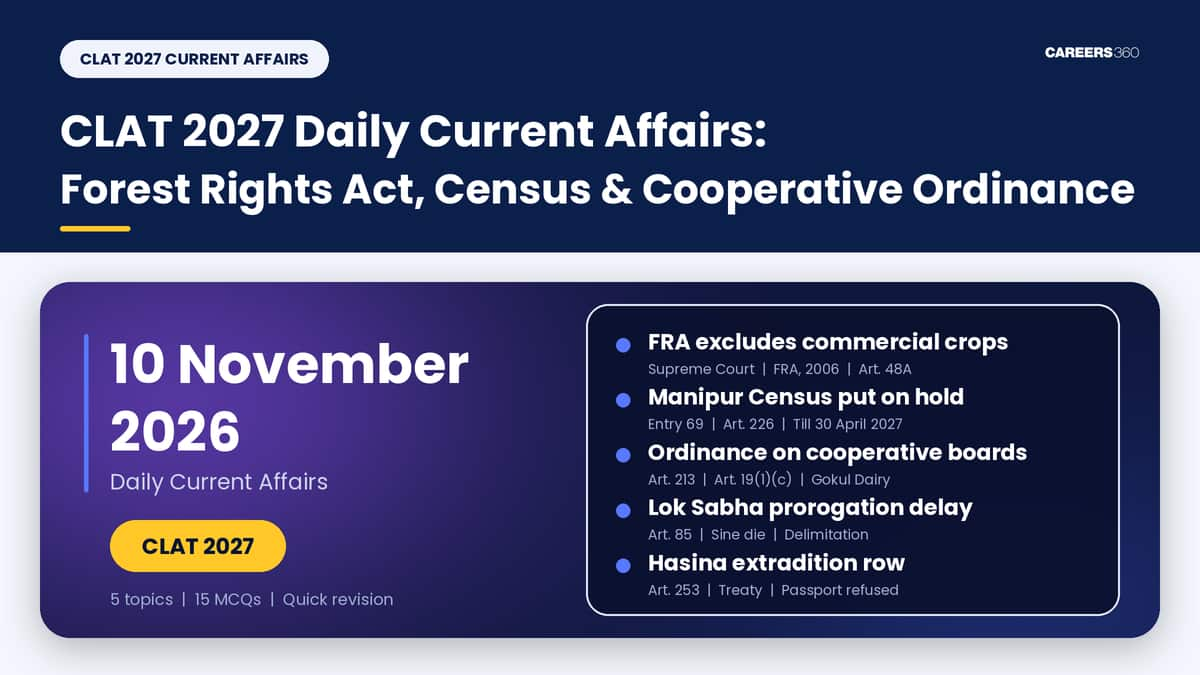
Today's CLAT 2027 current affairs cover five topics: the Supreme Court's ruling on commercial farming in reserve forests, the Manipur High Court's order on the Census, a Maharashtra ordinance on cooperative boards, the delay in proroguing the Lok Sabha and Bangladesh's demand for Sheikh Hasina's extradition. Candidates can revise important facts and practise MCQs for CLAT 2027.
In the news: The Supreme Court has said that commercial crop cultivation in reserve forests is not protected under the Forest Rights Act (FRA), 2006. The Bench of Justices Vikram Nath and Sandeep Mehta said the Act protects forest-dwelling Scheduled Tribes and Other Traditional Forest Dwellers who depend on forests for their livelihood, not commercial cultivators and plantation owners.
The November 6 order concerns silk cotton cultivation in the Agasthyamalai Biosphere Reserve. The Court asked the Central Empowered Committee to examine Tamil Nadu's claim that silk cotton is a “minor forest produce”. It also questioned the State's claim of historical cultivation, saying commercial crops could change the nature of a forest.
India’s only private university to be ranked for Graduate Employability | 6000+ Placements | 800+ Recruiters | 75 LPA-Highest Salary
Ranked #18 amongst Institutions in India by NIRF | Get Upto 100% Scholarships | Spot Admissions via CUET
What CLAT 2027 aspirants should know
FRA, 2006: Recognises the rights of tribal communities and other traditional forest dwellers over forest land and produce.
Purpose of the Act: Protects traditional use of forests and livelihood, not commercial plantations.
Minor forest produce: Non-timber products collected from forests by local communities. Whether a crop qualifies depends on the facts and law.
Article 48A: Directs the State to protect the environment, forests and wildlife.
Q1. Why did the Supreme Court distinguish commercial plantation owners from traditional forest dwellers?
A. A law's protection depends on the purpose for which it was made
B. All forest land must be given to those who farm it
C. Tribal rights cannot be recognised by law
D. Forests are beyond judicial review
Answer: A
Q2. Which Directive Principle asks the State to protect forests and wildlife?
A. Article 39A
B. Article 43
C. Article 48A
D. Article 51A(a)
Answer: C
Q3. A company grows a commercial crop inside a reserve forest and seeks protection under the FRA. What does the Supreme Court's order suggest?
A. All cultivation is protected under the Act
B. Protection depends only on the State's approval
C. The claim must be rejected without any inquiry
D. The claim is unlikely to succeed because the Act protects forest dwellers' livelihood rights, not commercial cultivation
Answer: D
In the news: The Manipur High Court has kept the Census on hold until at least April 30, 2027. The Centre is considering requests to delay or change the dates. The Bench of Chief Justice M. Sundar and Justice A. Guneshwar Sharma said existing postponement notices cannot be withdrawn or changed.
Petitioners said the Census could not give an accurate count as thousands remain displaced by the violence that began in May 2023. They also raised concerns about its impact on Assembly constituency boundaries. The Court asked the Registrar-General and Census Commissioner to issue a reasoned decision. The Census will remain on hold for four weeks after that, allowing affected people to approach the court.
What CLAT 2027 aspirants should know
Census: A Union subject under Entry 69 of the Union List.
Reasoned order: An authority must explain the reasons behind its decision. This helps courts review it.
Four-week period: Gives affected people time to challenge the authorities' decision in court.
Judicial review: Courts examine whether a decision is legal, fair and properly reasoned. They do not usually replace the authority's decision with their own.
Article 226: Gives High Courts the power to issue writs to protect fundamental and other legal rights.
Grade 'A+' Accredited by NAAC | Ranked 33rd in India by NIRF
Scholars’ Round Deadline: 14th Nov’26 | Earn upto 50% merit Scholarship + 10% for top performers | EFMD Accredited | AACSB (USA) & AMDISA Member | Highest CTC 28 LPA
Q1. Why did the Court ask the authorities to issue a “reasoned order”?
A. To allow delegated legislation
B. To apply the doctrine of severability
C. To ensure transparent decision-making that can be reviewed by a court
D. To prevent judicial review
Answer: C
Q2. The Census falls under which List of the Seventh Schedule?
A. Union List
B. State List
C. Concurrent List
D. Residuary list under Article 248 only
Answer: A
Q3. Why has the Court kept the Census on hold for four weeks after the authorities give their decision?
A. To let the Registrar-General amend the Census Act
B. To give affected people time to challenge the decision in court
C. To hold fresh elections
D. To close the matter without allowing further legal action
Answer: B
In the news: The Bombay High Court refused to urgently stay a Maharashtra ordinance allowing the State to nominate five directors, four with voting rights, to the boards of large cooperatives. It directed that the Gokul Dairy chairperson's election be held on Tuesday, with the nominated directors' votes kept in a separate ballot box and counted separately. The case will be heard later this month.
Congress MLC Satej Patil challenged the ordinance after his panel won the Gokul Dairy board elections in October. The State said the ordinance also covers three other large cooperatives. Farmers and Opposition parties protested against the move in Kolhapur.
What CLAT 2027 aspirants should know
Article 213: Allows a Governor to issue an ordinance when the State Legislature is not in session.
Ordinance limit: An ordinance must be placed before the Legislature and normally lapses six weeks after it reassembles unless approved earlier.
Cooperatives: Article 19(1)(c), amended by the 97th Constitutional Amendment, protects the right to form cooperative societies.
Autonomy: Cooperatives are expected to function through elected and democratic boards.
Interim relief: A court can allow an election to proceed while keeping disputed votes separate until the case is decided.
Q1. Under which Article can a Governor issue an ordinance?
A. Article 123
B. Article 161
C. Article 213
D. Article 356
Answer: C
Q2. The State's power to nominate voting directors to a cooperative board is being challenged. Which principle is at stake?
A. Autonomy and democratic control of cooperative societies
B. Independence of the judiciary
C. Freedom of inter-State trade
D. Right to property as a fundamental right
Answer: A
Q3. Why might a court count nominated directors' votes separately instead of stopping the election?
A. To decide the case in favour of the State
B. To allow the election while keeping the disputed votes separate until the case is decided
C. To cancel the ordinance immediately
D. To transfer the case to the Supreme Court
Answer: B
In the news: Congress leader Jairam Ramesh questioned why the Lok Sabha had not been prorogued even 88 days after it was adjourned sine die. He alleged that the delay was meant to give Home Minister Amit Shah time to secure a two-thirds majority for the Delimitation Bills. He said the Opposition had blocked the government's plans on April 17, 2026, and would do so again.
Ramesh also said Congress president Mallikarjun Kharge had written to the Prime Minister four times in six months, seeking an all-party meeting on delimitation before any Bill was introduced. He alleged that the Prime Minister had not agreed to the request. The report did not include the government's response.
What CLAT 2027 aspirants should know
Adjournment sine die: The presiding officer ends a sitting without announcing the date of the next sitting.
Prorogation: The President formally ends a session under Article 85(2)(a).
Six-month rule: Under Article 85(1), the gap between two sessions of Parliament cannot exceed six months.
Delimitation: The process of redrawing constituency boundaries, usually based on population.
Special majority: A constitutional amendment requires a majority of the total membership of each House and at least two-thirds of members present and voting under Article 368.
Q1. Who has the power to prorogue a session of Parliament?
A. The Speaker
B. The Prime Minister
C. The Vice-President
D. The President
Answer: D
Q2. What is the difference between adjournment sine die and prorogation?
A. Adjournment ends a session, while prorogation ends a sitting
B. The presiding officer adjourns a sitting, while the President prorogues a session
C. Both powers rest with the Speaker
D. There is no difference
Answer: B
Q3. Under Article 85(1), what is the maximum gap allowed between two sessions of Parliament?
A. Three months
B. Four months
C. Six months
D. One year
Answer: C
In the news: A London-based law firm representing former Bangladesh Prime Minister Sheikh Hasina has asked Dhaka to issue her a new passport and National Identity Card. Bangladesh's Acting Foreign Minister Humayun Kabir refused the request, called her a “terrorist” and said India should return her under the extradition treaty. He also referred to an “acceptable prisoner exchange” process.
India's Ministry of External Affairs has not responded. A source told The Hindu that the lack of a passport could complicate extradition, as the document would be needed if India considered the request. Hasina's passport was revoked after she fled to India in August 2024.
What CLAT 2027 aspirants should know
Extradition: When one country hands over a person accused or convicted of a crime to another country, usually under a treaty.
Treaty basis: Extradition depends on the treaty between the countries and the law of the country receiving the request.
Sovereign discretion: The requested country examines whether the legal conditions for extradition are met.
Passport: An official travel document that establishes a person's identity and nationality.
Article 253: Gives Parliament the power to make laws to implement international treaties and agreements.
Q1. What does extradition mean?
A. Deporting any foreigner for violating visa rules
B. Handing over a person wanted for a crime to another country, usually under a treaty
C. Giving asylum to a political leader
D. Transferring a case between two High Courts
Answer: B
Q2. Which Article allows Parliament to make laws to implement international treaties?
A. Article 51
B. Article 245
C. Article 253
D. Article 372
Answer: C
Q3. A country receives an extradition request under a treaty. What must it do?
A. Hand over the person immediately
B. Check under its own laws whether the treaty conditions are met
C. Refer the case to the United Nations
D. Let the person decide whether to return
Answer: B
Common Law Admission Test 2027 aspirants can revise today’s five current affairs news through the below important facts and terms:
Forest Rights Act, 2006: SC says commercial crop cultivation in reserve forests is not protected.
Silk cotton cultivation: CEC to examine Tamil Nadu's claim that it is minor forest produce.
Manipur Census: High Court keeps the Census on hold until at least April 30, 2027.
Gokul Dairy ordinance: Bombay HC refuses to stay the ordinance; nominated directors' votes to be counted separately.
Lok Sabha: Congress questions the 88-day gap between adjournment sine die and prorogation.
Sheikh Hasina: Bangladesh refuses to issue a passport and seeks her extradition from India.
Delhi HC: Orders a committee to address unsafe buildings during GRAP restrictions.
NMC: Issues an advisory on checking medical college approvals after Supreme Court directions.


India’s only private university to be ranked for Graduate Employability | 6000+ Placements | 800+ Recruiters | 75 LPA-Highest Salary
Ranked #18 amongst Institutions in India by NIRF | Get Upto 100% Scholarships | Spot Admissions via CUET
Grade 'A+' Accredited by NAAC | Ranked 33rd in India by NIRF
Scholars’ Round Deadline: 14th Nov’26 | Earn upto 50% merit Scholarship + 10% for top performers | EFMD Accredited | AACSB (USA) & AMDISA Member | Highest CTC 28 LPA
BA LLB, BBA LLB, or BCom LLB and LLB | LLM 1 Year – 4 Specializations | Approved by BCI | Highest CTC 9 LPA
Moot Court | Mock trials | Legal Aid Clinic | Recruiting Partners: FICCI, TCS, Adani, Trilegal, and many others