School of Law, UPES, Dehradun
Ranked #18 amongst Institutions in India by NIRF | Get Upto 100% Scholarships | Spot Admissions via CUET


Understanding of Contract Law and Tort Law are some areas which are essential to grasp while preparing for CLAT 2027 Legal Reasoning. But there is no necessity for an aspirant to learn about these two law subjects like a law student. The objective should be learning basic laws and applying them to different situations.
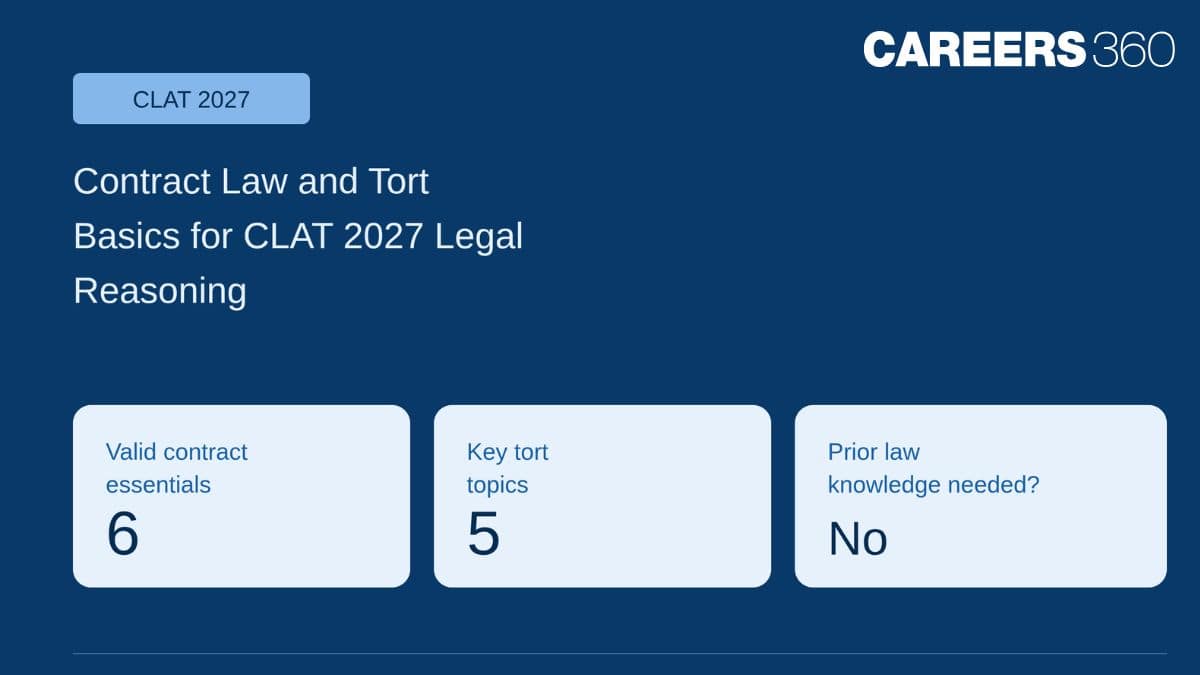
The Legal Reasoning section in CLAT will judge the understanding of legal principles, application of the principles to various facts and also the impact of changing a legal principle on its application. It is mentioned by Consortium of NLUs that prior knowledge of laws is not essential for this section.
Introduction to Contract Law and Tort Law will familiarize the students with some general legal concepts that may come in the form of passage based questions. Knowing these concepts may help aspirants recognize the rule being applied and also help them in applying the rule to the facts mentioned in the passage.
Ranked #18 amongst Institutions in India by NIRF | Get Upto 100% Scholarships | Spot Admissions via CUET
Scholars’ Round Deadline: 14th Nov’26 | Earn upto 50% merit Scholarship + 10% for top performers | EFMD Accredited | AACSB (USA) & AMDISA Member | Highest CTC 28 LPA
Contract Law is mostly concerned with agreements and obligations whereas Tort Law is all about civil wrong and the damage done to another individual.
Aspirants must familiarize themselves with the fundamentals of the subjects and practice on CLAT-like questions.
Contract Law pertains to the agreement between two parties that results in the creation of a legally binding obligation. Candidates must have knowledge about the following basics.
The offer is the proposal made by one person to the other with an intention to get accepted. Acceptance means the acceptance of the terms of offer.
Candidates must know the difference between offer and the invitation to offer. The candidates must also know the basics of acceptance of an offer and revocation of an offer.
For CLAT, these topics can be questioned using practical examples such as purchase of a product, making an order through the website or acceptance of any business offer.
Candidates must have basic knowledge about the essentials of making a contract legally binding.
Essentials of a valid contract include:
Offer and acceptance
Lawful consideration
Free consent
Competency of parties
Lawful object
Intention to create legal relations
The candidates must know the meanings of these terms instead of just memorizing them.
The law does not make everyone competent to enter into a binding agreement. Age and soundness of mind are examples of considerations that may determine the competence of a person to enter into a contract.
CLAT students should know the basic rule of capacity to contract and its application in practice.
Consideration denotes something valuable exchanged in consideration of a promise made. This is an essential element of Contract Law.
An example of a question is where one party makes a promise, and the question will ask if the other party has exchanged something in consideration of the promise.
Breach is the failure by one of the parties to perform their duties under the contract.
CLAT students need to understand the basic concept of breach and the remedy available, which includes damages or compensation.
Also check: 5 Common Excuses CLAT Aspirants Make (And How to Stop)
Torts is a branch of law that talks about civil wrongs that lead to injury to another person. The understanding of many tort principles can be made easier through practical examples and thus become a good resource for CLAT Legal Reasoning preparation.
One of the most vital tort principles is that of negligence.
Simply put, negligence happens when a person fails to take reasonable care leading to injury to another person.
The basic components are:
Duty of care
Breach of duty
Harm or damage
Connection between the two
For example, where a person fails to take reasonable care and the other person gets injured because of it, then the concept of negligence applies.
Trespass refers to any direct interference with another person’s rights in an unlawful manner.
It is important that students understand the distinction between trespass to the person and trespass to property. For instance, trespass could be where the aspirant enters the other person’s property or directly interferes with another person.
Defamation is where the person makes a statement that tarnishes the reputation of another person.
It is important for aspirants to understand concepts like publication, reputation and the nature of the statement.
Nuisance essentially deals with unreasonable interference with a person’s use or enjoyment of land, as well as some public rights.
Examples might include unreasonable noise pollution, smoke, pollution, etc.
Vicarious liability relates to instances where one party might be liable for an act committed by someone else due to the nature of a certain relationship existing between them.
One example is the relationship between an employer and his/her employee.
Also check: 10 Current Affairs and GK Topics You Must Read for CLAT 2027
Understanding the difference between these two areas can help students avoid confusion.
Contract Law | Tort Law |
Usually arises from an agreement | Generally arises from a civil wrong |
Deals with contractual obligations | Deals with duties imposed by law |
Parties usually have a contractual relationship | A contractual relationship is generally not required |
Breach occurs when a contractual promise is not fulfilled | Liability may arise when a legal duty is wrongfully breached |
Candidates should not waste too much time on remembering laws. They should rather learn basic concepts and practice their application.
The following strategy may prove helpful for your preparation:
Learn basic concepts using simple language.
Note down important principles in brief.
Practice passage-based Legal Reasoning questions.
Practice past year CLAT questions.
Take mock tests within time limit.
Analyze wrong answers after each mock test.
Do not make any assumption which is not stated in the passage.
The key factor is the ability to relate legal principle with the facts of the case.
Also check: CLAT 2027 Study Plan with Class 12 Board
When trying to solve a problem, the following steps must be followed. First, understand what is the principle of law that is being considered. Then, find the key facts in the case and see if the principle will apply to the facts. The students should also find exceptions or conditions stated in the passage.
The last step is to analyse the answer choices. The students should exclude those answers which provide additional information not provided in the passage.
Some typical errors made by students include:
Rote memorisation of concepts without comprehension.
Confusion of offer and invitation to offer.
Disregard of key details in the problem statement.
Answers based on one's personal opinion.
Use of external legal principles rather than the stated one.
Failing to note the exceptions/conditions.
Taking too much time on one question.
Not analysing one's errors after mock exams.
Avoiding such errors helps in increasing accuracy and confidence.
Also check: How to Improve Logical Reasoning Accuracy for CLAT 2027

On Question asked by student community
Hello Student,
Here are the Careers360 CLAT 2027 Mock Test Resources for your exam preparation.
1. Online CLAT Mock Test
2. CLAT Mock Tests and Solutions
Hello student,
CLAT 2027 aspirants can access these monthly current affairs compilations for regular revision. Use these resources to stay updated with important events and topics for CLAT 2027.
|
Particular |
Download PDF |
|
CLAT Current Affairs- August Month (2026) |
|
|
CLAT Current Affairs- |
If you have only two months, use a highly structured plan: daily current affairs, English reading, legal reasoning practice, logical reasoning sets, basic quantitative practice and regular full-length mocks. Spend as much time analysing incorrect questions as taking the mock itself. Consistency during these two months can make a substantial
You can download the CLAT previous years' question papers from here:
https://law.careers360.com/articles/clat-previous-year-question-papers
https://law.careers360.com/download/clat-sample-papers-previous-years
For CLAT 2027 UG, candidates need to have passed Class 12/equivalent with at least 45% marks, or 40% for SC/ST/PwD candidates.
In your situation, having an RT in an additional subject but subsequently passing the required qualification through an improvement examination does not automatically make you ineligible. However, the important

Ranked #18 amongst Institutions in India by NIRF | Get Upto 100% Scholarships | Spot Admissions via CUET
Scholars’ Round Deadline: 14th Nov’26 | Earn upto 50% merit Scholarship + 10% for top performers | EFMD Accredited | AACSB (USA) & AMDISA Member | Highest CTC 28 LPA
Moot Court | Mock trials | Legal Aid Clinic | Recruiting Partners: FICCI, TCS, Adani, Trilegal, and many others
NAAC A+ Accredited University
BA LLB, BBA LLB, or BCom LLB and LLB | LLM 1 Year – 4 Specializations | Approved by BCI | Highest CTC 9 LPA
Grade 'A+' Accredited by NAAC | Ranked 33rd in India by NIRF