Amity Law School, Noida
Experiential Learning through Legal Aid Camps, Lok Adalats, Court Visits, Community Lawyering and regular Moot Court sessions


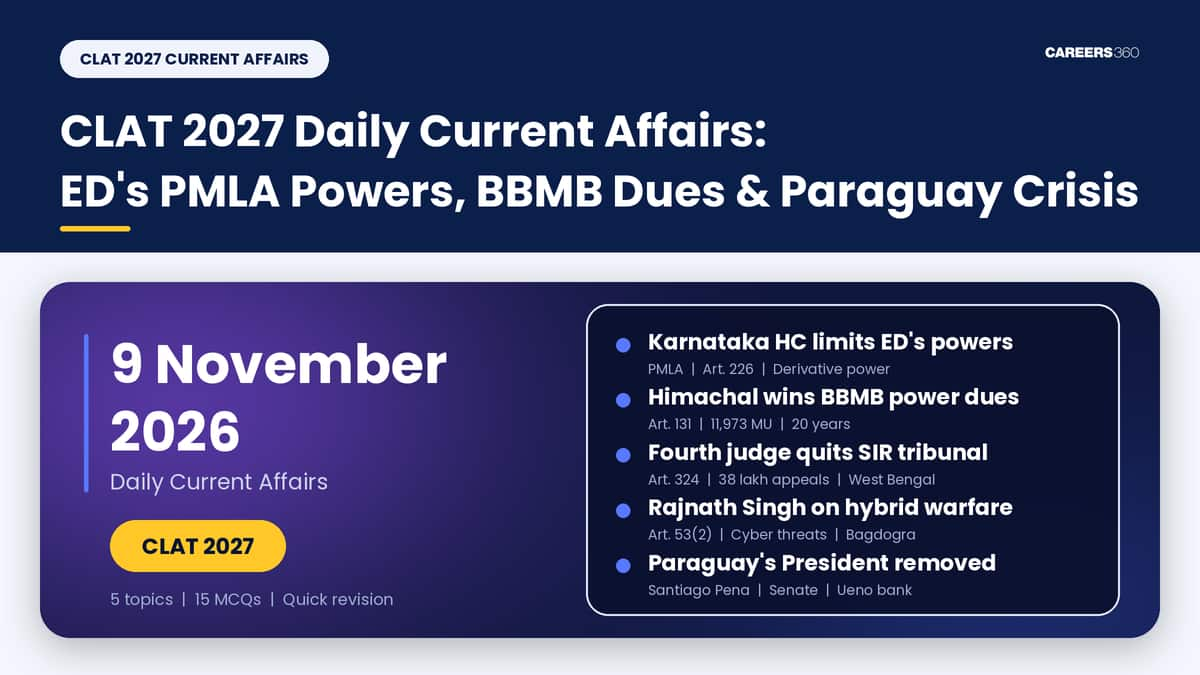
Today's CLAT 2027 current affairs cover five important developments: a Karnataka High Court ruling on the Enforcement Directorate's powers, the Supreme Court's verdict on Himachal Pradesh's power dues, resignations from West Bengal's SIR tribunals, Defence Minister Rajnath Singh's warning on hybrid warfare, and the removal of Paraguay's President. Candidates can read the CLAT exam-related key facts and practise the MCQs below.
In the news: The Karnataka High Court ruled that the Enforcement Directorate (ED) cannot file a private complaint to start a money-laundering case if the agencies responsible for the underlying offence refuse to prosecute it. Justice M.I. Arun said the ED's powers under the Prevention of Money Laundering Act (PMLA) are “derivative and not original”. This means the agency can use only the powers given to it by law.
The case began with a private complaint about an alleged land scam. During its investigation, the ED found evidence of a separate job scam and shared it with the police. When the police did not act, the ED filed a private complaint. The court rejected this approach, saying it could allow the agency to investigate anyone on its own.
What CLAT 2027 Aspirants Should Know
Scheduled offence: An offence listed under the PMLA, such as corruption or fraud, which forms the basis of a money-laundering case.
Derivative power: A power that depends on another offence or legal authority. The ED cannot start a PMLA case independently.
ECIR: The ED's internal record of a case. It is not the same as an FIR.
Checks and balances: Government agencies must act within the powers given to them by law.
Writ jurisdiction: High Courts can hear petitions against unlawful government action under Article 226.
Q1. What did the Karnataka High Court mean by saying that the ED's powers under the PMLA are derivative?
A. The ED can start any investigation on its own
B. The ED's powers depend on an underlying scheduled offence
C. The ED can act only on orders from the Supreme Court
D. The ED has the same powers as the police under all laws
Answer: B
Q2. Which principle requires government agencies to exercise only the powers granted to them by law?
A. Rule of law
B. Doctrine of eclipse
C. Doctrine of pith and substance
D. Principle of res judicata
Answer: A
Q3. If the police do not act on information shared by the ED about a scheduled offence, can the ED take over the investigation by filing a private complaint?
A. Yes, in every case
B. Yes, with the approval of the Governor
C. No, it cannot take over the scheduled offence on its own
D. No, unless Parliament passes a special law
Answer: C
In the news: The Supreme Court ruled in favour of Himachal Pradesh in its long-running dispute over power dues from the Bhakra Nangal and Beas projects. Under the order, the state will receive 11,973 million units of electricity from Punjab and Haryana over 20 years. The dispute had been pending for around 15 years.
A 2011 Supreme Court verdict had fixed Himachal Pradesh's share of the projects' dues since 1966 at 7.19%. Chief Minister Sukhvinder Singh Sukhu linked the issue to the proposed 440-MW Kishau Dam project. Haryana has also assured the court that it will file an affidavit supporting Himachal Pradesh's position.
What CLAT 2027 Aspirants Should Know
Inter-state dispute: A disagreement between two or more states, including disputes over shared resources.
Article 131: Gives the Supreme Court original jurisdiction to decide certain disputes between states or between the Centre and states.
Article 141: Makes the law declared by the Supreme Court binding on all courts in India.
Cooperative federalism: The Centre and states, or different states, work together on matters of common interest.
Arrears: Money or dues that remain unpaid.
Scholars’ Round Deadline: 14th Nov’26 | Earn upto 50% merit Scholarship + 10% for top performers | EFMD Accredited | AACSB (USA) & AMDISA Member | Highest CTC 28 LPA
BA LLB, BBA LLB, or BCom LLB and LLB | LLM 1 Year – 4 Specializations | Approved by BCI | Highest CTC 9 LPA
Q1. Which Article gives the Supreme Court original jurisdiction in disputes between states?
A. Article 32
B. Article 131
C. Article 136
D. Article 226
Answer: B
Q2. Under which Article is the law declared by the Supreme Court binding on all courts in India?
A. Article 124
B. Article 136
C. Article 141
D. Article 226
Answer: C
Q3. A dispute between two states over the sharing of power dues can be heard by the Supreme Court under:
A. Its original jurisdiction
B. Its advisory jurisdiction
C. Its review jurisdiction
D. Its appellate jurisdiction only
Answer: A
In the news: Retired Calcutta High Court judge Biswajit Basu has resigned from a tribunal hearing appeals against voter deletions in West Bengal. He cited personal reasons and sent his resignation to the Chief Justice of the High Court. He is the fourth judge to quit, after T.S. Sivagnanam, Ranjit Kumar Bag and Indrajit Chatterjee.
Nineteen tribunals are handling around 38 lakh appeals from voters removed during the Special Intensive Revision (SIR), which deleted 91 lakh electors. Justice Basu said the work was being carried out on the Supreme Court's directions and had to be completed. Some judges were reportedly unhappy with the slow disposal of appeals.
What CLAT 2027 Aspirants Should Know
Article 324: Gives the Election Commission control over elections and the preparation of electoral rolls.
Article 326: Provides for elections to the Lok Sabha and state assemblies on the basis of adult suffrage.
Appellate remedy: Allows a person affected by a decision to challenge it before a higher authority or tribunal.
Quasi-judicial body: A body that decides disputes like a court but is not part of the regular judiciary.
Speedy disposal: Appeals must be decided without unnecessary delay so that people can get effective relief.
Q1. Which Article deals with the Election Commission's powers over elections and electoral rolls?
A. Article 280
B. Article 324
C. Article 329
D. Article 368
Answer: B
Q2. Which constitutional provision provides for elections based on adult suffrage?
A. Article 14
B. Article 19
C. Article 326
D. Article 356
Answer: C
Q3. What is a quasi-judicial body?
A. A body that makes laws
B. A body that decides disputes but is not a regular court
C. A body that conducts elections
D. A body that advises the President
Answer: B
In the news: Defence Minister Rajnath Singh warned of changing security threats while addressing personnel at the Bagdogra Air Force station ahead of Deepavali. Without naming any country, he said adversaries were avoiding direct confrontation and trying to exploit vulnerabilities. He urged the armed forces to focus on cyber security, information integrity and awareness across different domains.
At Sukna, he reviewed the Army's Trishakti Corps and infrastructure along the Line of Actual Control (LAC). He said threats now include hybrid warfare, proxy wars, cyberattacks, drone incursions and misinformation spread through social media. He also asked soldiers to take care of their mental health.
What CLAT 2027 Aspirants Should Know
Hybrid warfare: A mix of military action, cyberattacks, proxy forces and misinformation.
Domain awareness: Understanding developments across land, air, sea, cyber and space.
Article 53(2): Vests the supreme command of India's armed forces in the President.
Defence in the Union List: Defence is a subject on which Parliament can make laws under the Seventh Schedule.
LAC: The Line of Actual Control is the de facto boundary between India and China. It is not a formally settled international border.
Q1. Who holds the supreme command of India's armed forces under the Constitution?
A. Prime Minister
B. Defence Minister
C. President
D. Chief of Defence Staff
Answer: C
Q2. Which of the following is an example of hybrid warfare?
A. A conflict fought only through naval forces
B. A combination of military action, cyberattacks and misinformation
C. A war fought only under a UN mandate
D. A conflict limited to nuclear weapons
Answer: B
Q3. Defence of India falls under which list of the Seventh Schedule?
A. State List
B. Union List
C. Concurrent List
D. Residuary List
Answer: B
In the news: Paraguay's Senate removed President Santiago Pena from office following the collapse of Ueno, a government-linked bank. Regulators seized the bank on November 3, leaving customers unable to access their accounts. Pena was placed under house arrest over allegations including breach of trust and influence peddling. He has denied the charges.
Lawmakers accused him of using his political influence to direct public funds towards the bank while regulators ignored risky insider lending. Vice-President Pedro Alliana took the oath as President and will remain in office until August 2028. Some depositors began receiving their money back on November 5.
What CLAT 2027 Aspirants Should Know
Impeachment: A legal process through which a legislature can remove a head of state or other public official for serious misconduct.
Succession: The process through which another person takes over an office when the existing office-holder leaves.
Article 61: Provides the procedure for impeaching the President of India for violation of the Constitution.
Breach of trust: Misusing property or authority that was entrusted to a person.
Accountability of regulators: Regulatory bodies are expected to supervise institutions and act when rules are violated.
Q1. Under which Article can the President of India be impeached for violation of the Constitution?
A. Article 56
B. Article 61
C. Article 75
D. Article 124
Answer: B
Q2. The removal of a President by the legislature is an example of which constitutional principle?
A. Separation of powers and checks on the executive
B. Judicial activism
C. Federal supremacy
D. Delegated legislation
Answer: A
Q3. When a Vice-President takes over after the President is removed, which principle does this demonstrate?
A. Continuity of the constitutional office through succession
B. Dissolution of the legislature
C. Emergency rule
D. Judicial appointment
Answer: A
Aspirants preparing for CLAT 2027 can revise the important facts and terms below from today's five current affairs:
Karnataka HC on ED: ED's powers under the PMLA are derivative, not original.
ED and private complaints: The ED cannot take over a scheduled offence by filing a private complaint.
BBMB power dues: Himachal Pradesh to receive 11,973 million units of electricity over 20 years.
West Bengal SIR: Fourth judge resigns from the appellate tribunal; around 38 lakh appeals are pending.
Rajnath Singh: Warns of hybrid warfare, cyberattacks and misinformation.
Paraguay: Senate removes President Santiago Pena; Vice-President Pedro Alliana takes over.

On Question asked by student community
Hello Student,
The full form of the CLAT exam is the Common Law Admission Test. You can check the link related to the CLAT exam
https://law.careers360.com/articles/what-is-clat-full-form-all-about-nlus-entrance-exam
Hello Student,
Here are the Careers360 CLAT 2027 Mock Test Resources for your exam preparation.
1. Online CLAT Mock Test
2. CLAT Mock Tests and Solutions
Hello student,
CLAT 2027 aspirants can access these monthly current affairs compilations for regular revision. Use these resources to stay updated with important events and topics for CLAT 2027.
|
Particular |
Download PDF |
|
CLAT Current Affairs- August Month (2026) |
|
|
CLAT Current Affairs- |
If you have only two months, use a highly structured plan: daily current affairs, English reading, legal reasoning practice, logical reasoning sets, basic quantitative practice and regular full-length mocks. Spend as much time analysing incorrect questions as taking the mock itself. Consistency during these two months can make a substantial
You can download the CLAT previous years' question papers from here:
https://law.careers360.com/articles/clat-previous-year-question-papers
https://law.careers360.com/download/clat-sample-papers-previous-years

Experiential Learning through Legal Aid Camps, Lok Adalats, Court Visits, Community Lawyering and regular Moot Court sessions
Ranked #18 amongst Institutions in India by NIRF | Get Upto 100% Scholarships | Spot Admissions via CUET
Scholars’ Round Deadline: 14th Nov’26 | Earn upto 50% merit Scholarship + 10% for top performers | EFMD Accredited | AACSB (USA) & AMDISA Member | Highest CTC 28 LPA
BA LLB, BBA LLB, or BCom LLB and LLB | LLM 1 Year – 4 Specializations | Approved by BCI | Highest CTC 9 LPA
Grade 'A+' Accredited by NAAC | Ranked 33rd in India by NIRF
Moot Court | Mock trials | Legal Aid Clinic | Recruiting Partners: FICCI, TCS, Adani, Trilegal, and many others