School of Law, UPES, Dehradun
Ranked #18 amongst Institutions in India by NIRF | Get Upto 100% Scholarships | Spot Admissions via CUET


Elon Musk's Starlink is in the news these days. The company, which offers satellite internet services in many countries, is awaiting final approvals in India. The delay has also turned into a public clash between Musk and Mukesh Ambani's Reliance over satellite spectrum competition in India. For CLAT 2027 aspirants, this topic is highly relevant for the current affairs and legal reasoning sections. These developments are directly linked to national security and data privacy in India. The topic also connects to international affairs through Starlink's role in the Russia-Ukraine war. This article explains the Starlink controversy in the context of India and the key legal and constitutional issues that CLAT 2027 aspirants should know.
No. A foreign company can run internet services in India only with a licence from the Indian government, and the government retains the legal power to control or suspend services in a war or emergency. The real worry is practical, not legal: the satellites belong to a foreign company, and the Ukraine case showed that such a company can say no. As of 2026, Starlink has a licence in India but has not launched commercial service.
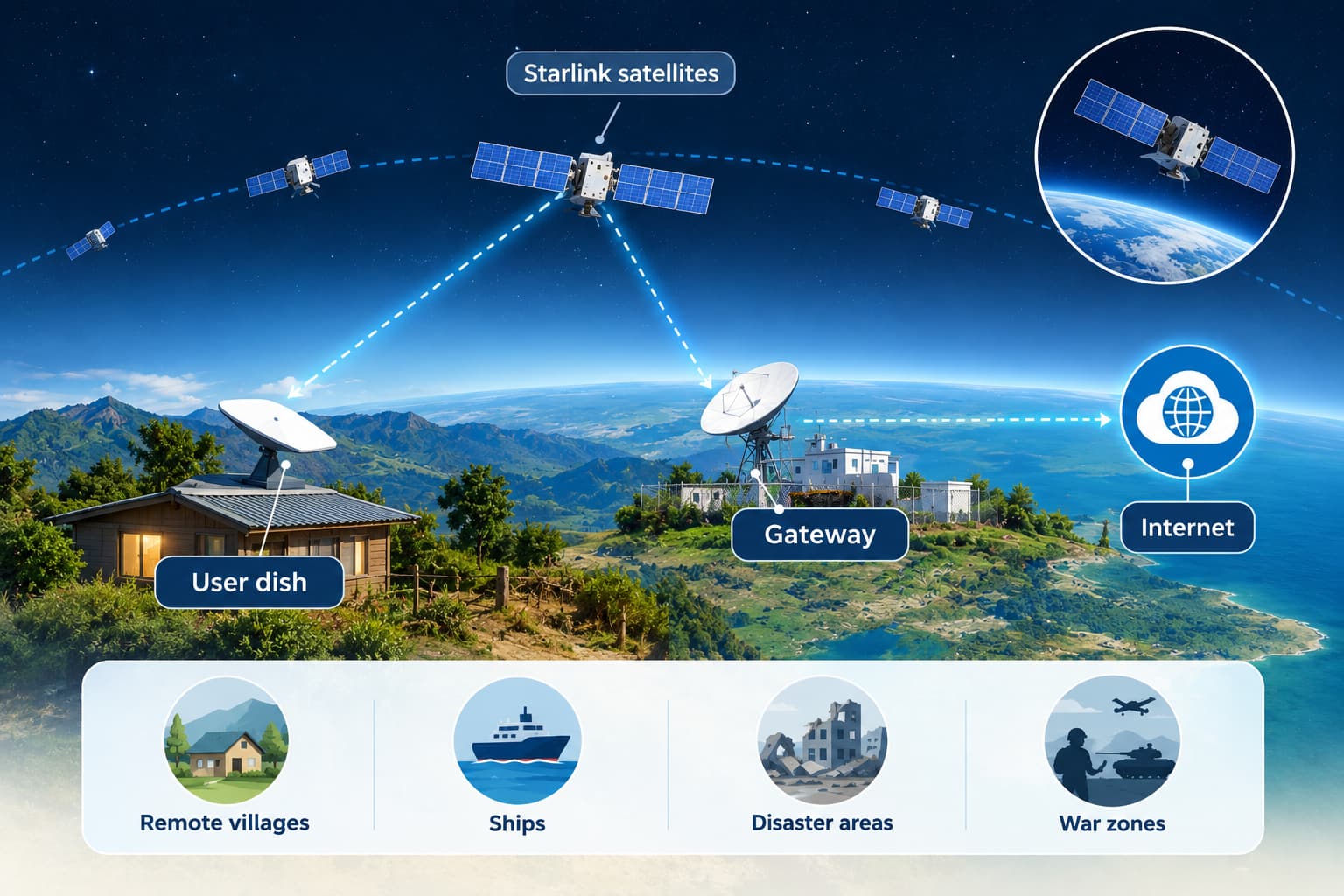
Starlink is a satellite internet service run by SpaceX, Elon Musk's company. Instead of cables or mobile towers, it uses thousands of small satellites in low Earth orbit to send internet to a dish at the user's home. It helps most where cables and towers do not exist or have been destroyed: remote villages, ships, disaster areas and war zones.
Ranked #18 amongst Institutions in India by NIRF | Get Upto 100% Scholarships | Spot Admissions via CUET
Scholars’ Round Deadline: 14th Nov’26 | Earn upto 50% merit Scholarship + 10% for top performers | EFMD Accredited | AACSB (USA) & AMDISA Member | Highest CTC 28 LPA
Two terms you must know for this topic:
Spectrum: the invisible radio waves that carry signals through the air. It is limited, so the government decides who gets to use it and on what terms.
Gateway: a ground station on Earth that connects the satellite signal to the normal internet. India wants these gateways inside India, so that Indian traffic never has to leave the country.
Why this matters in war: the same technology that keeps a hospital online can also keep an army's messages and drones connected. Whoever controls the switch has real power.
Feb 2022: After Russia’s invasion, SpaceX sent thousands of Starlink dishes to Ukraine, keeping hospitals, businesses and the army active online.
2022, Crimea: Ukraine asked Musk to extend coverage to Sevastopol so its naval drones could hit Russian warships. Musk refused. (Crimea is controlled by Russia since 2014.)
Oct 2022: The US-Ukraine relations changed dramatically. SpaceX told the Pentagon it could no longer fund Starlink in Ukraine as before and asked the US government to take over the cost.
Feb 2023: SpaceX restricted use of Starlink for guiding drones, saying it broke the service terms.
Sept 2023: Walter Isaacson, Elon Musk’s biographer, wrote that Musk had switched off Starlink near Crimea. Musk denied this. He said he only refused to activate it, to avoid complicity in a major act of war, and later added US sanctions on Russia as a second reason.
Opinion in Ukraine was divided. Some officials criticised Musk sharply. Ukraine's Deputy Prime Minister Mykhailo Fedorov said it was unfair to blame him alone, because Musk had also helped speed up delivery of about 10,000 more terminals during Russian attacks on the energy grid.
Why this matters for CLAT 2027: This is a typical international relations topic that CLAT often covers. The Russia-Ukraine war was asked in CLAT 2022 as part of current affairs. Given the recent developments, especially in the context of the strategic importance and control that Starlink holds, it remains relevant for the 2027 CLAT.
The fight is about one question: should the government sell satellite spectrum to the highest bidder, or give it out at a price it fixes itself?
Method | How it works | Who backed it |
Auction | Companies bid. The highest bidder wins. This is how India sells mobile spectrum. | Reliance Jio (Mukesh Ambani). Sunil Bharti Mittal also said satellite firms should buy spectrum like telecom companies. |
Administrative allocation | The government sets a price and assigns spectrum without bidding. Many operators can share it. | Starlink (Elon Musk), Amazon's Project Kuiper, and Telecom Minister Jyotiraditya Scindia. |
Musk's side: Many operators share satellite spectrum, so it cannot be priced for one company at a time. Allocating it administratively is the global practice, and Musk called an auction "unprecedented". India is also a member of the ITU (the UN body for telecom), whose treaty says spectrum should be used rationally, efficiently and economically.
Ambani's side: Jio and other Indian companies paid huge sums for mobile spectrum and built towers. Reliance argued that letting satellite firms in without an auction is not a level playing field and could favour foreign players. Reliance also said Indian law did not clearly say how satellite broadband should be given spectrum.
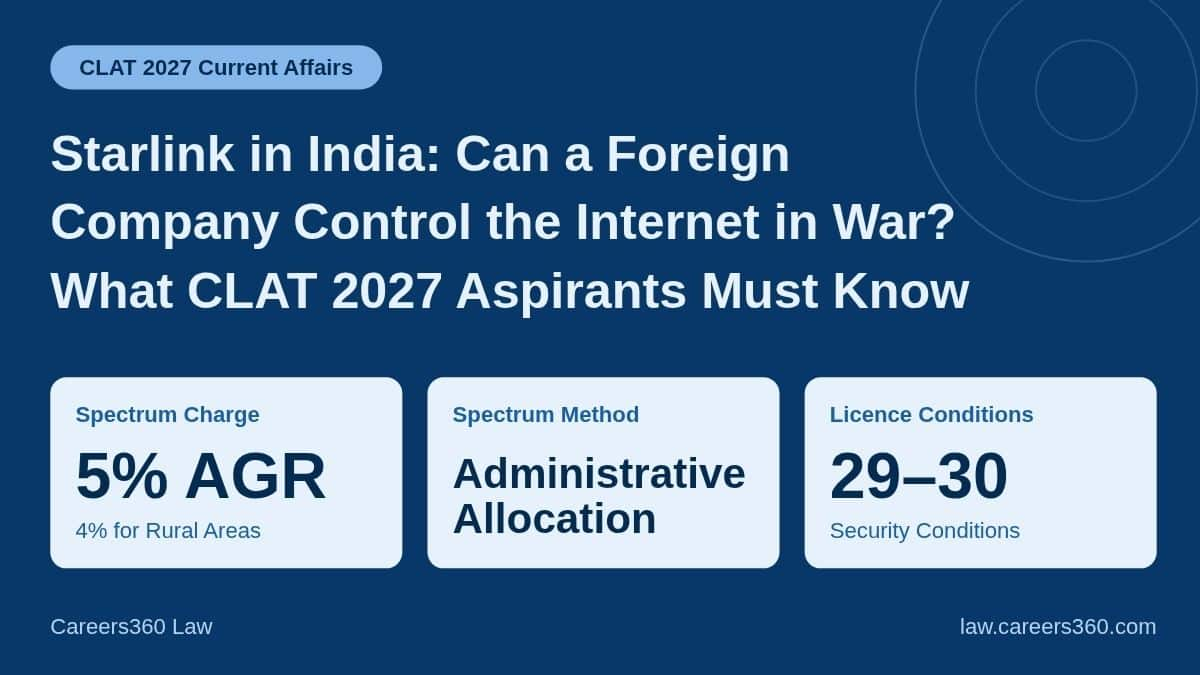
What the government decided: In October 2024, Minister Scindia announced that satellite spectrum would be allocated administratively, not auctioned. This follows the Telecommunications Act, 2023, which lists satellite services in its First Schedule, meaning they can be assigned without auction. Musk publicly welcomed the decision. The minister added that this does not mean the spectrum is free: TRAI, the telecom regulator, would recommend a price.
The price: In September 2026, the Digital Communications Commission cleared a spectrum charge of 5% of a company's adjusted gross revenue (AGR), with a lower effective charge of 4% for operators serving rural and remote areas. The proposal now needs Union Cabinet approval.
Starlink has a licence, but it cannot switch on commercial service yet. Three steps are still pending, and the two sides blame each other for the delay.
Date | What happened |
16 Oct 2026 | Reliance Industries rejected Musk's claims and said Jio's own satellite unit is waiting for the same clearances (as reported). |
7–8 Oct 2026 | Musk said on X that Starlink was being blocked by "certain oligarchs". The Ministry of Communications replied that its approval process is fair and non-discriminatory, and called the claim baseless. |
Sept 2026 | The Digital Communications Commission cleared the satellite spectrum rules, including the 5% revenue charge. The Cabinet must still approve them. |
July 2025 | Starlink received IN-SPACe approval (India's space regulator) for its first-generation satellites. |
June 2025 | The Department of Telecommunications gave Starlink its licence after it agreed to India's security conditions. |
Oct 2024 | The government chose administrative allocation of satellite spectrum over an auction. |
Dec 2023 | The Telecommunications Bill was introduced in the Lok Sabha and became the Telecommunications Act, 2023. |
2021–22 | Starlink first applied in 2021. The government later told it to refund more than 5,000 pre-orders taken before approval. |
Union Cabinet approval of the spectrum price and framework.
Security clearance. The ministry says every licence holder must prove it follows the security conditions, and this check is under way for all three licence holders: Starlink, Jio Satellite Communications and Eutelsat OneWeb.
FDI (foreign direct investment) approval. Starlink's Indian company is wholly owned by SpaceX, so its ownership is under scrutiny.
Starlink says it has already built more than 20 gateway sites in India and keeps Indian user data inside India. Both sides are making claims here, and this article does not take a side.
In law, no: India's government holds the control. In practice, a smaller risk remains, because the satellites are owned by a foreign company. Here is how both sides of the answer work.
Under the Telecommunications Act, 2023, only the Central Government has the exclusive privilege to provide telecom services. A company needs an authorisation (licence) from the Centre to operate.
The Act lets the Centre take control of, manage or suspend telecom services or networks in the interest of national security. In a public emergency or disaster, it can take temporary possession of networks. Section 20 is the section usually cited for these emergency powers; check the exact section numbers in the bare Act before using them in an answer.
The Act replaced three old laws: the Indian Telegraph Act, 1885, the Indian Wireless Telegraphy Act, 1933, and the Telegraph Wires (Unlawful Possession) Act, 1950.
Ground gateways must be inside India. No Indian user traffic may be routed through a gateway abroad.
No copying or decrypting of Indian data outside India, and no mirroring of Indian user traffic on servers abroad.
A data centre and domain name (DNS) resolution inside India.
Lawful interception, website blocking and metadata collection. Companies must give real-time location of user terminals to security agencies when required.
Operators must be able to restrict service for individuals, groups or areas during hostilities. This is the "war switch" in the title, and it is in the Indian government's hands.
Separate security clearance for voice and for data services, and clearance of each gateway location. In all, satcom firms face 29 to 30 security conditions.
The law binds the Indian company, not the satellites. Starlink's Indian company is wholly owned by SpaceX, a US firm that owns and runs the satellites. India can order the Indian company to restrict service. It cannot physically operate satellites in orbit. Critics point to Ukraine: a decision taken abroad, by a company or under US sanctions (a reason Musk himself gave), can change what a country gets from the sky. Some commentators even say India should treat Starlink with the same security-first caution it applied to Huawei. Supporters reply that gateways, data localisation and clearances reduce this risk.
Too much government power is also a worry. Critics of the Act say its wide emergency powers could be misused by the executive. The Supreme Court has already said that internet shutdowns must meet legal tests (see Anuradha Bhasin in the table below).
A foreign company cannot legally control India's internet in war, because licence conditions and the Telecommunications Act put the control with the Centre. The honest remaining concern is dependence: if a foreign company owns the satellites, its own choices, or its home government's orders, could still affect service.
CLAT 2027 aspirants can learn these ten items. They cover most CLAT 2027 questions that can come from this topic.
Term or case | What to remember |
Telecommunications Act, 2023 |
|
TRAI |
|
DoT and DCC |
|
IN-SPACe |
|
ITU |
|
AGR |
|
2G case (Centre for Public Interest Litigation v. Union of India, 2012) |
|
Presidential Reference (Special Reference No. 1 of 2012) |
|
Article 39(b) |
|
Anuradha Bhasin v. Union of India (2020) |
|
Q1. Under which entry of the Union List does Parliament get exclusive power to legislate on telegraphs, telephones and wireless?
(a) Entry 10
(b) Entry 31
(c) Entry 97
(d) Entry 1
Answer: (b).
Q2. In Anuradha Bhasin v. Union of India (2020), the Supreme Court held that:
(a) Internet shutdowns are unreviewable executive decisions
(b) Indefinite internet suspension is permissible
(c) Internet suspension orders must satisfy proportionality and be reviewable
(d) Internet access is not protected under Article 19
Answer: (c).
Q3. Under Article VI of the Outer Space Treaty, 1967, who bears international responsibility for the space activities of a private company?
(a) The company's CEO
(b) The State of the company's nationality
(c) The UN
(d) The host State of the user terminals
Answer: (b).
Q4. Which body of the Department of Telecommunications approved the satellite spectrum framework in September 2026?
(a) TRAI
(b) TDSAT
(c) Digital Communications Commission
(d) IN-SPACe
Answer: (c).
Q5 (Assertion-Reason). Assertion (A): The Government of India can direct suspension of a licensed satellite operator's services in a public emergency. Reason (R): The Telecommunications Act, 2023 gives the Central Government emergency powers over telecom services and networks.
(a) Both true, R explains A
(b) Both true, R does not explain A
(c) A is true, R is false
(d) A is false, R is true
Answer: (a).

On Question asked by student community
Hello Student,
Here are the Careers360 CLAT 2027 Mock Test Resources for your exam preparation.
1. Online CLAT Mock Test
2. CLAT Mock Tests and Solutions
Hello student,
CLAT 2027 aspirants can access these monthly current affairs compilations for regular revision. Use these resources to stay updated with important events and topics for CLAT 2027.
|
Particular |
Download PDF |
|
CLAT Current Affairs- August Month (2026) |
|
|
CLAT Current Affairs- |
If you have only two months, use a highly structured plan: daily current affairs, English reading, legal reasoning practice, logical reasoning sets, basic quantitative practice and regular full-length mocks. Spend as much time analysing incorrect questions as taking the mock itself. Consistency during these two months can make a substantial
You can download the CLAT previous years' question papers from here:
https://law.careers360.com/articles/clat-previous-year-question-papers
https://law.careers360.com/download/clat-sample-papers-previous-years
For CLAT 2027 UG, candidates need to have passed Class 12/equivalent with at least 45% marks, or 40% for SC/ST/PwD candidates.
In your situation, having an RT in an additional subject but subsequently passing the required qualification through an improvement examination does not automatically make you ineligible. However, the important

Ranked #18 amongst Institutions in India by NIRF | Get Upto 100% Scholarships | Spot Admissions via CUET
Scholars’ Round Deadline: 14th Nov’26 | Earn upto 50% merit Scholarship + 10% for top performers | EFMD Accredited | AACSB (USA) & AMDISA Member | Highest CTC 28 LPA
Moot Court | Mock trials | Legal Aid Clinic | Recruiting Partners: FICCI, TCS, Adani, Trilegal, and many others
NAAC A+ Accredited University
Law Admissions 2026 Open | Avail Merit-Based Scholarships
NAAC A++ Accredited | Ranked #11 by NIRF