
Search Colleges, Exams, Schools & more


Login
AIBE 22 Exam 2026 Analysis: Check Overall Difficulty & Passing Marks

The Bar Council of India (BCI) conducted the All India Bar Examination (AIBE) 22 on November 29, 2026, in offline, OMR-based mode. The examination comprised 100 multiple-choice questions carrying 100 marks. Candidates can now check the AIBE 22 Exam Difficulty Level 2026 and category-wise passing marks to understand the expected qualifying criteria and assess their performance in the examination.
Live | Nov 29, 2026 | 3:11 PM IST
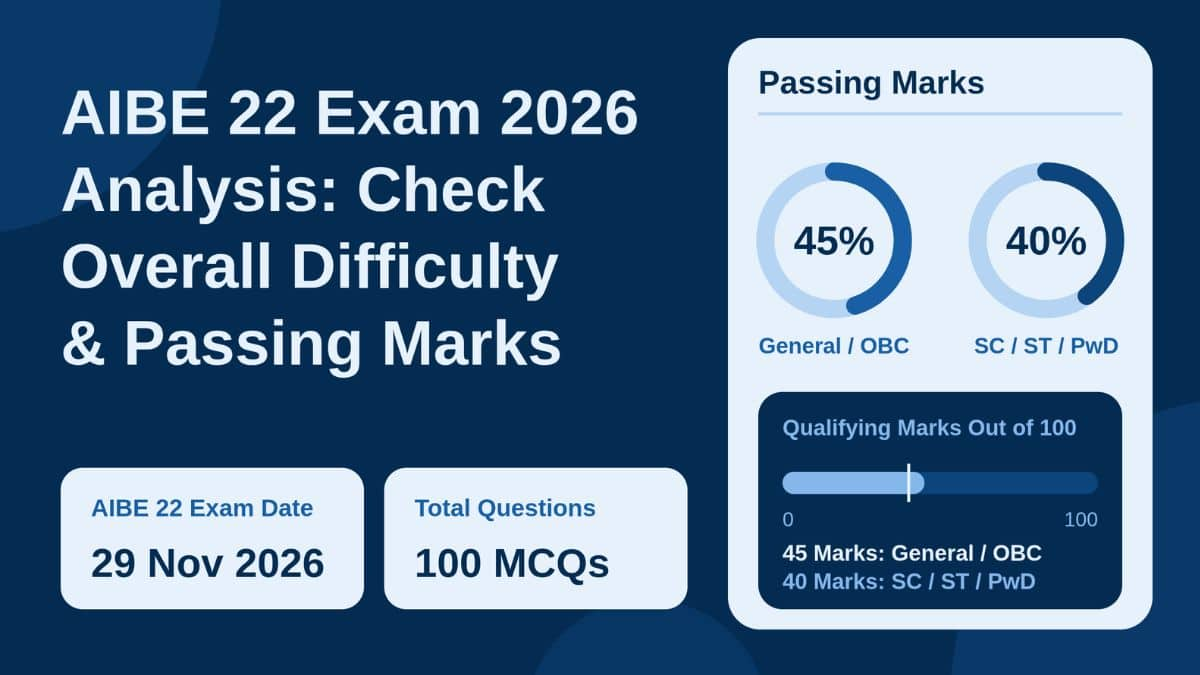
The difficulty level of AIBE 22 will be updated after the exam is conducted and the question paper and students' feedback are available. To be eligible for the Certificate of Practice (CoP) and qualify for the AIBE 22 examination, candidates must score the minimum percentage of marks prescribed by the Bar Council of India.
AIBE 22 Exam Difficulty Level 2026
The difficulty level of AIBE 22 as a whole will be decided after analysing the question paper and feedback received from the candidates. The analysis will help the candidates to judge whether the paper was easy, moderate, or tough.
After the examination, candidates can check the updated difficulty level from the table given below.
Particulars | AIBE 22 Difficulty Level |
Overall difficulty level | To be updated |
Constitutional Law | To be updated |
Criminal Law | To be updated |
Civil Procedure Code | To be updated |
Evidence Law | To be updated |
Family Law | To be updated |
Professional Ethics | To be updated |
Contract Law | To be updated |
AIBE - Previous Year Question Papers
Get the AIBE previous year question papers here
- Free PDF
- Detailed Solutions
- Instant Access
AIBE 22 Passing Marks 2026
As per the prescribed qualifying criteria, General and OBC candidates need to score a minimum marks of 45%, and SC, ST, and PwD candidates need to score a minimum marks of 40%. Candidates can check the AIBE 22 qualifying marks category-wise below.
Category | Minimum Qualifying Percentage | Passing Marks (Out of 100) |
General | 45% | 45 |
OBC | 45% | 45 |
SC | 40% | 40 |
ST | 40% | 40 |
PwD | 40% | 40 |
Note: The actual qualifying marks may change if the BCI withdraws questions or moderates the result after reviewing the final answer key.
AIBE 22 Category-Wise Qualifying Marks 2026
The qualifying marks for AIBE 22 vary as per the different categories of candidates. The candidates have to secure the prescribed qualifying percentage to pass the examination. AIBE is a qualifying examination and not a competitive entrance examination; hence, candidates are not required to secure any particular rank in AIBE.
The minimum eligibility criteria are 45% for General and OBC and 40% for SC, ST, and PwD candidates. The final cut-off marks in the qualifying examination shall be evaluated by the BCI and shall be subject to any further notification.
AIBE 22 Preparation
AIBE 22 Sample Paper
Download the Free AIBE 22 Sample Paper with Answer Key and Ace the All India Bar Examination
AIBE Previous Year Passing Marks and Cutoff Trends
Candidates can check the previous examination's qualifying marks in the table below.
AIBE Examination | General/OBC | SC/ST/PwD |
AIBE 21 (2026) | 42 | 37 |
AIBE 22 (2026) | 45 (prescribed) | 40 (prescribed) |
The AIBE 22 examination is a qualifying test conducted by the Bar Council of India to evaluate the basic legal knowledge and professional competence of law graduates. Candidates belonging to the General and OBC categories need to score 45% marks, while the candidates belonging to the SC, ST, or PwD categories need to score 40% marks. The final qualifying marks and overall difficulty level will be updated after the examination based on the question paper and answer key and BCI notifications.
Articles
Related Stories
|
Certifications By Top Providers
Explore Top Universities Across Globe
Popular Courses and Specializations
Questions related to AIBE
On Question asked by student community
Have a question related to AIBE ?
Hello student!
AIBE question papers in Kannada medium are not explicitly available. Meanwhile, you can check these resources for AIBE previous-year question papers and the AIBE 21 (2026) Set A and Set B papers for practice.
AIBE Previous-Year Question Papers:
https://law.careers360.com/articles/aibe-previous-year-question-papers
AIBE 21 Set B Question Paper 2026:
https://law.careers360.com/articles/aibe-21-set-b-question-paper-pdf-2026
AIBE
Hello Student,
You can check the relevant article below
https://law.careers360.com/download/ebooks/aibe-preparation-guide
Hope it helps!
Hello Student,
You can access the AIBE previous year question papers in Hindi by clicking on the relevant link given below.
https://law.careers360.com/hi/articles/aibe-previous-year-question-papers
Hey there,
No. If you are currently in the 5th semester of a 3-year LL.B., you generally cannot register for AIBE yet.
Under the current BCI rules, a 3-year LL.B. student must be in the final semester (6th semester) and have no backlogs from previous semesters to register for AIBE.
Hello Dear Student,
The All India Bar Examination (AIBE) covers 19 major legal subjects, carrying a high-weightage focus on Constitutional Law (8–12 questions) and Family Law including Hindu and Muslim law (6–8 questions)
You can check, find and access more information here:
-
https://law.careers360.com/articles/aibe-important-topics
Hope it helps!

Applications for Admissions are open.
Experiential Learning through Legal Aid Camps, Lok Adalats, Court Visits, Community Lawyering and regular Moot Court sessions
School of Law, UPES, Dehradun
ApplyRanked #18 amongst Institutions in India by NIRF | Get Upto 100% Scholarships | Spot Admissions via CUET
Manav Rachna University, Faridabad
ApplyNAAC A++ Accredited | Avail up to 100% scholarship via MRNAT-Manav Rachna National Aptitude Test
School of Law, Jain University, Bangalore
ApplyNAAC A++ Approved | Curriculum Aligned with BCI & UGC
Woxsen University, Hyderabad
ApplyUG Scholar's Round Deadline: 1st Dec'26 | Earn upto 50% merit Scholarship + 10% for top performers | Highest CTC 18 LPA
Institute of Law, Nirma University, Ahmedabad
ApplyGrade 'A+' Accredited by NAAC | Ranked 33rd in India by NIRF
AIBE Notifications
Never miss AIBE update
Get timely AIBE updates directly to your inbox. Stay informed!