ICFAI University Sikkim Law Admissions 2026
Approved by BCI


The Consortium of National Law Universities (NLUs) has issued guidelines for conducting CLAT 2026 for Persons with Disabilities (PwDs) on October 27, 2025. The main purpose of these guidelines is to ensure that candidates with disabilities are provided equal access, fair opportunity, and reasonable accommodations during the CLAT 2026 examination.
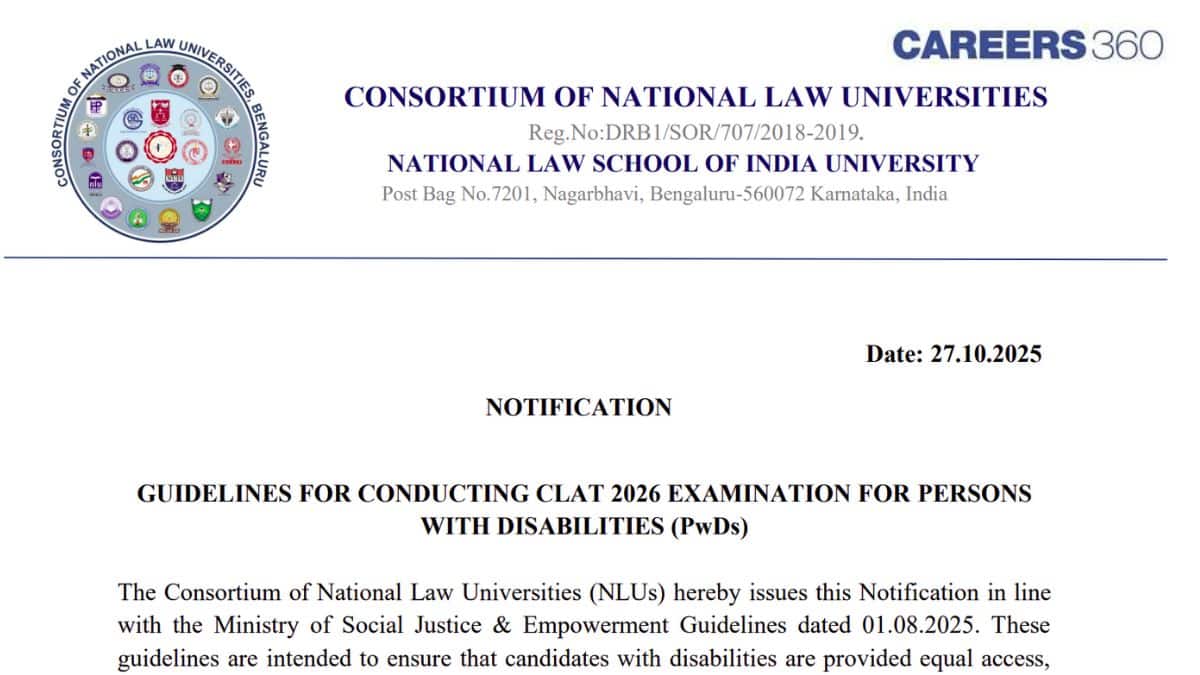
The provisions apply to individuals defined under Section 2(s) of the Rights of Persons with Disabilities (RPwD) Act, 2016. Candidates who face functional limitations in writing, reading, or comprehending due to physical, visual, intellectual, or other disabilities can avail support as certified by a competent authority. Moreover, those who acquire a disability after form submission can also claim reasonable accommodations upon producing valid medical documentation.
As per the new guidelines, eligible candidates will be entitled to special accommodations, including compensatory time, scribe/ reader/ lab assistant, use of technological aids, and access to barrier-free examination centres. Requests for specific assistance apart from scribe requests made through the application form must be emailed to the Consortium at least ten days before the exam.
To promote independent participation, PwD candidates will be encouraged to use technology-based tools such as screen-reading software, magnification tools, voice recognition software, and recording devices. However, they may opt for a scribe if preferred. Candidates can either bring their own scribe or request one from the Consortium’s approved panel.
Eligibility for using a scribe is extended to candidates with blindness, locomotor disabilities, cerebral palsy, or other specified conditions verified by a medical board. Even candidates with disabilities below 40% can avail a scribe if medically certified. The qualification norms for scribes ensure impartiality UG CLAT scribes must be two to three academic years below the exam level, while PG CLAT scribes must not be law or humanities students.
The guidelines also introduce compensatory time of 20 minutes per hour, meaning candidates will get 40 extra minutes for the 2 hour CLAT exam, regardless of whether they use a scribe. All certifications must adhere to formats prescribed by the Ministry of Social Justice & Empowerment and be issued by a government medical board.
The Consortium of NLUs has further committed to ensuring accessible exam centres with ramps, lifts, wide corridors, signage, wheelchairs, audio announcements and ground-floor seating for candidates with mobility challenges. Separate rooms will be arranged for candidates using scribes or those with neurodiverse or chronic health conditions. Medical staff will also be available at centres for emergency assistance.
To uphold transparency and privacy, candidates’ disability data will be securely handled under the Digital Personal Data Protection Act, 2023 and the RPwD Act, 2016. A Grievance Redressal Committee will address complaints related to accessibility, scribe arrangements, or compensatory time.
Through these comprehensive measures, the Consortium reaffirms its dedication to conducting CLAT 2026 in full compliance with the Rights of Persons with Disabilities Act, 2016- ensuring dignity, equality, and fairness for every aspirant.
CLAT registration 2026 is currently underway. Candidates can fill out the application form for CLAT until October 31, 2025. The CLAT 2026 exam date is December 7, 2025 from 2 pm to 4 pm.

On Question asked by student community
Hello Student,
Here are the Careers360 CLAT 2027 Mock Test Resources for your exam preparation.
1. Online CLAT Mock Test
2. CLAT Mock Tests and Solutions
Hello student,
CLAT 2027 aspirants can access these monthly current affairs compilations for regular revision. Use these resources to stay updated with important events and topics for CLAT 2027.
|
Particular |
Download PDF |
|
CLAT Current Affairs- August Month (2026) |
|
|
CLAT Current Affairs- |
If you have only two months, use a highly structured plan: daily current affairs, English reading, legal reasoning practice, logical reasoning sets, basic quantitative practice and regular full-length mocks. Spend as much time analysing incorrect questions as taking the mock itself. Consistency during these two months can make a substantial
You can download the CLAT previous years' question papers from here:
https://law.careers360.com/articles/clat-previous-year-question-papers
https://law.careers360.com/download/clat-sample-papers-previous-years
For CLAT 2027 UG, candidates need to have passed Class 12/equivalent with at least 45% marks, or 40% for SC/ST/PwD candidates.
In your situation, having an RT in an additional subject but subsequently passing the required qualification through an improvement examination does not automatically make you ineligible. However, the important

Ranked #18 amongst Institutions in India by NIRF | Get Upto 100% Scholarships | Spot Admissions via CUET
Ranked 1 st among Top Law Schools of super Excellence in India - GHRDC | NAAC A+ Accredited | #36 by NIRF
NAAC A++ Accredited | Ranked #11 by NIRF
Bar Council of India (BCI) approved | Accredited by LAWASIA | Ranked 13th , among the Best Law Colleges (Private) in India by IIRF
Free Ebook - CLAT 2025 English Language questions with detailed solutions
Stay updated with current affairs & check your preparation with the CLAT General Knowledge Mock Tests Ebook