
Search Colleges, Exams, Schools & more


Login
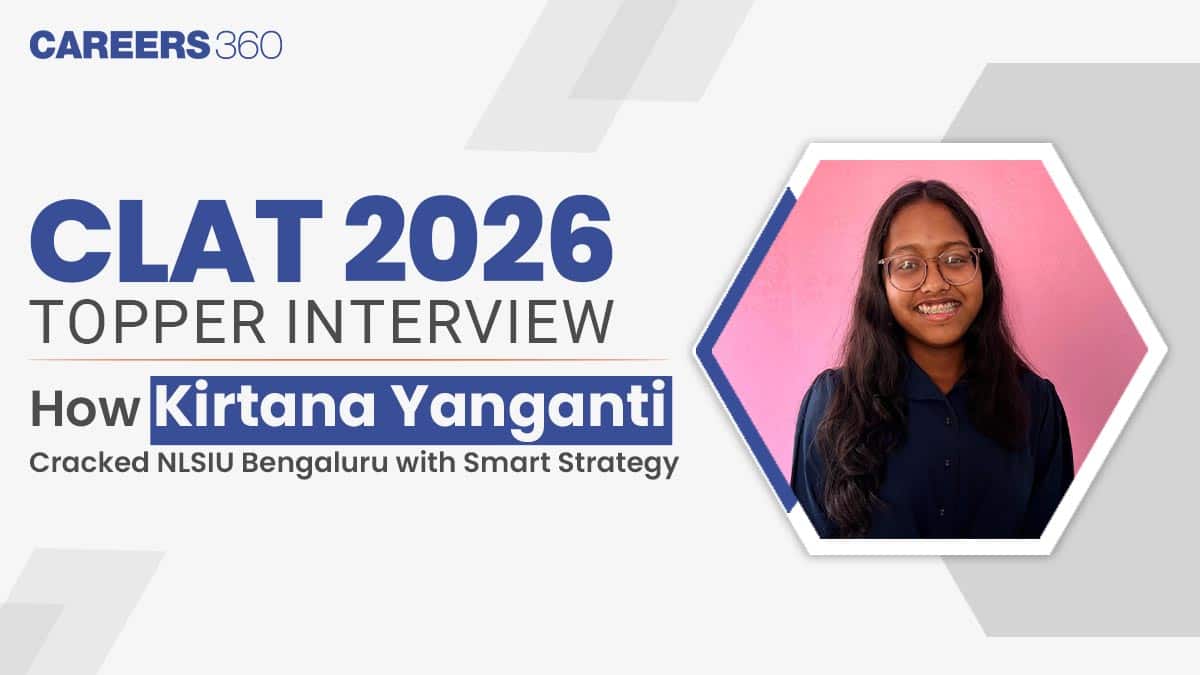
CLAT 2026 Topper Interview - How Kirtana Yanganti Cracked NLSIU Bangalore with Smart Strategy
Switch to

Switch to
It was a moment of immense joy for Kirtana Gajanan Yanganti when the CLAT 2026 results were declared on December 16. She secured an impressive All India Rank (AIR) 96 and OBC AIR 3 in the examination, marking a proud milestone for her and her family. Adding to this achievement, Kirtana also secured admission to the National Law School of India University (NLSIU), Bengaluru, the country’s top-ranked law school, in the first round of CLAT 2026 seat allotment. Yanganti says she was inclined towards social studies, and she felt choosing law as a field of study would give her all the opportunities to pursue what is her eventual dream. Careers360 got in an exclusive chat with CLAT 2026 topper Kirtana Gajanana Yanganti to get deep insights into her preparation plan, preferred study resources, advice for future CLAT aspirants and more. Below are some excerpts from the conversation.
Careers360: Hi, congratulations on getting a good AIR in CLAT 2026! What was the feeling when you first saw your rank? What were your expectations from the CLAT 2026 results?
Kirtana: Thank you! I remember the day we got the CLAT 2026 results, December 16. I was extremely nervous the entire day, and the results were declared at around 7:30 PM. I was chatting with my friends when I received a Telegram notification that the results were out. I logged into my account and checked my result—AIR 96. To be honest, it didn’t hit me immediately how big an achievement it was. It takes a few days to understand the weight of a double-digit rank finally.
Careers360: Tell us more about yourself, your educational background, the place you belong to, and your family background.
Kirtana: I am Kirtana Yanganti. I am currently studying in the 12th standard at Fattechand Jain Vidyalaya in Pune, Maharashtra, in the commerce stream. I completed my earlier education at Alphonsa High School, where I scored 93% in my Class 10 examinations. I have an older sister who is pursuing BHMS, and my father is an engineer.
Careers360: What motivated you to appear in CLAT 2026? When did your interest in law develop, and what are your future aspirations?
Kirtana: I wouldn’t say that I have always been inclined towards the humanities; I have always been a curious child who enjoys exploring different areas of interest. I started looking for a field that could bring together all my interests and qualities, and law fit perfectly. I discovered my passion for social studies in the 9th grade and have also been an avid reader. I realised that studying law could give me opportunities far beyond those offered by any other field of study.
Careers360: What colleges and courses are you targeting with this rank? In which college did you get a seat in the first CLAT allotment?
Kirtana: I got into NLSIU Bengaluru for the BA LL.B programme in the first allotment list.
Careers360: Coming to your preparation, how and when did you start preparing for CLAT? What motivated you to pursue legal studies?
Kirtana: I started my CLAT preparation immediately after my Class 10 board examinations. I began by familiarising myself with the exam pattern and understanding the requirements of the exam. I also started reading the newspaper daily to improve my vocabulary and quantitative skills.
My love for law, genuine curiosity, and interest in the subjects I was studying motivated me. I believe no external motivation is required when you choose a field that genuinely interests you.
Careers360: Did you take any coaching for CLAT preparation? How important do you think coaching is for CLAT preparation?
Kirtana: Yes, I did take coaching for my CLAT preparation. I was part of LegalEdge Toprankers for nearly 6–7 months towards the end of my preparation, through an online mode.
Coaching is very subjective, in my opinion. A student may or may not require coaching. What a coaching institute does is provide aspirants with the required resources and guide them in streamlining their preparation. Coaching personally helped me a lot. I did not have to look for resources or worry about following the wrong approach, as I had a mentor who guided me throughout and corrected me whenever I made mistakes.
Careers360: What was your daily preparation routine? How many hours did you dedicate to each section and overall CLAT preparation?
Kirtana: My daily preparation routine was task-based rather than hour-based. I had a specific list of tasks to complete each day, whether it took a couple of hours or eight hours. I planned my daily tasks based on my strengths and weaknesses identified in previous mocks. If I struggled with a particular topic or section, I included more practice for that area in my weekly tasks. Current affairs and reading were non-negotiable daily tasks.
My fixed daily tasks included current affairs updates, newspaper reading, revising GK, and practising one sectional test. Beyond that, I worked on areas identified through mock analysis.
Careers360: Which section of the CLAT exam did you find the most challenging?
Kirtana: The trickiest section for me was definitely GK, including current affairs. It took me some time to get comfortable with this section since I hadn’t been very interested in current affairs during my school years. I eventually managed to score well by sticking to a limited number of resources and revising them multiple times.
Careers360: What are the important subjects and topics one must cover for CLAT preparation?
Kirtana: One must cover the basics of all sections—English, Logical Reasoning, Legal Reasoning, Quantitative Techniques, and General Knowledge, including current affairs.
For English, reading a wide range of genres is important. Building vocabulary by noting down new words and using them in daily conversations also helps.
For Logical Reasoning, it is important to clear basic Critical Reasoning concepts like assumptions, inferences, and conclusions, as well as Analytical Reasoning topics such as coding-decoding, blood relations, and puzzles. Practice is key.
For Legal Reasoning, one should have a basic understanding of commonly asked concepts from Contract Law, Law of Torts, Criminal Law, and Constitutional Law, but without going into excessive detail. Regular reading of recent judgments and legal articles also helps.
For Quantitative Aptitude, topics studied up to Class 10 are sufficient. Revise concepts like ratio and proportion, percentages, interest, and speed–time–distance, and practise caselet-based questions.
For GK and current affairs, daily newspaper reading and consistent revision of a single compendium are crucial.
Careers360: Tell us about the subject-wise books or study materials you followed for CLAT preparation.
Kirtana: For English, there is no specific book that guarantees improvement in reading comprehension. I preferred practising through PYQs and mock tests.
For Logical Reasoning, I used the Manhattan GMAT book for Critical Reasoning and coaching material for Analytical Reasoning. MK Pandey can also be referred to.
For Quantitative Aptitude, I relied on YouTube playlists and mocks for practice.
For GK, I used CLAT Post+ by LegalEdge, Parcham Classes on YouTube, and The Indian Express.
For Legal Reasoning, I primarily used coaching material, as other resources were too lengthy for CLAT preparation.
Careers360: In the legal aptitude section, the Consortium says that prior knowledge of law is not required. What was your experience?
Kirtana: Although the Consortium mentions that prior knowledge of law is not required, I believe that having some familiarity with legal concepts and vocabulary helps significantly, especially given the limited time of 120 minutes for 120 questions. This year, we also had some static legal GK questions in the Legal Reasoning section, so staying updated with legal knowledge is beneficial.
Careers360: How did you prepare for current affairs, including legal current affairs? Is it necessary to read newspapers daily?
Kirtana: I watched daily GK videos by Parcham Classes on YouTube as my one-liner source. I also read The Indian Express daily to stay updated with current affairs.
Additionally, I revised the CLAT Post compendium multiple times. Whenever I came across an unfamiliar topic, I researched it using UPSC websites and made notes.
Careers360: Did you solve sample papers and mock tests? How important are mock tests for CLAT preparation?
Kirtana: Yes, I solved nearly 90–100 mock tests, along with the sample papers provided by the Consortium. Mock tests are extremely important, as they help identify weaknesses, improve time management, and refine strategy. However, over-reliance on mocks is not advisable. Giving one to two mocks per week is sufficient. Analysing mocks is more important than attempting them. I maintained a mock analysis notebook to track and correct my mistakes continuously.
Careers360: With the revised paper pattern, is CLAT still a lengthy exam? What was your time-management strategy on the exam day?
Kirtana: I don’t believe CLAT is a lengthy paper if one manages time well. On exam day, I skimmed through the paper initially to check for any new question patterns. I then followed my usual order—Legal, Logical, GK, English, and QT. I skipped doubtful legal questions initially and ensured extra time for Logical Reasoning, as it included Analytical Reasoning. I had about 15 minutes left at the end, which I used to attempt remaining questions. Time management improves with consistent practice.
Careers360: What other law entrance exams did you appear for apart from CLAT? How did they go?
Kirtana: I appeared for AILET 2026 and secured AIR 262 and OBC Rank 27.
Careers360: Any tips or suggestions for CLAT aspirants appearing next year?
Kirtana: My only tip for CLAT 2027 aspirants would be to keep working hard and believe in themselves. It won’t be an easy journey, but it will be worth it when you see your rank on the screen. Stick to your strategy, analyse mocks regularly, and trust the process. All the best!
Articles
Related Stories
|
Upcoming Law Exams

Certifications By Top Providers
Explore Top Universities Across Globe
Popular Courses and Specializations
Popular Degrees
List of colleges accepting CLAT
Browse Law Colleges by State
Questions related to CLAT
On Question asked by student community
Have a question related to CLAT ?
Hello Student,
Here are the Careers360 CLAT 2027 Mock Test Resources for your exam preparation.
1. Online CLAT Mock Test
2. CLAT Mock Tests and Solutions
Hello student,
CLAT 2027 aspirants can access these monthly current affairs compilations for regular revision. Use these resources to stay updated with important events and topics for CLAT 2027.
CLAT 2027 Current Affairs - Monthly Compilations
|
Particular |
Download PDF |
|
CLAT Current Affairs- August Month (2026) |
|
|
CLAT Current Affairs- |
If you have only two months, use a highly structured plan: daily current affairs, English reading, legal reasoning practice, logical reasoning sets, basic quantitative practice and regular full-length mocks. Spend as much time analysing incorrect questions as taking the mock itself. Consistency during these two months can make a substantial
You can download the CLAT previous years' question papers from here:
https://law.careers360.com/articles/clat-previous-year-question-papers
https://law.careers360.com/download/clat-sample-papers-previous-years
For CLAT 2027 UG, candidates need to have passed Class 12/equivalent with at least 45% marks, or 40% for SC/ST/PwD candidates.
In your situation, having an RT in an additional subject but subsequently passing the required qualification through an improvement examination does not automatically make you ineligible. However, the important

Applications for Admissions are open.
Ranked #18 amongst Institutions in India by NIRF | Get Upto 100% Scholarships | Spot Admissions via CUET
Woxsen University, Hyderabad
ApplyScholars’ Round Deadline: 14th Nov’26 | Earn upto 50% merit Scholarship + 10% for top performers | EFMD Accredited | AACSB (USA) & AMDISA Member | Highest CTC 28 LPA
Unitedworld School of Law, Karnavati University, Gandhinagar
ApplyMoot Court | Mock trials | Legal Aid Clinic | Recruiting Partners: FICCI, TCS, Adani, Trilegal, and many others
Chitkara University
ApplyNAAC A+ Accredited University
Parul Institute of Law, Vadodara
ApplyBA LLB, BBA LLB, or BCom LLB and LLB | LLM 1 Year – 4 Specializations | Approved by BCI | Highest CTC 9 LPA
Institute of Law, Nirma University, Ahmedabad
ApplyGrade 'A+' Accredited by NAAC | Ranked 33rd in India by NIRF
CLAT Notifications
Never miss CLAT update
Get timely CLAT updates directly to your inbox. Stay informed!