ICFAI University Sikkim Law Admissions 2026
Approved by BCI


The Law of Torts is a crucial component of the CLAT 2027 Legal Reasoning section, frequently appearing in both direct and application-based questions. Over the years, CLAT Previous year papers have repeatedly tested students on foundational tort principles, essential maxims, landmark judgments, and classic factual situations involving negligence, nuisance, defamation, and strict liability.
This Story also Contains
Since Torts is one of the most predictable and scoring areas of the CLAT 2027 Legal Reasoning section, understanding recurring patterns and high-frequency concepts becomes vital for effective CLAT preparation. This article compiles the most commonly asked tort law principles, important doctrines, and frequently tested case scenarios based on PYQs, enabling aspirants to strengthen their legal reasoning skills and boost their performance in the Common Law Admission Test (CLAT).
The CLAT Legal Reasoning is also a very integral part of the syllabus. This subject too has weightage in the entire exam. Roughly, there will be around 32 questions from CLAT 2027 Legal Reasoning. In the past few years, Tort Law has been a topic that has been repeated every time. There are around one or two passages each year from Tort Law. Given below throws light on the CLAT Tort Law Questions in previous (2021-2025) years and expected topics for the upcoming session.
Read the following passage and answer the given questions.
The remoteness of damage is an interesting principle. Once the damage is caused by a wrong, there have to be liabilities. The question is how much liability can be fixed, and what factor determines it. The principle of the Remoteness of Damages is relevant to such cases. An event constituting a wrong can constitute of single consequence or may constitute of consequence i.e. series of acts/wrongs. The damage may be proximate or might be remote, or too remote.
In law, the damage must be direct and the natural result of the consequence of the act of the defendant. Otherwise, the plaintiff will not succeed. This is In jure non-remota causas ed proxima spectatur (In law the immediate, not the remote cause of any event that is to be considered). The reason for this is that the defendant is presumed to have intended the natural consequences, but not the remote damage. It means then that the defendant's act must be the Causa Causans or the proximate (near) cause.
Novus actus interveniens: (new act intervening): The act and the consequences are to be connected directly and the defendant will not be liable for Novus actus interveniens and the consequences thereof.
The Test of Reasonable Foresight: If the consequences of a wrongful act could be foreseen by a reasonable man, then they are not too remote. If on the other hand, a reasonable man could not have foreseen the consequences, then they are too remote. And, an individual shall be liable only for the consequences which are not too remote i.e. which could be foreseen.
The Test of Directness: According to the test of directness, a person is liable for all the direct consequences of his wrongful act, whether he could foresee them or not; because consequences which directly follow a wrongful act are not too remote.
The test of reasonable foresight means that the liability of the defendant extends only to those consequences, which could have been foreseen by a reasonable man. This theory was rejected in 1921, and the second theory was applied in re Polemis and Furnace Ltd case. In this case, D chartered P's vessel to carry cargo which included petrol. Some cases were leaking and there were vapors of petrol. D's servants while shifting cargo negligently knocked at a plank which fell rubbing the wood and got ignited. As a result, the entire vessel caught fire and was destroyed. Held, D was liable. It was due to the negligence of D's servants that the fire had broken out and hence D was liable for all the consequences, even though those could not reasonably have been anticipated.
Question: 1
A’s car met with an accident with B’s bike due to which B’s leg got amputated and there was a lot of blood loss. One C was passing from there on his bike. After witnessing this horrific site he becomes unconscious and met with an accident. Decide.
A. A is liable for both the accidents
B. B is responsible for C’s accident
C. A is responsible for B’s accident but not C’s accident
D. A is not responsible for any accident.
Answer – (c)
Reason: As per the question, it may be assumed that in the car accident, there may be a chance of grievous injuries, due to which A will be held liable for B’s accident. A will not be held liable for C’s accident by applying the test of Reasonable Foresight, according to which a prudent man will not assume that any person met with an accident by seeing the accident sight of another person. Hence, option c is correct.
Question: 2
M’s ship was carrying fuel from Russia at Kandla Port, due to the negligence of M’s staff a huge amount of oil spilled into the sea.
Y is the owner of the shipyard, 200 KM far from the Kandla Port. Due to the high tides in the sea, oil spillage reached near the shipyard too, it catches fire due to welding work that was going on there. Y sues M for the damages. Decide.
A. M will compensate Y for the damages
B. The staff of M will compensate Y for the damages
C. The government will compensate Y
D. M cannot be made liable to pay the compensation in this case
Answer- (d)
Reason- The given factual situation is similar to the Landmark case of Wagon Mound, in which the court held that the loss of the plaintiff (here Y) is not the direct consequence of the defendant’s act (here M) but it is unforeseeable nature so there is no liability on the defendant M.
Hence option (d) is correct.
Question: 3
J a bus driver was picking up children from the school, just nearby the school, another bus was coming behind the bus and a lorry of one K was coming from another side. When two buses have been passed. One child ran to cross the road and got hit by K’s lorry. Decide.
A. J is responsible for not taking care of children by letting them crossroad alone
B. The Child was responsible for the accident, he suddenly ran without taking precautions
C. K’s lorry is responsible for the accident as he should drive carefully around school buses
D. K’s lorry is not responsible for the accident due to the remoteness of damages
Correct option: (c)
Reasoning – According to the test of directness, a person is liable for all the direct consequences of his wrongful act. In the given situation, the person driving the lorry shall take care while driving, especially nearby school. K’s lorry is responsible for the accident. Hence Option (c) is correct.
Question: 4
A pushes ‘B’ into a pit that ‘C’ dug two days ago for collecting rainwater. ‘B’ fall into the pit and has suffered several injuries. ‘B’ files a tort suit against ‘A’ and ‘C’ for damages. Decide.
A. A is liable for the offence
B. C is liable for the offence
C. A and C both are liable for offence
D. No one would be liable for the remoteness of damages.
Answer – (a)
Reason - The Suit for damages is maintainable against ‘A’ but not against ‘C’ because ‘A’s act has a direct relation with the injuries of ‘B’ but not against ‘C’ which is barred by applying the doctrine of remoteness of damages. Only A would be held liable here. Hence option (a) is correct
Question: 5
D, the worker of the railway company left the heap of fresh-cut grass on the Railway line. The grass caught fire and ash spread up to the house of E, which was at a distance of 200 yards. E sued the railway company for compensation. Decide.
A. D is liable for the loss
B. Railway Company is respondent superior and cannot be made liable for the loss.
C. No one would be liable, due to remoteness
D. No one would be liable because no one intentionally lit the fire.
Answer – (a)
Reason- D is liable for the loss because the damage is a direct consequence of the act. The given factual situation is a similar case of Smith V/s. London and South Western Rail Company, in which defence of remoteness was not allowed by the court, and an employee of the railway company was held liable for the loss. Hence, option (a) is correct.
Year | Total Tort Questions | Negligence Questions | Defamation Questions | Strict Liability Questions | Other Principles Questions | Percentage Weightage |
2021 | 6Q | 2 | 1 | - | 3 | 33% Negligence |
2022 | 5Q | 1 | 2 | - | 2 | 34% Defamation |
2023 | 7Q | 1 | - | 1 | 5 | 15% Trespass |
2024 | 4Q | - | - | 1 | 3 | 18% Vicarious Liability |
2025 | 5Q | 2 | - | 2 | 1 | 35% Strict Liability |
Here’s a structured breakdown of how just three core tort law principles—Negligence, Defamation, and Strict Liability—cover nearly 70% of CLAT tort questions (2021–2025):
Significance: Negligence is one of the most frequently tested principles in tort law. It revolves around the breach of a duty of care that results in harm to another person.
Why it's important: It applies to a wide range of scenarios, from accidents to medical malpractice, making it a fundamental principle for CLAT exams.
Aspect | Details |
Weightage | ~23% (2021–2025) |
Definition | Breach of a duty of care resulting in harm |
Example | A doctor leaves a surgical tool in a patient’s body. |
Exam Relevance | Frequently tested in real-life accident or malpractice scenarios. |
Significance: Defamation law is often tested in questions related to damage to reputation through false statements. It covers both slander and libel.
Why it's important: Defamation cases often appear in the context of freedom of speech, making it crucial for understanding the balance between reputation and expression.
Aspect | Details |
Weightage | ~22% (2021–2025) |
Definition | False statement damaging someone’s reputation (slander/libel). |
Example | A newspaper falsely claims a politician is corrupt. |
Exam Relevance | Balances freedom of speech vs the right to reputation. Common in media-related passages. |
Significance: Strict liability involves holding a defendant liable for harm caused by their actions, even if there was no intention to harm or negligence involved.
Why it's important: It applies to dangerous activities, such as using hazardous materials or keeping wild animals, and is commonly tested in multiple-choice scenarios.
Aspect | Details |
Weightage | ~25% (2021–2025) |
Definition | Liability for harm even without fault or negligence. |
Example | A toxic gas leak occurs despite the owner’s precautions. |
Exam Relevance | Frequently tested with hazardous substances, industries, or wild animals. |
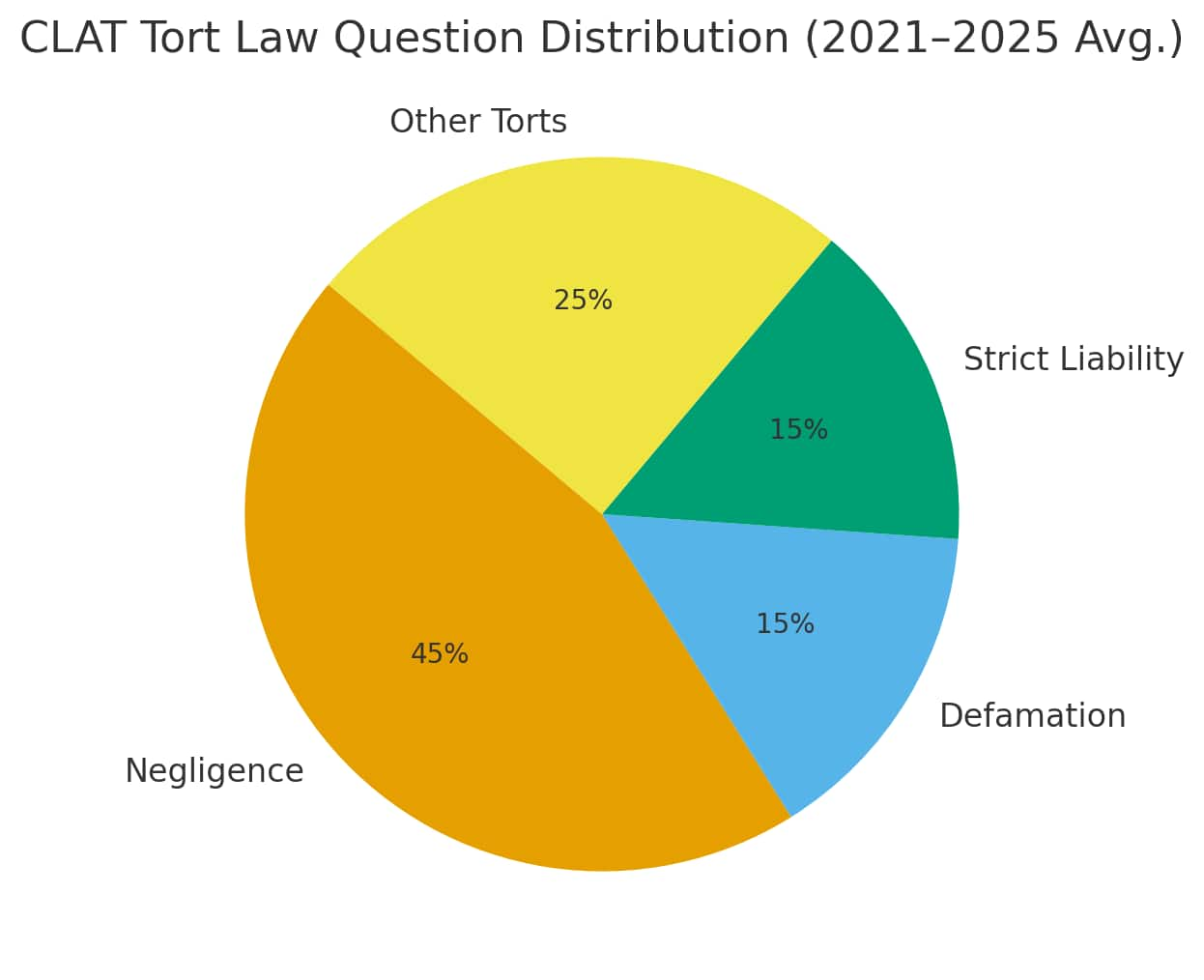
While Negligence, Defamation, and Strict Liability dominate, CLAT occasionally includes 1–2 questions from other tort principles. These appear irregularly but are still worth a quick review.
Principle | Frequency (2021–2025) | Weightage | Example Scenario | Exam Appearance |
Nuisance | 1/5 years | <10% | Factory noise affecting neighbours | Rare |
Vicarious Liability | 1/5 years | ~12% | The employer is liable for the employee’s negligence | Infrequent |
Trespass | 1/5 years | ~8% | Unauthorised entry into land | Rare |
Based on an analysis of previous CLAT papers, it's evident that three core principles in Tort Law cover nearly 70% of the questions asked. These principles are Negligence, Defamation, and Strict Liability. To help you focus your preparation, we have compiled MCQs to practice these high-weightage topics and additional topics. These will help you solidify your knowledge and prepare effectively for the CLAT 2027.

On Question asked by student community
Hello Student,
Here are the Careers360 CLAT 2027 Mock Test Resources for your exam preparation.
1. Online CLAT Mock Test
2. CLAT Mock Tests and Solutions
Hello student,
CLAT 2027 aspirants can access these monthly current affairs compilations for regular revision. Use these resources to stay updated with important events and topics for CLAT 2027.
|
Particular |
Download PDF |
|
CLAT Current Affairs- August Month (2026) |
|
|
CLAT Current Affairs- |
If you have only two months, use a highly structured plan: daily current affairs, English reading, legal reasoning practice, logical reasoning sets, basic quantitative practice and regular full-length mocks. Spend as much time analysing incorrect questions as taking the mock itself. Consistency during these two months can make a substantial
You can download the CLAT previous years' question papers from here:
https://law.careers360.com/articles/clat-previous-year-question-papers
https://law.careers360.com/download/clat-sample-papers-previous-years
For CLAT 2027 UG, candidates need to have passed Class 12/equivalent with at least 45% marks, or 40% for SC/ST/PwD candidates.
In your situation, having an RT in an additional subject but subsequently passing the required qualification through an improvement examination does not automatically make you ineligible. However, the important

Ranked #18 amongst Institutions in India by NIRF | Get Upto 100% Scholarships | Spot Admissions via CUET
Ranked 1 st among Top Law Schools of super Excellence in India - GHRDC | NAAC A+ Accredited | #36 by NIRF
NAAC A++ Accredited | Ranked #11 by NIRF
Bar Council of India (BCI) approved | Accredited by LAWASIA | Ranked 13th , among the Best Law Colleges (Private) in India by IIRF
Free Ebook - CLAT 2025 English Language questions with detailed solutions
Stay updated with current affairs & check your preparation with the CLAT General Knowledge Mock Tests Ebook