School of Law, UPES, Dehradun
Ranked #18 amongst Institutions in India by NIRF | Get Upto 100% Scholarships | Spot Admissions via CUET


The Ministry of Education will publish the NIRF 2026 rankings for law colleges and universities shortly on its website. The NIRF rankings are published every year, and institutes are invited to submit data on five parameters: Teaching, Learning & Resources, Research and Professional Practice, Graduation Outcomes, Outreach and Inclusivity, and Perception. The data is then evaluated and ranked based on the methodology. Each of the five parameters has different weightage and comprises several sub-parameters. Currently, the top 40 law colleges are ranked in the NIRF Law rankings.
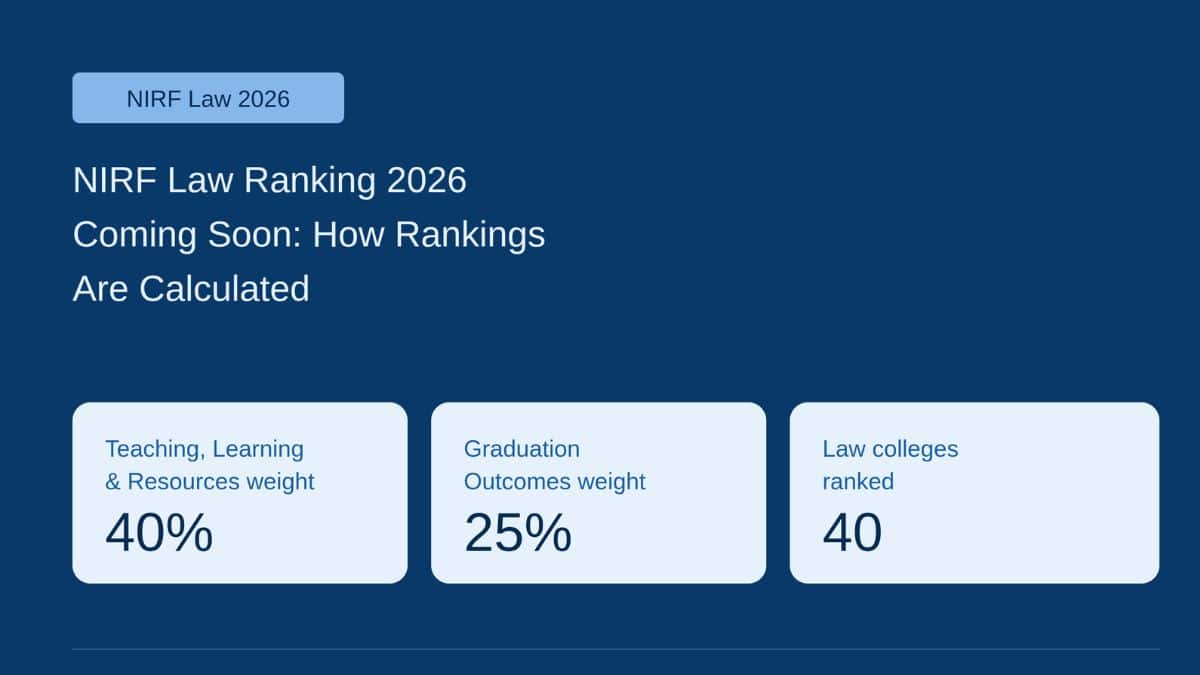
As mentioned above, NIRF rankings are determined by evaluating colleges on five parameters. Teaching, Learning & Resources carries the highest weightage in the NIRF rankings with 40% weightage, followed by Graduation Outcomes with 25% weightage and Research and Professional Practice with 15% weightage. Outreach and Inclusivity and Perception carry 10% weightage each.
The scores of each of the five parameters are calculated separately with proper weightage to submetrics of all parameters. After calculating individual scores of all parameters out of 100, they are adjusted against their weightage in the final NIRF law rankings to calculate their overall score. After the calculation of the overall score, all participating institutes are ranked from highest to lowest overall score.
Ranked #18 amongst Institutions in India by NIRF | Get Upto 100% Scholarships | Spot Admissions via CUET
Scholars’ Round Deadline: 14th Nov’26 | Earn upto 50% merit Scholarship + 10% for top performers | EFMD Accredited | AACSB (USA) & AMDISA Member | Highest CTC 28 LPA
The table below mentions the five parameters and their weightage and marks.
S.No | Parameter | Marks | Weightage |
1 | Teaching, Learning & Resources (TLR) | 100 | 0.40 |
2 | Research and Professional Practice (RP) | 100 | 0.15 |
3 | Graduation Outcomes (GO) | 100 | 0.25 |
4 | Outreach and Inclusivity (OI) | 100 | 0.10 |
5 | Perception (PR) | 100 | 0.10 |
Total | 1.00 |
The Teaching, Learning & Resources component is the most integral part of the NIRF ranking methodology, holding 40% weightage. TLR comprises several sub-metrics such as Student Strength (SS), Faculty-Student Ratio (FSR), Faculty Qualification & Experience (FQE), and Financial Resources & Utilisation (FRU). Each of these sub-metrics has different weightage. The table given below explains the Teaching, Learning and Resources parameter of NIRF Law rankings.
Sub-metric | Marks | What it measures | Key formula or rule |
Student Strength (SS) | 20 | Sanctioned intake, enrolment and doctoral students | SS = f(NT, NE) × 15 + f(NP) × 5 |
Faculty-Student Ratio (FSR) | 30 | Full-time regular faculty relative to students | Expected ratio 1:20 for maximum marks; set to zero if F/N < 1:70 |
Faculty Qualification & Experience (FQE) | 20 | PhD share and experience mix of faculty | FQE = FQ (10) + FE (10) |
Financial Resources & Utilisation (FRU) | 30 | Capital and operational spend per student (law only) | FRU = 7.5 × f(BC) + 22.5 × f(BO) |
Research and Professional Practice (RP) hold 15% weightage in the NIRF law rankings. The submetrics of the RP section include: publications, quality of publications, footprints of projects and professional practice, research funding and consultancy. Publications include the maximum weightage in this section, i.e. 50%. The table given below explains the sub-metrics and calculation formulas for the Research and Professional Practice section:
Sub-metric | Marks | Formula | Data source |
Publications (PU) | 50 | 50 × f(P/FRQ) | Third-party sources |
Quality of Publications (QP) | 30 | 30 × f(CC/P) | Third-party sources |
Footprint of Projects & Professional Practice (FPPP) | 20 | FPR + FPC | Institution (prescribed format) |
Research funding (FPR) | 10 | 10 × f(RF) | Institution |
Consultancy (FPC) | 10 | 10 × f(CF) | Institution |
Graduation Outcomes holds ¼ of the total weightage for NIRF law rankings. This parameter comprises submetrics like placements and higher studies, university examinations, median salary, PhD graduates, etc. Each of the sub-metrics has a specified weightage and marks calculation formula. The table given details out the Graduation Outcomes parameter of NIRF law rankings.
Sub-metric | Marks | Formula | What it captures |
Placement & Higher Studies (GPH) | 40 | 40 × (Np/100 + Nhs/100) | Graduates placed plus those selected for higher studies, previous three years |
University Examinations (GUE) | 15 | 15 × min[(Ng/80), 1] | Share of intake passing in the stipulated time, three-year average; 80% is the benchmark |
Median Salary (GMS) | 25 | 25 × f(MS) | Median salary of UG/PG graduates, previous three years |
PhD Graduates (GPHD) | 20 | 20 × f(Nphd) | Average number of PhDs awarded over three years |
The Outreach and Inclusivity parameter holds 10% weightage in the NIRF law rankings. This parameter holds less weightage but has crucial sub-metrics like regional diversity, women's diversity, and economically & socially challenged students and physically challenged students. Like other parameters, this comprises 100 marks and contributes 10% to the overall NIRF law rankings. The table given below explains the Outreach and Inclusivity parameter in detail.
Sub-metric | Marks | Formula | Benchmark or basis |
Region Diversity (RD) | 30 | 25 × fraction from other states + 5 × fraction from other countries | Other states weighted more heavily than other countries |
Women Diversity (WD) | 30 | 15 × (NWS/50) + 15 × (NWF/20) | 50% women students, 20% women faculty |
Economically & Socially Challenged Students (ESCS) | 20 | 20 × f(Nesc) | Percentage of UG students receiving full tuition reimbursement |
Physically Challenged Students (PCS) | 20 | Full marks for full facilities, else proportional | Verifiable responses to questions |
The perception parameter of NIRF law rankings mainly comprises surveying employers, professionals from reputed organisations, and academics regarding preference for graduates from different institutes. This parameter also comprises 100 marks but holds only 10% weightage in the final NIRF law rankings.
The data that decides the NIRF law rankings is collected from multiple sources. Talking about the most high-weightage parameter - Teaching, Learning & Resources- all the data is given by institutes in the prescribed format. For Research and Professional Practice, publications and quality of publications data are collected from third-party resources. The footprint of projects & professional practice data are provided by the institute in the prescribed format. Graduation Outcomes (GO) and Outreach & Inclusivity (OI) are also provided completely by the institutes in the prescribed format. Data for the Perception parameter is collected through a survey of a large category of employers, professionals from reputed organisations, and academics.

On Question asked by student community
Hello Student,
Here are the Careers360 CLAT 2027 Mock Test Resources for your exam preparation.
1. Online CLAT Mock Test
2. CLAT Mock Tests and Solutions
Hello student,
CLAT 2027 aspirants can access these monthly current affairs compilations for regular revision. Use these resources to stay updated with important events and topics for CLAT 2027.
|
Particular |
Download PDF |
|
CLAT Current Affairs- August Month (2026) |
|
|
CLAT Current Affairs- |
If you have only two months, use a highly structured plan: daily current affairs, English reading, legal reasoning practice, logical reasoning sets, basic quantitative practice and regular full-length mocks. Spend as much time analysing incorrect questions as taking the mock itself. Consistency during these two months can make a substantial
You can download the CLAT previous years' question papers from here:
https://law.careers360.com/articles/clat-previous-year-question-papers
https://law.careers360.com/download/clat-sample-papers-previous-years
For CLAT 2027 UG, candidates need to have passed Class 12/equivalent with at least 45% marks, or 40% for SC/ST/PwD candidates.
In your situation, having an RT in an additional subject but subsequently passing the required qualification through an improvement examination does not automatically make you ineligible. However, the important

Ranked #18 amongst Institutions in India by NIRF | Get Upto 100% Scholarships | Spot Admissions via CUET
Scholars’ Round Deadline: 14th Nov’26 | Earn upto 50% merit Scholarship + 10% for top performers | EFMD Accredited | AACSB (USA) & AMDISA Member | Highest CTC 28 LPA
Moot Court | Mock trials | Legal Aid Clinic | Recruiting Partners: FICCI, TCS, Adani, Trilegal, and many others
NAAC A+ Accredited University
BA LLB, BBA LLB, or BCom LLB and LLB | LLM 1 Year – 4 Specializations | Approved by BCI | Highest CTC 9 LPA
Grade 'A+' Accredited by NAAC | Ranked 33rd in India by NIRF