Amity Law School, Noida
Experiential Learning through Legal Aid Camps, Lok Adalats, Court Visits, Community Lawyering and regular Moot Court sessions


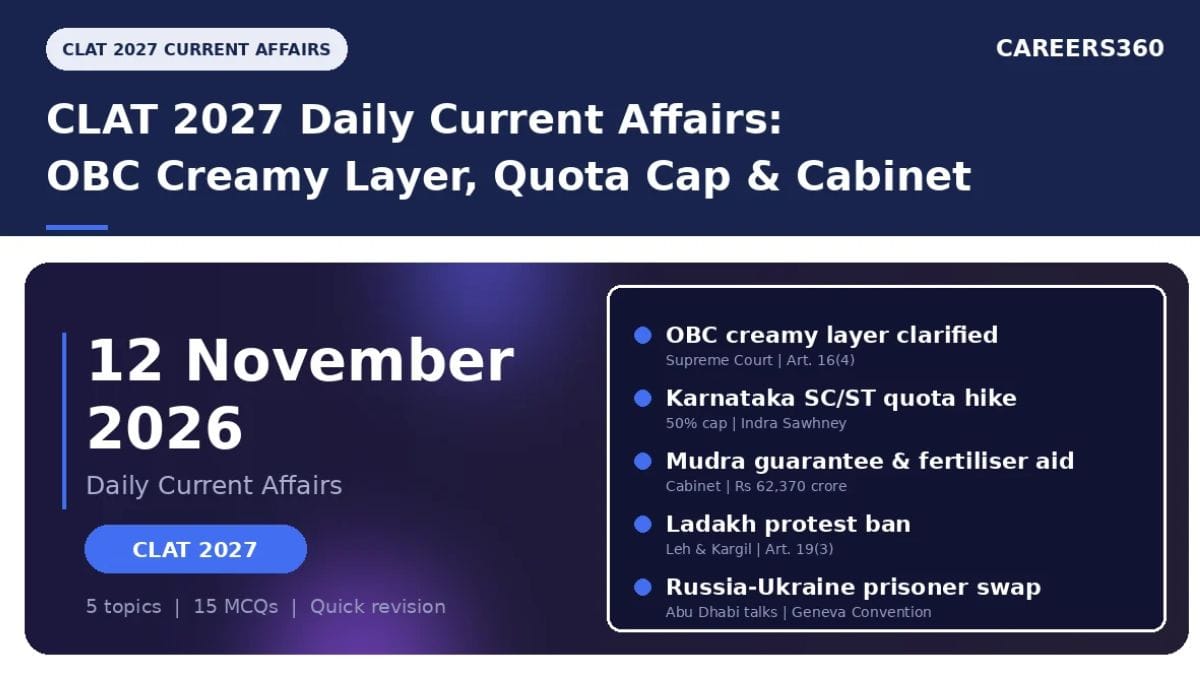
Today's CLAT 2027 current affairs cover five important topics from law, economy, national affairs and international relations. These include the Supreme Court's clarification on the OBC creamy layer, Karnataka's challenge to the SC/ST quota hike, two Union Cabinet decisions, a protest ban in Ladakh ahead of local polls and the latest Russia-Ukraine talks. These topics are relevant to the CLAT 2027 exam, particularly for legal reasoning, current affairs and general knowledge. Key facts, important legal provisions and practice MCQs are included to help aspirants understand the issues and test their preparation.
In the news: On November 6, the Supreme Court reaffirmed its March 11, 2026 ruling that a parent's salary or agricultural income alone cannot determine whether an OBC candidate falls under the creamy layer. The parent's post and service status must also be considered. The Centre had sought clarity on how the ruling applies to Civil Services candidates.
A Bench of Justices P.S. Narasimha and R. Mahadevan said past selections, appointments and promotions need not be reopened. However, pending claims must be decided on merit. The ruling will apply to service allocation for CSE 2025. The Court gave the Centre two more months to review posts but refused its request for a two-year extension.
Creamy layer: The better-off section of an OBC community that is excluded from reservation benefits.
Status-based test: The parent's post and service status matter. Salary alone cannot decide creamy layer status.
Office Memorandum: An official government instruction. A later clarification cannot add a new condition that was absent from the original rule.
Prospective effect: Past appointments remain undisturbed, while pending cases can be decided under the legal principle.
Article 16(4): Allows reservation in public employment for backward classes that are not adequately represented.
Q1. What did the Supreme Court say about deciding an OBC candidate's creamy layer status?
A. Only the parent's salary matters
B. Only agricultural income matters
C. The parent's post and service status must also be considered
D. All government employees belong to the creamy layer
Answer: C
Q2. Why did the Court refuse to reopen completed appointments and promotions?
A. To protect settled appointments and avoid disrupting past decisions
B. Because the creamy layer rule no longer applies
C. Because the Centre has final authority over all appointments
D. Because the earlier judgment was withdrawn
Answer: A
Q3. The ruling will apply to service allocation for which Civil Services Examination?
A. CSE 2022
B. CSE 2023
C. CSE 2024
D. CSE 2025
Answer: D
Attempt Free Official Practice Test & Solutions and Ace the CLAT Exam 2026
In the news: Karnataka has moved the Supreme Court against the High Court's decision to strike down its increase in SC reservation from 15% to 17% and ST reservation from 3% to 7%. On October 12, the High Court ruled that the hike was constitutionally impermissible as it took total reservation to 56%, crossing the 50% limit set by the Supreme Court in 1992. It struck down Sections 3 and 4 of the 2022 Act.
Karnataka's current reservation matrix provides 15% for SCs, 3% for STs and 32% for OBCs. The Chief Minister's Office said the State would continue asking the Centre to place the law in the 9th Schedule. It also said the 6% SC/ST backlog quota was protected when recruitment for 56,432 posts was allowed in February 2026.
50% reservation cap: The Supreme Court set this limit in the Indra Sawhney judgment (1992). It can be crossed only in exceptional circumstances.
Special Leave Petition (SLP): Under Article 136, a party can ask the Supreme Court for permission to appeal against a court or tribunal's decision.
Ultra vires: A law or government action that goes beyond the powers given by the Constitution.
9th Schedule: Created under Article 31B to protect certain laws from legal challenges. However, laws added after April 24, 1973, can be reviewed if they violate the Constitution's basic structure.
Articles 15(4) and 16(4): Allow special provisions and reservation for backward classes in education and public employment, respectively.
Scholars’ Round Deadline: 14th Nov’26 | Earn upto 50% merit Scholarship + 10% for top performers | EFMD Accredited | AACSB (USA) & AMDISA Member | Highest CTC 28 LPA
BA LLB, BBA LLB, or BCom LLB and LLB | LLM 1 Year – 4 Specializations | Approved by BCI | Highest CTC 9 LPA
Q1. Which Supreme Court judgment set the general 50% ceiling on reservation?
A. Kesavananda Bharati
B. Indra Sawhney
C. Maneka Gandhi
D. Minerva Mills
Answer: B
Q2. Can a law placed in the 9th Schedule be challenged in court?
A. No, it has complete protection
B. Only the President can challenge it
C. Yes, if it violates the basic structure of the Constitution
D. No, the 9th Schedule has no legal effect
Answer: C
Q3. Karnataka's reservation hike took the total quota to 56%. What was the main legal issue?
A. It crossed the general 50% reservation limit
B. States cannot make reservation laws
C. SC and ST communities cannot receive reservation
D. Reservation is allowed only in Central government jobs
Answer: A
In the news: The Union Cabinet extended the Credit Guarantee Fund for Micro Units (CGFMU) until March 2031 and approved a Rs 5,000 crore corpus. The fund will support PM Mudra Yojana loans worth Rs 12.6 lakh crore by covering lenders against default risks. Since the scheme began, over 60.36 crore loans worth Rs 43.34 lakh crore have been sanctioned.
The Cabinet also approved a Rs 62,370.02 crore fertiliser subsidy for the 2026-27 Rabi season, Rs 24,417.73 crore more than the previous Rabi budget. Including Kharif 2026, subsidy spending has crossed Rs 1 lakh crore against a budget of Rs 54,000 crore. Higher urea and LNG prices following the Iran war have added to the cost.
Credit guarantee: The government covers part of a lender's loss if a borrower fails to repay. This encourages banks to provide loans without asking for collateral.
MSMEs: Micro, Small and Medium Enterprises are important sources of jobs and economic activity.
Subsidy: Financial support from the government that reduces the cost of goods or services, such as fertilisers for farmers.
Collective responsibility: Under Article 75(3), the Union Council of Ministers is collectively responsible to the Lok Sabha.
Fiscal impact: Higher government spending on subsidies can put pressure on the fiscal deficit.
Q1. What is the main purpose of a credit guarantee fund for micro units?
A. To give free money to every borrower
B. To protect lenders against default risks and encourage loans without collateral
C. To replace banks and financial institutions
D. To fix the prices of all goods
Answer: B
Q2. Under which Article is the Union Council of Ministers collectively responsible to the Lok Sabha?
A. Article 74
B. Article 75(3)
C. Article 78
D. Article 112
Answer: B
Q3. If fertiliser prices rise and the government wants to keep them affordable for farmers, what is likely to happen?
A. Government subsidy spending may increase
B. The fiscal deficit will automatically disappear
C. Farmers will no longer need fertilisers
D. Government spending will remain unaffected
Answer: A
In the news: The Chief Electoral Officer of Ladakh has banned protests, rallies, dharnas and similar gatherings within the municipal limits of Leh and Kargil. The restriction will remain in force until the local body elections, scheduled from November 21 to December 4, are completed. The order cites the Model Code of Conduct and aims to prevent voters from facing intimidation or undue influence.
The ban comes as civil society groups plan to restart protests over their demands, including renewed talks with the Centre and postponement of hill council elections. District Election Officers and Superintendents of Police have been asked to ensure that the order is followed.
Model Code of Conduct (MCC): Guidelines issued by the Election Commission for political parties and candidates during elections. It is not a law passed by Parliament.
Free and fair elections: An important part of democracy and the basic structure of the Constitution.
Article 19(1)(b): Gives citizens the right to assemble peacefully without weapons.
Article 19(3): Allows reasonable restrictions on peaceful assembly in the interest of public order and India's sovereignty and integrity.
Proportionality: A restriction on a fundamental right should not be excessive. It must be reasonable and serve a valid purpose.
Q1. Which fundamental right is directly affected by a ban on protests and rallies?
A. Right to freedom of religion
B. Right to assemble peacefully under Article 19(1)(b)
C. Right to education
D. Right to constitutional remedies
Answer: B
Q2. Under Article 19(3), the State can impose reasonable restrictions on peaceful assembly on which ground?
A. Public order
B. Political convenience
C. Personal preferences of officials
D. Economic competition
Answer: A
Q3. A government imposes a complete ban on protests for several weeks. What would a court most likely examine?
A. Whether the restriction is reasonable and proportionate to its purpose
B. Whether protesters support the ruling party
C. Whether the protesters are government employees
D. Whether the order was issued on a working day
Answer: A
In the news: Russia and Ukraine have agreed in principle to a major prisoner exchange after two days of US-mediated talks in Abu Dhabi. However, the discussions made no major progress towards ending the war, which began with Russia's full-scale invasion nearly five years ago. It was the first meeting between the two delegations in nine months.
Key disputes remain over security guarantees, Russian-occupied Ukrainian territory and the role of European countries. US envoys are expected to travel to Moscow to meet President Vladimir Putin and then to Dublin for talks with Ukrainian President Volodymyr Zelenskyy.
Prisoners of war (POWs): Members of armed forces captured during an armed conflict. Their treatment is protected under the Third Geneva Convention.
Repatriation: The process of returning prisoners of war to their home country. POWs must be released and sent home after active hostilities end.
Mediation: A neutral third party helps countries or groups negotiate. The mediator cannot force them to accept a settlement.
Article 2(4) of the UN Charter: Prohibits countries from using or threatening force against another country's territorial integrity or political independence.
Article 33 of the UN Charter: Calls on countries involved in a dispute to first seek peaceful solutions, such as negotiation, mediation and arbitration.
Q1. Which international agreement mainly deals with the treatment of prisoners of war?
A. Vienna Convention on Diplomatic Relations
B. Third Geneva Convention
C. Paris Agreement
D. UN Convention on the Law of the Sea
Answer: B
Q2. What is the role of a mediator in an international conflict?
A. To impose a decision on both countries
B. To help the countries reach an agreement through talks
C. To take control of the countries' governments
D. To command the armed forces of both countries
Answer: B
Q3. Russia and Ukraine agree to a prisoner exchange 'in principle'. What does this mean?
A. The exchange has already been completed
B. Both sides agree to the proposal, but the details are yet to be finalised
C. All disputes between the countries have ended
D. The agreement applies to every country in the world
Answer: B
The key facts and important updates from all five topics are given below for quick revision before the Common Law Admission Test.
OBC creamy layer: A parent's salary alone cannot decide creamy layer status; the parent's post and service status also matter.
CSE 2025: The Supreme Court ruling will apply to service allocation.
Karnataka reservation: State moves Supreme Court against the High Court order striking down the SC/ST quota hike.
CGFMU: Credit guarantee fund extended until March 2031 with a Rs 5,000 crore corpus.
Fertiliser subsidy: Rs 62,370.02 crore approved for the 2026-27 Rabi season.
Ladakh elections: Protests banned in Leh and Kargil ahead of local polls from November 21 to December 4.
Russia-Ukraine: Both countries agree in principle to a prisoner exchange after Abu Dhabi talks.
Yuge Yugeen Bharat Museum: CCEA clears the Rs 3,230 crore project in the North and South Blocks.

On Question asked by student community
Hello Miruthula,
For CLAT PG 2027, you need to focus on the core subjects of your LLB curriculum, particularly the following:
Constitutional Law
Jurisprudence
Administrative Law
Law of Contract
Law of Torts
Family Law
Criminal Law
Property Law
Company Law
Public International Law
Tax Law
Environmental Law
Labour and Industrial
Hello Student,
The full form of the CLAT exam is the Common Law Admission Test. You can check the link related to the CLAT exam
https://law.careers360.com/articles/what-is-clat-full-form-all-about-nlus-entrance-exam
Hello Student,
Here are the Careers360 CLAT 2027 Mock Test Resources for your exam preparation.
1. Online CLAT Mock Test
2. CLAT Mock Tests and Solutions
Hello student,
CLAT 2027 aspirants can access these monthly current affairs compilations for regular revision. Use these resources to stay updated with important events and topics for CLAT 2027.
|
Particular |
Download PDF |
|
CLAT Current Affairs- August Month (2026) |
|
|
CLAT Current Affairs- |
If you have only two months, use a highly structured plan: daily current affairs, English reading, legal reasoning practice, logical reasoning sets, basic quantitative practice and regular full-length mocks. Spend as much time analysing incorrect questions as taking the mock itself. Consistency during these two months can make a substantial

Experiential Learning through Legal Aid Camps, Lok Adalats, Court Visits, Community Lawyering and regular Moot Court sessions
Ranked #18 amongst Institutions in India by NIRF | Get Upto 100% Scholarships | Spot Admissions via CUET
Scholars’ Round Deadline: 14th Nov’26 | Earn upto 50% merit Scholarship + 10% for top performers | EFMD Accredited | AACSB (USA) & AMDISA Member | Highest CTC 28 LPA
BA LLB, BBA LLB, or BCom LLB and LLB | LLM 1 Year – 4 Specializations | Approved by BCI | Highest CTC 9 LPA
Grade 'A+' Accredited by NAAC | Ranked 33rd in India by NIRF
Moot Court | Mock trials | Legal Aid Clinic | Recruiting Partners: FICCI, TCS, Adani, Trilegal, and many others