
Search Colleges, Exams, Schools & more


Login
From Literature to Law Felt Like a Natural Next Step: Meet NLSIU’s NLSAT 2026 AIR 1 Mehak Ahmed
'It felt like a natural next step.' — That's how Mehak Ahmed describes her transition from studying English Literature at Delhi University to topping the National Law School Admission Test (NLSAT) 2026. In just nine months, the Hindu College alumna scored 113.25 marks and a 99.85 percentile, securing AIR 1 and a seat at NLSIU Bengaluru. Corporate law is the immediate goal, but Ahmed hasn't ruled out a future in academia. Teaching and research, she says, have 'always appealed' to her. Beyond the rank, Ahmed hopes her journey becomes proof that a humanities background isn't a disadvantage in law.
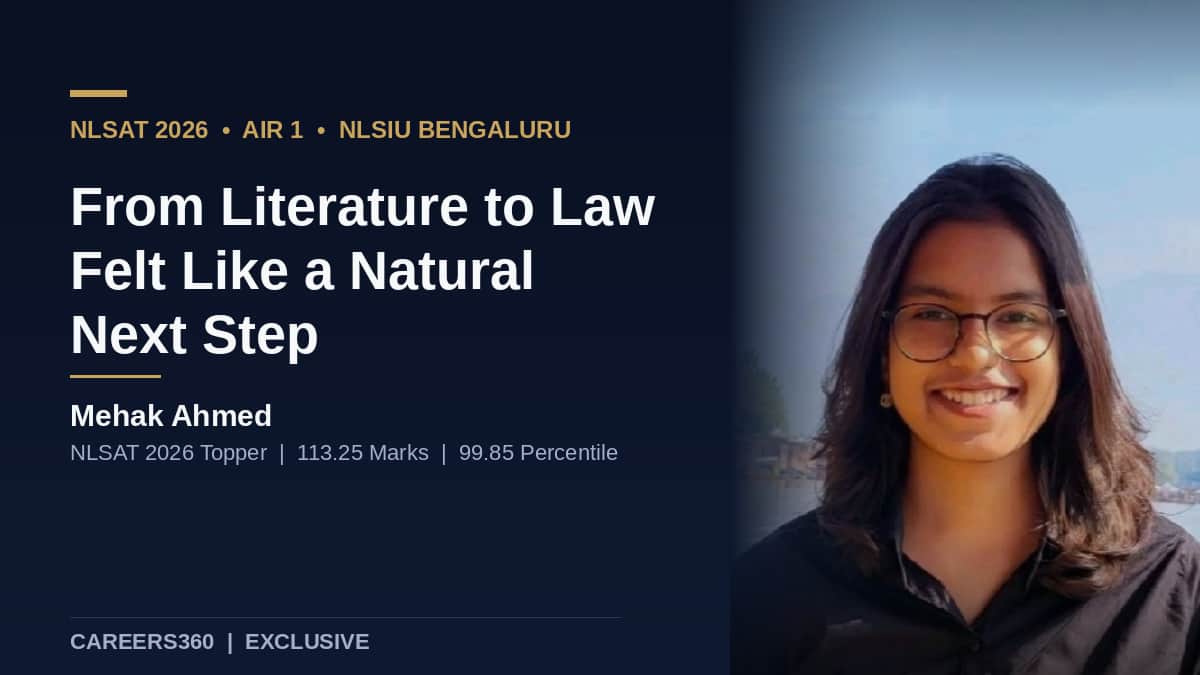
Talking to Careers360, the NLSAT 2026 AIR 1 discussed her prep journey, plans, transition from English Literature to law and more. Below are some excerpts from the exclusive conversation.
Careers360: Congratulations on AIR 1 in NLSAT 2026! When did you start preparing, and how long was your full prep journey?
Mehak: Thank you so much! I had known for a while that I wanted to sit for NLSAT, but my serious preparation began in June 2025, so my full prep journey was around eight to nine months.
Careers360: How did you structure your study plan — daily hours, weekly targets, subject-wise split?
Mehak: Since I was also doing my undergraduate degree at the time, I studied for about two to three hours every day. My routine included reading the newspaper daily, along with practising one set of Reading Comprehension and one set of Critical Reasoning questions each day. Every alternate day, I would write either a Legal Reasoning answer or an Analytical Essay to keep my writing skills sharp. I also made it a point to track current affairs through online websites and maintained active notes on important developments. Weekends were reserved for taking a mock test or sectional tests and revising everything I had covered through the week.
Careers360: Which section did you struggle with most initially, and what specific strategy turned it into a strength?
Mehak: I initially struggled with writing argumentatively, both for Legal Reasoning and the Analytical Essay. To work on this, I started studying how newspaper editorials and opinion pieces were structured and how writers built and supported their arguments and used that to develop a structure of my own. This gave far more clarity and coherence to my answers over time.
Careers360: How many mock tests did you take, and how did you use mock analysis to fix weak areas?
Mehak: I took around 25 mock tests in total. To analyse my performance, I maintained an Excel sheet where I recorded my score for each section along with the specific areas where I had gone wrong. I would then revisit and work on those concepts before the next mock, which helped me track my progress consistently.
Careers360: What books, sources, or newspapers did you rely on for current affairs and legal reasoning?
Mehak: For current affairs, I relied primarily on The Indian Express, along with a couple of websites such as The Print and The Wire, and GK compendiums for quick revision. There is no shortage of resources available online, but I made a conscious choice to stick to a few reliable sources and follow them diligently rather than spreading myself thin.
Careers360: Did you take coaching or prepare largely on your own — and what would you tell aspirants weighing that choice?
Mehak: I did take coaching from the National Law Training Institute. That said, I believe this exam can absolutely be cracked through self-preparation as well. What coaching genuinely helped me with was getting constructive, structured feedback on my Part B answers and that feedback loop improved the quality of my writing exponentially. So, for aspirants weighing this choice, I'd say coaching isn't mandatory, but if you do opt for it, make sure it's giving you real feedback on your written answers, not just syllabus coverage.
Careers360: How did you revise in the final weeks before the exam, and did your strategy change as the exam date approached?
Mehak: In the final weeks, I went back over the current affairs notes I had compiled over the previous months and revisited the GK compendiums. I also attempted many sectional tests for Reading Comprehension and Critical Reasoning. My strategy did shift slightly closer to the exam; the focus moved from learning new material to consolidating what I already knew, testing myself repeatedly through sectionals and mocks, and targeting my remaining weak spots.
Careers360: Where did you complete your prior UG degree, and what made you decide to pursue law through NLSAT afterwards?
Mehak: I completed my undergraduate degree in English Literature from Hindu College, Delhi University. Studying literature trained me to read closely, question interpretations, and construct arguments, and somewhere along the way, I realised these were essentially the same skills that law demands, just applied to a different text and a different stake. My pivot to law came from that growing interest in how language, argumentation, and interpretation translate directly into legal reasoning and advocacy. Law felt like a natural next step where I could put that analytical and communicative training to real-world use, and that realisation is ultimately what led me to NLSAT.
Careers360: Where do you see your legal career heading — litigation, corporate law, judiciary, academia, or policy?
Mehak: At this point, I see myself heading primarily into corporate law. I've always been drawn to the commercial and transactional side of legal practice. It feels like a space where legal reasoning meets real-world business strategy, and that combination is what excites me most about the path ahead. That said, I do keep an open mind about academia as well; teaching and research have always appealed to me, and I wouldn't rule out coming to that space at some point down the line, even as I build my footing in corporate law first.
Careers360: Do you already have specialization areas in mind for your law degree, and any early thoughts on an LLM further down the line?
Mehak: I haven't zeroed in on a specific specialization yet; I'd like to keep an open mind through law school and let my interests guide that choice. I do, however, know that I want to pursue an LLM at some point further down the line.
Careers360: What long-term goal or impact do you hope to achieve through a career in law?
Mehak: Ultimately, I want my work to translate into real, tangible value, whether that means strengthening sound governance and legal practice in whatever field I end up in, or simply being someone people can trust for sound legal judgment. But beyond the professional milestones, I'd like my journey to mean something for others coming up behind me. I want to be able to mentor and guide future aspirants the way I was guided during my own preparation. If a student from a humanities or literature background looks at my journey and feels a little less intimidated by law as a career path, I'd consider that its own kind of impact.
Articles
Related Stories
|
Upcoming Law Exams

Certifications By Top Providers
Explore Top Universities Across Globe
Popular Courses and Specializations
Popular Degrees
Popular Branches
List of colleges accepting NLSAT
Browse Law Colleges by State

Applications for Admissions are open.
Ranked #18 amongst Institutions in India by NIRF | Get Upto 100% Scholarships | Spot Admissions via CUET
Woxsen University, Hyderabad
ApplyScholars’ Round Deadline: 14th Nov’26 | Earn upto 50% merit Scholarship + 10% for top performers | EFMD Accredited | AACSB (USA) & AMDISA Member | Highest CTC 28 LPA
KCC Institute of Legal and Higher Education, Greater Noida
ApplyLaw Admissions 2026 Open | Avail Merit-Based Scholarships
SRM School of Law, Kattankulathur
ApplyNAAC A++ Accredited | Ranked #11 by NIRF
School of Law and Governance, Vishwakarma University, Pune
ApplyLaw Admissions Open 2026 | #2nd in India by The World University Rankings for Innovation | 200+ Collaborations | 700+ Industry Recruiters
WPU School of Law, Pune
ApplyLaw Application Open 2027 | International Students from 30 countries | Merit-Based Scholarship worth Rs. 50 Crores | 100,000+ Alumni Globally.
NLSAT Notifications
Never miss NLSAT update
Get timely NLSAT updates directly to your inbox. Stay informed!