
Search Colleges, Exams, Schools & more


Login
AIBE 22 Important Judgments: 70+ Landmark Case Laws Asked in Previous Year Papers

Important judgments are landmark Supreme Court decisions that have shaped how courts interpret the Constitution and various laws in India. These judgments help determine how legal principles are understood and applied by courts. The Bar Council of India (BCI) includes questions based on important judgments in the All India Bar Examination (AIBE 22), with around 6–8 questions generally focusing on landmark case law.
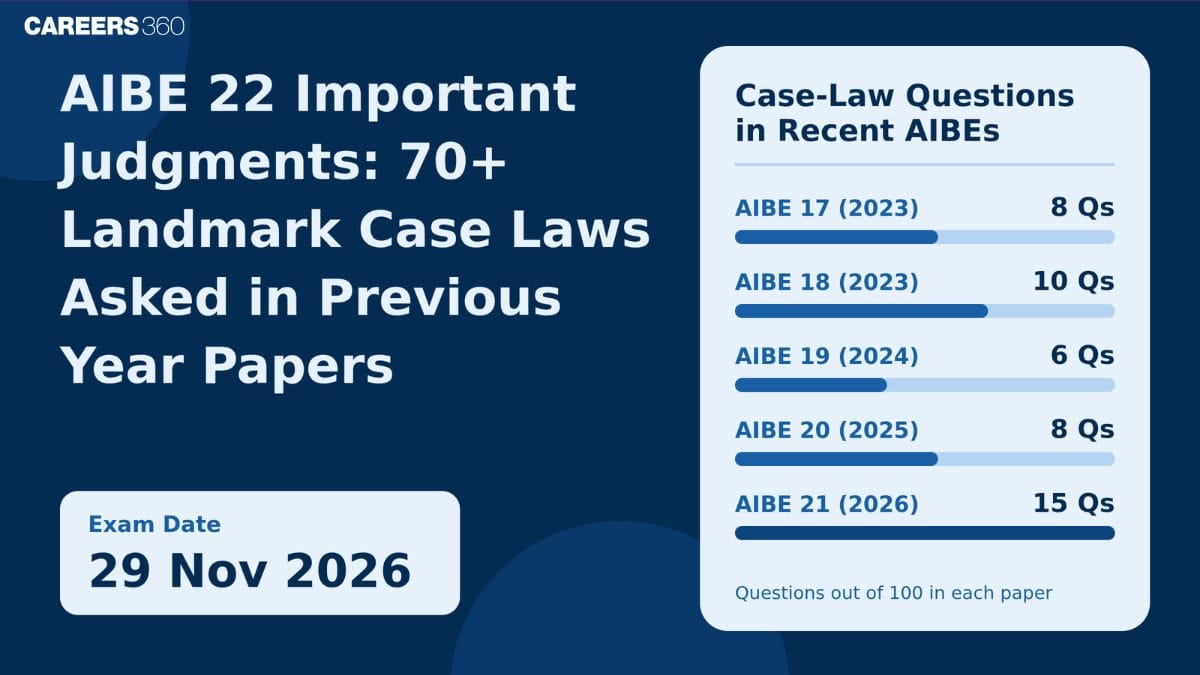
The AIBE 22 exam, scheduled for November 29, 2026, will consist of 100 multiple-choice questions (MCQs) from 19 different subjects. Candidates will get 3 hours and 30 minutes to complete the examination. These subjects include Constitutional Law, Criminal Law, Contract Law, Family Law, and other important areas. Candidates preparing for AIBE 22 should focus on landmark judgments from these subjects, as understanding important case laws is essential for AIBE 22 exam preparation.
AIBE 22 Important Judgments PDF: Download Case Law Study Sheet
AIBE 22 aspirants can download the important judgments PDF to revise landmark Supreme Court cases in one place. AIBE 22 aspirants can use this PDF for quick revision and to strengthen their understanding of important case laws before the AIBE exam.
AIBE 22 Important Judgments PDF: Download Case Law Study Sheet | Download Free PDF Here |
CLAT 2027 Target - Second Mock Test
CLAT 2027 Official Mock Test By NLU Consortium
Attempt Free Official Practice Test & Solutions and Ace the CLAT Exam 2026
How Many Case Law Questions Are Asked in AIBE?
The table below gives the paper-wise count and its share of the 100-question paper, so you can see how much revision time judgments deserve.
Year | Exam | Case-law questions | Share of paper | Weightage band |
2015 | AIBE VIII | 11 | 11% | High |
2017 | AIBE X | 9 | 9% | Medium |
2018 | AIBE XIII | 5 | 5% | Low |
2019 | AIBE XIV | 7 | 7% | Low |
2021 | AIBE XV | about 17 | about 17% | High |
2021 | AIBE XVI | about 10 | about 10% | Medium |
2023 | AIBE XVII | 8 | 8% | Medium |
2023 | AIBE XVIII | 10 (11 asked, 1 dropped) | 10% | Medium |
2024 | AIBE XIX | 6 | 6% | Low |
2025 | AIBE XX | 8 | 8% | Medium |
2026 | AIBE XXI | 15 | 15% | High |
Important Case Laws and Judgments Asked in Previous AIBE Exams
These topics are mostly asked in exams like CLAT PG. Hence, aspirants must read them carefully.
Topics | Important Case Laws |
Fundamental Rights – Landmark cases explaining the scope and protection of fundamental rights. | 1. Maneka Gandhi v. Union of India (1978) 2. K.S. Puttaswamy v. Union of India (2017) 3. Navtej Singh Johar v. Union of India (2018) |
Constitutional Amendments – Cases explaining Parliament's power to amend the Constitution and the limitations on this power. | 1. Kesavananda Bharati v. State of Kerala (1973) 2. Minerva Mills v. Union of India (1980) |
Reservation and Equality – Judgments dealing with equality, reservation policies and equal opportunities. | 1. Indra Sawhney v. Union of India (1992) 2. M. Nagaraj v. Union of India (2006) |
Criminal Law and Investigation – Cases addressing procedural safeguards and individual rights during criminal investigations. | 1. D.K. Basu v. State of West Bengal (1997) 2. Lalita Kumari v. Government of Uttar Pradesh (2013) |
Women's Rights – Landmark judgments concerning women's dignity, equality, rights and protection. | 1. Vishaka v. State of Rajasthan (1997) 2. Mohd. Ahmed Khan v. Shah Bano Begum (1985) |
Environmental Protection – Cases promoting environmental conservation and the right to a clean and healthy environment. | 1. M.C. Mehta v. Union of India (Multiple Judgments) 2. Vellore Citizens' Welfare Forum v. Union of India (1996) |
Public Interest and Social Welfare – Cases protecting the rights of disadvantaged and marginalised communities. | 1. Olga Tellis v. Bombay Municipal Corporation (1985) 2. Bandhua Mukti Morcha v. Union of India (1984) |
Technology and Digital Rights – Landmark cases addressing freedom of speech and individual rights in the digital space. | 1. Shreya Singhal v. Union of India (2015) |
Common Law Admission Test (CLAT UG) - Previous Year Question Papers with Answer Keys
Get the CLAT UG previous year question papers here
- Free PDF
- Answer Keys
- Instant Access
Subject-Wise Important Supreme Court Judgments for AIBE 22
AIBE 22 aspirants can check the table below for 70+ important Supreme Court judgments from different law subjects. These landmark cases will help students revise important case laws and prepare for the AIBE 22 exam.
Constitutional Law | ||
Case | Year | Key point |
Kesavananda Bharati | 1973 | Basic structure doctrine |
Minerva Mills | 1980 | Judicial review and the balance between FRs and DPSPs are basic structure |
I.R. Coelho | 2007 | Ninth Schedule laws are open to basic structure review |
Maneka Gandhi | 1978 | Arts. 14, 19 and 21 are interlinked; procedure must be fair |
Indra Sawhney | 1992 | 50% reservation cap, creamy layer, no reservation in promotions |
S.R. Bommai | 1994 | Art. 356 is judicially reviewable; secularism is basic structure |
K.S. Puttaswamy | 2017 | Privacy is a fundamental right (the 2018 Aadhaar judgment upheld Aadhaar with limits) |
Navtej Singh Johar | 2018 | Sec. 377 partly struck down |
Joseph Shine | 2018 | Adultery decriminalised |
Shayara Bano | 2017 | Triple talaq unconstitutional |
Shreya Singhal | 2015 | Sec. 66A IT Act struck down |
Vishaka | 1997 | Sexual harassment guidelines |
Olga Tellis | 1985 | Right to livelihood is part of Art. 21 |
Kihoto Hollohan | 1992 | Tenth Schedule valid; Speaker’s decision is reviewable |
SC Advocates-on-Record v. UoI | 2015 | NJAC struck down; collegium stands |
Common Cause | 2018 | Passive euthanasia and living wills |
Anuradha Bhasin | 2020 | Internet restrictions must be proportionate |
Janhit Abhiyan | 2022 | EWS reservation upheld |
Art. 370 abrogation case | 2023 | Abrogation upheld |
Electoral Bonds case | 2024 | Scheme struck down |
State of Punjab v. Davinder Singh | 2024 | Sub-classification of SCs allowed |
Anoop Baranwal | 2023 | Appointment of Election Commissioners |
Criminal Law (CrPC/BNSS, IPC/BNS) | ||
Bachan Singh | 1980 | “Rarest of rare” doctrine for death penalty |
Mithu v. Punjab | 1983 | Mandatory death penalty struck down |
Lalita Kumari | 2014 | FIR mandatory for cognizable offences; preliminary inquiry only in limited cases |
Arnesh Kumar | 2014 | Guidelines against arbitrary arrest |
D.K. Basu | 1997 | Arrest and custody safeguards |
Gurbaksh Singh Sibbia | 1980 | Anticipatory bail |
Sushila Aggarwal | 2020 | Anticipatory bail has no fixed time limit |
Satender Kumar Antil | 2022 | Bail guidelines |
Bhajan Lal | 1992 | Categories for quashing FIRs |
Selvi | 2010 | Involuntary narco-analysis and lie detector tests unconstitutional |
Nandini Satpathy | 1978 | Right against self-incrimination |
Hussainara Khatoon | 1979 | Speedy trial and free legal aid |
Kedar Nath Singh | 1962 | Sedition upheld; Sec. 124A use stayed in S.G. Vombatkere (2022) |
Virsa Singh | 1958 | Test for culpable homicide amounting to murder |
Evidence Act / BSA | ||
Anvar P.V. v. Basheer | 2014 | Sec. 65B certificate for electronic evidence |
Arjun Panditrao Khotkar | 2020 | Reaffirmed the Sec. 65B requirement |
Sharad Birdhichand Sarda | 1984 | Five golden principles of circumstantial evidence |
Hanumant v. State of MP | 1952 | Circumstantial evidence |
Pakala Narayana Swami | 1939 (PC) | Dying declaration |
Laxman v. State of Maharashtra | 2002 | Doctor’s fitness certificate not mandatory for dying declaration |
Pulukuri Kottaya | 1947 (PC) | Discovery under Sec. 27 |
Civil Procedure | ||
Salem Advocate Bar Association | 2005 | CPC amendments upheld |
Kiran Singh v. Chaman Paswan | 1954 | Objections to jurisdiction |
Dhulabhai v. State of MP | 1968 | Principles on bar to civil court jurisdiction |
Contract and Sale of Goods | ||
Mohori Bibee v. Dharmodas Ghose | 1903 | Minor’s agreement is void ab initio |
Satyabrata Ghose v. Mugneeram | 1954 | Frustration under Sec. 56 |
Central Inland Water Transport v. Brojo Nath | 1986 | Unconscionable contracts |
Lalman Shukla v. Gauri Dutt | 1913 | Communication of proposal |
Carlill v. Carbolic Smoke Ball (UK) | 1893 | General offer |
Hadley v. Baxendale (UK) | 1854 | Remoteness of damages |
Family and Personal Law | ||
Shah Bano | 1985 | Maintenance for divorced Muslim women |
Danial Latifi | 2001 | Upheld the 1986 Act, with maintenance beyond iddat |
Vineeta Sharma | 2020 | Daughters are coparceners by birth |
Sarla Mudgal | 1995 | Conversion doesn’t dissolve a Hindu marriage; second marriage is bigamy |
Githa Hariharan | 1999 | Mother as natural guardian |
Revanasiddappa | 2011 | Children of void/voidable marriages can claim parents’ property |
Arbitration | ||
BALCO | 2012 | Part I doesn’t apply to foreign-seated arbitrations |
Vidya Drolia | 2020 | Arbitrability test |
TRF Ltd. | 2017 | Ineligible person can’t nominate an arbitrator |
Perkins Eastman | 2019 | Unilateral appointment of sole arbitrator invalid |
In Re: Interplay | 2023 | Unstamped arbitration agreement is not void |
Environment | ||
M.C. Mehta (Oleum Gas) | 1987 | Absolute liability |
Vellore Citizens’ Welfare Forum | 1996 | Precautionary principle, polluter pays, sustainable development |
Subhash Kumar | 1991 | Pollution-free environment is part of Art. 21 |
T.N. Godavarman | 1996 onwards | Forests; continuing mandamus |
Administrative Law and Professional Ethics | ||
A.K. Kraipak | 1969 | Natural justice applies to administrative action |
Tata Cellular | 1994 | Limits of judicial review in contracts |
Harish Uppal | 2003 | Lawyers cannot strike |
Bar Council of India v. A.K. Balaji | 2018 | Foreign law firms and lawyers |
R.D. Saxena v. Balram Prasad Sharma | 2000 | Advocate’s lien on client’s papers |
Vinay Chandra Mishra | 1995 | Contempt by an advocate |
AIBE questions on landmark judgments are usually direct: know the case, the provision and the holding, and the marks are yours. Revise this list regularly, test yourself without looking at the table, and map the criminal law cases to the new BNS, BNSS and BSA sections. All the best for AIBE 22!
Articles
Related Stories
|
Upcoming Law Exams

Certifications By Top Providers
Explore Top Universities Across Globe
Popular Courses and Specializations
Popular Degrees
List of colleges accepting CLAT
Browse Law Colleges by State
Questions related to CLAT
On Question asked by student community
Have a question related to CLAT ?
Hello Student,
You can refer to the following Careers360 resources to study Law of Contracts for CLAT Legal Reasoning:
Contract Law – Chapter-wise Study Material:
https://www.careers360.com/legal-studies/contract-law-chapter-pge
Contract Law and Tort Basics for CLAT 2027:
https://law.careers360.com/articles/contract-law-and-tort-basics-for-clat-2027-legal-reasoning
Hello Lavina,
For CLAT 2028 preparation, students should choose an online coaching programme that offers comprehensive study material, regular mock tests, current affairs updates, doubt-solving sessions and expert guidance. Compare course features, faculty experience and student reviews before selecting a coaching programme.
Hello Miruthula,
For CLAT PG 2027, you need to focus on the core subjects of your LLB curriculum, particularly the following:
-
Constitutional Law
-
Jurisprudence
-
Administrative Law
-
Law of Contract
-
Law of Torts
-
Family Law
-
Criminal Law
-
Property Law
-
Company Law
-
Public International Law
-
Tax Law
-
Environmental Law
-
Labour and Industrial
Hello Student,
The full form of the CLAT exam is the Common Law Admission Test. You can check the link related to the CLAT exam
https://law.careers360.com/articles/what-is-clat-full-form-all-about-nlus-entrance-exam
Hello Student,
Here are the Careers360 CLAT 2027 Mock Test Resources for your exam preparation.
1. Online CLAT Mock Test
2. CLAT Mock Tests and Solutions

Applications for Admissions are open.
Ranked #18 amongst Institutions in India by NIRF | Get Upto 100% Scholarships | Spot Admissions via CUET
School of Law, Jain University, Bangalore
ApplyNAAC A++ Approved | Curriculum Aligned with BCI & UGC
Woxsen University, Hyderabad
ApplyUG Scholar's Round Deadline: 1st Dec'26 | Earn upto 50% merit Scholarship + 10% for top performers | Highest CTC 18 LPA
Institute of Law, Nirma University, Ahmedabad
ApplyGrade 'A+' Accredited by NAAC | Ranked 33rd in India by NIRF
Unitedworld School of Law, Karnavati University, Gandhinagar
ApplyMoot Court | Mock trials | Legal Aid Clinic | Recruiting Partners: FICCI, TCS, Adani, Trilegal, and many others
Manav Rachna University, Faridabad
ApplyNAAC A++ Accredited | Avail up to 100% scholarship via MRNAT-Manav Rachna National Aptitude Test
CLAT Notifications
Never miss CLAT update
Get timely CLAT updates directly to your inbox. Stay informed!