School of Law, UPES, Dehradun
Ranked #18 amongst Institutions in India by NIRF | Get Upto 100% Scholarships | Spot Admissions via CUET


October 2026 saw several important developments in India’s legal and constitutional landscape. The Supreme Court and High Courts addressed questions on internet access, freedom of speech, reservation, recruitment, arbitration, property rights, criminal justice, privacy, digital safety and the administration of justice. This has made October 2026 a key month for CLAT 2027 aspirants.
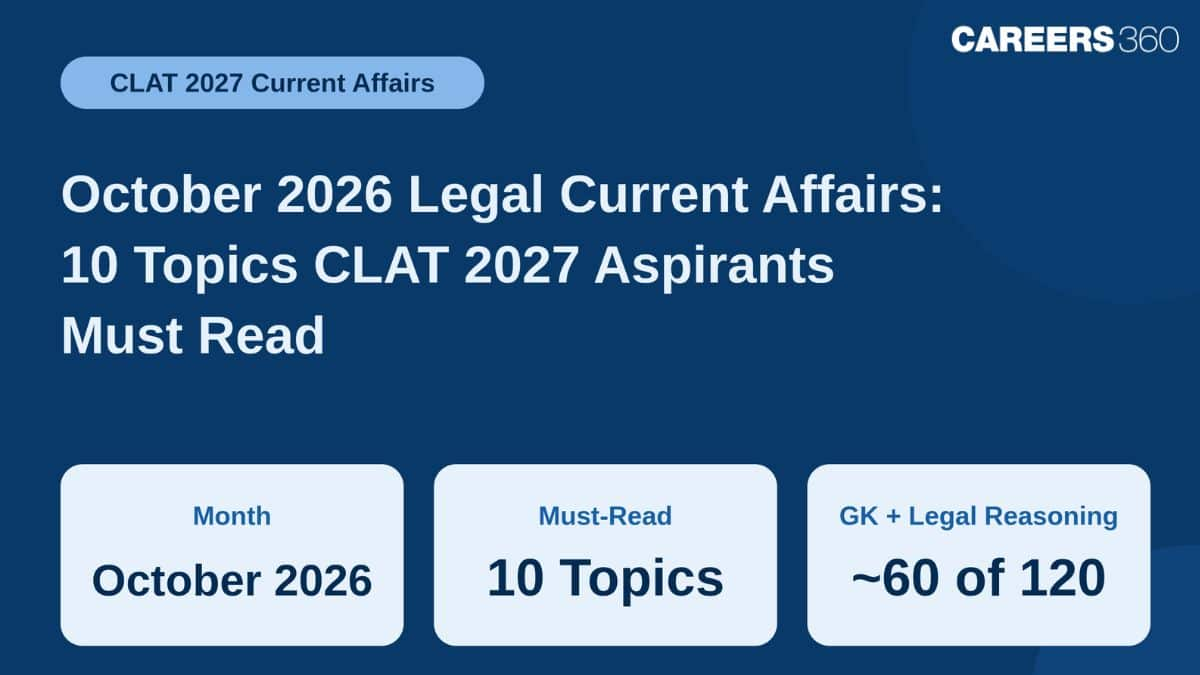
About 50% of the CLAT 2027 question paper covers CLAT 2027 current affairs, General Knowledge and Legal Reasoning. Out of 120 questions, roughly 60 come from these two sections, so staying updated can make a real difference to your score. This article highlights the 10 October 2026 legal current affairs topics that CLAT 2027 aspirants should read for CLAT 2027 preparation. Each topic is explained along with the legal or constitutional principle behind it, so you can revise quickly and connect real events to CLAT-style questions.
October 2026 was an important month for constitutional law, criminal justice, digital rights and public administration. Key court decisions looked at individual liberty versus government regulation, the limits of legislative power, property protection, children’s rights and the independence of the judicial process.
Ranked #18 amongst Institutions in India by NIRF | Get Upto 100% Scholarships | Spot Admissions via CUET
Scholars’ Round Deadline: 14th Nov’26 | Earn upto 50% merit Scholarship + 10% for top performers | EFMD Accredited | AACSB (USA) & AMDISA Member | Highest CTC 28 LPA
In the news: In Just Rights for Children Alliance v. S. Harish, the Supreme Court examined the right to access the internet alongside children’s online safety. It linked internet access to freedom of speech under Article 19(1)(a) and personal liberty under Article 21. The Court also supported a National Hash and URL Database to help identify and remove child sexual abuse material from digital platforms.
What should CLAT 2027 aspirants know?
Article 19(1)(a) protects freedom of speech and expression. Article 21 protects life and personal liberty.
Restrictions on internet access must be proportionate.
Children should be protected from harmful content without losing access to education and information.
A hash value is a digital fingerprint used to identify known files.
Q1. Which Articles were linked to internet access in this case?
A. Articles 14 and 15
B. Articles 19(1)(a) and 21
C. Articles 32 and 226
D. Articles 44 and 51A
Answer: B
Q2. What is a hash value?
A. A court order
B. A type of tax
C. A digital fingerprint of a file
D. A criminal offence
Answer: C
In the news: On 29 October 2026, the Supreme Court declared the Karnataka Civil Services (Validation of Selection and Appointment of 2011 Batch Gazetted Probationers) Act, 2022 unconstitutional. The law tried to protect the appointment of 362 probationers whose recruitment had already been cancelled over irregularities. The Court ordered fresh recruitment under existing rules.
What should CLAT 2027 aspirants know?
A legislature cannot simply cancel the effect of a final court judgment.
It can change the law only by removing the legal basis of that judgment.
The case is about separation of powers and judicial review.
Article 309 deals with recruitment and service conditions of government employees.
Q1. The Karnataka validation law was mainly struck down because it:
A. Created new posts
B. Tried to override a final judicial decision
C. Reduced salaries
D. Changed the retirement age
Answer: B
Q2. Which Article deals with recruitment and conditions of service of public servants?
A. Article 309
B. Article 324
C. Article 368
D. Article 300A
Answer: A
In the news: In State v. Sameer Ahamed N., the Supreme Court held that a person who converts to Islam does not automatically become a member of a notified Backwards Class Muslim community. The person’s earlier caste or community identity cannot be carried over without meeting the legal requirements for that category.
What should CLAT 2027 aspirants know?
Article 16(4) allows reservation in public employment for backward classes not adequately represented in State services.
Reservation benefits depend on notified categories and eligibility rules.
A person’s earlier social identity is different from eligibility for a legally recognised category.
Q1. Which Article allows reservation in appointments for backward classes?
A. Article 14
B. Article 16(4)
C. Article 21
D. Article 32
Answer: B
Q2. According to the Court, conversion to Islam:
A. Automatically gives membership of a Backwards Class Muslim community
B. Does not automatically give membership of a notified category
C. Cancels all reservation rights
D. Requires a constitutional amendment
Answer: B
In the news: In K. Ramalingam v. State of Tamil Nadu, the Supreme Court examined a gift of temple inam land to the Tamil Nadu Government made by a temporary trustee. The Court held that the transfer was void under Section 41(1) of the Tamil Nadu Hindu Religious and Charitable Endowments Act, 1959.
What should CLAT 2027 aspirants know?
Property dedicated to a deity vests in the deity, not in the trustee or the State.
A Hindu deity is treated as a juristic person.
The State acts as a custodian or regulator of temple property, not its owner.
Trustees have limited power to transfer religious property.
Q1. Who owns property dedicated to a deity?
A. The trustee
B. The State Government
C. The deity
D. The worshippers
Answer: C
Q2. The temple land transfer in this case was held to be:
A. Valid
B. Voidable
C. Void
D. Temporary
Answer: C
In the news: On 31 October 2026, the Delhi High Court set aside an arbitration award in a Mohalla Clinic dispute. The government department had appointed the sole arbitrator itself. The Court found no express written waiver of Section 12(5) of the Arbitration and Conciliation Act, 1996 after the dispute arose.
What should CLAT 2027 aspirants know?
Section 12(5) makes certain persons ineligible to be arbitrators, to protect independence and impartiality.
A waiver must be an express agreement in writing, made after the dispute has arisen.
Filing a defence or taking part in the proceedings is not a valid waiver.
Section 11 deals with appointment of arbitrators. Section 34 deals with setting aside awards.
Q1. Which section deals with the ineligibility of certain persons to act as arbitrators?
A. Section 9
B. Section 11
C. Section 12(5)
D. Section 34
Answer: C
Q2. A valid waiver under Section 12(5) must be:
A. Oral and given before the dispute
B. Written and given after the dispute arises
C. Implied from participation
D. Given by the court
Answer: B
In the news: On 30 October 2026, the Delhi High Court set aside the Central Information Commission’s direction to disclose Special Flight Returns for foreign visits by Prime Minister Narendra Modi and former Prime Minister Manmohan Singh. The Court relied on the security-related exemptions in the Right to Information Act, 2005.
What should CLAT 2027 aspirants know?
Section 8(1)(a) exempts information that could affect sovereignty, integrity, security and other specified interests.
Section 8(1)(g) exempts information that could endanger life or physical safety, or reveal confidential sources.
The case shows the balance between transparency and national security.
The RTI Act was enacted in 2005.
Q1. Which Act was applied in the Special Flight Returns case?
A. DPDP Act, 2023
B. RTI Act, 2005
C. IT Act, 2000
D. Companies Act, 2013
Answer: B
Q2. Section 8(1)(g) of the RTI Act protects information that:
A. Is more than 20 years old
B. Concerns private bank accounts
C. May endanger life or physical safety or reveal confidential sources
D. Relates to court fees
Answer: C
Current affairs questions in CLAT often rest on a basic legal concept. Revise these static concepts alongside the October 2026 topics, so you can handle both the news and the principle behind it.
Sr.no | Current affairs topic | Key provisions | Principle to remember |
1 | Internet access and children’s online safety | Fundamental Rights | Articles 14, 19(1)(a), 19(2), 21 |
2 | Karnataka recruitment validation law struck down (29 Oct) | Separation of powers and judicial review | Articles 13, 141, 309 |
3 | Conversion and backward class reservation | Reservation provisions | Articles 15(4), 16(4), 243D, 243T |
4 | Temple inam land and government ownership | Property rights and juristic personality | Article 300A, Section 41(1) of the TN HR&CE Act, 1959 |
5 | Mohalla Clinic arbitration award set aside (31 Oct) | Arbitration basics | Sections 11, 12(5), 34 of the Arbitration and Conciliation Act, 1996 |
6 | RTI and the Prime Minister’s foreign visit records (30 Oct) | Transparency law and its limits | Sections 8(1)(a) and 8(1)(g) of the RTI Act, 2005 |
7 | Bribe demand and civil vs criminal disputes (from the full list) | Criminal law and evidence | BNS, BNSS and BSA (all in force from 1 July 2024), Prevention of Corruption Act, 1988 |
CLAT 2027 aspirants can access these monthly current affairs compilations for regular revision. Use these resources to stay updated with important events and topics for CLAT 2027.
Particular | Download PDF |
CLAT Current Affairs- October Month (2026) | Available Soon |
CLAT Current Affairs- September Month (2026) | |
CLAT Current Affairs- August Month (2026) | |
CLAT Current Affairs- July Month (2026) | |
CLAT Current Affairs- June Month (2026) | |
CLAT Current Affairs- May Month (2026) | |
CLAT Current Affairs- April Month (2026) | |
CLAT Current Affairs- March Month (2026) |
CLAT aspirants can read the following current affairs topics to stay updated on key national and international events and strengthen their CLAT 2027 GK and Current Affairs preparation.
Delhi CJP Protest Explained: Preventive Detention, Article 22 and the NSA for CLAT 2027
SIR Controversy Explained: Election Commission Powers, Voter Rights For CLAT 2027
New Zealand FTA Explained for CLAT 2027: Key Facts, Benefits and Legal Implications
CLAT 2027 Current Affairs: Right to Internet Access as a Fundamental Right

On Question asked by student community
Hello Student,
The full form of the CLAT exam is the Common Law Admission Test. You can check the link related to the CLAT exam
https://law.careers360.com/articles/what-is-clat-full-form-all-about-nlus-entrance-exam
Hello Student,
Here are the Careers360 CLAT 2027 Mock Test Resources for your exam preparation.
1. Online CLAT Mock Test
2. CLAT Mock Tests and Solutions
Hello student,
CLAT 2027 aspirants can access these monthly current affairs compilations for regular revision. Use these resources to stay updated with important events and topics for CLAT 2027.
|
Particular |
Download PDF |
|
CLAT Current Affairs- August Month (2026) |
|
|
CLAT Current Affairs- |
If you have only two months, use a highly structured plan: daily current affairs, English reading, legal reasoning practice, logical reasoning sets, basic quantitative practice and regular full-length mocks. Spend as much time analysing incorrect questions as taking the mock itself. Consistency during these two months can make a substantial
You can download the CLAT previous years' question papers from here:
https://law.careers360.com/articles/clat-previous-year-question-papers
https://law.careers360.com/download/clat-sample-papers-previous-years

Ranked #18 amongst Institutions in India by NIRF | Get Upto 100% Scholarships | Spot Admissions via CUET
Scholars’ Round Deadline: 14th Nov’26 | Earn upto 50% merit Scholarship + 10% for top performers | EFMD Accredited | AACSB (USA) & AMDISA Member | Highest CTC 28 LPA
BA LLB, BBA LLB, or BCom LLB and LLB | LLM 1 Year – 4 Specializations | Approved by BCI | Highest CTC 9 LPA
Grade 'A+' Accredited by NAAC | Ranked 33rd in India by NIRF
Moot Court | Mock trials | Legal Aid Clinic | Recruiting Partners: FICCI, TCS, Adani, Trilegal, and many others
Law Admissions 2026 Open | Avail Merit-Based Scholarships