Amity Law School, Noida
Experiential Learning through Legal Aid Camps, Lok Adalats, Court Visits, Community Lawyering and regular Moot Court sessions


Can an OCI cardholder enjoy the same rights as an Indian citizen? The Bombay High Court has clarified its position on this issue, making it an important topic for CLAT 2027 aspirants. While hearing a petition filed by Bollywood actor Imran Khan Pal, a US citizen and Overseas Citizen of India (OCI) cardholder, against a Leave India Notice, the court observed that OCI cardholders cannot claim the same rights as Indian citizens. The actor had participated in a protest against the Special Intensive Revision (SIR) of electoral rolls in Mumbai on October 10, 2026.
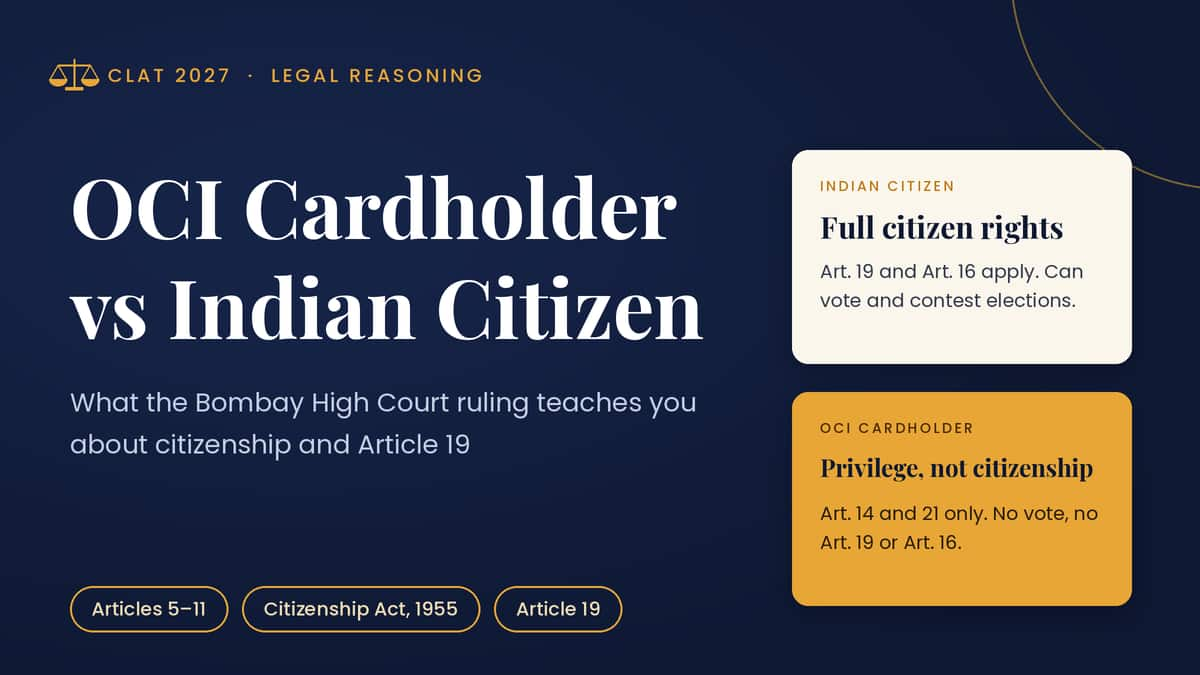
On November 2, 2026, he tendered an unconditional apology and agreed not to participate in future protests. The court continued interim protection against the notice until December 7, 2026. The case highlights important CLAT 2027 topics, including citizenship, OCI rights, constitutional provisions and political participation.
Core concept: Holding an OCI card does not make a person an Indian citizen.
The case: Imran Khan challenged a Leave India notice before the Bombay High Court.
The court’s direction: He was asked to apologise for taking part in a protest against the SIR (Special Intensive Revision) exercise.
Interim relief: The stay on the notice has been extended for now.
What OCI means: A long-term privilege to live, work and travel in India, but not citizenship.
What OCIs lack: Voting rights, the right to contest elections and eligibility for certain constitutional offices.
Article 19: Freedom of speech and assembly are guaranteed to citizens only.
Articles 14 and 21: These apply to every person in India, including OCIs.
Why it matters: The ruling highlights the line between citizen rights and OCI privileges, a favourite theme for CLAT 2027 Legal Reasoning and current affairs.
Imran Khan is a US citizen who has held an OCI card since 2006. In early October, he was detained at a Mumbai protest against Chief Election Commissioner Gyanesh Kumar over the SIR of electoral rolls. A few days later, the FRRO told him to leave India by October 28. He moved the Bombay High Court, saying the notice came without a hearing and that OCI rules don’t ban peaceful protest.
The court paused the notice. On November 2, it said an OCI cardholder can’t be treated like a citizen and asked why he joined a protest that didn’t affect him. It took his unconditional apology on record and kept the notice suspended until the FRRO hears him and decides. The next hearing is on December 7.
In India, Citizenship is governed by Part II of the Constitution (Articles 5-11) and the Citizenship Act, 1955. The Act lists five ways to become a citizen: birth, descent, registration, naturalisation and incorporation of territory. India follows single citizenship, so taking up another country’s citizenship ends your Indian citizenship. A citizen’s status is permanent in a way an OCI cardholder’s is not. That is the gap this ruling brings into focus.
Particular | Indian Citizen | OCI Cardholder |
Legal source | Part II of the Constitution (Articles 5–11) and the Citizenship Act, 1955 | Section 7A onwards of the Citizenship Act, 1955 |
Nationality | Indian | Foreign (holds another country's citizenship) |
Passport | Indian passport | Cannot hold an Indian passport |
Voting and elections | Can vote and contest | Cannot do either |
Constitutional offices | Eligible (President, Vice-President, judges) | Not eligible |
Public employment | Article 16 applies | Article 16 does not apply |
Article 19 freedoms (speech, assembly) | Guaranteed | Not guaranteed as a matter of right |
Articles 14 and 21 | Apply | Apply (these cover every person) |
Stay in India | Unconditional | Lifelong multiple-entry visa, but the status can be cancelled |
Can be asked to leave? | No | Yes, under the law, though the court wants a fair hearing first |
Note: Two traps to watch for in CLAT 2027:
OCI is not dual citizenship. India does not allow it.
“Person” vs “citizen” in the Constitution. Whenever a question says “any person,” OCI holders are covered. When it says “citizens,” they are not.
An OCI card gives a person of Indian origin an easy, lifelong link with India. It is a privilege and not citizenship, so it comes with clear limits.
What an OCI cardholder can do | What an OCI cardholder cannot do |
|
|
For CLAT 2027, remember Section 7B of the Citizenship Act, 1955, which lists these rights and exclusions.
CLAT 2027 aspirants can revise the following key points as part of their CLAT 2027 Preparation.
OCI is not citizenship. It is a lifelong visa-like privilege for persons of Indian origin.
India has single citizenship. OCI is not dual citizenship, and an OCI holder is a foreign national.
Source of law: Citizenship is covered by Articles 5-11 and the Citizenship Act, 1955. OCI is covered by Section 7A onwards of the same Act.
Five modes of acquiring citizenship: birth, descent, registration, naturalisation and incorporation of territory.
No political rights for OCIs: They cannot vote, contest elections or hold constitutional offices.
No Article 16 for OCIs: Equality in public employment is for citizens.
Article 19 is for citizens. Articles 14 and 21 cover every person, including OCIs.
OCI can be cancelled, for example, for fraud or acts against India’s interests.
The case: Imran Khan Pal v. Union of India, before the Bombay High Court.
What the court said: In oral observations, it said an OCI cardholder can’t be treated at par with a citizen.
Where it stands: The Leave India Notice is suspended until the FRRO hears Khan and decides. The next hearing is on December 7.
Exam trap: “Any person” includes OCIs. “Citizens” does not.
Scholars’ Round Deadline: 14th Nov’26 | Earn upto 50% merit Scholarship + 10% for top performers | EFMD Accredited | AACSB (USA) & AMDISA Member | Highest CTC 28 LPA
BA LLB, BBA LLB, or BCom LLB and LLB | LLM 1 Year – 4 Specializations | Approved by BCI | Highest CTC 9 LPA
CLAT 2027 aspirants can read the following current affairs topics to stay updated on key national and international events and strengthen their CLAT 2027 GK and Current Affairs preparation.
Delhi CJP Protest Explained: Preventive Detention, Article 22 and the NSA for CLAT 2027
SIR Controversy Explained: Election Commission Powers, Voter Rights For CLAT 2027
New Zealand FTA Explained for CLAT 2027: Key Facts, Benefits and Legal Implications
CLAT 2027 Current Affairs: Right to Internet Access as a Fundamental Right
CLAT 2027 aspirants can access these monthly current affairs compilations for regular revision. Use these resources to stay updated with important events and topics for CLAT 2027.
Particular | Download PDF |
CLAT Current Affairs- October Month (2026) | Available Soon |
CLAT Current Affairs- September Month (2026) | |
CLAT Current Affairs- August Month (2026) | |
CLAT Current Affairs- July Month (2026) | |
CLAT Current Affairs- June Month (2026) | |
CLAT Current Affairs- May Month (2026) | |
CLAT Current Affairs- April Month (2026) | |
CLAT Current Affairs- March Month (2026) |

On Question asked by student community
Hello Student,
The full form of the CLAT exam is the Common Law Admission Test. You can check the link related to the CLAT exam
https://law.careers360.com/articles/what-is-clat-full-form-all-about-nlus-entrance-exam
Hello Student,
Here are the Careers360 CLAT 2027 Mock Test Resources for your exam preparation.
1. Online CLAT Mock Test
2. CLAT Mock Tests and Solutions
Hello student,
CLAT 2027 aspirants can access these monthly current affairs compilations for regular revision. Use these resources to stay updated with important events and topics for CLAT 2027.
|
Particular |
Download PDF |
|
CLAT Current Affairs- August Month (2026) |
|
|
CLAT Current Affairs- |
If you have only two months, use a highly structured plan: daily current affairs, English reading, legal reasoning practice, logical reasoning sets, basic quantitative practice and regular full-length mocks. Spend as much time analysing incorrect questions as taking the mock itself. Consistency during these two months can make a substantial
You can download the CLAT previous years' question papers from here:
https://law.careers360.com/articles/clat-previous-year-question-papers
https://law.careers360.com/download/clat-sample-papers-previous-years

Experiential Learning through Legal Aid Camps, Lok Adalats, Court Visits, Community Lawyering and regular Moot Court sessions
Ranked #18 amongst Institutions in India by NIRF | Get Upto 100% Scholarships | Spot Admissions via CUET
Scholars’ Round Deadline: 14th Nov’26 | Earn upto 50% merit Scholarship + 10% for top performers | EFMD Accredited | AACSB (USA) & AMDISA Member | Highest CTC 28 LPA
BA LLB, BBA LLB, or BCom LLB and LLB | LLM 1 Year – 4 Specializations | Approved by BCI | Highest CTC 9 LPA
Grade 'A+' Accredited by NAAC | Ranked 33rd in India by NIRF
Moot Court | Mock trials | Legal Aid Clinic | Recruiting Partners: FICCI, TCS, Adani, Trilegal, and many others