ICFAI University Sikkim Law Admissions 2026
Approved by BCI


If you have been following the news this week, you have probably seen the same story everywhere: Delhi Police detaining leaders of the Cockroach Janta Party (CJP), All India Students' Association (AISA), and opposition parties just before a protest at Jantar Mantar. Behind the headlines lies a question that suits CLAT's legal reasoning and current affairs sections well.
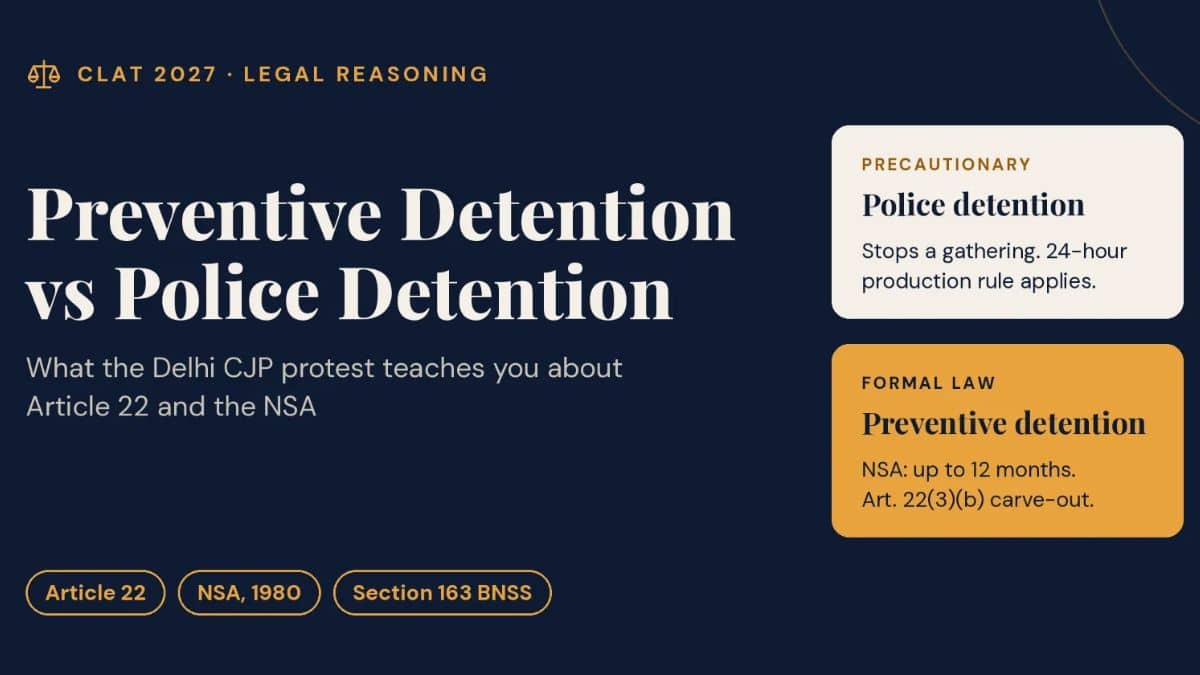
Within hours, one word was everywhere: detention. Is that an arrest? Is it preventive detention? Can the police really do this? If you are preparing for CLAT 2027, these are more than news questions. They sit exactly where constitutional law, criminal law and CLAT 2027 current affairs meet, and the answers are simpler than they look. Let's start with what happened, and then walk through the law behind it.
On 10 October 2026, Delhi Police detained Cockroach Janta Party (CJP) leaders Abhijeet Dipke, Ashutosh Ranka and Saurav Das, along with YouTuber Dhruv Rathee, ahead of a Jantar Mantar protest demanding Chief Election Commissioner Gyanesh Kumar’s resignation.
How it began: CJP, a youth-led online movement launched in May 2026, protested NEET paper leaks and demanded Education Minister Dharmendra Pradhan’s resignation. A march on 20 July turned violent, leaving 178 people injured, according to Delhi Police. Pradhan resigned on 25 July.
A new target: The movement later targeted Gyanesh Kumar over alleged irregularities in the Special Intensive Revision (SIR) of electoral rolls. On 2 October, police detained nearly 1,000 people, citing a lack of permission and prohibitory orders under Section 163 of the Bharatiya Nagarik Suraksha Sanhita (BNSS).
The warning: On 4 October, CJP spokesperson Saurav Das warned of possible arrests ahead of the protest. On 8 October, Dipke alleged that activists were being taken into preventive custody.
10 October: Police detained CJP leaders at Delhi airport and Dhruv Rathee at his Gurugram home. Reports said over 1,000 people were detained overnight, with heavy police deployment and restrictions on Metro station access.
The NSA angle: The Delhi Police Commissioner has National Security Act (NSA) detention powers until 18 October under a Lieutenant Governor’s notification. Police described this as a routine renewal, and reports have not confirmed anyone being detained under the NSA in this case.
For CLAT 2027 Preparation, the key distinction is between precautionary police detention to prevent a gathering and formal preventive detention under laws such as the NSA. As the matter is developing, check the latest reports before the CLAT 2027 exam.
Article 19(1)(b): Right of citizens to assemble peacefully and without arms.
Article 19(3): Allows the State to impose reasonable restrictions on this right in the interest of public order and the sovereignty and integrity of India.
Section 163, BNSS: Allows prohibitory orders in urgent cases of nuisance or danger. It replaced Section 144 CrPC.
Article 22: Protects a person who is arrested or detained. They must be informed of the grounds of arrest and produced before a magistrate within 24 hours.
Article 22(3)(b): Acts as a qualifying clause by excluding persons detained under preventive detention laws from the protections under Article 22(1) and (2). These protections also do not apply to enemy aliens.
Contempt of court: Wilful disobedience of a court order. It is punishable under the Contempt of Courts Act, 1971.
Preventive detention means holding a person not for a crime already committed, but to stop them from doing something the State fears they may do. It rests on suspicion about the future, not proof about the past.
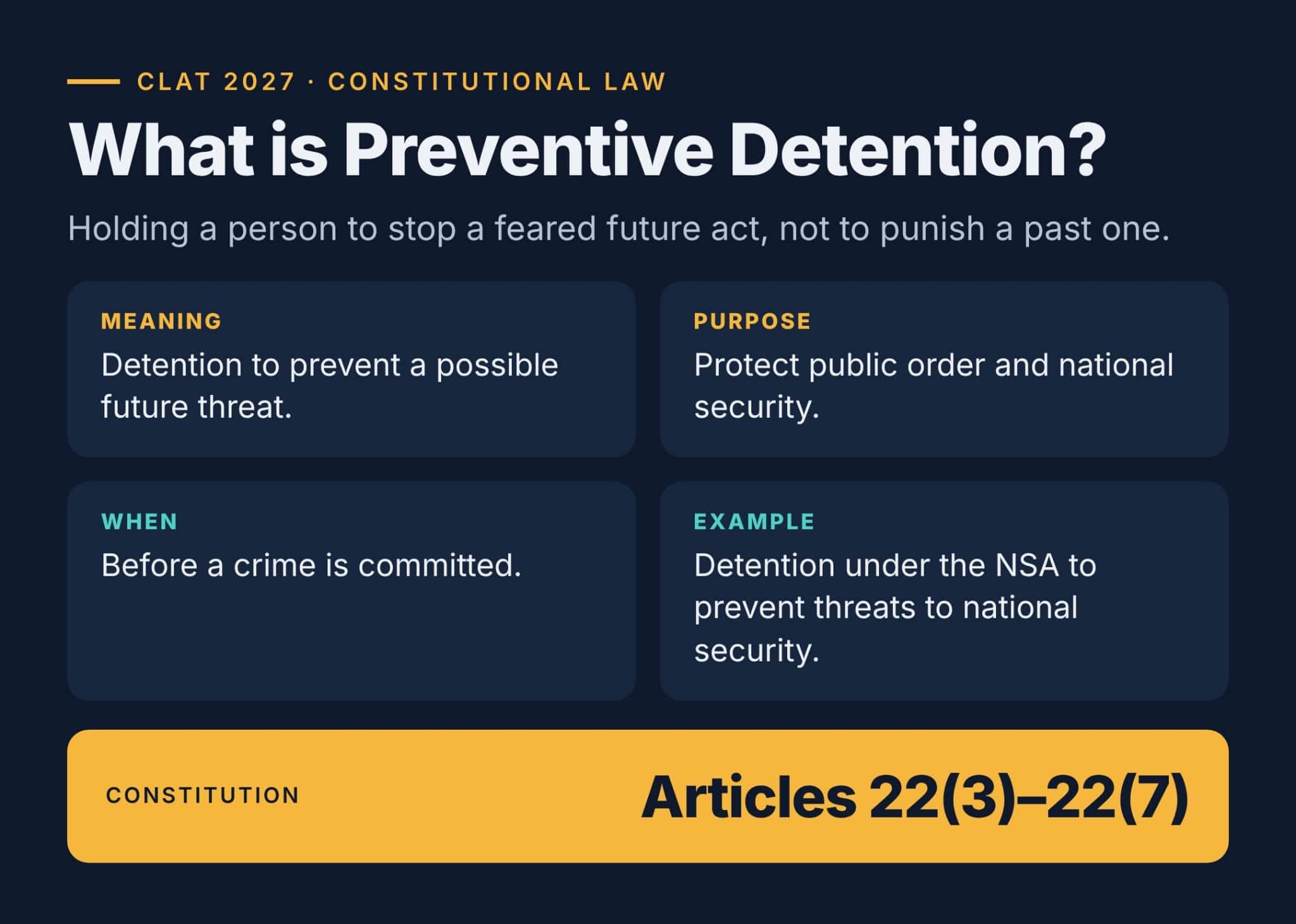
Article 21 is the heart of the topic, and Articles 21 and 19 frame it. Learn Article 22 clause by clause.
Clause | Description |
Article 22(1) | An arrested person must be informed of the grounds of arrest and has the right to consult and be defended by a lawyer of their choice. |
Article 22(2) | An arrested person must be produced before the nearest Magistrate within 24 hours, excluding travel time. |
Article 22(3) | The protections under Clauses (1) and (2) do not apply to enemy aliens or persons detained under preventive detention laws. |
Article 22(4) | Preventive detention generally cannot exceed three months unless the required Advisory Board review or applicable constitutional provisions permit further detention. |
Article 22(5) | The authority must communicate the grounds of detention as soon as possible and provide an opportunity to make a representation against the order. |
Article 22(6) | The authority need not disclose facts that it considers against the public interest to reveal. |
Article 22(7) | Parliament may prescribe the circumstances and conditions for detention beyond three months, the maximum detention period, and the Advisory Board's procedure, subject to constitutional limits. |
Note: The 44th Amendment (1978) proposed cutting the 3 months in Article 22(4) to 2 months and requiring a Board led by a sitting High Court judge. That change was never brought into force, so the original text still operates.
Learn the other important provisions as well for CLAT 2027 preparation.
Provision | Why it matters here |
Article 21 | Protects life and personal liberty. Any restriction must follow a fair, just and reasonable procedure, as explained in Maneka Gandhi v. Union of India (1978). |
Articles 19(1)(a) and 19(1)(b) | Protect freedom of speech and the right to assemble peacefully without arms. These rights are important for protests. |
Article 19(3) | Allows reasonable restrictions on peaceful assembly in the interests of public order and the sovereignty and integrity of India. |
Articles 32 and 226 | Allow people to approach the Supreme Court or High Courts for remedies, including habeas corpus against unlawful detention. |
Article 359 |
|
Seventh Schedule |
|
The National Security Act (NSA), 1980, allows the Central and state governments to detain a person without a criminal trial to prevent activities that may threaten national security, public order or essential supplies and services.
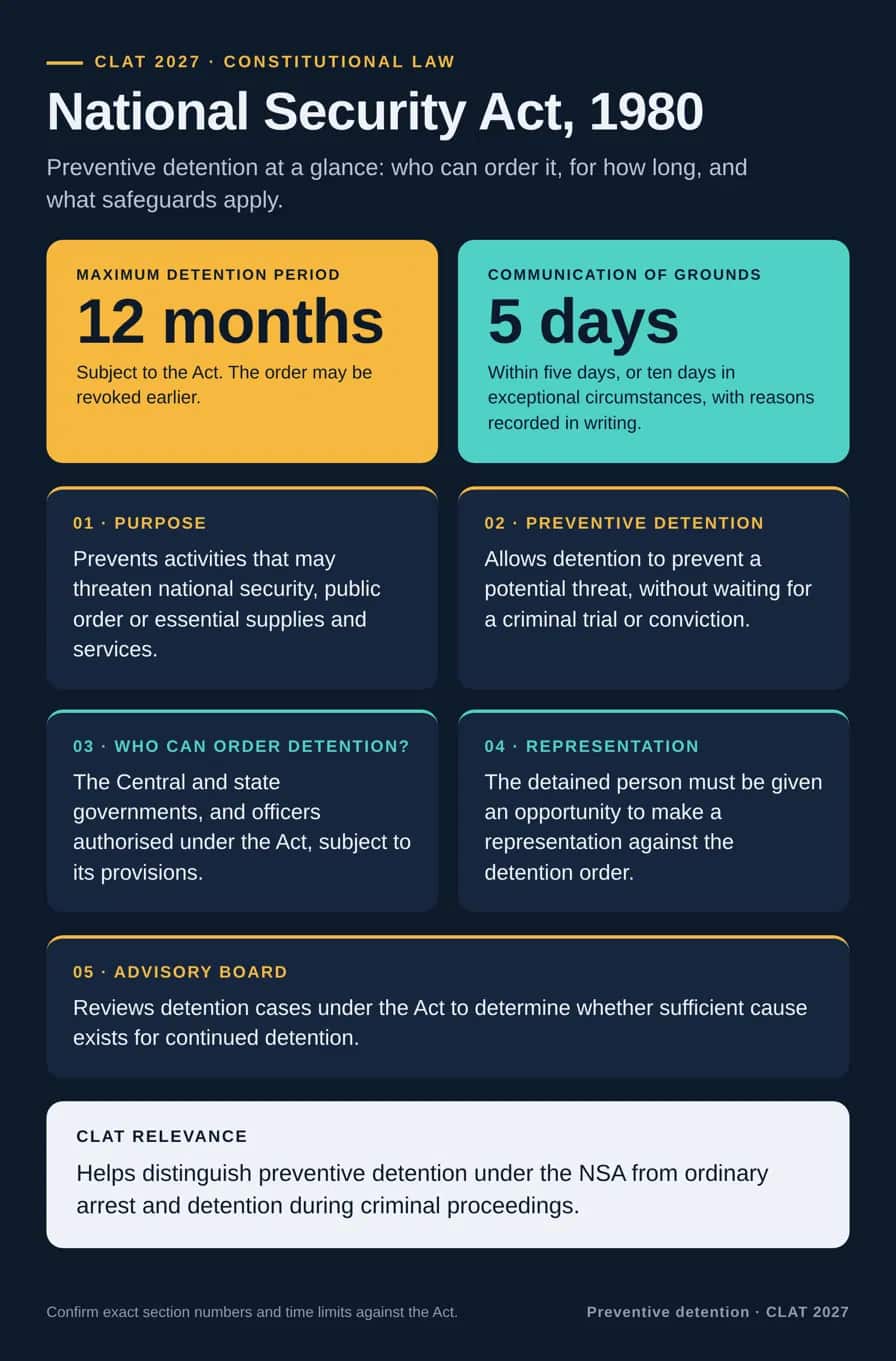
Given below are the important landmark cases related to Preventive Detention.
Case | Year | Takeaway |
A.K. Gopalan v. State of Madras | 1950 | Initially interpreted “procedure established by law” narrowly, accepting a procedure prescribed by a valid law. |
Ram Manohar Lohia v. State of Bihar | 1966 | Distinguished between law and order, public order and security of the State. |
ADM Jabalpur v. Shivkant Shukla | 1976 | During the Emergency, the majority restricted access to courts to challenge detention; later overruled. |
Maneka Gandhi v. Union of India | 1978 | Established that a procedure affecting personal liberty must be fair, just and reasonable. |
A.K. Roy v. Union of India | 1982 | Upheld the constitutional validity of the NSA and addressed safeguards in preventive detention proceedings. |
K.S. Puttaswamy v. Union of India | 2017 | Overruled ADM Jabalpur and reaffirmed the importance of fundamental rights. |
Rekha v. State of Tamil Nadu | 2011 | Preventive detention should not replace ordinary criminal law when it is sufficient to deal with the situation. |
Ramlila Maidan Incident, In re | 2012 | Recognised the importance of peaceful assembly and protest, subject to reasonable restrictions. |
Mazdoor Kisan Shakti Sangathan v. Union of India | 2018 | Addressed the balance between peaceful protests and the rights of residents and commuters near Jantar Mantar. |
Amit Sahni v. Commissioner of Police | 2020 | Held that public roads cannot be occupied indefinitely in the name of protest. |
Here are the quick revision notes that every CLAT 2027 aspirant must revise.
Preventive detention punishes no past act. It aims to prevent a future one.
Article 22(3)(b) removes the 24-hour production rule and the right to a lawyer for preventive detainees.
Article 22(4): no detention beyond 3 months without an Advisory Board's report.
Article 22(5): grounds "as soon as may be" plus the earliest chance to make a representation.
Article 22(6): facts against the public interest need not be disclosed.
Article 22(7): Parliament can fix the maximum period and the Board's procedure.
The 44th Amendment's change to Article 22(4) was never brought into force.
Union List Entry 9 and Concurrent List Entry 3 give the legislative power over preventive detention.
The NSA caps detention at 12 months and allows no lawyer before the Advisory Board.
Articles 20 and 21 cannot be suspended during an Emergency since the 44th Amendment.

On Question asked by student community
Hello Student,
Here are the Careers360 CLAT 2027 Mock Test Resources for your exam preparation.
1. Online CLAT Mock Test
2. CLAT Mock Tests and Solutions
Hello student,
CLAT 2027 aspirants can access these monthly current affairs compilations for regular revision. Use these resources to stay updated with important events and topics for CLAT 2027.
|
Particular |
Download PDF |
|
CLAT Current Affairs- August Month (2026) |
|
|
CLAT Current Affairs- |
If you have only two months, use a highly structured plan: daily current affairs, English reading, legal reasoning practice, logical reasoning sets, basic quantitative practice and regular full-length mocks. Spend as much time analysing incorrect questions as taking the mock itself. Consistency during these two months can make a substantial
You can download the CLAT previous years' question papers from here:
https://law.careers360.com/articles/clat-previous-year-question-papers
https://law.careers360.com/download/clat-sample-papers-previous-years
For CLAT 2027 UG, candidates need to have passed Class 12/equivalent with at least 45% marks, or 40% for SC/ST/PwD candidates.
In your situation, having an RT in an additional subject but subsequently passing the required qualification through an improvement examination does not automatically make you ineligible. However, the important

Ranked #18 amongst Institutions in India by NIRF | Get Upto 100% Scholarships | Spot Admissions via CUET
Ranked 1 st among Top Law Schools of super Excellence in India - GHRDC | NAAC A+ Accredited | #36 by NIRF
NAAC A++ Accredited | Ranked #11 by NIRF
Bar Council of India (BCI) approved | Accredited by LAWASIA | Ranked 13th , among the Best Law Colleges (Private) in India by IIRF
Free Ebook - CLAT 2025 English Language questions with detailed solutions
Stay updated with current affairs & check your preparation with the CLAT General Knowledge Mock Tests Ebook