School of Law, UPES, Dehradun
Ranked #18 amongst Institutions in India by NIRF | Get Upto 100% Scholarships | Spot Admissions via CUET


With so much legal news to follow, what should CLAT 2027 aspirants focus on? September 2026 saw several developments in law and the Constitution. This has made September 2026 an important month for CLAT 2027 aspirants. From legal judgments and laws to constitutional aspects and governmental decisions, there are a number of developments that have become highly relevant for the CLAT 2027 current affairs and Legal Reasoning section.
This Story also Contains
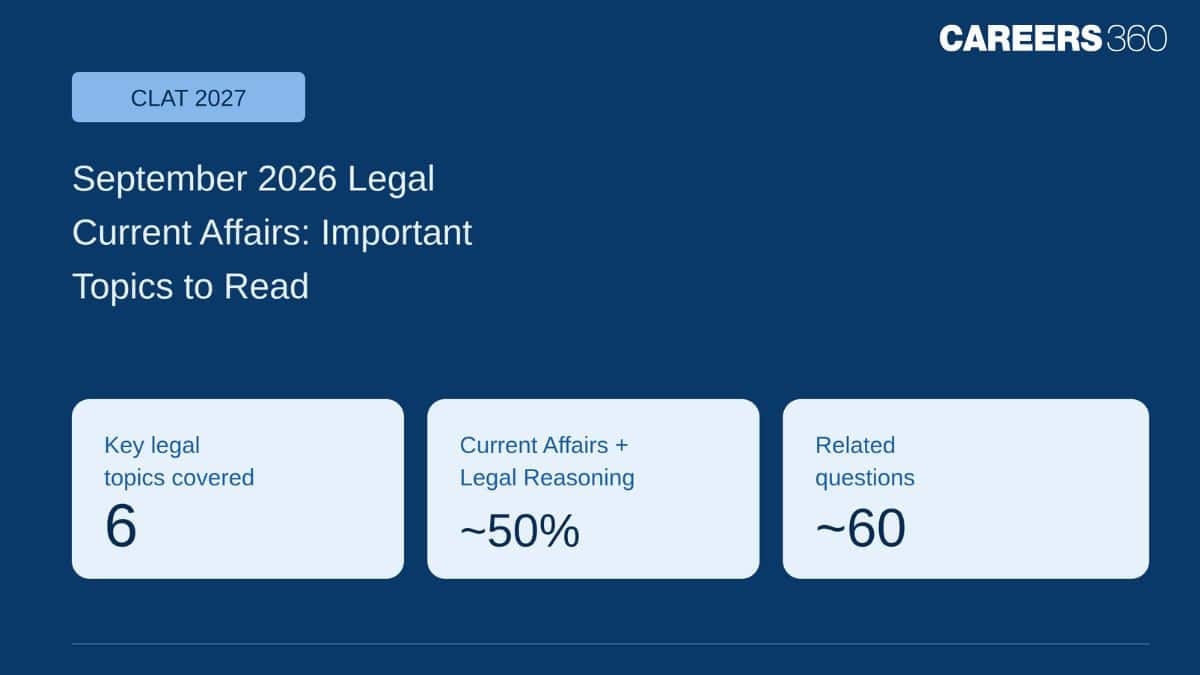
About 50% of the CLAT 2027 question paper covers Current Affairs, General Knowledge and CLAT 2027 legal reasoning. Out of 120 questions, there are approximately 60 questions that pertain to the Current Affairs and Legal Reasoning section of the paper. This article highlights September 2026 Legal Current Affairs for CLAT 2027 that CLAT 2027 aspirants should pay attention to. Each of these topics has been explained with the help of the legal or constitutional aspect associated with it.
In September 2026, there were some noteworthy legal and constitutional developments in India. Whether it is the SC judgment, POCSO, UCC, election-related issues, or some new criminal legislation, there have been several aspects worth focusing on for CLAT 2027 candidates. Below are the important legal news events of September 2026 Legal Current Affairs that candidates must go through.
Ranked #18 amongst Institutions in India by NIRF | Get Upto 100% Scholarships | Spot Admissions via CUET
Scholars’ Round Deadline: 14th Nov’26 | Earn upto 50% merit Scholarship + 10% for top performers | EFMD Accredited | AACSB (USA) & AMDISA Member | Highest CTC 28 LPA
In the news: The 18th BRICS Summit was held in New Delhi on September 12 and 13, 2026, under India's BRICS Chairship. The theme of India's chairship was “Building for Resilience, Innovation, Cooperation and Sustainability.” The summit concluded with the adoption of the New Delhi Declaration, covering areas including global cooperation, development, technology and sustainable development.
What should CLAT 2027 aspirants know?
BRICS is a grouping that promotes cooperation among its member countries on economic, political and global issues.
India held the BRICS Chairship in 2026.
The 18th BRICS Summit was held in New Delhi.
The theme of India's 2026 BRICS Chairship was Building for Resilience, Innovation, Cooperation and Sustainability.
The summit resulted in the New Delhi Declaration.
The BRICS grouping has expanded beyond its original members in recent years.
The summit is important for the September 2026 Legal Current Affairs for CLAT 2027.
Q1. Where was the 18th BRICS Summit held in 2026?
A. Moscow
B. New Delhi
C. Beijing
D. Brasília
Answer: B. New Delhi
Q2. What was the theme of India's BRICS Chairship in 2026?
A. One Earth, One Family, One Future
B. Building for Resilience, Innovation, Cooperation and Sustainability
C. Reforming Multilateralism for a Better World
D. Strengthening Global Partnerships
Answer: B. Building for Resilience, Innovation, Cooperation and Sustainability
In the news: The Delhi High Court refused to quash a POCSO case involving a man who had married a 16-year-old girl. The accused relied on Muslim personal law to argue that the marriage was valid. The Court held that marriage does not change the legal status of a child under the POCSO Act.
What should CLAT 2027 aspirants know?
POCSO stands for the Protection of Children from Sexual Offences Act, 2012.
Section 2(1)(d) of POCSO defines a child as a person below 18 years of age.
POCSO is a special law enacted to protect children from sexual offences.
The Delhi High Court rejected the argument that personal law could provide an exception to the application of POCSO.
The case highlights the relationship between personal law and statutory criminal law.
The legal age of a child under POCSO remains 18 irrespective of the validity or nature of a marriage.
Note: Remember the distinction between personal law and statutory law, along with the definition of a child under POCSO. A CLAT 2027 legal reasoning questions could give students a similar situation and ask them to apply the principle that a child-protection statute applies to a person below 18.
Q1. What does POCSO stand for?
A. Protection of Children from Sexual Offences
B. Prevention of Crimes against School Offenders
C. Protection of Citizens from Sexual Offences
D. Prevention of Child Safety Offences
Answer: A. Protection of Children from Sexual Offences
Q2. Under the POCSO Act, a child means a person below:
A. 14 years
B. 16 years
C. 18 years
D. 21 years
Answer: C. 18 years
In the news: The Special Intensive Revision (SIR) of electoral rolls remained an important constitutional and electoral issue in September 2026. In the Election Commission of India, the SIR process involves the verification and revision of electoral rolls. The Supreme Court also agreed to hear a plea challenging aspects of the Election Commission's functioning and the SIR process.
What should CLAT 2027 aspirants know?
SIR stands for Special Intensive Revision.
An electoral roll is the official list of registered electors.
The Election Commission of India supervises elections in India.
Article 324 of the Constitution provides for the constitutional authority of the Election Commission over elections.
Electoral rolls are governed by election laws, including the Representation of the People Act, 1950.
The SIR process involves verification and revision of electoral roll entries.
Revise Article 324, the Election Commission, electoral rolls and the legal basis of the right to vote.
Q1. What does SIR stand for?
A. Special Investigation Report
B. Special Intensive Revision
C. State Electoral Revision
D. Special Identification Rule
Answer: B. Special Intensive Revision
Q2. Which Article deals with the powers of the Election Commission?
A. Article 280
B. Article 300
C. Article 324
D. Article 356
Answer: C. Article 324
In the news: The Supreme Court of India dealt with several important issues related to Fundamental Rights and constitutional protections in September 2026. These developments are important for CLAT 2027 as they highlight how constitutional provisions such as Articles 21 and 22 are applied in real cases.
What should CLAT 2027 aspirants know?
Article 22(1) provides that an arrested person must be informed of the grounds of arrest.
Article 22(2) provides protection relating to production before a magistrate within 24 hours, subject to constitutional Laws.
The Supreme Court emphasised that these safeguards are important protections for personal liberty.
The Court distinguished release from an unconstitutional detention from ordinary release on bail.
The judgment also laid down safeguards governing re-arrest after an illegal arrest.
The development is closely connected with Article 21, which protects life and personal liberty.
CLAT 2027 Students should revise important constitutional provisions such as:
Article 14 – Equality before law
Article 19 – Important freedoms
Article 21 – Right to life and personal liberty
Article 25 – Freedom of religion
A Supreme Court judgment can become a CLAT 2027 Legal Reasoning passage, where students are asked to apply the Court's legal principle to a new situation.
Q1. Which Article protects the right to life and personal liberty?
A. Article 14
B. Article 19
C. Article 21
D. Article 25
Answer: C. Article 21
Q2. Article 14 deals with:
A. Freedom of religion
B. Equality before law
C. Right to education
D. Right to vote
Answer: B. Equality before law
In the news: The Uniform Civil Code (UCC) continues to be an important legal and constitutional issue. Uttarakhand has implemented its Uniform Civil Code framework, which covers areas such as marriage, divorce, inheritance, succession and live-in relationships.
What should CLAT 2027 aspirants know?
UCC stands for Uniform Civil Code.
Article 44 of the Constitution directs the State to endeavour to secure a Uniform Civil Code for citizens.
Article 44 is part of the Directive Principles of State Policy (DPSP).
UCC means having common rules for certain civil matters for citizens, regardless of their religion.
Matters that may be covered by a UCC include marriage, divorce and inheritance.
Uttarakhand is an important example of a state implementing a UCC framework.
The topic is connected with equality, personal laws and freedom of religion.
Remember Article 44, DPSP, personal laws and fundamental rights.
Q1. Which Article deals with the Uniform Civil Code?
A. Article 14
B. Article 21
C. Article 44
D. Article 51
Answer: C. Article 44
Q2. Article 44 is part of:
A. Fundamental Rights
B. Fundamental Duties
C. Directive Principles of State Policy
D. Emergency Provisions
Answer: C. Directive Principles of State Policy
In the news: The Supreme Court considered the issue of protecting minors from potential harms associated with social media platforms. On September 28, 2026, the Court urged the Centre to consider statutory measures relating to minors' access to social media, including the possibility of an age restriction.
What should CLAT 2027 aspirants know?
The issue concerns the regulation of social-media access by minors.
The debate involves child protection, privacy, parental consent and digital regulation.
The Supreme Court's observations have raised questions about how far the State can regulate access to digital platforms.
The matter also highlights the responsibilities of social-media platforms towards children.
Any future statutory regulation would need to operate within the constitutional framework.
India's new criminal laws continue to be important for September 2026 legal current affairs. Courts are also dealing with questions about how these laws should be understood and applied.
The three new criminal laws are:
Bharatiya Nyaya Sanhita (BNS), 2023
Bharatiya Nagarik Suraksha Sanhita (BNSS), 2023
Bharatiya Sakshya Adhiniyam (BSA), 2023
What should CLAT 2027 aspirants know?
BNS deals mainly with criminal offences and punishments.
BNSS deals mainly with criminal procedure.
BSA deals mainly with evidence.
These laws replaced the earlier IPC, CrPC and Indian Evidence Act framework.
The new laws came into effect on July 1, 2024.
CLAT aspirants should know the names, purpose and basic differences between the three laws.
Important court decisions interpreting these laws can also become part of Legal Current Affairs.
CLAT 2027 aspirants can access these monthly current affairs compilations for regular revision. Use these resources to stay updated with important events and topics for CLAT 2027.
Particular | Download PDF |
CLAT Current Affairs- September Month (2026) | |
CLAT Current Affairs- August Month (2026) | |
CLAT Current Affairs- July Month (2026) | |
CLAT Current Affairs- June Month (2026) | |
CLAT Current Affairs- May Month (2026) | |
CLAT Current Affairs- April Month (2026) | |
CLAT Current Affairs- March Month (2026) |
September 2026 current legal affairs need to be revised, taking into consideration important legal cases or decisions, constitutional changes, legislation, and legal issues. Do not try to mug up all the legal news; identify only those events that have significance for law or the country.
For proper revision, always remember a case or event, legal issue, provision, development or decision and its importance. Revision and practice of MCQs can help in making the task of current affairs less cumbersome.

On Question asked by student community
Hello Student,
Here are the Careers360 CLAT 2027 Mock Test Resources for your exam preparation.
1. Online CLAT Mock Test
2. CLAT Mock Tests and Solutions
Hello student,
CLAT 2027 aspirants can access these monthly current affairs compilations for regular revision. Use these resources to stay updated with important events and topics for CLAT 2027.
|
Particular |
Download PDF |
|
CLAT Current Affairs- August Month (2026) |
|
|
CLAT Current Affairs- |
If you have only two months, use a highly structured plan: daily current affairs, English reading, legal reasoning practice, logical reasoning sets, basic quantitative practice and regular full-length mocks. Spend as much time analysing incorrect questions as taking the mock itself. Consistency during these two months can make a substantial
You can download the CLAT previous years' question papers from here:
https://law.careers360.com/articles/clat-previous-year-question-papers
https://law.careers360.com/download/clat-sample-papers-previous-years
For CLAT 2027 UG, candidates need to have passed Class 12/equivalent with at least 45% marks, or 40% for SC/ST/PwD candidates.
In your situation, having an RT in an additional subject but subsequently passing the required qualification through an improvement examination does not automatically make you ineligible. However, the important

Ranked #18 amongst Institutions in India by NIRF | Get Upto 100% Scholarships | Spot Admissions via CUET
Scholars’ Round Deadline: 14th Nov’26 | Earn upto 50% merit Scholarship + 10% for top performers | EFMD Accredited | AACSB (USA) & AMDISA Member | Highest CTC 28 LPA
Moot Court | Mock trials | Legal Aid Clinic | Recruiting Partners: FICCI, TCS, Adani, Trilegal, and many others
NAAC A+ Accredited University
Law Admissions 2026 Open | Avail Merit-Based Scholarships
NAAC A++ Accredited | Ranked #11 by NIRF