School of Law, UPES, Dehradun
Ranked #18 amongst Institutions in India by NIRF | Get Upto 100% Scholarships | Spot Admissions via CUET


The SIR (Special Intensive Revision) has raised big questions about how much power the Election Commission of India really has, and what it means for every citizen’s right to vote. The idea behind the revision is to update the voter lists. If you’re preparing for CLAT 2027, this is a topic worth knowing well, because it brings together the Constitution, election laws, fundamental rights, and the role of the Election Commission in keeping elections free and fair.
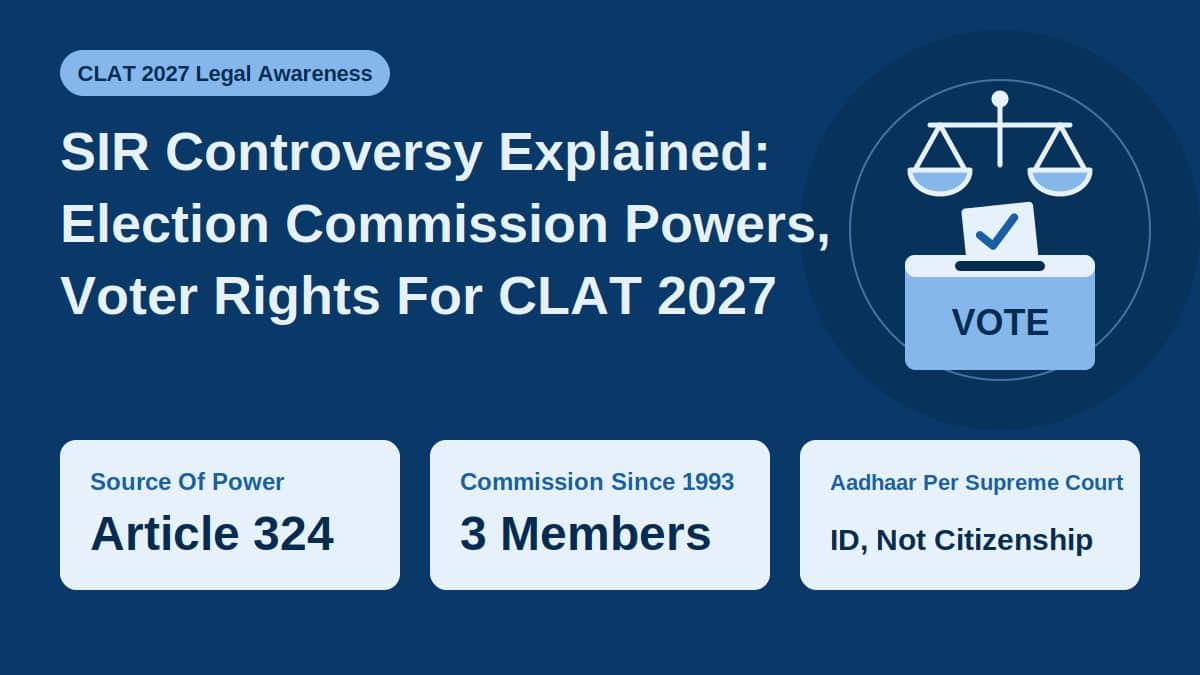
Under Article 324 of the Constitution, the Election Commission prepares the voter lists. The Representation of the People Act, 1950 explains how these lists are to be updated. In this article, we’ll look at what SIR is, what powers the Commission has, what rights voters have, and the key legal points to remember for CLAT 2027 Preparation.
What it is: SIR is a door-to-door, document-based re-verification of the electoral roll, much more detailed than the usual yearly update.
Where it started: The Election Commission began it in Bihar in 2025 and later extended it to other states.
The concern: Critics say large numbers of names can be deleted and that voters must prove their eligibility with documents. The Commission says it is removing dead, duplicate and shifted voters and ineligible entries.
Court angle: The matter reached the Supreme Court of India, which looked at the Commission’s power to run such an exercise, the documents accepted, and the need for fairness and transparency. The Court allowed Aadhaar as an identity document but not as proof of citizenship. -
The Election Commission of India (ECI) is an independent constitutional body established under Article 324 of the Constitution of India, which grants it the power of superintendence, direction and control over elections. Other important constitutional law provisions include Articles 325, 326, 327, 328 and 329, which deal with electoral rolls, adult suffrage, election laws and judicial interference in electoral matters.
A permanent, independent constitutional body under Article 324.
Set up on 25 January 1950, which is why that day is celebrated as National Voters’ Day.
It handles elections to the Lok Sabha, Rajya Sabha, State Legislative Assemblies and Councils, and the offices of the President and Vice-President.
It does not handle panchayat and municipal elections. Those are run by State Election Commissions (Articles 243K and 243ZA).
Ranked #18 amongst Institutions in India by NIRF | Get Upto 100% Scholarships | Spot Admissions via CUET
Scholars’ Round Deadline: 14th Nov’26 | Earn upto 50% merit Scholarship + 10% for top performers | EFMD Accredited | AACSB (USA) & AMDISA Member | Highest CTC 28 LPA
The following are the key provisions related to the composition and service conditions of the ECI:
Point | Details |
Members |
|
Appointed by |
|
Selection Committee (2023 Act) |
|
Earlier Position |
|
Term | Six years or until attaining 65 years of age, whichever is earlier, subject to the applicable law. |
The CEC can be removed only in the same way as a Supreme Court judge (Article 324(5)). This needs a special majority in Parliament.
Other Election Commissioners can be removed only on the CEC's recommendation.
Service conditions cannot be changed to their disadvantage after appointment.
Preparing and revising electoral rolls.
Announcing election schedules and supervising the whole process.
Recognising political parties and allotting symbols.
Enforcing the Model Code of Conduct, which is a set of guidelines and not a statute.
Advising the President or Governor on disqualification of MPs and MLAs (Articles 103 and 192).
Monitoring campaign spending and ensuring candidates follow the law.
Mohinder Singh Gill v. CEC (1978): Article 324 gives wide powers, but they cannot override laws made by Parliament, and they must be used fairly.
A.C. Jose v. Sivan Pillai (1984): The Commission's powers under Article 324 cannot be used against a valid law or rule.
Anoop Baranwal v. Union of India (2023): The Court stressed the need for an independent process for appointing election commissioners.
CLAT 2027 aspirants can also check,
The Indian Constitution's Part XV addresses elections and creates a commission to handle these issues. On January 25, 1950, the Election Commission was created under the Constitution. The Constitution's Articles 324 to 329 address the commission's and its members' authority, role, term, eligibility, and other matters.
Article | Provision |
Article 324 | Vests the superintendence, direction and control of elections in the Election Commission of India; also addresses the appointment and service conditions of the CEC and other Election Commissioners. |
Article 325 | Provides for one general electoral roll for every territorial constituency and prohibits exclusion from electoral rolls on grounds of religion, race, caste or sex. |
Article 326 | Provides for elections to the Lok Sabha and State Legislative Assemblies based on adult suffrage. Citizens aged 18 or above may vote, subject to disqualifications prescribed by law. |
Article 327 | Empowers Parliament to make laws relating to elections to Parliament and State Legislatures, subject to the Constitution. |
Article 328 | Empowers State Legislatures to make laws concerning elections to their respective legislatures, insofar as Parliament has not made provisions on the matter. |
Article 329 | Restricts judicial interference in electoral matters, subject to constitutional provisions. Elections to Parliament and State Legislatures can generally be challenged only through an election petition in the manner prescribed by law. |
CLAT 2027 aspirants can also check,
Three categories may be used to categorise the Election Commission of India's powers and functions, as outlined below.
Delimitation: Determines constituency boundaries through the Delimitation Commission.
Voter Lists: Prepares and updates electoral rolls.
Election Schedule: Announces election dates and scrutinises nomination papers.
Party Symbols: Allots symbols and recognises political parties.
Election Support: Requests staff and resources from the President or Governor.
Free and Fair Elections: Enforces the Model Code of Conduct.
Campaign Expenses: Monitors candidates’ election expenditure.
Re-polling: Can order a fresh poll if serious irregularities occur.
Advises the President on the disqualification of MPs.
Advises the Governor on the disqualification of MLAs and MLCs.
Advises on conducting elections in states under President’s Rule.
Resolves disputes over party recognition, names and symbols.
Appoints election observers to monitor the election process and report irregularities.
CLAT 2027 Tip: Remember the three categories — Administrative (conducts elections), Advisory (gives advice), and Quasi-Judicial (settles disputes).
Below are the landmark cases that influenced the Indian Electoral System.
Case Laws | Description |
Mohinder Singh Gill v. CEC (1978) | Article 324 gives wide powers, but they cannot override laws made by Parliament, and they must be used fairly. |
A.C. Jose v. Sivan Pillai (1984) | The Commission's powers under Article 324 cannot be used against a valid law or rule. |
A.C. Jose v. Sivan Pillai (1984) | Anoop Baranwal v. Union of India (2023): The Court stressed the need for an independent process for appointing election commissioners. |
The Chief Election Commissioner and Other Election Commissioners (Appointment, Conditions of Service and Term of Office) Act, 2023 lays down the rules for appointing Election Commissioners, their service conditions and their term of office. It replaced the 1991 Act.
Appointment: The President appoints the CEC and ECs on the recommendation of the Selection Committee.
Selection Committee: Prime Minister (Chairperson), a Union Cabinet Minister nominated by the PM, and the Leader of Opposition in the Lok Sabha (or leader of the largest opposition party if no LoP is recognised).
Search Committee: Headed by the Union Law Minister; prepares a panel of five candidates for consideration.
Eligibility: Must be or have been a Secretary-level officer to the Government of India, with integrity and experience in election management.
Vacancy in Committee: Recommendations remain valid even if the Selection Committee has a vacancy.
Salary: The CEC and ECs receive a salary equal to that of a Supreme Court judge, not the Cabinet Secretary.
Term: Six years or until the age of 65, whichever comes first. Reappointment is not allowed.
CLAT 2027 key fact: The 2023 Act replaced the 1991 Act. Remember the salary distinction: Supreme Court judge, not Cabinet Secretary.
Below is the list of India's Chief Election Commissioners.
No. | Chief Election Commissioner | Tenure |
1 | Sukumar Sen | 21 March 1950 – 19 December 1958 |
2 | K. V. K. Sundaram | 20 December 1958 – 30 September 1967 |
3 | S. P. Sen Verma | 1 October 1967 – 30 September 1972 |
4 | Dr. Nagendra Singh | 1 October 1972 – 6 February 1973 |
5 | T. Swaminathan | 7 February 1973 – 17 June 1977 |
6 | S. L. Shakdhar | 18 June 1977 – 17 June 1982 |
7 | R. K. Trivedi | 18 June 1982 – 31 December 1985 |
8 | R. V. S. Peri Sastri | 1 January 1986 – 25 November 1990 |
9 | V. S. Ramadevi | 26 November 1990 – 11 December 1990 |
10 | T. N. Seshan | 12 December 1990 – 11 December 1996 |
11 | M. S. Gill | 12 December 1996 – 13 June 2001 |
12 | J. M. Lyngdoh | 14 June 2001 – 7 February 2004 |
13 | T. S. Krishnamurthy | 8 February 2004 – 15 May 2005 |
14 | B. B. Tandon | 16 May 2005 – 29 June 2006 |
15 | N. Gopalaswami | 30 June 2006 – 20 April 2009 |
16 | Navin Chawla | 21 April 2009 – 29 July 2010 |
17 | S. Y. Quraishi | 30 July 2010 – 10 June 2012 |
18 | V. S. Sampath | 11 June 2012 – 15 January 2015 |
19 | H. S. Brahma | 16 January 2015 – 18 April 2015 |
20 | Nasim Zaidi | 19 April 2015 – 5 July 2017 |
21 | Achal Kumar Jyoti | 6 July 2017 – 22 January 2018 |
22 | Om Prakash Rawat | 23 January 2018 – 1 December 2018 |
23 | Sunil Arora | 2 December 2018 – 12 April 2021 |
24 | Sushil Chandra | 13 April 2021 – 14 May 2022 |
25 | Rajiv Kumar | 15 May 2022 – 18 February 2025 |
26 | Gyanesh Kumar | 19 February 2025 – Present |
First Chief Election Commissioner: Sukumar Sen.
Current Chief Election Commissioner: Gyanesh Kumar, the 26th CEC, who assumed office on 19 February 2025.
Constitutional provision: Article 324 of the Constitution of India.
Source of power: Article 324.
Established: 25 January 1950.
Three-member body since 1993.
Term: 6 years or age 65, whichever is earlier.
CEC removal: same as a Supreme Court judge.
Does not conduct local body elections.
Its powers are wide but subject to law and judicial review.

On Question asked by student community
Hello Student,
Here are the Careers360 CLAT 2027 Mock Test Resources for your exam preparation.
1. Online CLAT Mock Test
2. CLAT Mock Tests and Solutions
Hello student,
CLAT 2027 aspirants can access these monthly current affairs compilations for regular revision. Use these resources to stay updated with important events and topics for CLAT 2027.
|
Particular |
Download PDF |
|
CLAT Current Affairs- August Month (2026) |
|
|
CLAT Current Affairs- |
If you have only two months, use a highly structured plan: daily current affairs, English reading, legal reasoning practice, logical reasoning sets, basic quantitative practice and regular full-length mocks. Spend as much time analysing incorrect questions as taking the mock itself. Consistency during these two months can make a substantial
You can download the CLAT previous years' question papers from here:
https://law.careers360.com/articles/clat-previous-year-question-papers
https://law.careers360.com/download/clat-sample-papers-previous-years
For CLAT 2027 UG, candidates need to have passed Class 12/equivalent with at least 45% marks, or 40% for SC/ST/PwD candidates.
In your situation, having an RT in an additional subject but subsequently passing the required qualification through an improvement examination does not automatically make you ineligible. However, the important

Ranked #18 amongst Institutions in India by NIRF | Get Upto 100% Scholarships | Spot Admissions via CUET
Scholars’ Round Deadline: 14th Nov’26 | Earn upto 50% merit Scholarship + 10% for top performers | EFMD Accredited | AACSB (USA) & AMDISA Member | Highest CTC 28 LPA
Law Admissions 2026 Open | Avail Merit-Based Scholarships
NAAC A++ Accredited | Ranked #11 by NIRF
Law Admissions Open 2026 | #2nd in India by The World University Rankings for Innovation | 200+ Collaborations | 700+ Industry Recruiters
Law Application Open 2027 | International Students from 30 countries | Merit-Based Scholarship worth Rs. 50 Crores | 100,000+ Alumni Globally.