School of Law, UPES, Dehradun
Ranked #18 amongst Institutions in India by NIRF | Get Upto 100% Scholarships | Spot Admissions via CUET


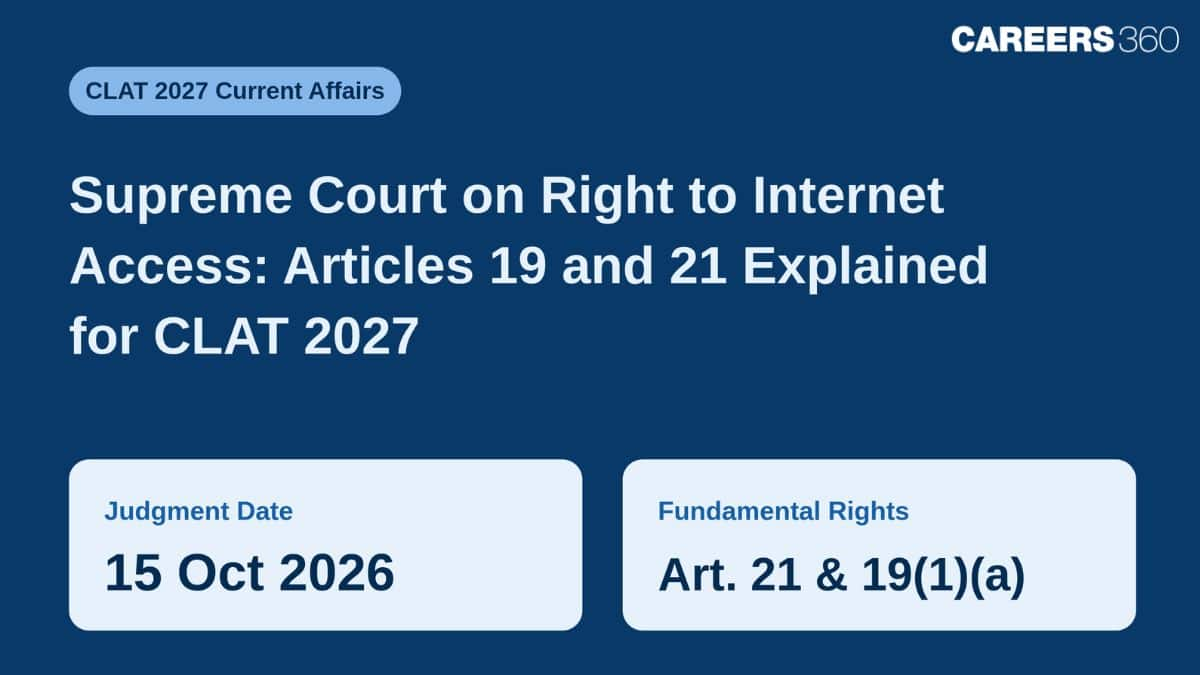
On October 15, 2026, the Supreme Court did something that matters well beyond the courtroom: it recognised the right to access and use the internet as a fundamental right, reading it into Article 21 (right to life and personal liberty) and Article 19(1)(a) (freedom of speech and expression). The Court also rejected the idea that blanket restrictions on children’s internet access are the answer to online abuse.
For CLAT 2027 aspirants, this is exactly the kind of development to have at your fingertips. The CLAT 2027 Legal Reasoning and CLAT 2027 current affairs sections regularly draw on recent constitutional rulings, and a judgment that links two of the most-tested Fundamental Rights (Articles 19 and 21) with technology, child protection and state regulation is a strong candidate for a passage or a CLAT 2027 GK question. Here is what happened and why it matters for your CLAT 2027 preparation.
A Bench of Justices J.B. Pardiwala and K. Vinod Chandran observed while dealing with concerns relating to children’s online safety and the circulation of Child Sexual Exploitation and Abuse Material (CSEAM). The Court rejected the idea of a blanket age-based ban on internet access for children.
What happened: The Supreme Court of India heard concerns about child sexual exploitation and abuse material, or CSEAM, being shared online.
What was the concern: How do we protect children without completely cutting off their internet access?
The Court said: Children have a right to use the internet, and that right must be protected by ensuring their safety.
What approach did it support: Suitable safeguards, parental guidance and stronger action against harmful content.
The Supreme Court held that blanket restrictions on children’s internet access are not an acceptable solution to online abuse.
Since the internet is now a key medium for education, information, communication and creative expression, cutting children off from it would also cut them off from these benefits.
The concern is sharpest for children in remote areas, where digital platforms may be the only route to learning opportunities that are otherwise unavailable.
Because access is now part of Article 21 read with Article 19(1)(a), any restriction on it must be justified and cannot be imposed wholesale.
This ruling follows the Court’s earlier holding in Pragya Prasun v. Union of India (2025), where it recognised that access to the digital world is an intrinsic part of the right to life.
Attempt Free Official Practice Test & Solutions and Ace the CLAT Exam 2026
The Constitutional law does not contain a separate article called the “Right to Internet." Courts have recognised its protection through existing fundamental rights.
Article | Meaning and connection with internet access |
Article 14 | Guarantees equality before the law. It is relevant when digital systems unfairly exclude people. |
Article 19(1)(a) | Protects freedom of speech and expression, including expressing views and sharing information online. |
Article 19(1)(g) | Protects the freedom to practice a profession or carry on a business, including through the internet. |
Article 19(2) | Allows reasonable restrictions on speech on specified grounds, such as public order and state security. |
Article 21 | Protects life and personal liberty. Courts have recognised digital access as part of this protection. |
Article 21A | Guarantees free and compulsory education for children aged six to fourteen. It is relevant to discussions about online education. |
The legal position developed over several years. Each of these cases added something different. The Faheema Shirin ruling connected education and privacy with Article 21. It should not be described simply as a ruling under Article 21A.
Case | Judgement |
Faheema Shirin R.K. v. State of Kerala (2019) | The Kerala High Court linked internet access with education and privacy under Article 21 while examining restrictions in a college hostel. |
Anuradha Bhasin v. Union of India (2020) | The Supreme Court protected speech and business carried out through the internet under Articles 19(1)(a) and 19(1)(g). |
Pragya Prasun v. Union of India and Amar Jain v. Union of India (2025) | The Supreme Court recognised digital access as part of Article 21 and directed changes to make digital verification accessible. |
Just Rights for Children Alliance v. S. Harish (October 2026) | The Supreme Court expressly recognised internet access and use as a fundamental right, including for children. |
Get the CLAT UG previous year question papers here
This judgment is extremely relevant for CLAT 2027 as it connects constitutional rights with the emerging questions of digital regulation.
Article 19(1)(a): Safeguard of freedom of speech and expression.
Article 21: Protects life and liberty.
Children’s rights: Children also have constitutional protections and cannot be denied internet access simply because they are kids.
Proportionality. Restrictions on digital access should be reasonable and no more than is necessary.
Digital safety: Online platforms might have to implement stronger child protection mechanisms.
CSEAM: The ruling is closely related to efforts to identify and eliminate child sexual exploitation material online.
Scholars’ Round Deadline: 14th Nov’26 | Earn upto 50% merit Scholarship + 10% for top performers | EFMD Accredited | AACSB (USA) & AMDISA Member | Highest CTC 28 LPA
BA LLB, BBA LLB, or BCom LLB and LLB | LLM 1 Year – 4 Specializations | Approved by BCI | Highest CTC 9 LPA
For CLAT 2027 preparation in the CLAT GK syllabus 2027, this case is important for understanding how fundamental rights evolve in response to technology, and how courts balance freedom, privacy, child safety and State regulation in the digital age.
CLAT 2027 aspirants can read the following current affairs topics to stay updated on important national and international events and strengthen their preparation for the CLAT 2027 GK and Current Affairs section.

On Question asked by student community
Hello Miruthula,
For CLAT PG 2027, you need to focus on the core subjects of your LLB curriculum, particularly the following:
Constitutional Law
Jurisprudence
Administrative Law
Law of Contract
Law of Torts
Family Law
Criminal Law
Property Law
Company Law
Public International Law
Tax Law
Environmental Law
Labour and Industrial
Hello Student,
The full form of the CLAT exam is the Common Law Admission Test. You can check the link related to the CLAT exam
https://law.careers360.com/articles/what-is-clat-full-form-all-about-nlus-entrance-exam
Hello Student,
Here are the Careers360 CLAT 2027 Mock Test Resources for your exam preparation.
1. Online CLAT Mock Test
2. CLAT Mock Tests and Solutions
Hello student,
CLAT 2027 aspirants can access these monthly current affairs compilations for regular revision. Use these resources to stay updated with important events and topics for CLAT 2027.
|
Particular |
Download PDF |
|
CLAT Current Affairs- August Month (2026) |
|
|
CLAT Current Affairs- |
If you have only two months, use a highly structured plan: daily current affairs, English reading, legal reasoning practice, logical reasoning sets, basic quantitative practice and regular full-length mocks. Spend as much time analysing incorrect questions as taking the mock itself. Consistency during these two months can make a substantial

Ranked #18 amongst Institutions in India by NIRF | Get Upto 100% Scholarships | Spot Admissions via CUET
NAAC A++ Approved | Curriculum Aligned with BCI & UGC
Scholars’ Round Deadline: 14th Nov’26 | Earn upto 50% merit Scholarship + 10% for top performers | EFMD Accredited | AACSB (USA) & AMDISA Member | Highest CTC 28 LPA
BA LLB, BBA LLB, or BCom LLB and LLB | LLM 1 Year – 4 Specializations | Approved by BCI | Highest CTC 9 LPA
India's Largest University | NAAC A++ Accredited | THE-2027 Ranked 4th in India | Highest CTC: INR 2.5 Cr | Top 25% Average Salary: INR 10.2 LPA | 2225+ Recruiters
Grade 'A+' Accredited by NAAC | Ranked 33rd in India by NIRF