School of Law, UPES, Dehradun
Ranked #18 amongst Institutions in India by NIRF | Get Upto 100% Scholarships | Spot Admissions via CUET


The Indian freedom struggle saw a unified participation of people and icons from all castes and creeds. In 1922, a young barrister trained at the Inner Temple of London’s Inn of Courts stood before a British Court defending himself against charges of sedition. The man was Mahatma Gandhi, and instead of denying the charges, he pleaded guilty, while simultaneously turning his sentencing statement into a political indictment of the colonial system. This is just one of the many legal battles that many Indian freedom fighters fought and won before finally getting to the road to freedom. In this article, we look at five such legal icons - Mahatma Gandhi, Jawaharlal Nehru, Muhammad Ali Jinnah, Sardar Vallabhbhai Patel, and Dr B.R. Ambedkar.
This Story also Contains
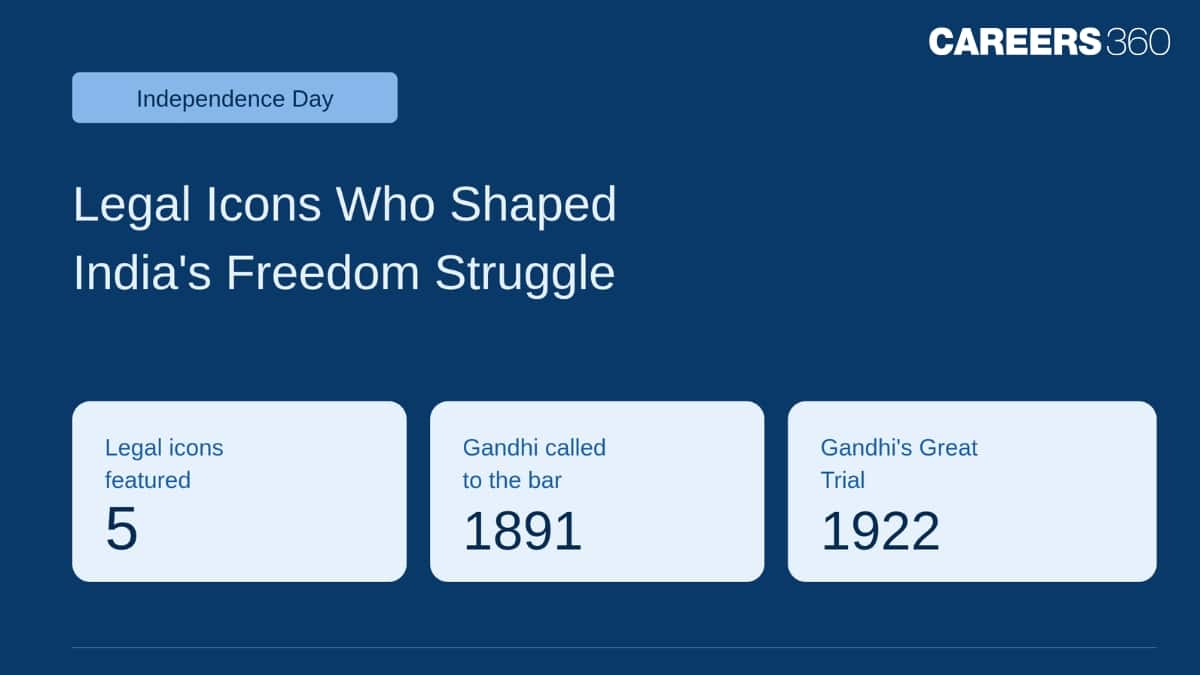
Mohandas Karamchand Gandhi, known by the masses as Mahatma Gandhi, was the face of India’s freedom struggle. Gandhi studied law from the famous Inner Temple of London’s historic Inns of Court. He was later called to the bar in 1891 before returning briefly to India. Later, Gandhi practised law in South Africa from 1893 to 1914. Gandhi’s legal achievements include The Great Trial of 1922, where he was tried for sedition under Section 124A of the Indian Penal Code in Ahmedabad for articles published in Young India. He pleaded guilty to all the charges against him and was sentenced to six years in prison.
However, Gandhi used his sentencing statement to explain and justify his political opposition. With all of his years of study of law, Gandhi mastered civil disobedience combined with acceptance of legal consequences. Other famous legal cases involving Mahatma Gandhi were the Champaran Cases (1917), the Ahmedabad Mill Strike-related case (1918), the Salt Satyagraha prosecutions (1930), etc.
Ranked #18 amongst Institutions in India by NIRF | Get Upto 100% Scholarships | Spot Admissions via CUET
Scholars’ Round Deadline: 14th Nov’26 | Earn upto 50% merit Scholarship + 10% for top performers | EFMD Accredited | AACSB (USA) & AMDISA Member | Highest CTC 28 LPA
Like Gandhi, Jawaharlal Nehru also studied law at the Inner Temple of London’s Inn of Courts. Nehru was called to the bar in 1912, after which he returned to India. After returning home, Nehru enrolled as a barrister at the Allahabad High Court. During his leadership days at Congress, he played a major role in its campaign to challenge colonial laws through civil disobedience.
The major legal spectacle in his life came when, in 1945, he donned his barrister’s gown after decades of not practising law in connection with the INA trials. Nehru, however, was not the principal lawyer, but was a member of the INA defence committee, which also included other prominent lawyers like Bhulabhai Desai, Asaf Ali, Tej Bahadur Sapru and Kailash Nath Katju. Another notable legal involvement of Nehru was in the Gorakhpur trials in 1940, where he challenged the political basis of British rule and criticised the suspension of elected institutions and the expansion of government powers during the war.
Muhammad Ali Jinnah, who is also known as ‘Father of Pakistan’, was among the prominent figures of the Indian Independence movement. Jinnah also studied law at Lincoln's Inn, one of London’s famous Inns of Court. He was called to the bar in 1896, after which he returned to India in the same year. Jinnah then started his legal career in Bombay (now called Mumbai). The Karachi-born barrister played a major role in the famous Bal Gangadhar Tilak's sedition trial in 1916. Jinnah appeared as one of the lawyers in defence of Tilak’s sedition trial, which was prosecuted under the colonial sedition provisions for writings published in Kesari. Tilak was acquitted in this trial.
Jinnah played a major role in gathering protesters and mobilising political pressure when Annie Besant was arrested, as the movement was garnering nationwide agitation and attention. The Muslim League leader also strongly opposed the Rowlatt Act in 1919. Jinnah also resigned from the Imperial Legislative Council after the Act was passed. Apart from this, his legal expertise also played a major role in debates around the constitutional reforms introduced through the Government of India Acts, especially the Government of India Act, 1935.
Sardar Vallabh Bhai Patel also enjoyed a substantial legal career before stepping into full-time politics. Due to a lack of funds, Patel started his legal training in India and cleared the District Pleader's examination in 1900 in Godhra. Later, Patel went to England in 1910, completing his legal training at the Middle Temple of the Inns of Court, and was called to the bar in 1913. The same year, he returned to India and applied for enrolment in the Bombay High Court. However, he did not practice at the Bombay HC and moved to Ahmedabad, establishing himself as a successful advocate.
Patel gained prominence as a nationalist lawyer after he represented the farmers in negotiations with the British authorities in the Kheda Satyagraha. This particular satyagraha stemmed from an issue concerning land revenue collection in Kheda district after crop failure and poor agricultural conditions. Later, Patel led the Borsad Satyagraha in 1923, a campaign that led the government to withdraw a punitive tax/levy imposed on residents in the Borsad area. The most important legal dispute associated with Patel was the Bardoli Satyagraha. The “iron man of India” led this campaign of non-payment of the enhanced revenue after the Bombay government had increased land revenue assessments in Bardoli.
Dr BR Ambedkar studied at Elphinstone College, Bombay, and graduated from the University of Bombay in 1912. Later, he went to the United States, where he obtained an M.A. from Columbia University in 1915. In 1916, Ambedkar went to London’s Gray’s Inn to study law, but had to return the next year due to financial constraints. He went back to London in 1920 with financial assistance from Shahu Maharaj of Kolhapur, along with other funds, to complete his studies.
Ambedkar gained huge credibility as a lawyer in the Phillip Spratt sedition case in 1927, where Ambedkar appeared as a junior counsel for Spratt's defence. Spratt, one of the founders of the Communist Party of India, was charged with sedition over a pamphlet titled “India and China.” Ambedkar argued that the pamphlet was a general commentary on imperialism and did not specifically attack the Government of India. He eventually was successful in the argument, and Spratt was acquitted. Ambedkar was also highly involved in the Mahad / Chavdar Tank litigation, Simon Commission proceedings 1928, Poona Pact 1932, etc. Ambedkar was also an important part of the Round Table Conferences in London concerning India's constitutional future.
Apart from the five figures being talked about above, many lawyers and legal icons played a major role in the fight for India’s independence. Among them were Chittaranjan Das, Motilal Nehru, Tej Bahadur Sapru, Bhulabhai Desai, K.M. Munshi, Rajendra Prasad, Asaf Ali, Saifuddin Kitchlew, Madan Mohan Malaviya and many more who used their legal expertise and nationalist agenda to shape India’s struggle for independence.

On Question asked by student community
Hello Student,
Here are the Careers360 CLAT 2027 Mock Test Resources for your exam preparation.
1. Online CLAT Mock Test
2. CLAT Mock Tests and Solutions
Hello student,
CLAT 2027 aspirants can access these monthly current affairs compilations for regular revision. Use these resources to stay updated with important events and topics for CLAT 2027.
|
Particular |
Download PDF |
|
CLAT Current Affairs- August Month (2026) |
|
|
CLAT Current Affairs- |
If you have only two months, use a highly structured plan: daily current affairs, English reading, legal reasoning practice, logical reasoning sets, basic quantitative practice and regular full-length mocks. Spend as much time analysing incorrect questions as taking the mock itself. Consistency during these two months can make a substantial
You can download the CLAT previous years' question papers from here:
https://law.careers360.com/articles/clat-previous-year-question-papers
https://law.careers360.com/download/clat-sample-papers-previous-years
For CLAT 2027 UG, candidates need to have passed Class 12/equivalent with at least 45% marks, or 40% for SC/ST/PwD candidates.
In your situation, having an RT in an additional subject but subsequently passing the required qualification through an improvement examination does not automatically make you ineligible. However, the important

Ranked #18 amongst Institutions in India by NIRF | Get Upto 100% Scholarships | Spot Admissions via CUET
Scholars’ Round Deadline: 14th Nov’26 | Earn upto 50% merit Scholarship + 10% for top performers | EFMD Accredited | AACSB (USA) & AMDISA Member | Highest CTC 28 LPA
Moot Court | Mock trials | Legal Aid Clinic | Recruiting Partners: FICCI, TCS, Adani, Trilegal, and many others
NAAC A+ Accredited University
Law Admissions 2026 Open | Avail Merit-Based Scholarships
NAAC A++ Accredited | Ranked #11 by NIRF