School of Law, UPES, Dehradun
Ranked #18 amongst Institutions in India by NIRF | Get Upto 100% Scholarships | Spot Admissions via CUET


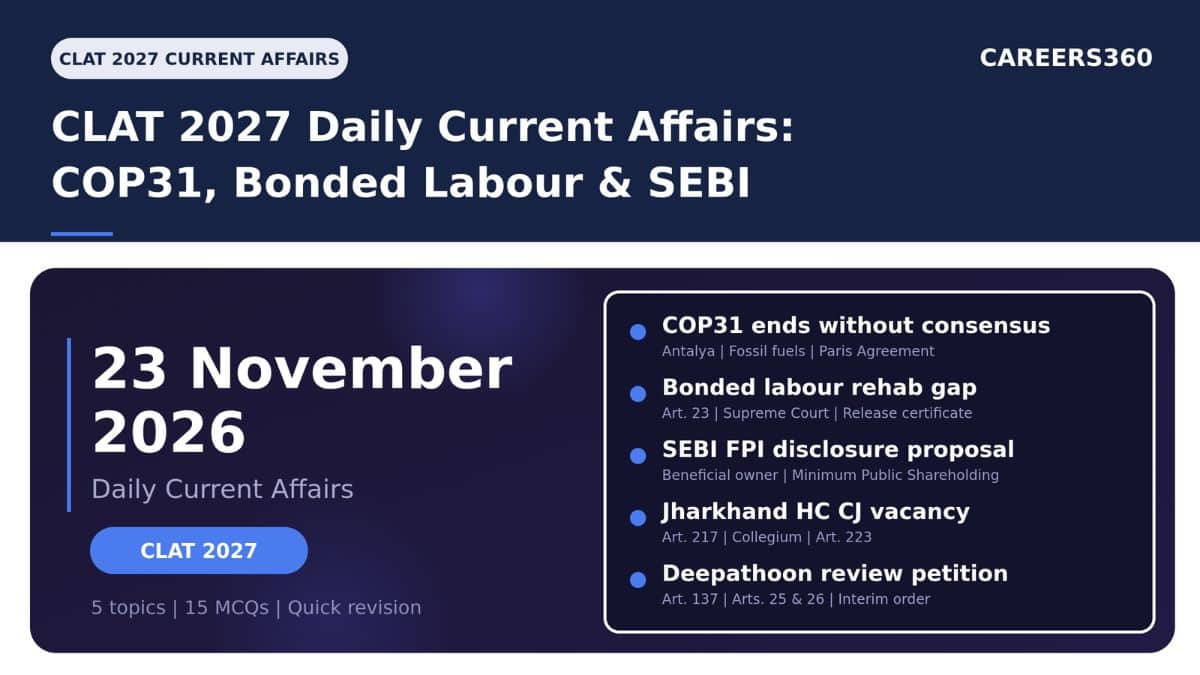
Today's CLAT 2027 current affairs cover five important topics from international affairs, law, economy, the judiciary and religion. These include COP31, the Supreme Court's bonded labour directions, SEBI's FPI disclosure proposal, Jharkhand High Court appointments and the Deepathoon dispute. These topics help CLAT exam aspirants understand current events along with the legal and constitutional issues behind them. Each section includes key facts, legal terms, and MCQs to practise for the exam.
In the news: The COP31 climate summit in Antalya, Türkiye, ended without an agreement on future climate action. The 12-day summit ran 48 hours beyond its scheduled closing time. The European Union and over 130 countries opposed the final text because it did not clearly mention moving away from fossil fuels. The summit president said no new text would be presented.
India, China and Saudi Arabia supported the proposed text. Environment Minister Bhupendra Yadav said climate targets must be backed by finance and technology. The EU opposed attempts to “greenwash” fossil fuels, while Panama called the lack of a firm commitment to the 1.5°C target a setback. COP31 was the first summit since the UN confirmed that global temperatures were set to cross the 1.5°C limit.
COP: The Conference of the Parties, which is the decision-making body of the UN Framework Convention on Climate Change (UNFCCC).
Consensus: Countries must agree on a decision. Even one country's objection can prevent a common text from being adopted.
Paris Agreement: Aims to keep global warming well below 2°C and make efforts to limit it to 1.5°C.
Common but differentiated responsibilities: Recognises that developed and developing countries have different responsibilities. Developing countries also seek financial and technology support.
Phase-out vs phase-down: Phase-out means ending the use of something, while phase-down means gradually reducing it. The wording on fossil fuels remains a major point of disagreement.
Q1. The Paris Agreement aims to limit global warming to well below 2°C and pursue efforts to keep it at which level?
A. 1°C
B. 1.5°C
C. 2.5°C
D. 3°C
Answer: B
Q2. Why could COP31 not adopt the proposed text despite support from a majority of countries?
A. Decisions are taken only by majority vote
B. Decisions require consensus, and objections can block the final text
C. The UN Secretary-General rejected the proposal
D. Only the host country can approve the text
Answer: B
Q3. India's statement that climate targets must be supported by finance and technology reflects which principle?
A. Developing countries need support to meet climate commitments
B. Climate action is optional
C. Only developed countries must reduce emissions
D. Fossil fuels are completely banned under the UNFCCC
Answer: A
Attempt Free Official Practice Test & Solutions and Ace the CLAT Exam 2026
In the news: Bonded labourers rescued from Telangana, Uttar Pradesh, Chhattisgarh and Maharashtra said they were struggling to receive rehabilitation money under the Central Sector Scheme. More than 200 people have been traced and rescued in recent years by officials, police, lawyers and the National Campaign Committee for Eradication of Bonded Labour (NCCEBL). One woman said no FIR had been registered more than a month after her rescue from domestic work in Delhi.
The campaign's convener said the Supreme Court's November 2 judgment directs authorities to issue a uniform release certificate within 24 hours of rescue and provide financial assistance within seven days. Some workers also alleged that their thumbprints were taken on documents without explanation before they were sent to a brick kiln in Telangana.
Article 23: Prohibits human trafficking and forced labour, including begar.
Article 21: Protects the right to life and personal liberty. Bonded labour also violates a person's right to live with dignity.
Bonded Labour System (Abolition) Act, 1976: Abolishes bonded labour and frees workers from their related debts.
Release certificate: An official document confirming that a person has been freed from bonded labour. It helps the worker claim rehabilitation benefits.
Implementation gap: The difference between what a court orders and what government authorities actually do.
Q1. Which Article of the Constitution prohibits forced labour and human trafficking?
A. Article 21
B. Article 23
C. Article 24
D. Article 19(1)(g)
Answer: B
Q2. Why is a release certificate important for a rescued bonded labourer?
A. It helps the worker access rehabilitation benefits
B. It automatically provides a government job
C. It cancels every criminal case
D. It is required only for child labourers
Answer: A
Q3. The Supreme Court has fixed timelines for issuing certificates and providing financial aid, but workers still face delays. What does this show?
A. The gap between court directions and their implementation
B. That courts cannot issue directions
C. That bonded labour is legally permitted
D. That the rehabilitation scheme has been cancelled
Answer: A
In the news: SEBI proposed removing the Additional Disclosure Framework (ADF) for foreign portfolio investors (FPIs) in a discussion paper released on November 20. The proposal comes after FPIs withdrew more than Rs 5.61 lakh crore ($62.24 billion) from Indian equities between October 2024 and October 2026. SEBI said the rules on identifying and disclosing the actual owners of investments needed a review.
Congress leader Jairam Ramesh criticised the proposal. He said SEBI introduced the ADF in June 2023 to prevent investors from bypassing rules such as Minimum Public Shareholding. The move followed the Hindenburg report and a Supreme Court-appointed committee's finding that SEBI could not identify the owners behind some funds. Sovereign wealth funds, pension funds and other regulated funds were already exempt.
Foreign Portfolio Investor (FPI): A foreign investor who buys shares or bonds in another country without taking control of the company.
Beneficial owner: The actual person who ultimately owns or controls an investment, even if it is held through companies or funds.
Minimum Public Shareholding: A rule requiring a minimum portion of a listed company's shares to be held by public investors.
SEBI: The Securities and Exchange Board of India regulates the securities market under the SEBI Act, 1992.
Regulatory balance: SEBI must balance the need to attract foreign investment with transparency and fair market practices.
Q1. Who is a beneficial owner in securities regulation?
A. The person who ultimately owns or controls an investment
B. The broker who places the trade
C. The stock exchange
D. The company's auditor
Answer: A
Q2. Why do regulators ask investors to disclose their ultimate owners?
A. To prevent hidden ownership and misuse of rules such as Minimum Public Shareholding
B. To increase share prices
C. To stop all foreign investment
D. To reduce income tax
Answer: A
Q3. SEBI's proposal aims to make investment rules easier, while critics fear a loss of transparency. What is the main issue here?
A. Attracting investment while protecting market transparency
B. Federalism versus secularism
C. Freedom of speech versus privacy
D. Direct taxes versus indirect taxes
Answer: A
Get the CLAT UG previous year question papers here
In the news: Jharkhand Chief Minister Hemant Soren has written to Chief Justice of India Surya Kant and the Supreme Court Collegium, asking them to recommend a successor to Jharkhand High Court Chief Justice M.S. Sonak. Justice Sonak is due to retire on November 27. In his November 12 letter, Soren said frequent changes and long periods without a permanent Chief Justice affect court administration and planning.
He pointed out that no successor has been named and no judge has been transferred in advance to take charge. He said this goes against the process and timelines set out in the Memorandum of Procedure and the Collegium's February 26 statement.
Article 217: Deals with the appointment and conditions of office of High Court judges. The President appoints them after the required consultations.
Collegium system: The system through which senior judges of the Supreme Court recommend appointments and transfers of judges.
Memorandum of Procedure (MoP): Sets out the process followed for appointing and transferring judges.
Article 223: Allows the President to appoint an acting Chief Justice when the office of a High Court Chief Justice is vacant or the Chief Justice cannot perform duties.
Judicial continuity: Timely appointments help courts manage cases and avoid disruption in administration.
Q1. Which Article deals with the appointment of High Court judges?
A. Article 124
B. Article 217
C. Article 226
D. Article 233
Answer: B
Q2. Which body recommends names for the appointment of High Court Chief Justices under the current collegium system?
A. The Law Minister alone
B. The Supreme Court Collegium
C. The Election Commission
D. The Governor alone
Answer: B
Q3. Under which Article can the President appoint an acting Chief Justice of a High Court?
A. Article 222
B. Article 223
C. Article 224
D. Article 225
Answer: B
In the news: Tamil Nadu's Hindu Religious and Charitable Endowments (HR&CE) Department filed a review petition against the Supreme Court's interim order in the Deepathoon dispute. The plea came two days before the Karthigai Deepam lamp-lighting scheduled for November 24. The Supreme Court had stayed the Madras High Court's January 6 direction but allowed the lamp to be lit on the Deepathoon, a stone pillar near a dargah on Thirupparankundram Hill, as a one-time arrangement.
The HR&CE Commissioner argued that the order contains an “error apparent on the face of the record”. The department said the Court had stayed the High Court's direction but had still allowed the lamp to be lit on the same pillar.
Review petition: A request asking the same court to reconsider its judgment. The Supreme Court's power to review its decisions comes from Article 137.
Grounds for review: These include a clear error in the judgment, discovery of new evidence or another sufficient reason.
Interim order: A temporary direction issued by a court while the main case is still pending.
Articles 25 and 26: Protect freedom of religion and the right of religious groups to manage their own affairs, subject to public order, morality and health.
Public order: The State can take steps to maintain peace when disputes or competing claims risk disturbing public order.
Q1. Which Article gives the Supreme Court the power to review its own judgments?
A. Article 136
B. Article 137
C. Article 141
D. Article 142
Answer: B
Q2. What does “error apparent on the face of the record” mean in a review petition?
A. A clear mistake that can be seen from the case record
B. A request for a completely new trial
C. An appeal to a higher court
D. A challenge to the judge's appointment
Answer: A
Q3. The freedom of religion under Articles 25 and 26 is subject to which conditions?
A. Public order, morality and health
B. No restrictions
C. Only the wishes of the majority
D. Approval of the State government in every case
Answer: A
The following points cover the important facts and developments from today's news for a quick revision before the CLAT 2027 exam.
COP31: Climate summit ends without consensus after 48 hours of overtime; disagreement over the mention of fossil fuels in the final text.
Bonded labour: Supreme Court directs authorities to issue release certificates within 24 hours and provide financial assistance within seven days.
SEBI: Proposes removing the Additional Disclosure Framework for foreign portfolio investors.
FPI outflows: More than Rs 5.61 lakh crore withdrawn from Indian equities between October 2024 and October 2026.
Jharkhand High Court: Chief Justice M.S. Sonak retires on November 27; CM Hemant Soren asks the Collegium to name a successor.
Deepathoon dispute: Tamil Nadu files a review petition against the Supreme Court's interim order.
Parliament: Remains unprorogued for a record 100 days since August 13.
Nepal PM Balendra Shah: Makes his first official visit to India; talks with PM Modi include energy and connectivity.

On Question asked by student community
Hello Student,
You can refer to the following Careers360 resources to study Law of Contracts for CLAT Legal Reasoning:
Contract Law – Chapter-wise Study Material:
https://www.careers360.com/legal-studies/contract-law-chapter-pge
Contract Law and Tort Basics for CLAT 2027:
https://law.careers360.com/articles/contract-law-and-tort-basics-for-clat-2027-legal-reasoning
Hello Lavina,
For CLAT 2028 preparation, students should choose an online coaching programme that offers comprehensive study material, regular mock tests, current affairs updates, doubt-solving sessions and expert guidance. Compare course features, faculty experience and student reviews before selecting a coaching programme.
Hello Miruthula,
For CLAT PG 2027, you need to focus on the core subjects of your LLB curriculum, particularly the following:
Constitutional Law
Jurisprudence
Administrative Law
Law of Contract
Law of Torts
Family Law
Criminal Law
Property Law
Company Law
Public International Law
Tax Law
Environmental Law
Labour and Industrial
Hello Student,
The full form of the CLAT exam is the Common Law Admission Test. You can check the link related to the CLAT exam
https://law.careers360.com/articles/what-is-clat-full-form-all-about-nlus-entrance-exam
Hello Student,
Here are the Careers360 CLAT 2027 Mock Test Resources for your exam preparation.
1. Online CLAT Mock Test
2. CLAT Mock Tests and Solutions

Ranked #18 amongst Institutions in India by NIRF | Get Upto 100% Scholarships | Spot Admissions via CUET
NAAC A++ Approved | Curriculum Aligned with BCI & UGC
UG Scholar's Round Deadline: 1st Dec'26 | Earn upto 50% merit Scholarship + 10% for top performers | Highest CTC 18 LPA
Grade 'A+' Accredited by NAAC | Ranked 33rd in India by NIRF
Moot Court | Mock trials | Legal Aid Clinic | Recruiting Partners: FICCI, TCS, Adani, Trilegal, and many others
NAAC A++ Accredited | Avail up to 100% scholarship via MRNAT-Manav Rachna National Aptitude Test