Amity Law School, Noida
Experiential Learning through Legal Aid Camps, Lok Adalats, Court Visits, Community Lawyering and regular Moot Court sessions


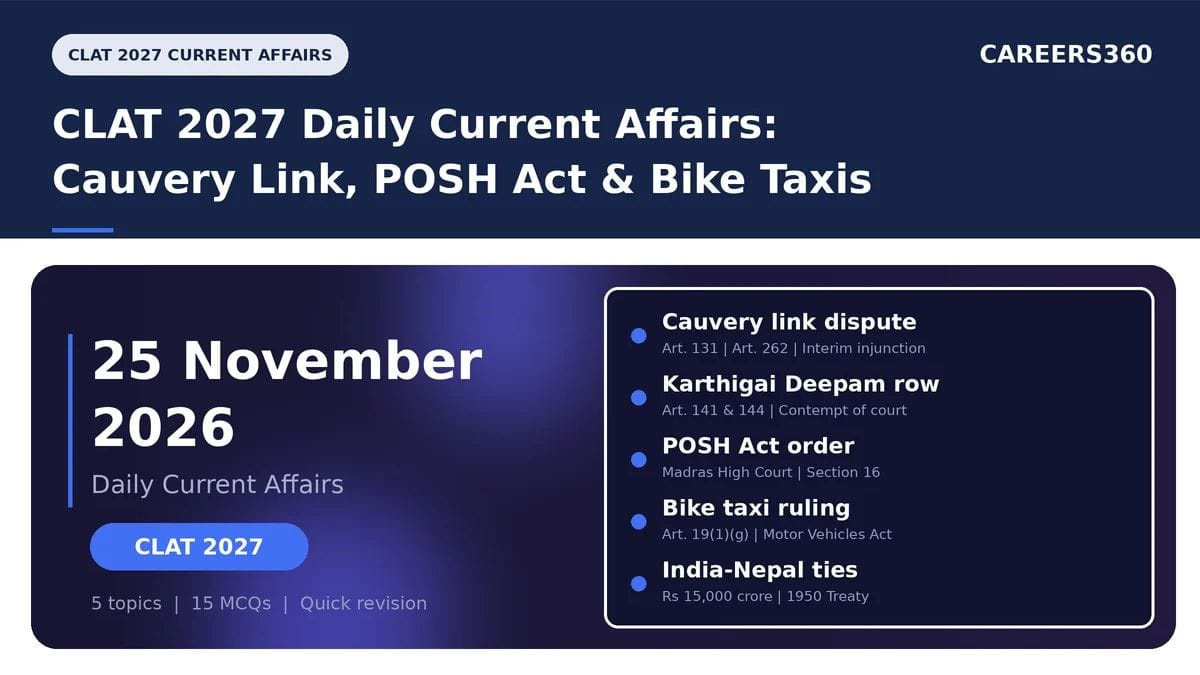
Today's CLAT 2027 current affairs cover five topics from law, governance, transport and international relations. These include the Cauvery link dispute, Karthigai Deepam row, POSH Act order, bike taxi ruling and India-Nepal ties. These developments are important for CLAT 2027 as they connect current news with constitutional provisions, court judgments and important laws. Candidates can refer to the key facts and legal concepts below, followed by MCQs for CLAT 2027 preparation.
In the news: Karnataka has asked the Supreme Court to temporarily stop Tamil Nadu and the Union government from proceeding with the Cauvery-South Vellar-Vaigai-Gundar Link (CVG Link) project. The plea is part of its existing case against the project. Tamil Nadu sought the Centre's in-principle approval and national project status on January 5, 2021. The Supreme Court disposed of a similar plea last January because the Centre had not approved the project.
Karnataka now says a Madras High Court order quoted a Tamil Nadu status report showing that Phase-I work began on January 21, 2021. It alleges that this information was not shared with the Supreme Court. Karnataka wants the ongoing work stopped. The matter is likely to be heard on December 10.
Article 131: Gives the Supreme Court original jurisdiction in certain disputes between the Centre and States or between States.
Article 262: Allows Parliament to make laws for inter-State river disputes and exclude courts from hearing them.
Interim injunction: A temporary court order that stops a party from taking a particular action until the case is decided.
Suppression of facts: Parties must disclose important facts to the court. Hiding relevant information can affect their claim for relief.
Water in the Constitution: Water is mainly a State subject under Entry 17 of List II. The Union can regulate inter-State rivers under Entry 56 of List I.
Q1. Which Article gives the Supreme Court original jurisdiction in certain disputes between States?
A. Article 32
B. Article 131
C. Article 136
D. Article 226
Answer: B
Q2. Why does a court grant a temporary injunction?
A. To give a final decision
B. To maintain the position until the dispute is decided
C. To dismiss the case
D. To transfer the case to a tribunal
Answer: B
Q3. A person approaches a court but hides important facts about the case. What can the court do?
A. Refuse relief because the person has not made a full and fair disclosure
B. Grant relief automatically
C. Transfer the case to another court
D. Ignore the missing information
Answer: A
Attempt Free Official Practice Test & Solutions and Ace the CLAT Exam 2026
In the news: The Thirupparankundram temple lit the Karthigai Deepam on Tuesday at its traditional spot, not at the newly identified deepathoon on the hill. The Supreme Court had allowed the lamp to be lit at the deepathoon as a one-time arrangement. Earlier, the Madurai Bench of the Madras High Court recorded the District Collector's promise to follow the Supreme Court's order. The temple trustees, however, decided to use the usual location.
The district administration said the temple did not authorise its team to light the lamp. BJP leaders and Hindu groups protested, and police detained several leaders. Allies of the ruling TVK welcomed the temple's decision. Tamil Nadu had also filed a review petition against the Supreme Court's order.
Article 141: The law declared by the Supreme Court binds all courts in India.
Article 144: All civil and judicial authorities must act in aid of the Supreme Court.
Contempt of court: Wilful disobedience of a court order can amount to contempt. The Supreme Court and High Courts have this power under Articles 129 and 215, respectively.
Undertaking to court: A promise given to a court and recorded in its order is binding on the person who gives it.
Articles 25 and 26: Protect religious freedom and the right of religious groups to manage their affairs, subject to public order, morality and health.
Q1. Under which Article must all authorities act in aid of the Supreme Court?
A. Article 142
B. Article 143
C. Article 144
D. Article 145
Answer: C
Q2. Which Articles give the Supreme Court and High Courts the power to punish for contempt?
A. Articles 129 and 215
B. Articles 14 and 21
C. Articles 32 and 226
D. Articles 368 and 370
Answer: A
Q3. An official gives an undertaking to a High Court to follow a Supreme Court order but later fails to do so. What can happen?
A. Nothing, because an undertaking is informal
B. The court may take action because the undertaking is binding
C. The undertaking is automatically cancelled
D. Only the District Collector can take action
Answer: B
In the news: Tamil Nadu Police told the Madras High Court that an FIR had been registered against a sitting legislator for allegedly misbehaving with a woman IAS officer. Justice V. Lakshminarayanan appointed a Superintendent of Police to investigate the case and an IG-level officer to monitor the probe, noting that the accused holds a constitutional office. He also directed the Chief Secretary to set up an Internal Complaints Committee (ICC) under the POSH Act, 2013.
The court barred the media from publishing details protected under Section 16 of the Act, including the woman's identity and information about witnesses. It also ordered prosecution of those who violate the restriction and said the press should have shown greater sensitivity.
POSH Act, 2013: Protects women from sexual harassment at the workplace and provides a process for handling complaints.
Internal Complaints Committee (ICC): A workplace committee that receives and investigates sexual harassment complaints.
Section 16: Bars publication of complaint details, inquiry proceedings and the identity of the woman or witnesses.
Vishaka judgment (1997): The Supreme Court laid down workplace sexual harassment guidelines before the POSH Act was enacted.
Separate proceedings: A criminal case and a workplace inquiry under the POSH Act can run at the same time.
Q1. Which Supreme Court judgment laid down guidelines against workplace sexual harassment before the POSH Act was enacted?
A. Vishaka v. State of Rajasthan
B. Nandini Sundar v. State of Chhattisgarh
C. Olga Tellis v. Bombay Municipal Corporation
D. Joseph Shine v. Union of India
Answer: A
Q2. Why does Section 16 of the POSH Act restrict the publication of a woman's identity and complaint details?
A. To protect her privacy and prevent public disclosure of sensitive information
B. To help the accused avoid investigation
C. To stop the police from registering an FIR
D. To prevent the ICC from conducting an inquiry
Answer: A
Q3. Can a criminal case and an internal workplace inquiry under the POSH Act proceed at the same time?
A. No, only one proceeding is allowed
B. Yes, both are separate proceedings
C. Only with the Chief Secretary's permission
D. Only if the accused agrees
Answer: B
Get the CLAT UG previous year question papers here
In the news: On November 20, the Supreme Court dismissed Karnataka's appeal, allowing motorcycles to be registered as transport vehicles. Karnataka launched an electric bike-taxi scheme in 2021 but withdrew it in 2024 over safety concerns and driver disputes. Bengaluru has around 7,000 buses, against a target of 13,000 for 2025.
The Centre's 2025 Motor Vehicle Aggregator Guidelines allow States to permit privately registered motorcycles to operate through aggregators. A Road Transport Ministry figure cited by The Hindu shows that two-wheeler users account for 46.2% of road deaths. The editorial has called for aggregators to report road injuries and deaths.
Motor Vehicles Act, 1988: Governs vehicle registration, permits and the use of motor vehicles.
Transport vehicle: A vehicle used to carry passengers or goods for payment.
Articles 19(1)(g) and 19(6): Article 19(1)(g) gives citizens the right to practise a profession or run a business. Article 19(6) allows reasonable restrictions in the public interest.
Concurrent List: Motor vehicles fall under this List, so both Parliament and State legislatures can make laws on the subject.
Public safety: Governments can regulate businesses to protect public safety, subject to constitutional limits.
Q1. Which fundamental right is most closely linked to a driver's right to operate a bike-taxi business?
A. Article 19(1)(a)
B. Article 19(1)(g)
C. Article 25
D. Article 30
Answer: B
Q2. Under Article 19(6), when can the government restrict a person's right to carry on a business?
A. When the restriction is reasonable and in the public interest
B. Whenever the government chooses
C. Only when every citizen approves
D. Only for a period of one year
Answer: A
Q3. Motor vehicles fall under the Concurrent List. What does this mean?
A. Only State governments can make laws on them
B. Both Parliament and State legislatures can make laws on them
C. Only local authorities can regulate them
D. The subject is outside the law-making powers of both
Answer: B
In the news: Nepal Prime Minister Balendra Shah made his first state visit to India, around eight months after the GenZ movement brought his party to power. India announced a Rs 15,000 crore (about $1.6 billion) development package for Nepal. It will also give the landlocked country access to ports in Gujarat and Odisha. Both sides agreed to set up an IIT campus in Nepal.
The two countries will review their bilateral treaties. However, India's position that the Eminent Persons Group report on the 1950 Friendship Treaty is "not relevant" could cause concern in Kathmandu. The boundary dispute and overflight access for two airports remain unresolved. Both sides said these issues would be settled through dialogue.
1950 Treaty of Peace and Friendship: An important agreement governing India-Nepal relations. It provides for an open border between the two countries.
Landlocked country: A country without a coastline. It depends on neighbouring countries for access to seaports and trade routes.
Joint statement: A document recording the shared positions and plans of two countries after a meeting. It is different from a legally binding treaty.
Neighbourhood First policy: India's approach to building stronger relations, trade and connectivity with neighbouring countries.
Treaty review: Countries can review or renegotiate an existing treaty if both sides agree.
Q1. What is the name of the 1950 agreement between India and Nepal?
A. Treaty of Peace and Friendship
B. Indus Waters Treaty
C. Simla Agreement
D. Tashkent Declaration
Answer: A
Q2. Why is access to Indian ports important for Nepal?
A. Nepal is landlocked and needs access to ports for international trade
B. Nepal has no rivers
C. Nepal has no airports
D. Nepal is an island country
Answer: A
Q3. What is the main purpose of a joint statement issued after a visit between two countries?
A. To record their shared positions and plans
B. To automatically create a new law
C. To amend the Constitution
D. To replace all existing treaties
Answer: A
The key facts, figures and developments from today's news are listed below for a quick revision before the CLAT exam.
Cauvery link project: Karnataka seeks a temporary injunction against Tamil Nadu's CVG Link project. Hearing is likely on December 10.
Karthigai Deepam: The temple lit the lamp at its traditional location instead of the deepathoon permitted by the Supreme Court.
POSH Act: Madras High Court orders an ICC and restricts publication of protected details under Section 16.
Bike taxis: Supreme Court dismisses Karnataka's appeal on November 20. Two-wheeler users account for 46.2% of road deaths.
India-Nepal relations: India announces a Rs 15,000 crore package, port access and an IIT campus.
Jharkhand High Court: Collegium proposes Karnataka Chief Justice Vibhu Bakhru's transfer as the new Chief Justice.
Punjab politics: Akali Dal rejoins the NDA after six years ahead of the Assembly election.
Delhi-NCR vehicles: CAQM tells the Supreme Court that over 2.36 million end-of-life vehicles are operating in Delhi-NCR.

On Question asked by student community
Hello Student,
You can refer to the following Careers360 resources to study Law of Contracts for CLAT Legal Reasoning:
Contract Law – Chapter-wise Study Material:
https://www.careers360.com/legal-studies/contract-law-chapter-pge
Contract Law and Tort Basics for CLAT 2027:
https://law.careers360.com/articles/contract-law-and-tort-basics-for-clat-2027-legal-reasoning
Hello Lavina,
For CLAT 2028 preparation, students should choose an online coaching programme that offers comprehensive study material, regular mock tests, current affairs updates, doubt-solving sessions and expert guidance. Compare course features, faculty experience and student reviews before selecting a coaching programme.
Hello Miruthula,
For CLAT PG 2027, you need to focus on the core subjects of your LLB curriculum, particularly the following:
Constitutional Law
Jurisprudence
Administrative Law
Law of Contract
Law of Torts
Family Law
Criminal Law
Property Law
Company Law
Public International Law
Tax Law
Environmental Law
Labour and Industrial
Hello Student,
The full form of the CLAT exam is the Common Law Admission Test. You can check the link related to the CLAT exam
https://law.careers360.com/articles/what-is-clat-full-form-all-about-nlus-entrance-exam
Hello Student,
Here are the Careers360 CLAT 2027 Mock Test Resources for your exam preparation.
1. Online CLAT Mock Test
2. CLAT Mock Tests and Solutions

Experiential Learning through Legal Aid Camps, Lok Adalats, Court Visits, Community Lawyering and regular Moot Court sessions
Ranked #18 amongst Institutions in India by NIRF | Get Upto 100% Scholarships | Spot Admissions via CUET
NAAC A++ Accredited | Avail up to 100% scholarship via MRNAT-Manav Rachna National Aptitude Test
NAAC A++ Approved | Curriculum Aligned with BCI & UGC
UG Scholar's Round Deadline: 1st Dec'26 | Earn upto 50% merit Scholarship + 10% for top performers | Highest CTC 18 LPA
Grade 'A+' Accredited by NAAC | Ranked 33rd in India by NIRF