School of Law, UPES, Dehradun
Ranked #18 amongst Institutions in India by NIRF | Get Upto 100% Scholarships | Spot Admissions via CUET


The SLAT 2027 topics that are considered significant for the candidate to know before appearing in SLAT 2027 include Logical Reasoning and Analytical Reasoning. Though both these topics examine the reasoning capability of a SLAT 2027 candidate, they require completely different skill sets and methodologies in solving questions.
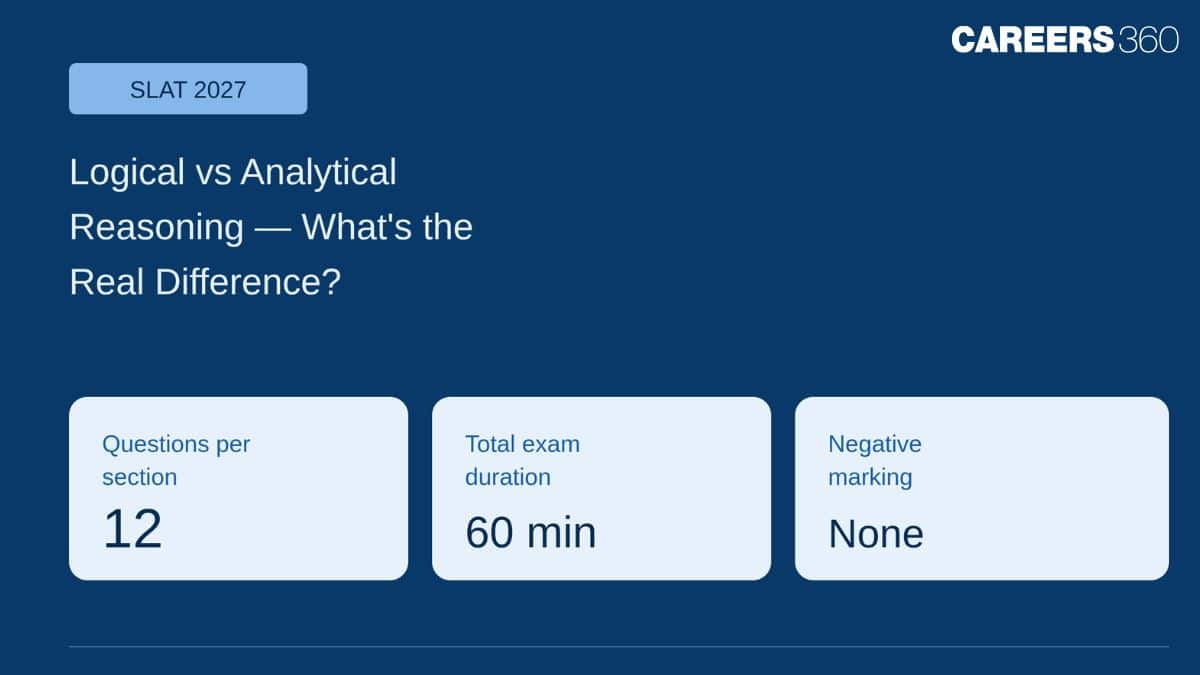
SLAT 2027 Aspirants often get confused regarding SLAT 2027 Logical Reasoning vs. Analytical Reasoning; both of these qualities in the SLAT 2027 applicant. Being aware of the distinction between these two would be of great help for SLAT 2027 preparation.
The SLAT 2027 Logical Reasoning test checks the aptitude of the candidate in comprehending the relationship between the statements and drawing logical conclusions. The questions in SLAT 2027 Logical Reasoning usually expect SLAT 2027 candidates to go through information given in a passage or a set of statements and then choose the right answer.
Some common types of SLAT 2027 Logical Reasoning Questions are:
Arguments and Conclusions
Assumption
Inference
Statements and Conclusions
Cause and Effect
Strengthening and Weakening Arguments
Logical Relationships
Critical Reasoning Questions
Ranked #18 amongst Institutions in India by NIRF | Get Upto 100% Scholarships | Spot Admissions via CUET
Scholars’ Round Deadline: 14th Nov’26 | Earn upto 50% merit Scholarship + 10% for top performers | EFMD Accredited | AACSB (USA) & AMDISA Member | Highest CTC 28 LPA
The key point here is comprehension of the relationship between information and coming to a logical conclusion.
SLAT 2027 Analytical Reasoning is more concerned with analysing the data and arriving at a pattern for answering the question. In this section, SLAT 2027 candidates are required to analyse data in terms of numbers, sequences, relationships, or any kind of data.
Some of the important sections of SLAT 2027 Analytical Reasoning are:
Number and alphabet series
Percentages
Ratio & proportion
Profit and loss
Averages
Basic calculation
Data-related questions
Pattern-related questions
In analytical reasoning, SLAT 2027 candidates are required to analyse the data and use the right methodology to answer the question.
The major difference between SLAT 2027 Logical and Analytical Reasoning lies in the type of thinking required.
Logical Reasoning | Analytical Reasoning |
Focuses on arguments, statements, and conclusions | Focuses on patterns, numbers, and structured problems |
Requires interpretation of information | Requires systematic analysis and calculation |
Tests critical and logical thinking | Tests analytical and numerical ability |
Often involves passage or statement-based questions | Often involves problem-solving and pattern-based questions |
Emphasis is on identifying valid conclusions | Emphasis is on finding relationships or solving a problem |
Even though the methods may be different, each section of the test requires the SLAT 2027 candidate to read the questions carefully without making any unsupported assumptions.
Also check: Legal Current Affairs for SLAT 2027 Aspirants
This is because each area is easy depending on the strength of the candidate. People who have good numerical skills can do well in the SLAT exam Analytical Reasoning. On the other hand, people who love to go through the reasoning and arguments of others can easily excel in SLAT 2027 Logical Reasoning.
Candidates need to do some practice questions in both areas to see which is easier for them. SLAT 2027 mock test and sectional tests will show you the areas where you always perform well.
SLAT 2027 Preparation for Logical Reasoning should consist of learning how arguments and statements are constructed. Reading editorials and opinion pieces will be helpful in developing the skills to comprehend the argument. When practising questions, one should concentrate on comprehending the reason behind the correctness of an option rather than remembering the answer.
Timed practice is essential since the candidate needs to retain accuracy as well as speed during the SLAT 2027 exam.
Also check: Legal Maxims for SLAT
Analytical Reasoning Practice Questions for SLAT 2027 require regular practice with numbers and patterns. It is advised that the candidate practice his or her basics first before proceeding to higher levels of questions.
Create a small SLAT 2027 sheet of formulas and shortcuts on topics like percentages, ratio, average, and profit/loss. Solving questions using a timer helps improve calculation speed. It is also advised that candidates go through wrong answers and figure out whether the answer was wrong due to miscalculation or approach.
Time management is especially significant in SLAT 2027 since candidates must do the whole test within a span of 60 minutes. SLAT 2027 Candidates should be careful about investing a lot of time in an intricate question on reasoning skills.
In the course of SLAT 2027 preparation, take note of the time spent in answering different types of questions. In case you come across an extremely long question, simply switch to other questions and then get back to it in case you have some time left. Remember, SLAT doesn’t have any negative marking system.
Also check: How to Solve SLAT 2027 Legal Reasoning Questions Fast
Answering the question based on the assumptions made by the SLAT 2027 candidate is one mistake that many people make when answering a multiple-choice question. The candidate must focus only on the facts and relationships in the question.
For SLAT 2027 Analytical Reasoning questions, mistakes in calculation and using the wrong formula are major causes of avoidable mistakes. For SLAT 2027 Logical Reasoning questions, misinterpreting the argument or confusing an assumption for a conclusion is another mistake that candidates might make.
Another mistake that many SLAT 2027 candidates make is practising only one format of question.
It would not be wise for SLAT 2027 candidates to neglect either section completely. Rather, they need to prepare based on their own strengths and weaknesses. They should give more attention to the section where they are less accurate but, at the same time, practice their stronger section regularly.
The best way of preparing is by doing topic-wise practice, sectional tests, and SLAT 2027 full-length mock tests.
Also check: SLAT 2027 Analytical Reasoning: Question Types & Practice Set

On Question asked by student community
Yes, the shortlisted list of candidates for the SLAT 2026 Personal Interview (PI) has been released by the respective Symbiosis Law Schools (Pune, Noida, Hyderabad, Nagpur).
Hello,
Symbiosis International University conducts the SLAT (Symbiosis Law Admission Test) entrance examination for admission to the 5 year LLB course. Four Law Schools participate in this process. They select the students after they go through the SLAT and personal interview.
Practicing the previous year questions will help you get
Hi,
You can check the SLAT previous year question papers for Slot 1 and Slot 2 on the Careers360 website. Here's the link :
https://law.careers360.com/articles/slat-2025-question-paper
Hello
The Symbiosis Law Admission Test (SLAT) 2025 results were declared on December 26, 2024 .
While the official cutoffs for Symbiosis Law Schools (SLS) have not been released yet , previous years data suggests that the expected cutoffs for SLS Pune are approximately :
BA LLB (Hons) : 45

Ranked #18 amongst Institutions in India by NIRF | Get Upto 100% Scholarships | Spot Admissions via CUET
Scholars’ Round Deadline: 14th Nov’26 | Earn upto 50% merit Scholarship + 10% for top performers | EFMD Accredited | AACSB (USA) & AMDISA Member | Highest CTC 28 LPA
Moot Court | Mock trials | Legal Aid Clinic | Recruiting Partners: FICCI, TCS, Adani, Trilegal, and many others
NAAC A+ Accredited University
BA LLB, BBA LLB, or BCom LLB and LLB | LLM 1 Year – 4 Specializations | Approved by BCI | Highest CTC 9 LPA
Grade 'A+' Accredited by NAAC | Ranked 33rd in India by NIRF