School of Law, UPES, Dehradun
Ranked #18 amongst Institutions in India by NIRF | Get Upto 100% Scholarships | Spot Admissions via CUET


Analytical Reasoning comes under the list of five topics in SLAT 2027 (Symbiosis Law Admission Test). Analytical Reasoning tests the capability of a candidate to understand patterns, numerical information, and logic to arrive at the correct answer. In compliance with the current SLAT 2027 pattern, there are 12 questions on Analytical Reasoning, each carrying 1 mark, making the total marks 12, and the time allotted for 60 questions is 60 minutes.
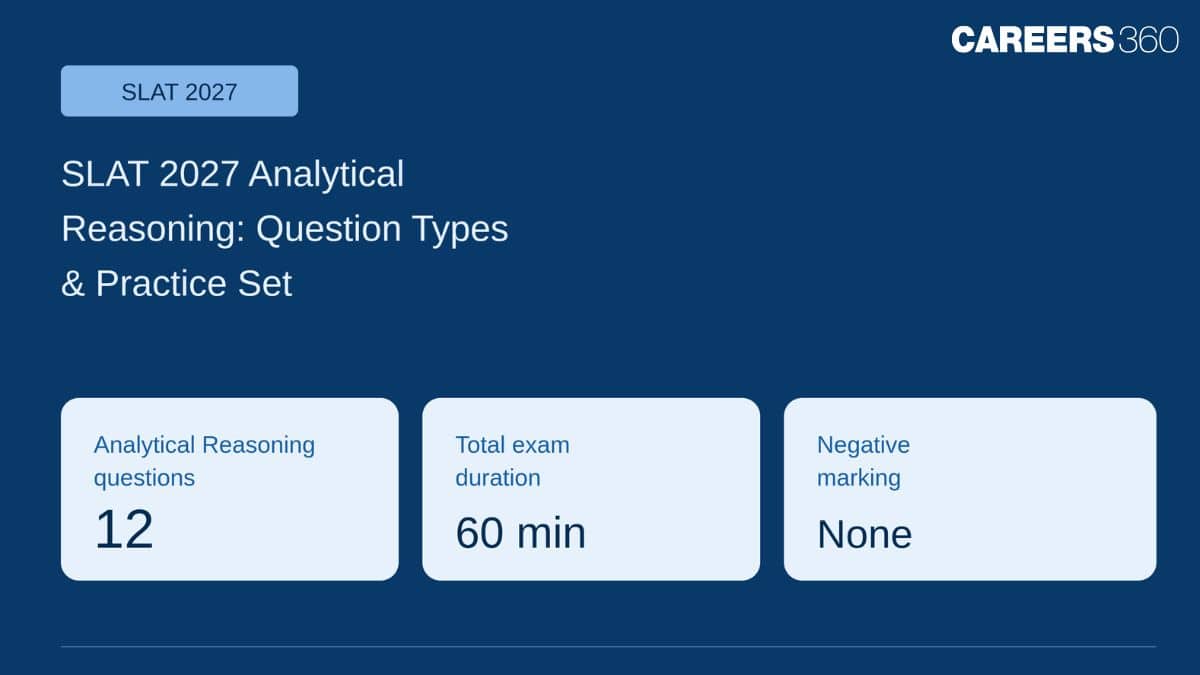
Understanding the type of Analytical Reasoning questions in SLAT 2027 becomes very important for the candidates, as the subject can take a lot of time if the approach is not known well.
SLAT 2027 Analytical Reasoning Preparation through a special practice set that comprises important questions and concepts. SLAT 2027 candidates can download the free Analytical Reasoning Practice Set in PDF format from the link given below.
SLAT 2027 Analytical Reasoning Practice Set - Free PDF |
SLAT 2027 preparation for Analytical Reasoning is usually about basic numeracy skills and pattern and data reasoning. Candidates are expected to know the question formats well before starting any practice. Some important topics include:
Patterns in numbers and alphabets
Problems based on percentages
Ratio and proportion
Profit and loss
Arithmetic operations
Problems related to data
Sequence and series
Pattern in numbers
From the SLAT exam syllabus, it can be seen that Analytical Reasoning measures basic numerical skills. So candidates need to understand how a problem is solved rather than simply learning formulae.
Regular practice of solving questions is the most effective way of preparing for Analytical Reasoning. The questions below will assist the candidate in understanding the type of approach needed. SLAT 2027 aspirants can also check out how to prepare for SLAT 2026 In 2 months.
Find the next number in the series:
2, 6, 12, 20, 30,?
A. 36
B. 40
C. 42
D. 44
Answer: C. 42
Explanation: The differences between consecutive numbers are 4, 6, 8 and 10. The next difference is 12. Therefore, 30 + 12 = 42.
A student scores 72 marks out of 100 in a test. What percentage of marks did the student score?
A. 68%
B. 70%
C. 72%
D. 74%
Answer: C. 72%
Explanation: Percentage = (Marks obtained ÷ Total marks) × 100. Therefore, (72 ÷ 100) × 100 = 72%.
The ratio of boys to girls in a class is 3:2. If there are 30 boys, how many girls are there?
A. 15
B. 20
C. 25
D. 30
Answer: B. 20
Explanation: If 3 parts represent 30 boys, one part represents 10 students. Therefore, 2 parts represent 20 girls.
A book is purchased for Rs. 400 and sold for Rs. 480. What is the profit percentage?
A. 15%
B. 18%
C. 20%
D. 25%
Answer: C. 20%
Explanation: Profit = Rs. 480 - Rs. 400 = Rs. 80. Profit percentage = (80 ÷ 400) × 100 = 20%.
Speed is very crucial in SLAT since there is 60 minutes available for 60 questions in five different segments. Thus, candidates have approximately 1 minute to answer each question on average.
It is advisable that candidates first understand what exactly the question wants rather than diving into solving. If it is a series question, candidates need to check out the difference between numbers first. If it is a percentage or ratio question, candidates should at least write the basic formula before moving on to solve the question. This will reduce the chance of making any unnecessary errors.
In addition, candidates should also not spend too much time on a complex question since there is no negative marking in SLAT.
Strategic practice will definitely ease Analytical Reasoning. Some useful tips for preparation include:
Practice simple calculations: Practice basic skills like speed in calculating percentages, ratios, averages, etc.
Practice questions under a time limit: Practising under a time limit will make the candidate comfortable with the pace of answering during the examination.
Keep an error journal: Record all errors made in calculations and in solving certain types of questions.
Start with simple questions: Gain confidence by solving questions that are known first and then attempt difficult ones.
Regular revision: Revise the formulas and techniques regularly rather than practising them just once.
Previous years’ questions: Questions from previous years’ examinations help in gaining an idea about the type of questions asked in the examination.
Ranked #18 amongst Institutions in India by NIRF | Get Upto 100% Scholarships | Spot Admissions via CUET
Scholars’ Round Deadline: 14th Nov’26 | Earn upto 50% merit Scholarship + 10% for top performers | EFMD Accredited | AACSB (USA) & AMDISA Member | Highest CTC 28 LPA
Also check: Best Books for SLAT 2027 Preparation (Section-Wise)
One of the most serious mistakes that candidates tend to make is wasting time on a particular problem. Problems in Analytical Reasoning could seem simple but may involve numerous calculations. Candidates have to get used to identifying those cases where they spend more time than required on a question and switch to another one.
Making mistakes while performing calculations due to hurry is also one of the common mistakes. Candidates have to pay special attention to reading numbers and verify calculations whenever it is possible. It is also better to use simple approaches in cases when a problem involves simple calculations.
Finally, another mistake is ignoring arithmetic. As the Analytical Reasoning section mainly deals with numerical and pattern-based skills, having a good knowledge of basic calculations will make preparation easier.
Also check: Legal Current Affairs for SLAT 2027 Aspirants
The aspirants need to practice in two ways, namely, topic-wise and mixed practice. Initially, practice in topics like percentage, ratio, sequence and basic mathematics should be done. Then one needs to practice mixed problems where there will be problems of various types.
There should also be a SLAT 2027 mock test in the preparation process. After each mock test, analyse the questions that you could not answer properly or took too much time to solve.
Analytical Reasoning can be made into a scoring segment through practice and effective time management. It is advised that the candidates concentrate on comprehending the basics, increasing their speed of calculations and practising varied types of questions on a frequent basis. Their objective should be not to answer every question quickly, but rather, they need to figure out which questions can be solved effectively within the stipulated period of time.
Also check: How to Solve SLAT 2027 Legal Reasoning Questions Fast

On Question asked by student community
Yes, the shortlisted list of candidates for the SLAT 2026 Personal Interview (PI) has been released by the respective Symbiosis Law Schools (Pune, Noida, Hyderabad, Nagpur).
Hello,
Symbiosis International University conducts the SLAT (Symbiosis Law Admission Test) entrance examination for admission to the 5 year LLB course. Four Law Schools participate in this process. They select the students after they go through the SLAT and personal interview.
Practicing the previous year questions will help you get
Hi,
You can check the SLAT previous year question papers for Slot 1 and Slot 2 on the Careers360 website. Here's the link :
https://law.careers360.com/articles/slat-2025-question-paper
Hello
The Symbiosis Law Admission Test (SLAT) 2025 results were declared on December 26, 2024 .
While the official cutoffs for Symbiosis Law Schools (SLS) have not been released yet , previous years data suggests that the expected cutoffs for SLS Pune are approximately :
BA LLB (Hons) : 45

Ranked #18 amongst Institutions in India by NIRF | Get Upto 100% Scholarships | Spot Admissions via CUET
Scholars’ Round Deadline: 14th Nov’26 | Earn upto 50% merit Scholarship + 10% for top performers | EFMD Accredited | AACSB (USA) & AMDISA Member | Highest CTC 28 LPA
Moot Court | Mock trials | Legal Aid Clinic | Recruiting Partners: FICCI, TCS, Adani, Trilegal, and many others
NAAC A+ Accredited University
BA LLB, BBA LLB, or BCom LLB and LLB | LLM 1 Year – 4 Specializations | Approved by BCI | Highest CTC 9 LPA
Grade 'A+' Accredited by NAAC | Ranked 33rd in India by NIRF