KCC ITM | Law Admissions 2026
Law Admissions 2026 Open | Avail Merit-Based Scholarships


Preparing for TS LAWCET 2026 becomes easier when you focus on the topics that are frequently asked in the TS LAWCET Examination. Instead of studying the entire syllabus randomly, students can improve their scores by prioritising high-weightage and commonly repeated concepts. In this article, we highlight the most asked topics for TS LAWCET 2026 based on previous year question paper trends to help students plan their preparation effectively and score better in the exam.
Before beginning with the TS LAWCET Preparation journey, let's get thorough Prospective candidates should acquaint themselves with the exam pattern of TS LAWCET 2026, which is outlined as follows:
The exam will be conducted online.
The test language is in English and Telugu.
The examination time will be 1 and a half hours.
The question type will be objective-type questions.
The paper will consist of 120 questions.
Scoring: Each correct answer will earn candidates 1 mark.
Negative Marking: The exam will not have any negative marking.
The TS LAWCET syllabus consists of 120 multiple-choice questions divided into three sections: Current Affairs (30 questions), General Knowledge (30 questions), and Aptitude for Study of Law (60 questions). Each question carries 1 mark, and there is no negative marking.
Among these sections, Aptitude for Study of Law holds the highest weightage with 50% of the total questions, making it the most important section for candidates preparing for the exam. Understanding this distribution helps students plan their preparation and focus more on high-weightage areas.
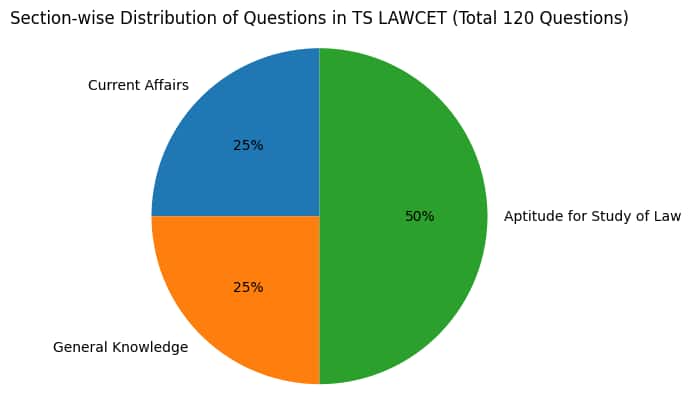
The TS LAWCET question paper consists of 120 multiple-choice questions divided into three sections. Each question carries 1 mark, and there is no negative marking. Understanding the data-based distribution of questions helps students focus on the most important topics during TS LAWCET 2026 Preparation.
This section mainly focuses on recent national and international events. Based on previous year trends, most questions are asked from the following areas:
National Current Affairs – 8 to 10 questions
International Events & Organisations – 4 to 6 questions
Government Schemes & Policies – 3 to 5 questions
Awards & Honours – 2 to 3 questions
Sports News – 2 to 3 questions
Important Summits & Conferences – 2 to 3 questions
This section evaluates static GK and basic awareness about India and the world. Previous exam analysis shows the following distribution:
Indian History & Freedom Movement – 5 to 7 questions
Indian Geography – 4 to 6 questions
Indian Polity & Constitution Basics – 5 to 6 questions
Science & Technology – 3 to 4 questions
Important Days, Books & Authors – 3 to 4 questions
Miscellaneous GK – 4 to 5 questions
This is the highest-weightage section, testing candidates’ legal reasoning ability and understanding of legal principles. Data from previous papers suggests the following pattern:
Legal Reasoning & Principle-Fact Questions – 20 to 25 questions
Legal Terms & Legal Maxims – 8 to 10 questions
Basic Constitutional Law – 8 to 10 questions
Important Landmark Judgements – 5 to 7 questions
Assertion–Reason-Based Legal Questions – 5 to 6 questions
Basic Legal Facts & Concepts – 5 to 7 questions
Register for Judiciary Exam Preparation from TopRankers.
By focusing on these high-frequency topics, candidates can strategically prepare for TS LAWCET 2026 and maximise their chances of scoring higher in the exam.
Here are some useful tips to prepare effectively for the TS LAWCET:
Understand the Exam Pattern: Although the 3-year LLB and 5-year LLB exams may appear similar, their difficulty level and question focus can differ. Prepare according to the specific exam you are appearing for.
Create a Proper Study Plan: Make a well-structured study timetable and allocate time to each section based on its weightage in the syllabus. This helps in maintaining a systematic preparation approach.
Use Smart Guessing: Since there is no negative marking, candidates can use the process of elimination to make smart guesses and increase their chances of answering more questions correctly.

On Question asked by student community
Hello dear student,
You can find and access more information here: https://law.careers360.com/articles/ts-lawcet-3-year-llb-2026-rank-wise-college-list
Hope it helps!
Hello Dear Student,
Yes, if your TS LAWCET rank is around 500 and you belong to the BC-A category , you have a strong chance of getting a seat in Osmania University's law programs , especially in the 3-Year LLB course. Admissions to Osmania University's law courses are based on
Hello Shafia,
Download the TS LAWCET 5-Year 2024 ebook with solutions from the link below to check your answers.
Hello Keerthana,
Download TS LAWCET 2026 5-Year Shift 1 paper with answer key from the link below:
https://law.careers360.com/articles/ts-lawcet-2026-question-paper-with-solutions-download-pdf
Hi you can get the TS LAWCET previous year question papers by clicking on the link given below:
https://law.careers360.com/articles/ts-lawcet-question-papers

Ranked 1 st among Top Law Schools of super Excellence in India - GHRDC | NAAC A+ Accredited | #36 by NIRF
Last Date to Apply: 17th August | QS I-Gauge Diamond Rated | NAAC A+ Accredited | 621 Recruitment Partners | INR 40 LPA Highest CTC | 4482 Job offers
NAAC A++ Accredited | Ranked #11 by NIRF
Bar Council of India (BCI) approved | Accredited by LAWASIA | Ranked 13th , among the Best Law Colleges (Private) in India by IIRF
60+ Years of Education Legacy | UGC & AICTE Approved | Prestigious Scholarship Worth 6 Crores
Free Ebook - CLAT 2025 English Language questions with detailed solutions