SRM University, Chennai LLM 2026
NAAC A++ Accredited | Ranked #11 by NIRF


Legal Aptitude is one of the most decisive sections of the MH CET LLB 2026 Exam — a place where smart preparation can directly translate into high scores. With questions designed to test your understanding of legal principles, reasoning ability, and real-life application of laws, mastering the right topics can give you a strong competitive edge. If you’re aiming to crack the MH CET 3 Years LLB 2026 with confidence, knowing the most scoring areas in MH CET 3-year LLB 2026 Legal Aptitude is the first step toward a winning strategy. This article highlights exactly where to focus your efforts for maximum results.

Before preparing, familiarise yourself with the Legal Aptitude for MH CET 3 year LLB 2026 and MH CET Law 2026 exam syllabus. The Legal Aptitude for MH CET 3-year LLB 2026 comprises:
Aspect | Details |
Purpose of the Section | Assesses understanding of legal principles and ability to apply them logically to given situations. |
Skills Tested | Analytical thinking, legal reasoning, decision-making, and interpretation skills. |
Need for Prior Legal Knowledge | No prior legal background required; basic comprehension of principles is sufficient. |
Question Pattern | Mostly principle-based and situation-based questions. |
Difficulty Level | Moderate; requires practice for accuracy and speed. |
Importance in Exam | High-weightage section that significantly affects overall ranking. |
The Legal Aptitude section in MH CET 3-Year LLB 2026 is structured to test a candidate’s ability to think legally, analyse facts, and apply legal principles to practical situations. Instead of focusing on rote memorisation, this section evaluates logical reasoning, interpretation skills, and clarity of judgment. Below is a visual representation of the approximate distribution of question types in the Legal Aptitude section based on recent exam trends:
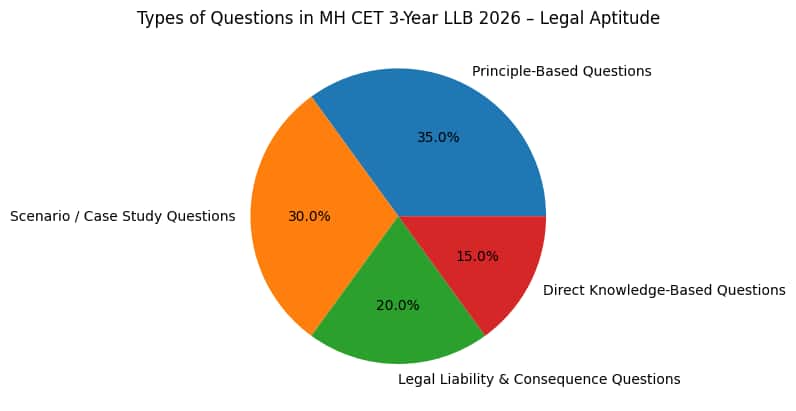
The Legal Aptitude section in MH CET 3-Year LLB typically contributes 30–40% of the total question paper, making it one of the highest-weightage and most scoring areas. An analysis of previous years’ papers shows that questions are repeatedly asked from a fixed set of core legal topics. Focusing on these high-return areas can significantly increase your overall score.
Accounts for nearly 10–15% of Legal Aptitude questions.
Covers basic concepts of law, justice, rights, and duties.
Frequently asked question types:
Difference between civil and criminal law.
Purpose and functions of law in society.
Easy scoring due to concept-based and straightforward application questions.
Contributes around 8–10% of questions.
Key principles tested:
Audi Alteram Partem (right to be heard).
Nemo Judex in Causa Sua (rule against bias).
Most questions are situation-based, asking whether natural justice is violated.
High accuracy is achievable with minimal memorisation.
One of the highest-weightage topics (15–20%).
Core areas tested: Offer, acceptance, consideration, free consent, lawful object.
Past papers show 4–6 direct questions from contracts alone.
Scenario-based questions on valid contracts and breach remedies are common.
Covers approximately 10–12% of the section.
Frequently tested concepts:
Negligence
Defamation
Nuisance
Strict and absolute liability
Fact-based liability identification questions dominate.
Contributes about 8–10% of Legal Aptitude questions.
Topics include crime, intention (mens rea), act (actus reus), and punishment.
Common question pattern: the difference between civil wrong and criminal offence.
Accounts for nearly 10–15% of questions.
Frequently tested areas:
Fundamental Rights (Articles 12–35)
Fundamental Duties (Article 51A)
Directive Principles of State Policy
Direct factual questions make this a reliable scoring area.
Low effort, high return topic.
Makes up around 5–8% of questions.
Usually 2–3 direct meaning-based questions.
Easy to memorise and quick to answer.
Around 5–10% of questions.
Focus on major Supreme Court rulings and recent legal news.
Questions are direct and fact-oriented.
Relies more on logical understanding than memorisation, making it easier to master.
Core legal principles remain consistent, reducing the need for frequent updates.
Predictable question pattern based on principle–fact–application format.
Commonly repeated topics like Contracts, Torts, Criminal Law, and Constitutional Principles.
Legal Maxims and basic legal terminology are easy to learn and score.
No complex calculations or lengthy reading passages involved.
Saves time during the exam and improves the speed of answering.
Regular practice leads to high accuracy in problem-solving.
Offers strong potential to boost the overall MH CET 3-year LLB 2026 score.
Builds a solid foundation for future law studies.


Approved by BCI | Ranked #4 among Law Institutes in UP | NAAC A+ Accredited
Ranked 1 st among Top Law Schools of super Excellence in India - GHRDC | NAAC A+ Accredited | #36 by NIRF
Admission Against Cancellation/Lapsed Seats | Pay 500 Application Fee instead of ₹1500 | NIRF Ranked 87 | NAAC A+ Grade | Upto 100% scholarship
NAAC A+ Accredited | Students | Moot Court Session | Legal Aid Clinics | | Scholarships to Meritorious
Last Date to Apply: 17th August | QS I-Gauge Diamond Rated | NAAC A+ Accredited | 621 Recruitment Partners | INR 40 LPA Highest CTC | 4482 Job offers
Law at SCSVMV | NAAC 'A' Grade | AICTE, BCI & UGC Aproved | 100% Placement Support | Merit-based Scholarships