
Search Colleges, Exams, Schools & more


Login
7 CLAT Syllabus Topics That Decide 60% of Your Score
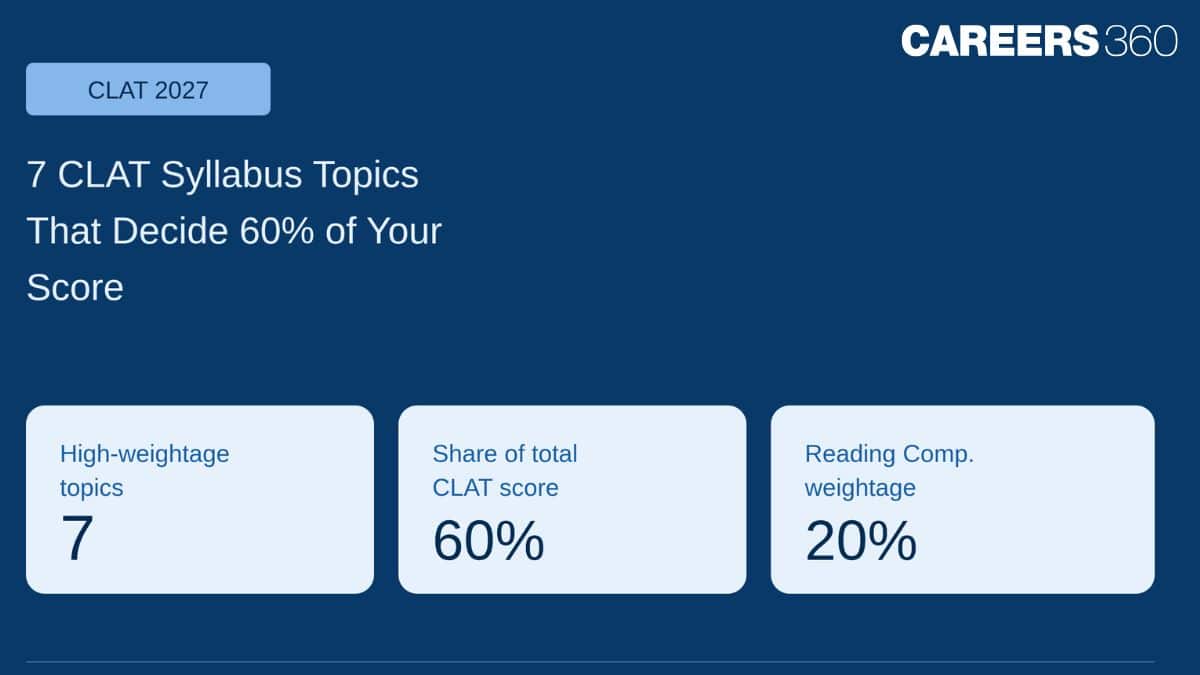
The Common Law Admission Test comprises five sections - English Language, Current Affairs including General Knowledge, Legal Reasoning, Logical Reasoning, and Quantitative Techniques. While the CLAT 2027 syllabus is expansive, candidates can still sort topics based on the weightage. Reading comprehension is a single topic with the highest weightage in the CLAT syllabus. The entire English Language section comprises RC sub-topics like inference, tone, vocabulary-in-context, etc. Apart from RC, there are some important legal reasoning, logical reasoning and current affairs topics that will decide 60% of the CLAT 2027 score.
7 CLAT Syllabus Topics That Decide 60% of Your Score
Topic | CLAT Section | Weightage | Previous Year Questions |
Reading Comprehension (inference, tone, author's intent, vocabulary-in-context) | English Language | 20% | 24/24 questions in every year's English section are passage-based — no standalone grammar or vocab exists in the section, so this single skill is the section (24/120 = 20%). |
Applying Recent Acts, Bills & Policy Reforms to Fact Patterns | Legal Reasoning | 8% | Roughly half of Legal Reasoning passages test a live/recent statute applied to a scenario — DPDPA (2024, 2025), Juvenile Justice Act (2024, 2025), PRP Bill (2024), GI/Contract Act (2025), GST reform & One Nation One Election Bill (2026). |
Applying Landmark/Recent Supreme Court Judgments to Fact Patterns | Legal Reasoning | 8% | The other half of Legal Reasoning — Shreya Singhal, Manoj Narula, void-marriage succession rulings, State of TN v. Governor of TN (2025), Supriyo v. UOI — each turned into 5-7 scenario-based questions per year. |
Data Interpretation (percentage, ratio, average, projected growth) | Quantitative Techniques | 10% | 12/12 questions in every year's Quant section are DI-passage-based — no standalone arithmetic exists, so this is effectively the whole section (12/120 = 10%). |
Puzzles (blood relations, coding, seating/scheduling arrangement) | Logical Reasoning | 6% | Consistently 6-9 of the section's ~24-25 questions across all 3 years; peaked hard in 2026 with 3 full puzzle sets (word-transformation, blood-relation coding, round-robin scheduling). |
Geopolitics & India's Foreign Relations | Current Affairs/GK | 4% | A major foreign-affairs passage appears every year: Israel-Hamas (2024), BRICS summit (2025), Trump tariffs/Op Sindoor/SCO Summit (2026) — the single most consistently recurring GK theme. |
Indian Polity, Constitutional History & Recent National Legislation | Current Affairs/GK | 4% | J&K reorganisation & Art. 370 (2025), Nari Shakti Vandan Adhiniyam (2025), Ambedkar's Constituent Assembly speech (2024) — a recurring domestic-legislation/constitutional-history passage each year. |
Total | 60% |
CLAT 2027 Syllabus - Subject-Wise Weightage
The CLAT 2027 syllabus has been divided into five subjects. Legal Reasoning and Current Affairs, including GK holds highest weightage. These two sections alone comprise 50% of the questions, equally divided among both. English Language and Logical Reasoning each hold 20% weightage. Quantitative Aptitude section comprises the least weightage of 10%. The table below shows section-wise weightage and number of questions asked from each subject:
CLAT 2027 Syllabus
Sections | Weightage | Number of Questions |
Current affairs & GK | 25% | 28-32 |
Legal reasoning | 25% | 28-32 |
English | 20% | 22-26 |
Logical reasoning | 20% | 22-26 |
Quantitative techniques | 10% | 10-14 |
How to prepare for CLAT 2027: High-Weightage Topics?
Here are some basic preparation strategies for each of the seven topics given above:
Reading Comprehension: Candidates are advised to read one opinion piece or literary excerpt daily and infer word meanings from context. Also, this will help candidates improve their reading speed.
Applying Recent Acts, Bills & Policy Reforms to Fact Patterns: While no prior legal knowledge is required for the legal reasoning section of CLAT, candidates must still keep track of the recent acts, bills and reforms made in the last 12 months.
Landmark/Recent SC Judgments: A good way to prepare for this topic is to take the last two years' landmark SC judgments and prepare a two-line summary by yourself. This way you will get a good understanding of the judgment and also will be a quick tab to revise.
Data Interpretation: Quantitative Techniques section is one of the easiest sections of the CLAT exam and comprises passage-based questions from class 10 Maths. Do a good revision of the Class 10 Maths topics and practice previous year question papers.
Puzzles (blood relations, coding, seating/scheduling arrangement): This topic can only be aced with regular practice. Candidates must make sure they ace this section by solving as many different passage-based questions from this section as possible.
Geopolitics and Indian Foreign Relations: Candidates can do a weekly roundup of Geopolitics and Indian foreign relations events, focusing on India's summits, treaties, and bilateral developments. With the weekly roundup, they can also prepare a six-month timeline of all the important events and their agenda.
Indian Polity, Constitutional History & Recent Legislation: Revise NCERT Class 11 polity for basics of the Preamble/Constituent Assembly. Also, look out for recent amendments and reorganisation Acts from the last 2 years.
Articles
Related Stories
|
Upcoming Law Exams

Certifications By Top Providers
Explore Top Universities Across Globe
Popular Courses and Specializations
Popular Degrees
List of colleges accepting CLAT
Browse Law Colleges by State
Questions related to CLAT
On Question asked by student community
Have a question related to CLAT ?
Hello Student,
Here are the Careers360 CLAT 2027 Mock Test Resources for your exam preparation.
1. Online CLAT Mock Test
2. CLAT Mock Tests and Solutions
Hello student,
CLAT 2027 aspirants can access these monthly current affairs compilations for regular revision. Use these resources to stay updated with important events and topics for CLAT 2027.
CLAT 2027 Current Affairs - Monthly Compilations
|
Particular |
Download PDF |
|
CLAT Current Affairs- August Month (2026) |
|
|
CLAT Current Affairs- |
If you have only two months, use a highly structured plan: daily current affairs, English reading, legal reasoning practice, logical reasoning sets, basic quantitative practice and regular full-length mocks. Spend as much time analysing incorrect questions as taking the mock itself. Consistency during these two months can make a substantial
You can download the CLAT previous years' question papers from here:
https://law.careers360.com/articles/clat-previous-year-question-papers
https://law.careers360.com/download/clat-sample-papers-previous-years
For CLAT 2027 UG, candidates need to have passed Class 12/equivalent with at least 45% marks, or 40% for SC/ST/PwD candidates.
In your situation, having an RT in an additional subject but subsequently passing the required qualification through an improvement examination does not automatically make you ineligible. However, the important

Applications for Admissions are open.
Ranked #18 amongst Institutions in India by NIRF | Get Upto 100% Scholarships | Spot Admissions via CUET
Woxsen University, Hyderabad
ApplyScholars’ Round Deadline: 14th Nov’26 | Earn upto 50% merit Scholarship + 10% for top performers | EFMD Accredited | AACSB (USA) & AMDISA Member | Highest CTC 28 LPA
Unitedworld School of Law, Karnavati University, Gandhinagar
ApplyMoot Court | Mock trials | Legal Aid Clinic | Recruiting Partners: FICCI, TCS, Adani, Trilegal, and many others
Chitkara University
ApplyNAAC A+ Accredited University
KCC Institute of Legal and Higher Education, Greater Noida
ApplyLaw Admissions 2026 Open | Avail Merit-Based Scholarships
SRM School of Law, Kattankulathur
ApplyNAAC A++ Accredited | Ranked #11 by NIRF
CLAT Notifications
Never miss CLAT update
Get timely CLAT updates directly to your inbox. Stay informed!