
Search Colleges, Exams, Schools & more


Login
CLAT 2026: The Paper That Rewarded Readers, Not Rote Learners
With only a few days left for CLAT 2027, the previous year’s CLAT question paper offers useful clues about the exam’s design and questions. CLAT has five different sections. Each section is designed to test certain skills, but English reading and comprehension is common across all sections. Three major sections drew heavily on editorials, judgments, foreign affairs, and news materials that require careful reading. With the CLAT syllabus and pattern remaining unchanged for 2027, a similar pattern and theme is expected, even though the composition and sourcing of questions may differ.
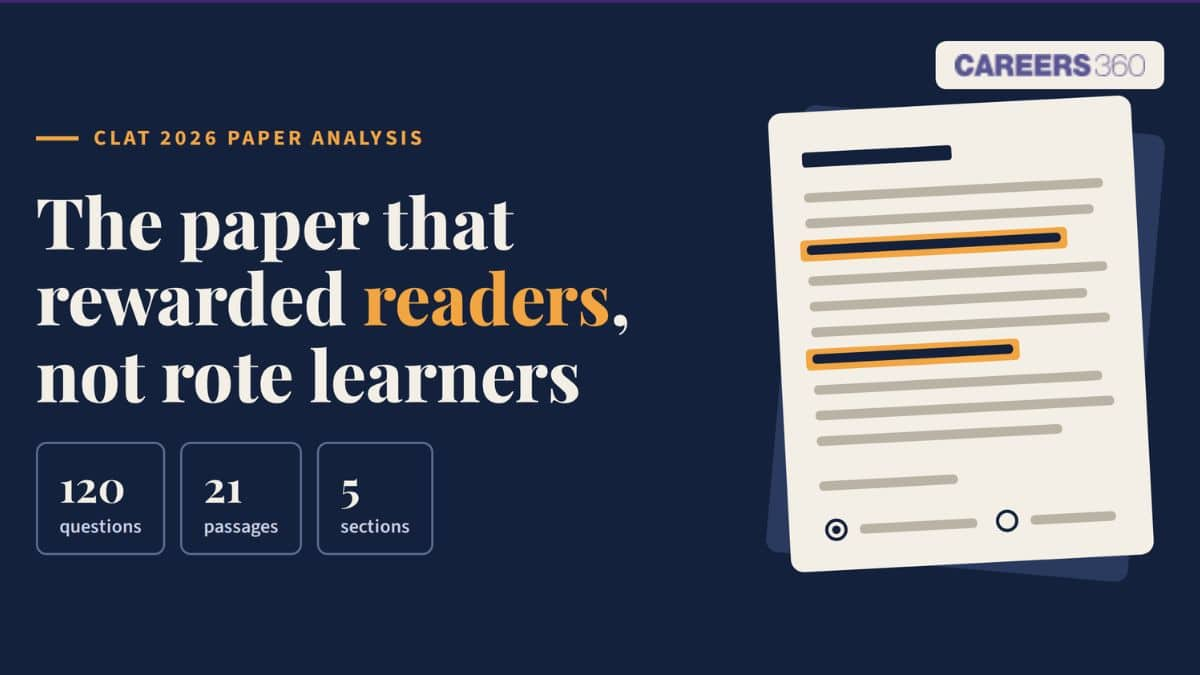
CLAT 2026 At a Glance
CLAT 2026 question paper contained 21 passages and 120 questions across all five sections. It was a lengthy paper which rewarded readers. Each section required reading passages or argumentative text materials.
Section | Q. Nos. | Questions | Passages |
I - English Language | 1-24 | 24 | 5 |
II - Current Affairs incl. GK | 25-52 | 28 | 5 |
III - Legal Reasoning | 53-82 | 30 | 5 |
IV - Logical Reasoning | 83-108 | 26 | 4 |
V - Quantitative Aptitude | 109-120 | 12 | 2 |
Total | 1-120 | 120 | 21 |
CLAT English: 5 passages, 24 questions
The five passages in CLAT English were on diverse topics. One passage came from Bipin Chandra’s popular book, India’s Struggle for Independence; another came from Francis Fukuyama’s The Origins of Political Order; and the remaining three were fiction and non-fiction. Among these, George Orwell has consistently featured in CLAT in the last three years.
CLAT English Analysis
Passage | No. of Questions | Type | Source | Topic |
Passage 1 | 5 | History | Bipin Chandra et al., India's Struggle for Independence | Non-Cooperation Movement and communal unity |
Passage 2 | 5 | Non-Fiction | Yuval Noah Harari, Sapiens | Prehistoric humans; how species are classified |
Passage 3 | 5 | Political | Francis Fukuyama, The Origins of Political Order | Third wave of democratisation; 'democratic recession' |
Passage 4 | 5 | Fiction | Rabindranath Tagore, 'The Hungry Stones' | Narrator's encounter with a mysterious man on a train |
Passage 5 | 4 | Dystopian fiction | George Orwell, Animal Farm | Old Major's speech on animal exploitation |
All these sections required reading and comprehension skills. The first section did include some elements of factual history related to the non-cooperation movement, but the questions were carefully designed not to test rote memorisation.
CLAT Current Affairs: International Relations Dominate
The CLAT current affairs section has repeatedly featured topics from international relations in recent years. A passage around the BRICS summit was featured in 2025. Next year, a full passage covering the SCO summit was given. In fact, three of five passages, accounting for 17 out of 28 questions, were based on topics of foreign policy or international relations. The passages were taken from primary materials such as PIB, ministerial statements, and press releases.
This gives a hint to prospective candidates: read all major topics around foreign policy and international relations, such as the BRICS Summit 2026, World Economic Forum, G20, Greenland, NATO, Venezuela crisis, US-Iran war, energy and food security.
Passage | No. of Questions | Type | Source | Topic |
Passage 1 | 5 | Foreign relations - International Relations | The Times of India, 21 Sep 2025 | US-India ties: H-1B, 50% tariffs, Chabahar waiver |
Passage 2 | 5 | Sports | The Hindu, 29 Jul 2025 | Divya Deshmukh wins the Women's Chess World Cup |
Passage 3 | 6 | Foreign relations - International Relations | EAM Dr S. Jaishankar's statement in Lok Sabha, 28 Jul 2025 | Foreign policy response to Pahalgam / Operation Sindoor; Indus Waters Treaty |
Passage 4 | 6 | Foreign relations - International Relations | PIB press release, 1 Sep 2025 | 25th SCO Summit, Tianjin |
Passage 5 | 6 | Disaster/Accident | Air India press release, 26 Jul 2025 | AI-171 crash: compensation and memorial trust |
Legal Reasoning: Three SC Judgments, Constitution and Political Debates
5 passages with 30 questions were asked from this section in CLAT 2026. Of these, one passage was an extract of a SC judgment and two passages were taken from The Hindu editorials discussing different SC judgments and their implications. Prior knowledge of Law was not required for answering questions in this section. However, familiarity with legal current affairs and constitutional provisions helped students.
Of the remaining two passages, one was extracted from a research article published by Carnegie Endowment, while the second passage was based on B. Shiva Rao’s Framing of India's Constitution discussing the drafting of the Preamble.
The takeaway is that editorials, judgments and research articles are crucial; answers are given within the passages. However, for passages based on the Constitution or the political system, some factual knowledge will be helpful.
CLAT Legal Reasoning
Passage | No. of Questions | Type | Source | Topic |
Passage 1 | 6 | Political debate | Milan Vaishnav et al., 'Does "One Nation, One Election" Make Sense for India?' (28 Jul 2025) | 'One Nation' policies; simultaneous elections |
Passage 2 | 6 | Constitution | B. Shiva Rao, Framing of India's Constitution | Drafting history of the Preamble |
Passage 3 | 6 | Judgment | Supreme Court judgment, Manoj Narula v. Union of India | Constitutional ethos; good governance; ministers facing criminal charges |
Passage 4 | 6 | Editorial based on SC Judgment | The Hindu, 8 Apr 2025 | State of Tamil Nadu v. Governor of Tamil Nadu: Governor's assent, 'pocket veto' |
Passage 5 | 6 | Editorial based on SC Judgment | The Hindu, 27 Oct 2023 | Supriyo v. Union of India: same-sex marriage |
Logical Reasoning
This section stayed text-heavy, with passages ranging from 150 to 269 words, making reading skill a prerequisite while still testing argumentative skills, puzzles or fact situations.
A notable departure from the previous years was that no passage in this section was borrowed from any editorial or journal. All passages appear original, signalling a shift in how CLAT tests these skills.
Passage | Number of questions | Source | Topic |
|---|---|---|---|
Passage 1 | 6 | Not cited (appears original) | Word-transformation puzzle using 'ELECTROCARDIOGRAPH' |
Passage 2 | 7 | Not cited (appears original) | Theft of the 'Sunburst Medallion': suspects, alibis, evidence, logical flaws |
Passage 3 | 6 | Not cited (appears original) | Blood relations using coded symbols (+, -, x, /) |
Passage 4 | 7 | Not cited (appears original) | Four-team tournament scheduling and rule constraints |
Maths
Over the last three years, this section has repeatedly tested ratio and proportion, percentage, growth, seating arrangements and averages. Mastering these skills would be crucial for aspirants. An advantage of having this section is that the answers are objectively clear, so disputes are rare. The recent reform report released by Justice Indu Malhotra Committee also notes that maths has been one of the least disputed sections in CLAT, though it suggests testing more skills.
Passage | Number of questions | Source | Topic |
Passage 1 | 6 | Not cited (appears original) | Urban vs rural health insurance coverage: ratios, percentages, growth |
Passage 2 | 6 | Not cited (appears original) | State electricity generation by source and quarter; renewable share |
The Common Thread
Although each section is designed to test different skills, English reading skill appears as a common thread across all sections. The legal and logical reasoning sections sometimes test overlapping skills. This is a widely recognised issue with CLAT, and the reform committee has recommended removing the logical skill section once the new pattern is adopted. The quantitative section is relatively narrow in scope and focuses on limited data and numerical problems, which often require interpretation.
For CLAT 2027, prospective candidates should prepare around the current format while keeping the previous year's question paper as a crucial reference point. With the question paper being centred around intensive English reading skills, candidates should practice comprehension-based questions sourced from news, editorials, journals and fiction.
Articles
Related Stories
|
Upcoming Law Exams

Certifications By Top Providers
Explore Top Universities Across Globe
Popular Courses and Specializations
Popular Degrees
List of colleges accepting CLAT
Browse Law Colleges by State
Questions related to CLAT
On Question asked by student community
Have a question related to CLAT ?
Hello Student,
Here are the Careers360 CLAT 2027 Mock Test Resources for your exam preparation.
1. Online CLAT Mock Test
2. CLAT Mock Tests and Solutions
Hello student,
CLAT 2027 aspirants can access these monthly current affairs compilations for regular revision. Use these resources to stay updated with important events and topics for CLAT 2027.
CLAT 2027 Current Affairs - Monthly Compilations
|
Particular |
Download PDF |
|
CLAT Current Affairs- August Month (2026) |
|
|
CLAT Current Affairs- |
If you have only two months, use a highly structured plan: daily current affairs, English reading, legal reasoning practice, logical reasoning sets, basic quantitative practice and regular full-length mocks. Spend as much time analysing incorrect questions as taking the mock itself. Consistency during these two months can make a substantial
You can download the CLAT previous years' question papers from here:
https://law.careers360.com/articles/clat-previous-year-question-papers
https://law.careers360.com/download/clat-sample-papers-previous-years
For CLAT 2027 UG, candidates need to have passed Class 12/equivalent with at least 45% marks, or 40% for SC/ST/PwD candidates.
In your situation, having an RT in an additional subject but subsequently passing the required qualification through an improvement examination does not automatically make you ineligible. However, the important

Applications for Admissions are open.
Ranked #18 amongst Institutions in India by NIRF | Get Upto 100% Scholarships | Spot Admissions via CUET
Woxsen University, Hyderabad
ApplyScholars’ Round Deadline: 14th Nov’26 | Earn upto 50% merit Scholarship + 10% for top performers | EFMD Accredited | AACSB (USA) & AMDISA Member | Highest CTC 28 LPA
Parul Institute of Law, Vadodara
ApplyBA LLB, BBA LLB, or BCom LLB and LLB | LLM 1 Year – 4 Specializations | Approved by BCI | Highest CTC 9 LPA
Institute of Law, Nirma University, Ahmedabad
ApplyGrade 'A+' Accredited by NAAC | Ranked 33rd in India by NIRF
Unitedworld School of Law, Karnavati University, Gandhinagar
ApplyMoot Court | Mock trials | Legal Aid Clinic | Recruiting Partners: FICCI, TCS, Adani, Trilegal, and many others
KCC Institute of Legal and Higher Education, Greater Noida
ApplyLaw Admissions 2026 Open | Avail Merit-Based Scholarships
CLAT Notifications
Never miss CLAT update
Get timely CLAT updates directly to your inbox. Stay informed!