School of Law, UPES, Dehradun
Ranked #18 amongst Institutions in India by NIRF | Get Upto 100% Scholarships | Spot Admissions via CUET


The Consortium of National Law Universities (NLUs) has confirmed that there will be no changes to the syllabus, pattern, or sections of the CLAT 2027 UG and PG examinations. The decision was made at the annual meeting of the consortium's governing body, held on July 18, 2026. The CLAT 2027 syllabus will have five sections: English, current affairs including general knowledge, legal reasoning, logical reasoning, and quantitative techniques. The CLAT 2027 will consist of 120 questions to be completed within two hours. However, the convenor of CLAT 2027 and the paper setters will consider the recommendations of the expert committee report regarding the quality of questions.
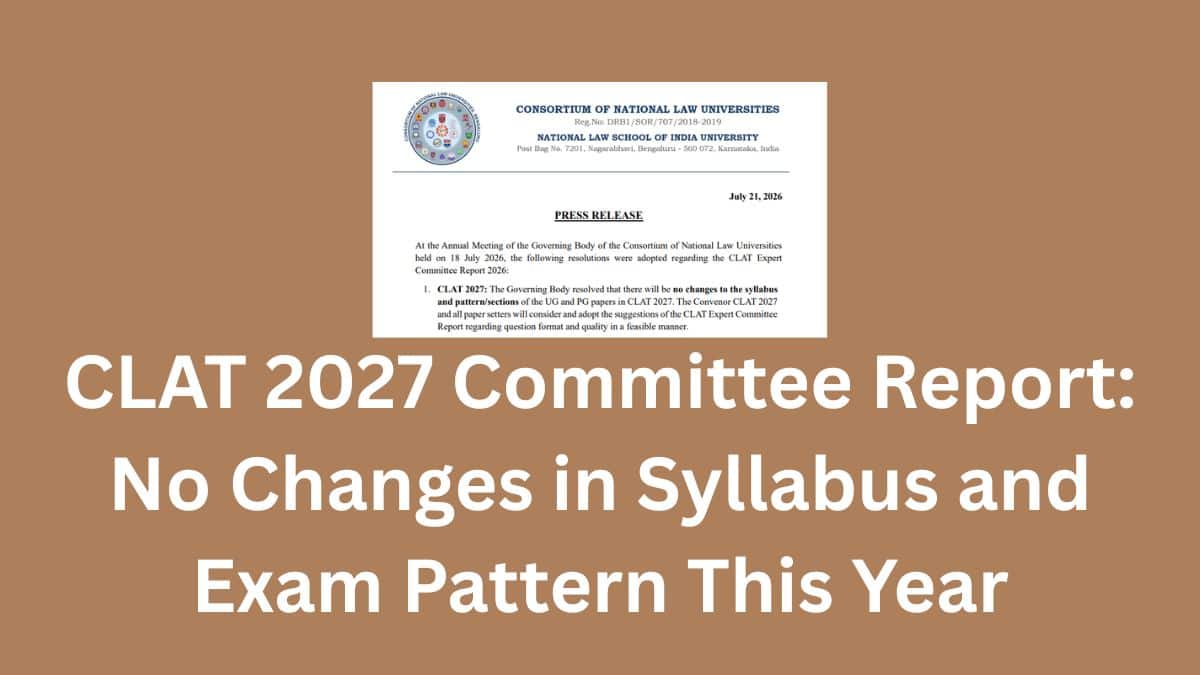
The consortium has shared the CLAT expert committee report on its official website. It has invited feedback and suggestions from experts, students, and the general public. Candidates can submit their feedback by filling out the form provided on the official website by August 31, 2026. The consortium will continue the discussions on the recommendations. The recommendations, along with public feedback, might be considered for CLAT 2028.
The CLAT expert committee has recommended several changes to the CLAT exam pattern. Some key recommendations that might be taken into consideration while preparing the CLAT 2028 syllabus.
The CLAT UG exam should have three sections, including logical reasoning and legal aptitude, language and comprehension, and quantitative techniques.
The committee proposed adding the legal knowledge and problem question section to the CLAT PG exam. The proposed legal knowledge section would focus on important legal developments and the application of legal principles, while the problem question section would test structured legal reasoning and written articulation.
Both CLAT UG & PG exams should have 10 to 15 questions per section and a total duration of two hours.
The committee has also recommended institutional reforms, including professionalising the examination-setting process, establishing permanent governance structures, introducing stronger quality-control, and regular publication of sample papers.
Ranked #18 amongst Institutions in India by NIRF | Get Upto 100% Scholarships | Spot Admissions via CUET
Scholars’ Round Deadline: 14th Nov’26 | Earn upto 50% merit Scholarship + 10% for top performers | EFMD Accredited | AACSB (USA) & AMDISA Member | Highest CTC 28 LPA
Candidates preparing for the exam must continue the preparation based on the existing CLAT 2027 syllabus. Any major changes are likely to be considered for CLAT 2028.

On Question asked by student community
Hello Student,
Here are the Careers360 CLAT 2027 Mock Test Resources for your exam preparation.
1. Online CLAT Mock Test
2. CLAT Mock Tests and Solutions
Hello student,
CLAT 2027 aspirants can access these monthly current affairs compilations for regular revision. Use these resources to stay updated with important events and topics for CLAT 2027.
|
Particular |
Download PDF |
|
CLAT Current Affairs- August Month (2026) |
|
|
CLAT Current Affairs- |
If you have only two months, use a highly structured plan: daily current affairs, English reading, legal reasoning practice, logical reasoning sets, basic quantitative practice and regular full-length mocks. Spend as much time analysing incorrect questions as taking the mock itself. Consistency during these two months can make a substantial
You can download the CLAT previous years' question papers from here:
https://law.careers360.com/articles/clat-previous-year-question-papers
https://law.careers360.com/download/clat-sample-papers-previous-years
For CLAT 2027 UG, candidates need to have passed Class 12/equivalent with at least 45% marks, or 40% for SC/ST/PwD candidates.
In your situation, having an RT in an additional subject but subsequently passing the required qualification through an improvement examination does not automatically make you ineligible. However, the important

Ranked #18 amongst Institutions in India by NIRF | Get Upto 100% Scholarships | Spot Admissions via CUET
Scholars’ Round Deadline: 14th Nov’26 | Earn upto 50% merit Scholarship + 10% for top performers | EFMD Accredited | AACSB (USA) & AMDISA Member | Highest CTC 28 LPA
Moot Court | Mock trials | Legal Aid Clinic | Recruiting Partners: FICCI, TCS, Adani, Trilegal, and many others
Law Admissions 2026 Open | Avail Merit-Based Scholarships
NAAC A++ Accredited | Ranked #11 by NIRF
Law Admissions Open 2026 | #2nd in India by The World University Rankings for Innovation | 200+ Collaborations | 700+ Industry Recruiters