School of Law, UPES, Dehradun
Ranked #18 amongst Institutions in India by NIRF | Get Upto 100% Scholarships | Spot Admissions via CUET


Today's CLAT 2027 current affairs cover five developments in Parliament, constitutional law, public health, financial regulation and elections. These include the proposed delimitation changes, the Anand Mohan remission case, food warning labels, PMLA rules and an MLA's disqualification. The news also covers important constitutional provisions, laws and court rulings. The sections below explain the CLAT exam key facts and legal concepts, followed by MCQs for practice.
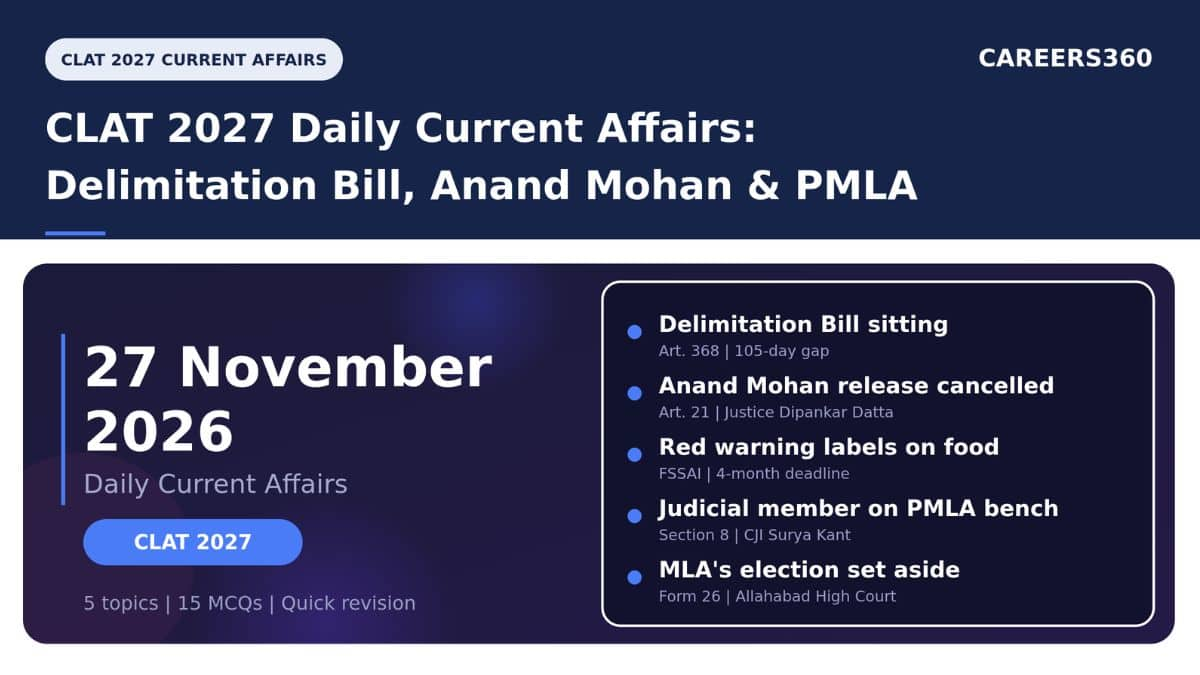
In the news: Parliament will hold a special sitting from November 30 to December 3. The Lok Sabha meets from November 30 and the Rajya Sabha from December 2. The gap since both Houses were adjourned on August 13 is 105 days, breaking the previous record of 87 days in 2008. The Cabinet is expected to clear the new Bill on Friday.
The proposed changes include a 50% increase in Lok Sabha seats, a 25-year extension of the freeze on using the 1971 Census to decide each State's share, and fresh constituency boundaries based on the 2011 Census. The earlier 131st Amendment Bill failed in April with 298 votes out of 528. The NDA now claims 358 votes, against the required two-thirds majority of 360 out of 540.
Article 368: A constitutional amendment needs a majority of the House's total membership and two-thirds of members present and voting.
Delimitation: Redrawing constituency boundaries and deciding the number of seats.
84th Amendment, 2001: Extended the freeze on the allocation of Lok Sabha seats among States until 2026.
Prorogation: Formally ends a session of Parliament. The President does this under Article 85.
Tenth Schedule: Deals with defection. A merger is exempt from disqualification if at least two-thirds of a party's legislators agree to it.
Q1. What majority is needed to pass a constitutional amendment under Article 368?
A. Simple majority of those present
B. Majority of total membership and two-thirds of members present and voting
C. Three-fourths of total membership
D. Unanimity
Answer: B
Q2. Who prorogues Parliament?
A. The Speaker
B. The Prime Minister
C. The President
D. The Vice-President
Answer: C
Q3. What does delimitation mean?
A. Redrawing constituency boundaries and seat numbers
B. Cancelling an election
C. Counting votes
D. Dissolving the House
Answer: A
Attempt Free Official Practice Test & Solutions and Ace the CLAT Exam 2026
In the news: The Supreme Court cancelled former MP Anand Mohan's early release. He was serving life imprisonment for the 1994 murder of Gopalganj District Magistrate G. Krishnaiah. A Bench led by Justice Dipankar Datta said Article 21 protects victims and their families, not just convicts.
The Court struck down Bihar's revised remission policy as arbitrary and said signs of reform alone cannot justify release. Mohan must surrender within one month. Any fresh remission plea must first hear the victim's wife, Uma Krishnaiah. The trial court awarded him the death penalty in 2007, but the Patna High Court commuted it to life imprisonment in 2008. The Supreme Court upheld that decision in 2012.
Remission: Reduces the period of a sentence without changing the nature of the punishment. State governments can grant remission under the law.
Articles 72 and 161: Give the President and Governors powers to grant pardon, remission and other forms of relief.
Article 14: Protects against arbitrary State action.
Article 21: Protects life and personal liberty. Courts have also linked it to victims' rights.
Rarest of rare: The test laid down in Bachan Singh v. State of Punjab (1980) for awarding the death penalty.
Commutation: Replaces a punishment with a lighter one, such as changing a death sentence to life imprisonment.
Q1. Which Article was read to cover victims' rights as well as convicts' rights?
A. Article 14
B. Article 19
C. Article 21
D. Article 32
Answer: C
Q2. Why did the Supreme Court strike down Bihar's remission notification?
A. The sudden change in policy was arbitrary
B. States cannot grant remission
C. The convict was declared innocent
D. The notification was too old
Answer: A
Q3. Which case laid down the 'rarest of rare' test for the death penalty?
A. Bachan Singh v. State of Punjab
B. Maneka Gandhi v. Union of India
C. Vishaka v. State of Rajasthan
D. Joseph Shine v. Union of India
Answer: A
In the news: The Supreme Court directed the FSSAI to frame rules for red warning labels on packaged food high in sugar, saturated fat or salt. It gave the regulator four months to finalise the draft. The order came on a PIL filed by Kerala-based 3S and Our Health Society. The Bench said the right to health allows the State to regulate harmful industry practices.
Labels must show total sugar, saturated fat and salt, with separate warnings such as 'HIGH SUGAR' and 'HIGH SALT'. The Court warned that thresholds set too low could cause 'label fatigue', making consumers ignore the warnings. It also said the FSSAI need not wait for complete agreement among stakeholders.
Right to health: Recognised by courts as part of the right to life under Article 21.
Article 47: Directs the State to improve nutrition, living standards and public health.
FSSAI: The food safety regulator set up under the Food Safety and Standards Act, 2006.
PIL: A case filed to protect public interest, even by someone who is not directly affected.
Label fatigue: When consumers see too many warnings and begin to ignore them.
Q1. Under which Article is the right to health recognised?
A. Article 19
B. Article 21
C. Article 25
D. Article 32
Answer: B
Q2. Which law established the FSSAI?
A. Food Safety and Standards Act, 2006
B. Consumer Protection Act, 2019
C. Drugs and Cosmetics Act, 1940
D. Essential Commodities Act, 1955
Answer: A
Q3. Why did the Court warn against setting warning-label thresholds too low?
A. Consumers may begin ignoring too many warnings
B. It would raise food prices
C. It would ban food exports
D. It would remove all food labels
Answer: A
Get the CLAT UG previous year question papers here
In the news: A three-judge Supreme Court Bench led by CJI Surya Kant ruled that every Bench of the PMLA Adjudicating Authority must include at least one judicial member. The Authority decides whether property is proceeds of crime and should remain attached under Section 8 of the PMLA.
The Court noted that attachment can affect a person's property before guilt is proved. The Authority issues notices, hears both sides and passes written orders. It said these powers require judicial oversight. The Court also asked the Centre to consider restoring multiple Authorities. A 2009 amendment had replaced the earlier system with a single body.
Adjudicating Authority: A statutory body under the PMLA that decides whether property attached by the Enforcement Directorate should remain attached.
Proceeds of crime: Property obtained, directly or indirectly, through criminal activity linked to a scheduled offence.
Section 8, PMLA: Deals with adjudication of property attachment.
Show-cause notice: A notice asking a person to explain why action should not be taken.
Natural justice: Requires a fair hearing, notice to the affected person and a reasoned decision.
Q1. What does the PMLA Adjudicating Authority decide?
A. Whether property is proceeds of crime and should remain attached
B. Whether the accused is guilty
C. Whether the accused should get bail
D. What sentence should be imposed
Answer: A
Q2. Why did the Supreme Court require a judicial member on the Authority's Bench?
A. To ensure legal oversight in decisions affecting property
B. To reduce the number of police officers
C. To replace the Enforcement Directorate
D. To hear criminal appeals
Answer: A
Q3. Which of the following is part of natural justice?
A. Notice and an opportunity to be heard
B. Immediate sale of attached property
C. Arrest of every property owner
D. Automatic closure of the case
Answer: A
In the news: The Allahabad High Court set aside BJP MLA Om Kumar's election from Nehtaur in Bijnor. Justice Salil Kumar Rai found that his Form 26 nomination affidavit lacked mandatory financial and criminal disclosures. RLD candidate Munshi Ram had challenged the election through a petition.
The Court stayed part of its order for 15 days. During this period, Om Kumar can take part in Assembly debates but cannot vote or claim monetary benefits.
Election petition: A legal challenge to an election. It is filed before the High Court under the Representation of the People Act, 1951.
Form 26: The affidavit submitted by candidates with their nomination papers. It includes details of assets, liabilities, education and criminal cases.
Right to know: Voters have a right to know candidates' backgrounds, recognised by the Supreme Court in Union of India v. Association for Democratic Reforms (2002).
Section 33A, RPA 1951: Requires candidates to disclose specified criminal cases.
Section 100: Lists grounds on which an election can be declared void, including certain defects in the acceptance of nominations.
Q1. Where is an election petition filed?
A. The High Court
B. The Election Commission
C. The Lok Sabha Speaker
D. The Governor
Answer: A
Q2. Which case recognised voters' right to know about election candidates?
A. Union of India v. Association for Democratic Reforms
B. Kesavananda Bharati v. State of Kerala
C. S.R. Bommai v. Union of India
D. Indra Sawhney v. Union of India
Answer: A
Q3. Why must candidates disclose their assets and criminal cases in Form 26?
A. To help voters make an informed choice
B. To raise campaign funds
C. To reduce the number of candidates
D. To avoid holding elections
Answer: A
The key facts, figures and developments from today's news are listed below for a quick revision before the CLAT 2027.
Delimitation Bill: Special Parliament sitting begins November 30. Proposed changes include a 50% increase in Lok Sabha seats and a 25-year extension of the 1971 Census freeze.
Parliament session: The gap between sittings is 105 days. The previous record was 87 days in 2008.
Anand Mohan: Supreme Court cancels his early release and says Article 21 also protects victims and their families.
Food labels: FSSAI gets four months to frame rules for red warnings on food high in sugar, saturated fat and salt.
PMLA: Supreme Court says every Adjudicating Authority Bench must have at least one judicial member.
Om Kumar: Allahabad High Court sets aside the Nehtaur MLA's election over disclosure defects in Form 26.
Deepathoon row: Supreme Court is scheduled to hear contempt petitions on Friday.
Jet Airways: NCLAT clears Rs 480 crore in staff dues, payable within two weeks.

On Question asked by student community
Hello Student,
You can refer to the following Careers360 resources to study Law of Contracts for CLAT Legal Reasoning:
Contract Law – Chapter-wise Study Material:
https://www.careers360.com/legal-studies/contract-law-chapter-pge
Contract Law and Tort Basics for CLAT 2027:
https://law.careers360.com/articles/contract-law-and-tort-basics-for-clat-2027-legal-reasoning
Hello Lavina,
For CLAT 2028 preparation, students should choose an online coaching programme that offers comprehensive study material, regular mock tests, current affairs updates, doubt-solving sessions and expert guidance. Compare course features, faculty experience and student reviews before selecting a coaching programme.
Hello Miruthula,
For CLAT PG 2027, you need to focus on the core subjects of your LLB curriculum, particularly the following:
Constitutional Law
Jurisprudence
Administrative Law
Law of Contract
Law of Torts
Family Law
Criminal Law
Property Law
Company Law
Public International Law
Tax Law
Environmental Law
Labour and Industrial
Hello Student,
The full form of the CLAT exam is the Common Law Admission Test. You can check the link related to the CLAT exam
https://law.careers360.com/articles/what-is-clat-full-form-all-about-nlus-entrance-exam
Hello Student,
Here are the Careers360 CLAT 2027 Mock Test Resources for your exam preparation.
1. Online CLAT Mock Test
2. CLAT Mock Tests and Solutions

Experiential Learning through Legal Aid Camps, Lok Adalats, Court Visits, Community Lawyering and regular Moot Court sessions
Ranked #18 amongst Institutions in India by NIRF | Get Upto 100% Scholarships | Spot Admissions via CUET
NAAC A++ Accredited | Avail up to 100% scholarship via MRNAT-Manav Rachna National Aptitude Test
NAAC A++ Approved | Curriculum Aligned with BCI & UGC
UG Scholar's Round Deadline: 1st Dec'26 | Earn upto 50% merit Scholarship + 10% for top performers | Highest CTC 18 LPA
Grade 'A+' Accredited by NAAC | Ranked 33rd in India by NIRF