School of Law, UPES, Dehradun
Ranked #18 amongst Institutions in India by NIRF | Get Upto 100% Scholarships | Spot Admissions via CUET


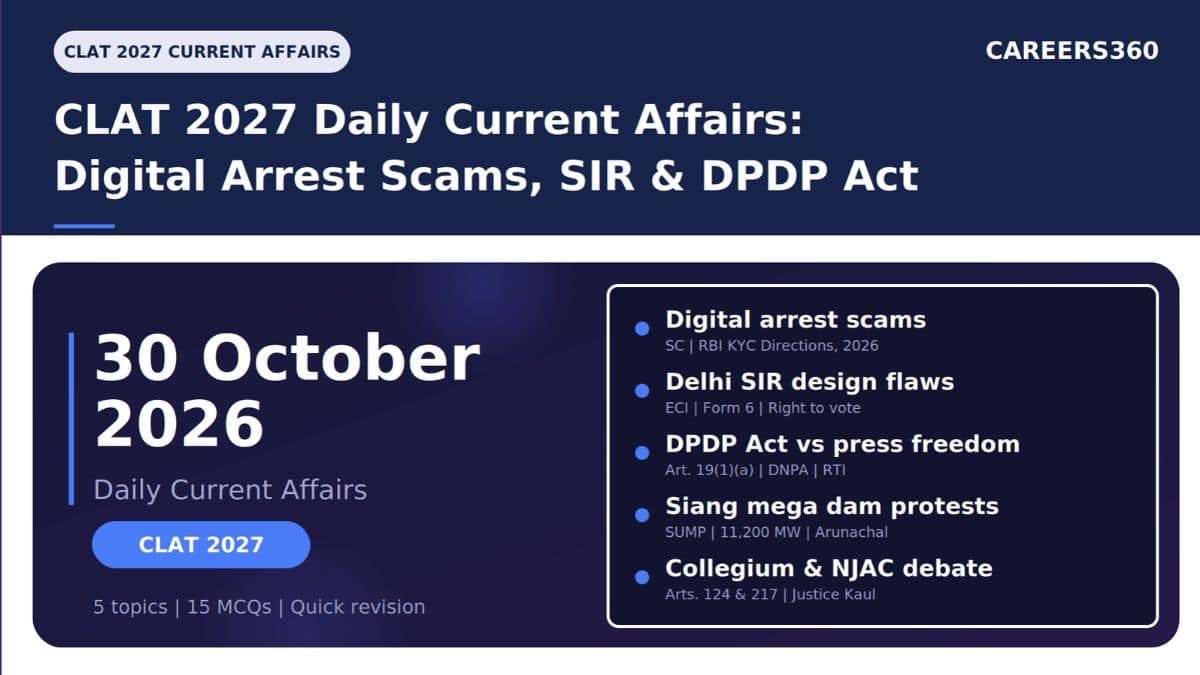
Today's CLAT 2027 current affairs cover five major developments. These include the Supreme Court's questions to the RBI over digital arrest scams, concerns over the Delhi SIR exercise. It also includes a challenge to the DPDP Act over press freedom, protests against a mega dam in Arunachal Pradesh, and a former judge's remarks on judicial appointments. These topics are important for CLAT 2027 preparation.
In the news: The Supreme Court asked the RBI to make banks fully compensate digital arrest victims whenever the fraud happened due to institutional lapses. CJI Surya Kant noted over Rs 800 crore was lost to such scams in a year, calling it the "biggest financial fraud in the history of this country."
The Court wants to examine the draft RBI (KYC) Amendment Directions, 2026, which require banks to flag unusual transactions and alert police. The Attorney-General said these rules will be notified by November 30 and rolled out by December 31. The Court also sought FIR data from States and listed the matter for November 30.
Ranked #18 amongst Institutions in India by NIRF | Get Upto 100% Scholarships | Spot Admissions via CUET
Scholars’ Round Deadline: 14th Nov’26 | Earn upto 50% merit Scholarship + 10% for top performers | EFMD Accredited | AACSB (USA) & AMDISA Member | Highest CTC 28 LPA
What CLAT 2027 aspirants should know
Digital arrest scam: A cyber fraud where scammers pose as police or officials on video calls and threaten victims into paying money.
KYC (Know Your Customer): A regulatory process banks follow to verify identity, now being expanded to flag suspicious transactions.
Amicus curiae: A "friend of the court," an independent expert assisting the court, as seen in this case.
Consumer protection in banking: Financial institutions can be held responsible for losses when their own systems fail to catch fraud.
Q1. How much money was reported lost to digital arrest scams in a year, as cited in the Court?
A. Rs 200 crore
B. Rs 800 crore
C. Rs 8,000 crore
D. Rs 80 crore
Answer: B
Q2. What did the Supreme Court ask the RBI to ensure through financial institutions?
A. A complete ban on digital transactions
B. Full compensation to victims where institutional lapses caused the fraud
C. Closure of all online banking
D. Arrest of all bank employees
Answer: B
Q3. By when is the RBI (KYC) Amendment Directions, 2026 expected to be notified?
A. October 30, 2026
B. November 30, 2026
C. December 31, 2026
D. January 2027
Answer: B
In the news: Hearing a plea on Delhi's Special Intensive Revision (SIR), Justice Joymalya Bagchi asked if a voter slow to respond to forms could lose their right to vote forever. The Bench said the ECI was wrong to make such deleted voters reapply as fresh voters through Form 6, instead of letting them simply update their details.
The Court noted that in Karnataka's SIR, about 84 lakh electors were deleted as "shifted" or "absent," while only 8.2 lakh were added back, leaving the final roll 64.5 lakh short of the projected population. It also clarified the Bihar SIR judgment was not binding on other States.
What CLAT 2027 aspirants should know
Special Intensive Revision (SIR): A detailed door-to-door re-verification of electoral rolls by the Election Commission.
Form 6: The form for fresh voter registration; the Court objected to deleted voters being forced to use it.
Binding precedent: A past judicial decision other courts must follow; the Bihar SIR ruling does not bind every State.
Right to vote: Recognised as a statutory right under the Representation of the People Act, 1951.
Burden of enrolment: Who must act to keep a voter's name on the roll; the Court questioned shifting this entirely onto voters.
Q1. What concern did Justice Bagchi raise about voters deleted for being "lax" in responding to forms?
A. Whether they could lose their right to vote forever
B. Whether they should be fined
C. Whether they needed police verification
D. Whether they could vote online instead
Answer: A
Q2. What did the Court say about the Bihar SIR judgment?
A. It applies automatically to all States
B. It was not a binding precedent for other States
C. It was overturned entirely
D. It applies only to Bihar's municipal elections
Answer: B
Q3. In Karnataka's SIR, how many electors were deleted as "shifted" or "absent," according to the passage?
A. 8.2 lakh
B. 64.5 lakh
C. 84 lakh
D. 1 lakh
Answer: C
Concerns
In the news: The Digital News Publishers Association (DNPA) has challenged the Digital Personal Data Protection Act, 2023 before the Supreme Court, saying it has no exemption for journalism. Without this, reporters investigating official misconduct could be treated as a "data fiduciary" and made to seek consent from the people they are investigating. Earlier drafts, from 2018, 2019 and 2021, did carry this exemption.
The petition also challenges Section 44(3) of the Act, which amended the RTI Act, 2005 to drop the public-interest rule for disclosing personal information. The Supreme Court, while issuing notice, said press freedom and privacy both need balancing.
What CLAT 2027 aspirants should know
Digital Personal Data Protection Act, 2023: India's law on how personal data is collected, processed and protected.
Data fiduciary: Under the Act, any entity deciding the purpose of processing personal data, bound by duties like seeking consent.
Article 19(1)(a): Guarantees freedom of speech and expression, under which press freedom has been read in.
Section 44(3), DPDP Act: Amended the RTI Act, 2005 to remove the public-interest exception for personal data disclosure.
RTI Act, 2005: Allows citizens to seek information from public authorities, subject to certain exemptions.
MCQs
Q1. What is the DNPA's main concern about the DPDP Act, 2023?
A. It bans all digital news
B. It has no specific exemption for journalistic activity
C. It only applies to television channels
D. It gives journalists unlimited access to data
Answer: B
Q2. Which earlier law did Section 44(3) of the DPDP Act amend?
A. The Indian Penal Code
B. The RTI Act, 2005
C. The IT Act, 2000
D. The Press Council Act, 1978
Answer: B
B. Article 14
C. Article 19(1)(a)
D. Article 32
Answer: C
In the news: A rally in Itanagar demanded release of people detained over protests against the 11,200-MW Siang Upper Multipurpose Project (SUMP). Over 30 were detained after violence on October 23-24. The government says the dam is needed to offset China's much larger 60,000-MW project on the Yarlung Tsangpo, which becomes the Siang as it enters Arunachal Pradesh.
Protesters said they aren't against dams generally but oppose the project being pushed without consultation, accusing the government of militarising the area for survey work. A week earlier, an NHPC office was set on fire and two MLAs' homes were vandalised.
What CLAT 2027 aspirants should know
Yarlung Tsangpo-Siang-Brahmaputra: The same river is called Yarlung Tsangpo in China, Siang in Arunachal Pradesh, and Brahmaputra after Assam.
Trans-boundary river: A river flowing across international borders, raising questions of shared water rights and cooperation.
NHPC: The National Hydroelectric Power Corporation, involved in preparing the project's feasibility report.
Right to land and livelihood: A concern raised by protesters, linked to fundamental rights and indigenous identity.
Federal and local consultation: The protests highlight tension between national infrastructure priorities and local community rights.
Q1. What is the proposed capacity of the Siang Upper Multipurpose Project (SUMP)?
A. 1,605 MW
B. 11,200 MW
C. 60,000 MW
D. 800 MW
Answer: B
Q2. What name does the Yarlung Tsangpo river take once it enters Arunachal Pradesh?
A. Brahmaputra
B. Siang
C. Dibang
D. Lohit
Answer: B
Q3. Why does the government say the SUMP is necessary?
A. To stop flooding in Assam only
B. To counter the impact of China's larger hydropower project on the same river
C. To provide drinking water to Itanagar
D. To replace the Subansiri project entirely
Answer: B
In the news: Retired judge Justice Sanjay Kaul said former CJI D.Y. Chandrachud may have discussed proposed judge names with the government even before the collegium formally met, calling this "pre-approval" that weakens judicial independence. The remark has reignited debate on India's collegium system.
Articles 124 and 217 provide for appointment of Supreme Court and High Court judges by the President after consulting the judiciary. The collegium system, created by the Second Judges case (1993) and reaffirmed by the Third Judges case (1998), now decides these appointments. Parliament's NJAC, set up via the 99th Amendment in 2014, was struck down in 2015 for violating judicial independence.
What CLAT 2027 aspirants should know
Article 124: Provides for appointment of Supreme Court judges by the President after consulting the CJI.
Article 217: Provides for appointment of High Court judges after consulting the CJI, High Court Chief Justice and Governor.
Collegium system: Created by the Second Judges case (1993), reaffirmed by the Third Judges case (1998).
National Judicial Appointments Commission (NJAC): Set up by the 99th Amendment, 2014; struck down by the SC in 2015.
Basic structure doctrine: Core constitutional features, like judicial independence, cannot be altered even by amendment.
Q1. Which case created the collegium system for judicial appointments?
A. First Judges case (1981)
B. Second Judges case (1993)
C. Kesavananda Bharati case (1973)
D. NJAC case (2015)
Answer: B
Q2. Why was the NJAC struck down by the Supreme Court in 2015?
A. It was not passed by Parliament
B. It violated the basic structure doctrine on judicial independence
C. It was opposed by the President
D. It lacked a Law Minister's approval
Answer: B
Q3. Under Article 217, who is consulted before appointing a High Court judge?
A. Only the President
B. CJI, Chief Justice of the High Court and the State Governor
C. Only Parliament
D. Only the Prime Minister
Answer: B
Candidates can refer to the key facts and practise the MCQs below to revise these topics for CLAT 2027:
RBI (KYC) Amendment Directions, 2026 - To curb digital arrest fraud
Special Intensive Revision (SIR) - Electoral roll exercise under SC scrutiny
Form 6 - Fresh voter registration, flagged as wrongly applied to deleted voters
Digital Personal Data Protection Act, 2023 - Challenged for lacking journalist exemption
Article 19(1)(a) - Basis for constitutionally protected press freedom
Yarlung Tsangpo-Siang-Brahmaputra - Trans-boundary river at the centre of the dam dispute
Article 124 and Article 217 - Appointment of Supreme Court and High Court judges
Collegium system - Created by the Second and Third Judges cases; NJAC struck down in 2015

On Question asked by student community
Hello Student,
Here are the Careers360 CLAT 2027 Mock Test Resources for your exam preparation.
1. Online CLAT Mock Test
2. CLAT Mock Tests and Solutions
Hello student,
CLAT 2027 aspirants can access these monthly current affairs compilations for regular revision. Use these resources to stay updated with important events and topics for CLAT 2027.
|
Particular |
Download PDF |
|
CLAT Current Affairs- August Month (2026) |
|
|
CLAT Current Affairs- |
If you have only two months, use a highly structured plan: daily current affairs, English reading, legal reasoning practice, logical reasoning sets, basic quantitative practice and regular full-length mocks. Spend as much time analysing incorrect questions as taking the mock itself. Consistency during these two months can make a substantial
You can download the CLAT previous years' question papers from here:
https://law.careers360.com/articles/clat-previous-year-question-papers
https://law.careers360.com/download/clat-sample-papers-previous-years
For CLAT 2027 UG, candidates need to have passed Class 12/equivalent with at least 45% marks, or 40% for SC/ST/PwD candidates.
In your situation, having an RT in an additional subject but subsequently passing the required qualification through an improvement examination does not automatically make you ineligible. However, the important

Ranked #18 amongst Institutions in India by NIRF | Get Upto 100% Scholarships | Spot Admissions via CUET
Scholars’ Round Deadline: 14th Nov’26 | Earn upto 50% merit Scholarship + 10% for top performers | EFMD Accredited | AACSB (USA) & AMDISA Member | Highest CTC 28 LPA
BA LLB, BBA LLB, or BCom LLB and LLB | LLM 1 Year – 4 Specializations | Approved by BCI | Highest CTC 9 LPA
Grade 'A+' Accredited by NAAC | Ranked 33rd in India by NIRF
Moot Court | Mock trials | Legal Aid Clinic | Recruiting Partners: FICCI, TCS, Adani, Trilegal, and many others
Law Admissions 2026 Open | Avail Merit-Based Scholarships