Amity Law School, Noida
Experiential Learning through Legal Aid Camps, Lok Adalats, Court Visits, Community Lawyering and regular Moot Court sessions


Today's CLAT 2027 current affairs cover five important developments in law, polity, defence and international affairs. These include the Supreme Court's observations on the two-child norm, a ruling on the State's power to levy additional sales tax, the challenge to lifelong immunity for Election Commissioners, the extension of Agniveer service and the Democrats' victory in the US midterm elections. Candidates can revise the key facts and practise the MCQs below for CLAT preparation.
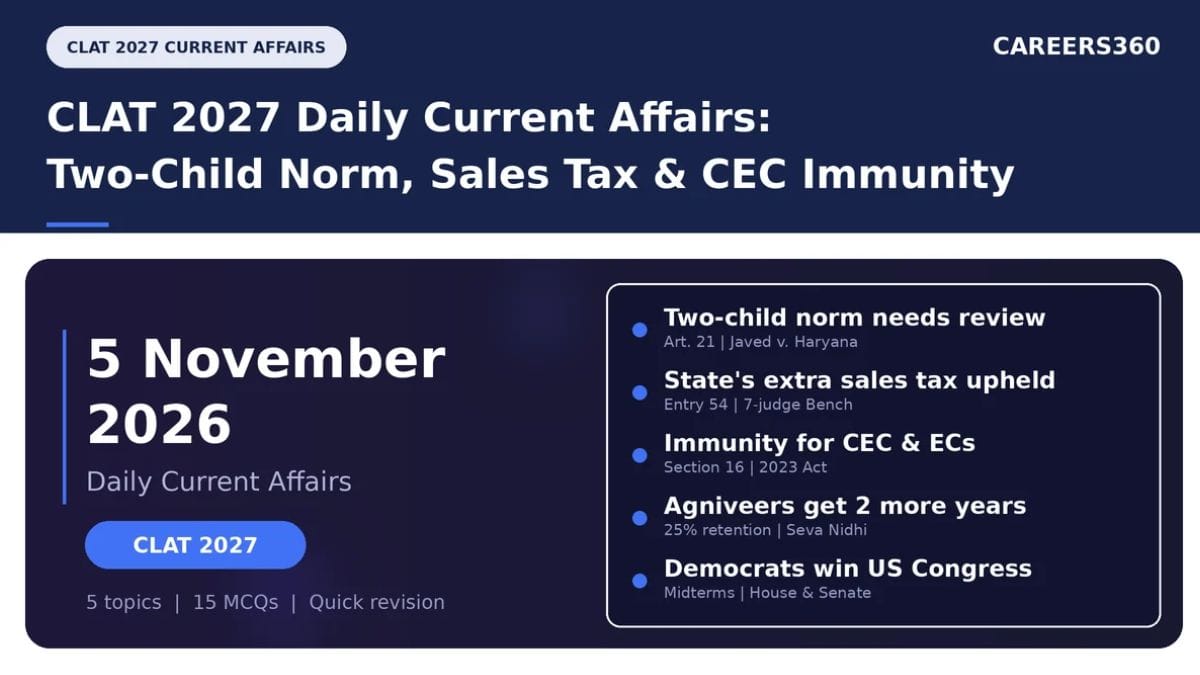
In the news: The Supreme Court said laws that penalise people for having more than two children may no longer be relevant. A Bench led by Justice P.S. Narasimha noted that India's Total Fertility Rate (TFR) has fallen from 3.02 to 1.9, below the replacement rate of 2.1.
The Court said a larger Bench should reconsider its 2003 judgment in Javed v. State of Haryana, which upheld such laws. It also said linking motherhood to political rights raises concerns under Article 21 and reproductive autonomy. The case involved a Maharashtra sarpanch who lost her post under the two-child rule. The Court allowed her to continue in office and stayed the proceedings against her.
What CLAT 2027 Aspirants Should Know
Total Fertility Rate (TFR): The average number of children a woman is expected to have in her lifetime.
Replacement rate: A TFR of 2.1 is generally needed for one generation to replace itself.
Article 21: Protects the right to life and personal liberty. It also covers reproductive autonomy.
Larger Bench: A bigger group of judges that reconsiders a legal question referred to it by a smaller Bench.
Q1. India's TFR has fallen to 1.9. What does this indicate?
A. Every woman has exactly two children
B. The birth rate is below the replacement level
C. The population will double every year
D. The government has stopped family planning programmes
Answer: B
Q2. Which constitutional right did the Supreme Court link to reproductive autonomy?
A. Right to equality
B. Right to freedom of religion
C. Right to life and personal liberty
D. Right to education
Answer: C
Q3. Why can the Supreme Court refer a case to a larger Bench?
A. To reconsider an important legal question or an earlier ruling
B. To allow Parliament to decide the case
C. To transfer the case to a High Court
D. To avoid giving a judgment
Answer: A
In the news: A seven-judge Constitution Bench of the Supreme Court ruled that State legislatures can levy an additional tax on the sale or purchase of goods. The Court upheld its 1975 judgment in S. Kodar v. State of Kerala, which said an extra levy added to sales tax must be treated like the main tax.
CJI Surya Kant said a surcharge calculated as a percentage of sales tax is an increase in the tax rate. It falls under Entry 54 of the State List in the Seventh Schedule. Justice K.V. Viswanathan also agreed with the ruling. The case arose from petitions filed in 1994.
What CLAT 2027 Aspirants Should Know
Seventh Schedule: Divides law-making powers between the Centre and States through three lists.
State List, Entry 54: Gives States the power to tax the sale or purchase of goods.
Cess and surcharge: Extra amounts charged over an existing tax.
Stare decisis: A legal principle under which courts generally follow earlier judgments.
Q1. A State wants to impose a tax on the sale of goods. Which part of the Constitution gives it this power?
A. Union List
B. State List
C. Concurrent List
D. Fundamental Duties
Answer: B
Q2. What is the main idea behind the principle of stare decisis?
A. Courts should generally follow earlier judgments
B. Parliament can cancel every court judgment
C. All cases must go to a larger Bench
D. States can ignore Supreme Court rulings
Answer: A
Q3. How did the Supreme Court classify an additional levy calculated as a percentage of sales tax?
A. As an income tax
B. As a separate Union tax
C. As an increase in the sales tax rate
D. As an unconstitutional charge
Answer: C
In the news: The Supreme Court issued notice to the Centre and the Election Commission on petitions challenging Section 16 of the CEC and Other Election Commissioners Act, 2023. The provision protects the Chief Election Commissioner (CEC) and Election Commissioners from civil and criminal cases for actions taken during official duties, even after retirement. The Bench led by CJI Surya Kant will hear the matter on December 18.
The petitions were filed by RJD MP Manoj Jha and advocate Arun Kumar Agrawal. They argue that the provision is unconstitutional as it limits judicial review, which is part of the Constitution's Basic Structure.
What CLAT 2027 Aspirants Should Know
Section 16 of the 2023 Act: Protects the CEC and Election Commissioners from legal proceedings for actions taken as part of their official duties.
Judicial review: The power of courts to check whether laws and government actions follow the Constitution.
Basic Structure doctrine: Certain core features of the Constitution cannot be removed, even through a constitutional amendment.
Issuing notice: When a court asks the other side to respond to a petition.
Scholars’ Round Deadline: 14th Nov’26 | Earn upto 50% merit Scholarship + 10% for top performers | EFMD Accredited | AACSB (USA) & AMDISA Member | Highest CTC 28 LPA
BA LLB, BBA LLB, or BCom LLB and LLB | LLM 1 Year – 4 Specializations | Approved by BCI | Highest CTC 9 LPA
Q1. Which provision is being challenged in the Supreme Court for giving legal protection to the CEC and Election Commissioners?
A. Section 10 of the RPA, 1950
B. Section 16 of the CEC and Other Election Commissioners Act, 2023
C. Article 21
D. Article 148
Answer: B
Q2. What does judicial review allow courts to do?
A. Appoint members of Parliament
B. Examine whether laws and government actions follow the Constitution
C. Make laws for the States
D. Conduct elections
Answer: B
Q3. The petitioners argue that Section 16 affects judicial review. Which constitutional doctrine protects this feature?
A. Doctrine of Eclipse
B. Basic Structure doctrine
C. Doctrine of Lapse
D. Doctrine of Separation of Powers
Answer: B
In the news: The Union Cabinet has approved an additional two-year service period for a section of Agniveers. Under the original Agnipath scheme, up to 25% of each batch could join the regular armed forces after four years. Under the revised plan, the remaining 75% can serve for another two years and may then be considered for regular enrolment.
Chief of Defence Staff General N.S. Raja Subramani said the extended service will bring higher pay, a larger Seva Nidhi package and seniority benefits. The decision follows a review of Agniveers' performance and recommendations from the three services.
What CLAT 2027 Aspirants Should Know
Agnipath scheme: A scheme under which young people are recruited into the armed forces for a fixed period as Agniveers.
Seva Nidhi: The financial package given to Agniveers after completing their service.
Chief of Defence Staff (CDS): The senior military officer who coordinates the Army, Navy and Air Force.
Union Cabinet: The group of senior ministers headed by the Prime Minister that takes major government decisions.
Q1. Under the revised Agnipath arrangement, what happens to the 75% of Agniveers not selected for regular service after four years?
A. They are automatically made permanent
B. They can serve for another two years
C. They must join the police
D. They receive an automatic promotion
Answer: B
Q2. Which benefit has been announced for Agniveers serving the additional two years?
A. Higher pay and an enhanced Seva Nidhi package
B. Free overseas education
C. Automatic permanent commission
D. A guaranteed government job outside the armed forces
Answer: A
Q3. Who coordinates the work of India's three armed forces as the senior-most military officer?
A. Defence Secretary
B. Chief of Defence Staff
C. Chief Election Commissioner
D. Home Secretary
Answer: B
In the news: The Democratic Party won control of both Houses of the US Congress in the midterm elections held on Tuesday. It secured at least 237 of the 435 seats in the House of Representatives and 54 of the 100 seats in the Senate. Democrats also won several seats previously held by Republicans. Rising living costs and US President Donald Trump's low approval ratings were cited as reasons for the result.
Trump said he was willing to accept the outcome but warned Democrats against trying to impeach him. The new Congress will take charge in January 2027. Democratic control could limit Trump's decisions on domestic and foreign policy, including issues affecting India-US relations.
What CLAT 2027 Aspirants Should Know
Midterm elections: Elections held halfway through a US President's four-year term.
US Congress: The country's law-making body, made up of the House of Representatives (435 members) and the Senate (100 members).
Impeachment: A process to remove a President. The House brings charges, and the Senate conducts the trial.
Presidential veto: The President's power to reject a Bill passed by Congress. Congress can override it with the required majority.
Q1. What is the main purpose of US midterm elections?
A. To elect a new President
B. To elect members of Congress halfway through a President's term
C. To appoint Supreme Court judges
D. To choose the Vice President
Answer: B
Q2. Which House of the US Congress brings charges against a President during impeachment?
A. Senate
B. House of Representatives
C. Supreme Court
D. Electoral College
Answer: B
Q3. Even after Democrats gained control of Congress, what power does the US President still hold?
A. Power to dissolve Congress
B. Power to veto Bills
C. Power to appoint all members of Congress
D. Power to cancel midterm elections
Answer: B
CLAT 2027 aspirants can revise these important facts and terms from today's five current affairs:
Javed v. State of Haryana (2003): Supreme Court judgment on the two-child norm, now referred for reconsideration.
India's TFR: 1.9, below the replacement rate of 2.1.
Entry 54, State List: Gives States the power to tax the sale or purchase of goods.
S. Kodar v. State of Kerala (1975): Earlier ruling on additional sales tax, upheld by a seven-judge Bench.
Section 16, CEC and Other Election Commissioners Act, 2023: Gives legal protection to the CEC and Election Commissioners for official acts.
Agnipath scheme: 25% can join regular service, while the remaining 75% can get two more years of service under the revised plan.
US midterm elections: Democrats won control of both the House of Representatives and the Senate.
Impeachment: The House brings charges against a US President, while the Senate conducts the trial.

On Question asked by student community
Hello Student,
The full form of the CLAT exam is the Common Law Admission Test. You can check the link related to the CLAT exam
https://law.careers360.com/articles/what-is-clat-full-form-all-about-nlus-entrance-exam
Hello Student,
Here are the Careers360 CLAT 2027 Mock Test Resources for your exam preparation.
1. Online CLAT Mock Test
2. CLAT Mock Tests and Solutions
Hello student,
CLAT 2027 aspirants can access these monthly current affairs compilations for regular revision. Use these resources to stay updated with important events and topics for CLAT 2027.
|
Particular |
Download PDF |
|
CLAT Current Affairs- August Month (2026) |
|
|
CLAT Current Affairs- |
If you have only two months, use a highly structured plan: daily current affairs, English reading, legal reasoning practice, logical reasoning sets, basic quantitative practice and regular full-length mocks. Spend as much time analysing incorrect questions as taking the mock itself. Consistency during these two months can make a substantial
You can download the CLAT previous years' question papers from here:
https://law.careers360.com/articles/clat-previous-year-question-papers
https://law.careers360.com/download/clat-sample-papers-previous-years

Experiential Learning through Legal Aid Camps, Lok Adalats, Court Visits, Community Lawyering and regular Moot Court sessions
Ranked #18 amongst Institutions in India by NIRF | Get Upto 100% Scholarships | Spot Admissions via CUET
Scholars’ Round Deadline: 14th Nov’26 | Earn upto 50% merit Scholarship + 10% for top performers | EFMD Accredited | AACSB (USA) & AMDISA Member | Highest CTC 28 LPA
BA LLB, BBA LLB, or BCom LLB and LLB | LLM 1 Year – 4 Specializations | Approved by BCI | Highest CTC 9 LPA
Grade 'A+' Accredited by NAAC | Ranked 33rd in India by NIRF
Moot Court | Mock trials | Legal Aid Clinic | Recruiting Partners: FICCI, TCS, Adani, Trilegal, and many others