School of Law, UPES, Dehradun
Ranked #18 amongst Institutions in India by NIRF | Get Upto 100% Scholarships | Spot Admissions via CUET


The Consortium of NLUs has conducted the CLAT 2027 second mock test for the Quantitative Aptitude section on November 20, 2026. A total of 10 questions were asked in the CLAT 2027 Quantitative Aptitude second mock test section. The topics covered in the CLAT 2027 Quantitative Aptitude mock test 2 were percentages, income and expenditure, data interpretation, and ratio and proportion. The second mock test for CLAT 2027 Quantitative Aptitude has two passages.
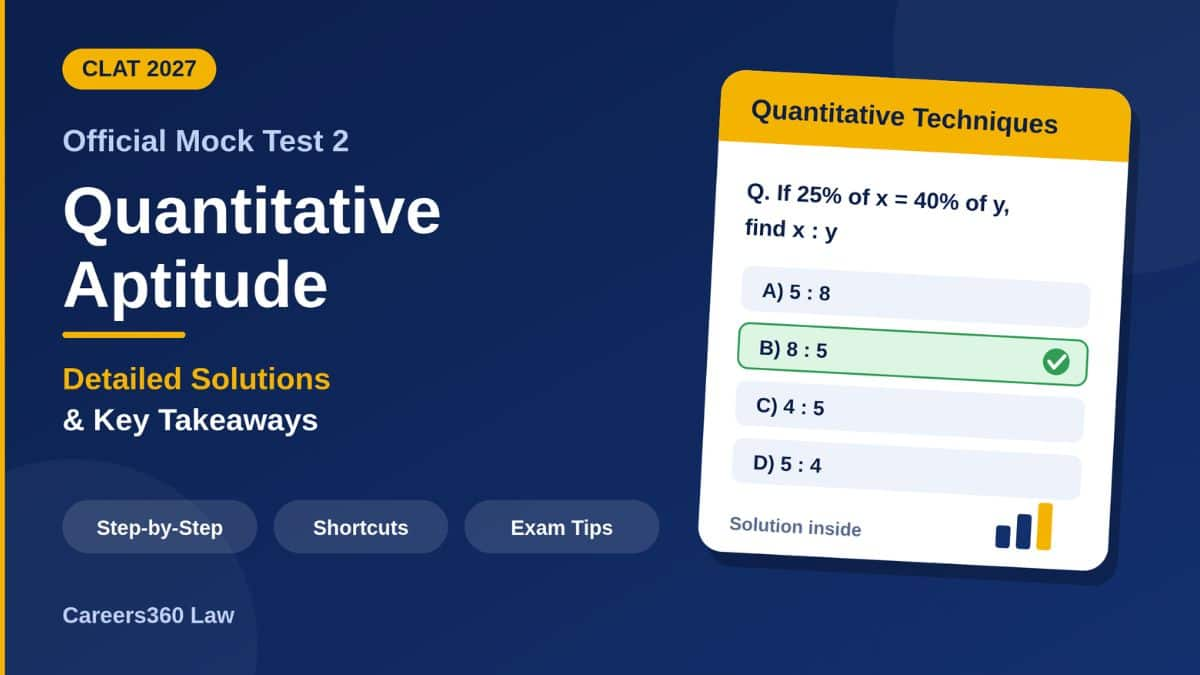
A key takeaway from this second CLAT 2027 official mock test is that candidates preparing for the exam should put more effort into data interpretation sets that involve percentages, ratios, averages, income, expenditure, and savings. The overall difficulty level for the second CLAT 2027 official Quantitative Aptitude mock test held on November 20, 2026 was easy to moderate.
PASSAGE I (Worker Earnings): A cooperative surveyed the daily earnings of workers in four districts. In District A, 120 workers earned an average of ₹450 each per day. In District B, 150 workers earned an average of ₹400. In District C, 100 workers earned an average of ₹520, while in District D, 80 workers earned an average of ₹480. In each district, the survey separately recorded men and women.
In District A, 70 men earned ₹500 per day and the remaining workers were women earning ₹380.
In District B, 90 men earned ₹440 and the remaining workers were women earning ₹340.
In District C, 60 men earned ₹600 and the remaining workers were women earning ₹400.
In District D, 50 men earned ₹520 and the remaining workers were women earning ₹410.
Data check (men and women split per district)
District | Men (no. × wage) | Women (no. × wage) | Total |
|---|---|---|---|
A | 70 × 500 = 35,000 | 50 × 380 = 19,000 | 54,000 (= 120 × 450 ✓) |
B | 90 × 440 = 39,600 | 60 × 340 = 20,400 | 60,000 (= 150 × 400 ✓) |
C | 60 × 600 = 36,000 | 40 × 400 = 16,000 | 52,000 (= 100 × 520 ✓) |
D | 50 × 520 = 26,000 | 30 × 410 = 12,300 | 38,300 (but 80 × 480 = 38,400 ✗) |
District D's split is off by ₹100 from its stated average. It does not affect any question below.
A: 500 − 380 = 120
B: 440 − 340 = 100
C: 600 − 400 = 200
D: 520 − 410 = 110
Answer: (c) District C. Matches the key.
Women = 120 − 70 = 50. Total = 50 × 380 = ₹19,000.
Answer: (a) ₹19,000. Matches the key.
Total = 150 × 400 = ₹60,000. Check: 39,600 + 20,400 = 60,000.
Answer: (a) ₹60,000.
The key says (c) ₹62,000, which is wrong. No method gives 62,000.
Women = 100 − 60 = 40. Ratio = 60 : 40 = 3 : 2.
Answer: (a) 3:2. Matches the key.
410 × 1.10 = ₹451.
Answer: (b) ₹451. Matches the key.
PASSAGE II (Family Budget): A family has a monthly income of ₹60,000 and allocates 25% to food, 18% to rent, 12% to education, 10% to transport, 8% to healthcare and 7% to other expenses. The remainder is saved. In the following month, the family’s income increases by 5%. Its food expenditure increases by 10%, rent remains unchanged in rupee terms, education expenditure increases by 8%, transport expenditure decreases by 5%, healthcare remains unchanged and other expenses increase by ₹500. The family saves whatever remains after these expenses. Assume all percentages in the first month are calculated from the original income.
Expenses take 25 + 18 + 12 + 10 + 8 + 7 = 80% of income. Savings = 20% of ₹60,000 = ₹12,000.
Answer: (a) ₹12,000. Matches the key.
18% of 60,000 = ₹10,800.
Answer: (b) ₹10,800. Matches the key.
60,000 × 1.05 = ₹63,000.
Answer: (c) ₹63,000. Matches the key.
Original food = 25% of 60,000 = ₹15,000. After a 10% rise: 15,000 × 1.10 = ₹16,500.
Answer: (b) ₹16,500. Matches the key.
Item | Original | New |
|---|---|---|
Food | 15,000 | 16,500 (+10%) |
Rent | 10,800 | 10,800 (unchanged) |
Education | 7,200 | 7,776 (+8%) |
Transport | 6,000 | 5,700 (−5%) |
Healthcare | 4,800 | 4,800 (unchanged) |
Other | 4,200 | 4,700 (+₹500) |
Total | 48,000 | 50,276 |
Savings = 63,000 − 50,276 = ₹12,724.
Attempt Free Official Practice Test & Solutions and Ace the CLAT Exam 2026
Q | Correct answer | Key | Status |
|---|---|---|---|
111 | C | C | ✓ |
112 | A | A | ✓ |
113 | A (₹60,000) | C | ✗ Key wrong |
114 | A | A | ✓ |
115 | B | B | ✓ |
116 | A | A | ✓ |
117 | B | B | ✓ |
118 | C | C | ✓ |
119 | B | B | ✓ |
120 | ₹12,724 (not listed) | A | ✗ Options flawed |
Question No. | Topic | Difficulty Level |
Q111 | Comparison of wages | Easy |
Q112 | Calculation of total wages | Easy |
Q113 | Total daily earnings | Easy |
Q114 | Ratio and proportion | Easy |
Q115 | Percentage increase in wages | Easy |
Q116 | Savings and percentages | Easy |
Q117 | Calculation of rent expenditure | Easy |
Q118 | Percentage increase in income | Easy |
Q119 | Percentage increase in expenditure | Easy |
Q120 | Income, expenditure and savings | Moderate |
CLAT 2027 Official Mock Test: Important Instructions
The CLAT Quantitative Aptitude section official mock tests are being conducted for both UG and PG.
Candidates can take the CLAT 2027 Quantitative Aptitude mock test as many times as required.
The exam format, structure, difficulty level, and type of questions included in the CLAT 2027 mock tests are only indicative.
Candidates should use the CLAT Quantitative Aptitude 2027 official mock tests to evaluate their preparation, revise important topics, and improve time management and speed.
Get the CLAT UG previous year question papers here

On Question asked by student community
Hello Student,
You can refer to the following Careers360 resources to study Law of Contracts for CLAT Legal Reasoning:
Contract Law – Chapter-wise Study Material:
https://www.careers360.com/legal-studies/contract-law-chapter-pge
Contract Law and Tort Basics for CLAT 2027:
https://law.careers360.com/articles/contract-law-and-tort-basics-for-clat-2027-legal-reasoning
Hello Lavina,
For CLAT 2028 preparation, students should choose an online coaching programme that offers comprehensive study material, regular mock tests, current affairs updates, doubt-solving sessions and expert guidance. Compare course features, faculty experience and student reviews before selecting a coaching programme.
Hello Miruthula,
For CLAT PG 2027, you need to focus on the core subjects of your LLB curriculum, particularly the following:
Constitutional Law
Jurisprudence
Administrative Law
Law of Contract
Law of Torts
Family Law
Criminal Law
Property Law
Company Law
Public International Law
Tax Law
Environmental Law
Labour and Industrial
Hello Student,
The full form of the CLAT exam is the Common Law Admission Test. You can check the link related to the CLAT exam
https://law.careers360.com/articles/what-is-clat-full-form-all-about-nlus-entrance-exam
Hello Student,
Here are the Careers360 CLAT 2027 Mock Test Resources for your exam preparation.
1. Online CLAT Mock Test
2. CLAT Mock Tests and Solutions

Ranked #18 amongst Institutions in India by NIRF | Get Upto 100% Scholarships | Spot Admissions via CUET
NAAC A++ Approved | Curriculum Aligned with BCI & UGC
UG Scholar's Round Deadline: 1st Dec'26 | Earn upto 50% merit Scholarship + 10% for top performers | Highest CTC 18 LPA
Grade 'A+' Accredited by NAAC | Ranked 33rd in India by NIRF
Moot Court | Mock trials | Legal Aid Clinic | Recruiting Partners: FICCI, TCS, Adani, Trilegal, and many others
NAAC A++ Accredited | Avail up to 100% scholarship via MRNAT-Manav Rachna National Aptitude Test