
Search Colleges, Exams, Schools & more


Login
How a National-Level Taekwondo Athlete Prepared for CLAT and Made It to GNLU Gandhinagar
Bhagyaraj Shrestha, a national-level Taekwondo athlete, secured AIR 603 in CLAT 2026 and made it to GNLU, Gandhinagar. Shrestha, CLAT 2026 topper handled both the Taekwondo tournaments and CLAT preparation together, often studying while travelling on trains and buses and in the breaks between tournaments. His reading habit also played a key role. Reading books, Bhagyaraj says, helped him build reading speed and comprehension.
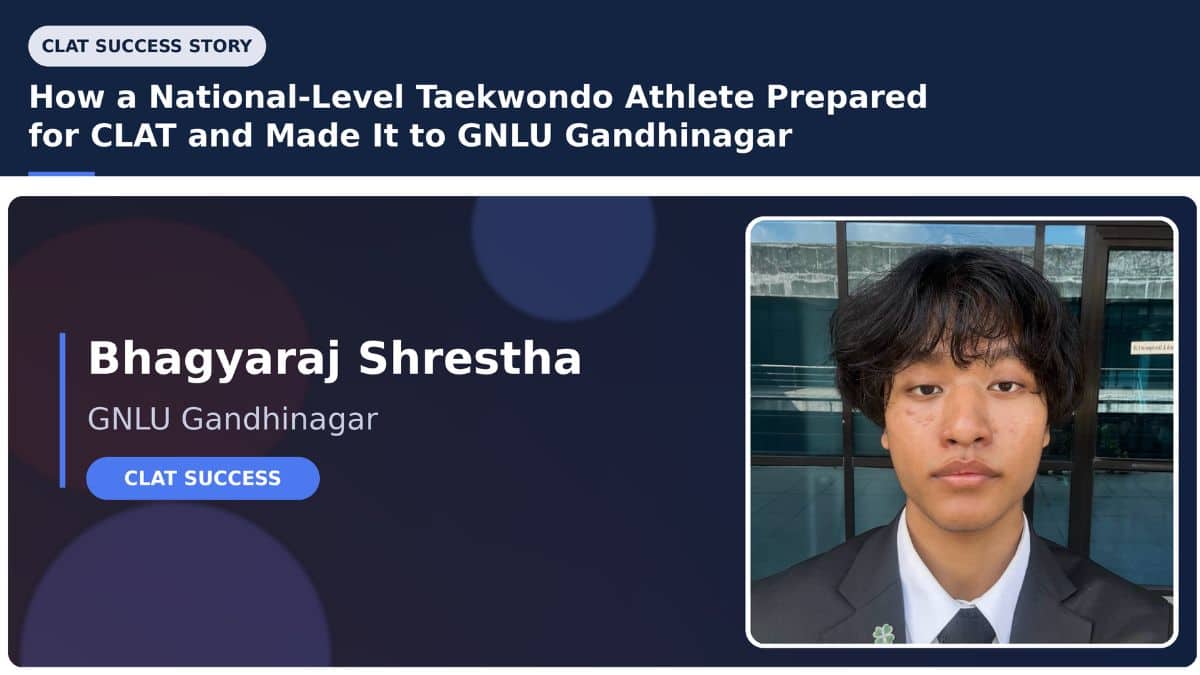
In a CLAT topper interview with Careers360, Bhagyaraj talks about balancing Taekwondo with CLAT preparation, how his multilingual background shaped his approach to reading, why he chose BBA LLB and his transition from Assam to GNLU Gandhinagar.
Careers360: As a national-level Taekwondo athlete, did the discipline of training help you handle CLAT’s pressure and time constraints?
Bhagyaraj: Yes, a lot. People think of Taekwondo as purely physical, but a big part of it is a mind game. In a match, you're constantly reading your opponent, planning your next move and changing your strategy in seconds. You don't get time to overthink. When the clock is running down, you can't panic and throw away the round. You have to stay composed and do what you've trained for.
CLAT felt very similar. It's a two-hour paper where the clock is always against you, and the students who do well aren't necessarily the ones who know the most. They're the ones who stay calm under pressure and make quick, clear decisions about what to attempt and what to leave. Taekwondo had already trained that instinct in me.
There's also a part people don't really think about. I spent a huge amount of time travelling between states for tournaments, often on long train and bus journeys. Instead of letting those hours go to waste, I used them to study. I read, revised and practised on the way to tournaments and on the way back, and even studied in the gaps between matches. So Taekwondo didn't just teach me composure. It gave me study hours I wouldn't otherwise have had. Many people assume sport takes time away from preparation, but in my case it added time.
Careers360: Coming from Assam and speaking Meitei, Nepali and Assamese, did your background influence how you approached English-heavy CLAT preparation?
Bhagyaraj: It did, though maybe not in the way people expect. I grew up switching between Meitei, Nepali and Assamese, so I was always translating meaning in my head instead of relying on one "default" language. That made me pay attention to what a sentence was actually trying to say, not just the words on the surface. That's really what CLAT comprehension tests are about, so long passages never scared me the way they scare a lot of students.
The bigger factor, though, was reading. I've been a reader since childhood. I had a Kindle and have probably read thousands of novels and books on it. I was so hooked that when my mom took it away at night, I would quietly steal it back just to finish the next chapter, or sometimes the next book! I didn't realise it then, but all those late nights built my reading speed, vocabulary and comprehension far more than any prep material could have. By the time I started preparing for CLAT, reading long passages quickly felt natural to me.
Careers360: You chose BBA LLB at GNLU. What made the business-law combination more appealing to you than a BA LLB?
Bhagyaraj: Partly because I didn't want to take the same route everyone else takes. BA LLB is the default choice for most people, and I wanted something that matched my own interests. I'm very interested in how corporate management and law work together, and I like the idea of work that involves dealing with many different companies, understanding how they run and learning something new from each one.
I also plan to start my own startup someday, and a BBA LLB gives me both sides of what I'll need: the business side to build and manage something, and the legal side to understand the structures, contracts and regulations around it. I've always been a logical, conceptual thinker, and I enjoy seeing how a business decision and its legal implications connect. The business-law combination felt like the right fit for how my mind works.
Careers360: Was there a particular section of CLAT where your preparation initially struggled, and what finally worked for you?
Bhagyaraj: Current affairs, without a doubt. It was my one real weak spot. Every time I sat down to analyse a mock, I already knew where most of the damage would be, and almost every mistake I made was in current affairs. It happened so reliably that it almost became a running joke with myself.
AILET showed it clearly. I scored around 47.5 in English and 68.75 in Logical Reasoning, but only around 10 in current affairs. Seeing those numbers side by side was a strange feeling. The sections that depend on reading and thinking were going well, and the one that depends on remembering facts kept letting me down. For a while, it was the section that worried me the most, because it felt like it didn't matter how well I understood a passage if I couldn't recall a news event from three months earlier.
To be honest, I never had a big breakthrough with it. It stayed my weakest section right up to the exam. What changed was how I looked at it. I stopped letting that one section decide how I felt about my whole preparation. Reading and reasoning were my strengths, so I leaned on them and let them do the heavy lifting.
It's a bit like Taekwondo: you don't win every exchange in a match, but you can still win the match. I think aspirants need to hear that more often. You don't need to be perfect in every section to get into an NLU. You need to know where you're strong, make that count, and not let one weak area shake your confidence in everything else.
Careers360: You moved from Guwahati to Gandhinagar for law school. What has surprised you most about GNLU or life in Gujarat?
Bhagyaraj: To be honest, the move wasn't as big an adjustment as I expected. If I had to pick one thing, it would be the food. A lot of the cuisine here is very different from what I grew up eating in the Northeast, so it took some getting used to. That said, the food at GNLU is of really good quality and very nutritious, which I appreciate.
The other surprise was the weather. Gujarat gets very hot, so an air cooler is more or less a survival essential! What I've enjoyed most, though, is the diversity of the cohort. There are people from all over the country; most of them are very kind and welcoming, and I've learned a lot just from the people around me. The pace of life and academics here also feels balanced, which has made settling in much easier.
Careers360: Many students stop sports completely during CLAT preparation. Based on your experience, do you think continuing Taekwondo helped rather than hurt your preparation?
Bhagyaraj: It helped, without any question. I know many people assume that every hour I spent training was an hour I could have spent studying. But that isn't how preparation works. Training burned off my anxiety, kept me physically fit and gave my mind a proper break, so when I sat down to study, I was fresher and more focused.
I can't stress enough how important regular exercise is during competitive exam preparation. A lot of aspirants think they'll start going to the gym or take up a sport after getting into college, but I think that's exactly backwards. The preparation phase is when you're under the most stress, and that's when your body and mind need exercise the most. For me, Taekwondo made my study hours count for more.
Careers360: What is one thing you would tell CLAT 2027 aspirants who are trying to balance exam preparation with other interests or commitments?
Bhagyaraj: Don't treat your other commitments as something competing with CLAT. Treat them as the thing that keeps you balanced. Many students quit everything to "focus 100%" and then burn out halfway through, because studying all the time isn't necessary, and honestly, it isn't sustainable either.
So have fun. Play games, go out with your friends, keep doing the things you love. In the end, consistency is what matters. Three to four hours of focused study every single day will always beat eight hours done irregularly. If you keep your routine steady and your mind healthy, the results will follow.
Articles
Related Stories
|
Upcoming Law Exams

Certifications By Top Providers
Explore Top Universities Across Globe
Popular Courses and Specializations
Popular Degrees
List of colleges accepting CLAT
Browse Law Colleges by State
Questions related to CLAT
On Question asked by student community
Have a question related to CLAT ?
Hello Student,
Here are the Careers360 CLAT 2027 Mock Test Resources for your exam preparation.
1. Online CLAT Mock Test
2. CLAT Mock Tests and Solutions
Hello student,
CLAT 2027 aspirants can access these monthly current affairs compilations for regular revision. Use these resources to stay updated with important events and topics for CLAT 2027.
CLAT 2027 Current Affairs - Monthly Compilations
|
Particular |
Download PDF |
|
CLAT Current Affairs- August Month (2026) |
|
|
CLAT Current Affairs- |
If you have only two months, use a highly structured plan: daily current affairs, English reading, legal reasoning practice, logical reasoning sets, basic quantitative practice and regular full-length mocks. Spend as much time analysing incorrect questions as taking the mock itself. Consistency during these two months can make a substantial
You can download the CLAT previous years' question papers from here:
https://law.careers360.com/articles/clat-previous-year-question-papers
https://law.careers360.com/download/clat-sample-papers-previous-years
For CLAT 2027 UG, candidates need to have passed Class 12/equivalent with at least 45% marks, or 40% for SC/ST/PwD candidates.
In your situation, having an RT in an additional subject but subsequently passing the required qualification through an improvement examination does not automatically make you ineligible. However, the important

Applications for Admissions are open.
Ranked #18 amongst Institutions in India by NIRF | Get Upto 100% Scholarships | Spot Admissions via CUET
Woxsen University, Hyderabad
ApplyScholars’ Round Deadline: 14th Nov’26 | Earn upto 50% merit Scholarship + 10% for top performers | EFMD Accredited | AACSB (USA) & AMDISA Member | Highest CTC 28 LPA
Unitedworld School of Law, Karnavati University, Gandhinagar
ApplyMoot Court | Mock trials | Legal Aid Clinic | Recruiting Partners: FICCI, TCS, Adani, Trilegal, and many others
Chitkara University
ApplyNAAC A+ Accredited University
KCC Institute of Legal and Higher Education, Greater Noida
ApplyLaw Admissions 2026 Open | Avail Merit-Based Scholarships
SRM School of Law, Kattankulathur
ApplyNAAC A++ Accredited | Ranked #11 by NIRF
CLAT Notifications
Never miss CLAT update
Get timely CLAT updates directly to your inbox. Stay informed!