School of Law, UPES, Dehradun
Ranked #18 amongst Institutions in India by NIRF | Get Upto 100% Scholarships | Spot Admissions via CUET


Most CLAT aspirants start their preparation at a coaching institute stocked with all the study materials, but Biswasalil Mitra's story is a little different. Mitra saw his mother argue a complex question of legal supremacy under the SARFAESI Act before the Chief Justice bench in the West Bengal High Court, a moment he remembers that led him to decide to pursue law. Mitra wants to continue the legacy that runs through two generations of women in his family and become the first male to step into the profession. He is currently a second-year BBA LLB student at MNLU Nagpur. Mitra says he did not go the conventional route to prepare for CLAT and only had a focused preparation time of less than a month.
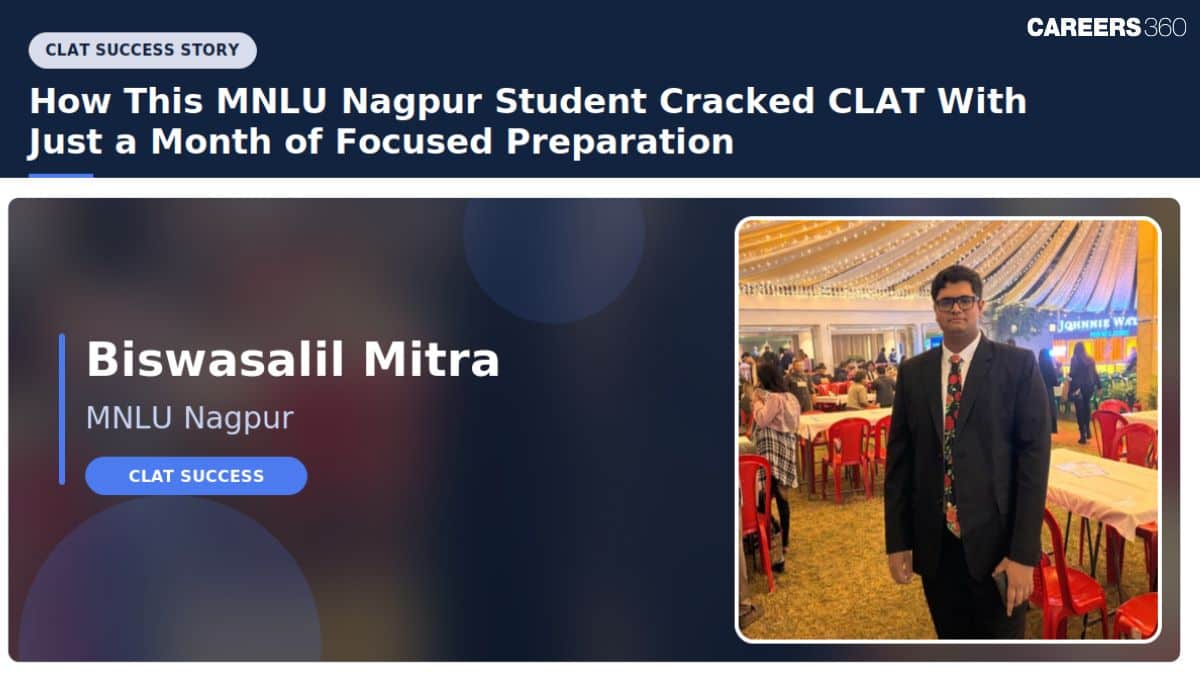
Careers360 had an exclusive conversation with Biswasalil, where he talked about his CLAT preparation timeline, the most common mistakes CLAT aspirants make, tips on tackling mock tests effectively, and why he chose MNLU Nagpur and BBA LLB over other NLUs and courses. He also talks about internships during law school, including stints at the Calcutta High Court and the Chambers of the Chief Justice of Sikkim. Below are some excerpts from the conversation.
Careers360: Hi Biswasalil, tell us about your background and the moment that made you decide to pursue law and eventually prepare for CLAT?
Biswasalil: I come from a family with a deep legal legacy, one that has run distinctly through the women in my family for two generations. My mother has been practising at the Calcutta High Court for nearly 23 years, working extensively with public sector banks and specialising in arbitration and mediation. Her mother, my grandmother, was part of the profession before her as well. In many ways, I am simply continuing something that began long before I was born, though I happen to be the first male in the family to formally take up law.
Ranked #18 amongst Institutions in India by NIRF | Get Upto 100% Scholarships | Spot Admissions via CUET
Scholars’ Round Deadline: 14th Nov’26 | Earn upto 50% merit Scholarship + 10% for top performers | EFMD Accredited | AACSB (USA) & AMDISA Member | Highest CTC 28 LPA
Growing up around the profession meant I absorbed a great deal of it without realising it at the time, but there was one moment that turned that quiet familiarity into genuine ambition. I watched my mother argue a matter before the Chief Justice's bench at the Calcutta High Court, in a case centred on the SARFAESI Act, 2002. The question before the court was one of legal supremacy: whether the Act, which had not even been enacted at the time the cause of action arose, could override the law of limitation, which was the only framework in force at that point. Watching her challenge the very vires of the Act, holding her ground with precision and conviction before one of the highest benches in the state, was the moment everything changed for me. It was not just advocacy. It was intellectual command over a genuinely difficult question of law, delivered with a kind of composure I found myself wanting to emulate one day.
That was when the profession stopped being a family backdrop and became a personal goal. Law demanded a rigor and a sophistication of thought that appealed to me deeply, and since CLAT was, at the time, the single centrally conducted examination that opened the door to the National Law Universities, it became the natural and only path I considered.
Careers360: Take us through your preparation timeline. When did you start, how did you structure your daily routine, and did you go with coaching, self-study, or a mix of both?
Biswasalil: My preparation window was fairly compact, roughly from June to December. I enrolled in a batch at Career Launcher's Park Street branch, with classes held every Saturday and Sunday. Alongside the classroom sessions, they offered access to an extensive bank of mock tests through their online platform, as well as periodic offline mocks conducted in parallel.
Honestly, if I am being candid, my period of genuinely intensive, focused preparation was closer to a single month than the full stretch of time I was enrolled. And yet I was consistently scoring well in the mocks I took. What that taught me, more than anything else, is that CLAT is far less about the sheer number of hours logged and far more about knowing precisely what to do and how to do it efficiently. Coaching is valuable in that it clarifies concepts and gives structure to your preparation, but it is deliberate practice, the repeated cycle of attempting mocks and dissecting your mistakes, that actually sharpens your instincts for the exam.
I would not want anyone to read this as a suggestion that less effort is somehow the smarter route. It is more that no amount of time is inherently insufficient, provided you are precise about your objectives and disciplined about how you use whatever time you do have. A large part of doing well lies in understanding the exam's own logic: you are not expected to attempt every question, and knowing which questions to skip is often as important as knowing which ones to answer. That filtering instinct, recognising quickly what is worth your time in the moment and what is not, ends up shaping your score far more than raw preparation hours ever could.
And honestly, that is not just an exam strategy. It is a life skill. Whether it is CLAT or the years that follow it, knowing what to filter out, what to let go of and what genuinely deserves your attention is what ultimately determines how far you get.
Careers360: Every aspirant has a section that tests their patience the most. Which one was toughest for you, and what specifically changed once you got better at it?
Biswasalil: Mathematics was never a natural strength of mine, and I will be honest, I never expected it to become one either. What I did come to realise, though, is that quantitative aptitude tends to be a genuine game-changer for those who have real command over it, but for the rest of us, it is General Knowledge and Current Affairs that quietly ends up deciding whether you get into an NLU or not. That section carries far more weight than people initially give it credit for.
I would not say I dramatically improved at mathematics by the end of my preparation, but I did reach a place where I was at least comfortable and consistent, which was enough. What mattered more than the improvement itself was how I approached both sections during the actual exam. I made a conscious decision to never revisit questions I had already chosen to leave. Going back only invites overthinking, and overthinking under exam conditions does two things at once: it disturbs your mental composure and it eats into time that could be spent securing marks elsewhere on the paper. Learning to make a decision and stand by it, rather than second-guessing myself mid-exam, ended up being just as important as any content preparation.
Careers360: Mock tests are often treated as just another test to clear rather than a learning tool. How did you actually use yours, how many did you take, and what did your post-mock analysis look like?
Biswasalil: I never treated mocks as a one-off performance check. To me, they were far more valuable as a diagnostic tool, a running checklist of exactly where my preparation was falling short and what needed sharper focus going forward. The score itself was almost secondary to what the mock revealed about my gaps.
In total, I gave around fifty mocks over the course of my preparation and scored reasonably well through most of them. A few did shake my confidence and left me disheartened for a day or two, but even those became useful in hindsight. Every setback taught me something specific about where I was slipping, and that is really the value mocks offer if you let them. It is those small, individual battles, the tests you do not do well in, that end up winning you the larger war, provided you treat them as lessons rather than verdicts.
I made it a point to spend close to an hour analysing each mock after taking it. That hour was non-negotiable for me. It was where the actual learning happened, far more than the test itself. This was especially true for General Knowledge and Current Affairs. My approach there was fairly disciplined: after every mock, I would go through each question I got wrong, or was simply unaware of, and note it down along with the correct answer. There is something about that act of writing it out that cements it in your memory far more effectively than passively reading an explanation. It plays into a fairly basic aspect of human nature too. We tend to remember our mistakes more vividly than our successes, and I made a conscious effort to use that tendency to my advantage rather than let it work against me.
Careers360: Preparation isn't just academic. There's pressure, comparison with peers, and self-doubt involved too. Was there a phase where your motivation dipped, and what kept you going?
Biswasalil: If motivation dipped at any point, it was because of my own performance, not because of anyone else's. Those handful of mocks I mentioned earlier, the ones that did not go my way, were really the only source of self-doubt I experienced during the entire process.
What I never did, and would strongly advise against, is comparing myself to other aspirants. I mean that quite firmly. Everybody is built differently. Someone else might have a natural edge in an area you struggle with, and you might well have an advantage in something they find difficult. Recognising that, accepting your own strengths and weaknesses honestly and choosing to work on them instead of measuring yourself against someone else's journey, is, I think, a genuine sign of maturity and self-awareness. Comparison rarely tells you anything useful. It only distracts you from the one thing that actually is in your control, which is your own improvement.
What kept me going through the lower moments was simply the belief that there is always a silver lining hidden somewhere within the clouds, and that a bad mock or a difficult week does not define the outcome. You have to trust the process enough to look past the immediate disappointment and keep working.
Careers360: If you had to identify one mistake that trips up most CLAT aspirants, something you either made yourself or watched others make, what would it be, and how should someone avoid it?
Biswasalil: If I had to name one mistake that trips up most CLAT aspirants, it would be overthinking, closely followed by self-doubt. The two feed off each other, and honestly, they end up doing more damage than any actual gap in preparation.
My advice is simple: if you've put in the work, trust it. Don't let last-minute anxiety undo months of effort. In the final stretch, keep it easy. Sleep well, eat well, have your coffee, stay relaxed, and walk into the exam with a clear head instead of a cluttered one. And once it's done, it's done. Don't sit there replaying every question the second you walk out of the hall. Preparation has its own time, and once that's over, the best thing you can do is unwind, maybe go celebrate a little, and trust that the work you put in will speak for itself.
Careers360: For someone who doesn't land their preferred NLU on the first attempt, what would you say to help them think clearly about reattempting versus exploring other options?
Biswasalil: Look, you can absolutely reattempt if you've got the time and age on your side. But here's the thing, everything in life has a right time to happen, education, career, marriage, all of it. Don't sit around forever hoping something better comes along. If you've got a decent option in hand, take it. Wasting years chasing a "better" outcome isn't strategy, it's a gamble, and not always one that pays off.
Also, let's be real, CLAT is nothing compared to what's coming. The actual war starts once you're inside law school. So don't obsess over the entrance exam like it's the final boss. Keep your eyes on the long game, stay happy with where you land, and trust that the bigger picture matters way more than one exam attempt.
Careers360: Looking back, what's one piece of advice you wish someone had given you on day one of your CLAT prep?
Biswasalil: Money follows, bro, money follows. Jokes aside, if I could go back and tell my day-one self one thing, it would be this: it is perfectly fine to not be exceptional or brilliant right out of the gate. Keep calm and just do your best. The best result is not always the result you end up getting, but as long as you have genuinely given it your all, you will not have to carry any guilt afterwards, and that matters more than people realise.
Honestly, every piece of advice I have shared so far is really an extension of this one. Do not overthink, do not compare yourself to others, do not chase "better" endlessly, and do not treat one exam like it defines your entire future. If someone had sat me down and told me all of this on day one, I think I would have gone into my preparation with a lot less pressure and a lot more clarity.
Careers360: What made you choose MNLU Nagpur specifically, and now that you're two years in, does the college match the picture you had of it before joining?
Biswasalil: A few things drew me to MNLU Nagpur specifically. The campus and infrastructure genuinely impressed me, and Nagpur's central location within the country was a practical plus as well. Beyond that, I had a strong sense that the university was still on an upward trajectory, and that being part of its growth story now would mean something down the line, watching it establish itself and being able to say we were there in its earlier years as proud alumni.
As for whether it matches the picture I had going in, I would say it does and it does not, in equal measure. There are certainly a few gaps here and there, but nothing serious enough to overshadow the overall experience. Most of it is easy enough to look past. On the whole, I would say I am satisfied with where I ended up, genuinely so, and not just because there was no turning back at that point.
Careers360: NLUs offer multiple five-year integrated courses. What made you choose BBA LLB over other options like BA LLB, and how has that choice shaped your academic experience so far?
Biswasalil: Honestly, subjects like sociology and history were never really my thing. I am a fairly practical person by nature, and I gravitate towards subjects that make logical sense to me, things I can reason through and justify with clear, structured thinking rather than purely theoretical or interpretive frameworks. BBA LLB fits that inclination far better than BA LLB ever would have.
I want to be clear, there is nothing wrong with BA LLB as a choice, it simply was not the right fit for how my mind works. Management, economics, and the more analytical side of things appealed to me in a way that history and sociology did not. And looking back, I would say it has worked out well. I have found myself genuinely comfortable and reasonably good at what I chose, which is really all you can ask for when picking between two equally respected paths.
Careers360: CLAT prepares you to crack an exam, but law school asks something very different of you. What's been the biggest adjustment, academically or otherwise, since you started here?
Biswasalil: The biggest adjustment has honestly been cultural, simply because law school brings together people from so many different classes, backgrounds, and walks of life, all under one roof. That kind of exposure takes some getting used to. Alongside that, the competitive atmosphere within NLUs can, at times, feel surprisingly intense, even toxic. You quickly learn that you have to keep grinding to stay ahead, and that not everyone around you will genuinely want to see you succeed, aside from the handful of people who are truly close to you.
The adjustment, for me, was learning to do things purely for myself and not let other people's opinions or behaviour dictate my choices. I also learned fairly early on to be selective about who I share my plans with. Do not broadcast your next move to everyone, not even to your closest friend or your roommate. It is not about being secretive for its own sake, it is simply about protecting your own focus and not inviting unnecessary noise or comparison into your process.
Academically, the adjustment has been about staying disciplined without losing sight of the fact that this is also meant to be enjoyed. My advice to anyone starting out would be to stay focused, but do not skip out on genuinely enjoying college life. Once you step into the profession itself, that window closes. There is no real going back to relive it, and very little time left for that kind of enjoyment once the actual work begins.

On Question asked by student community
Hello Student,
Here are the Careers360 CLAT 2027 Mock Test Resources for your exam preparation.
1. Online CLAT Mock Test
2. CLAT Mock Tests and Solutions
Hello student,
CLAT 2027 aspirants can access these monthly current affairs compilations for regular revision. Use these resources to stay updated with important events and topics for CLAT 2027.
|
Particular |
Download PDF |
|
CLAT Current Affairs- August Month (2026) |
|
|
CLAT Current Affairs- |
If you have only two months, use a highly structured plan: daily current affairs, English reading, legal reasoning practice, logical reasoning sets, basic quantitative practice and regular full-length mocks. Spend as much time analysing incorrect questions as taking the mock itself. Consistency during these two months can make a substantial
You can download the CLAT previous years' question papers from here:
https://law.careers360.com/articles/clat-previous-year-question-papers
https://law.careers360.com/download/clat-sample-papers-previous-years
For CLAT 2027 UG, candidates need to have passed Class 12/equivalent with at least 45% marks, or 40% for SC/ST/PwD candidates.
In your situation, having an RT in an additional subject but subsequently passing the required qualification through an improvement examination does not automatically make you ineligible. However, the important

Ranked #18 amongst Institutions in India by NIRF | Get Upto 100% Scholarships | Spot Admissions via CUET
Scholars’ Round Deadline: 14th Nov’26 | Earn upto 50% merit Scholarship + 10% for top performers | EFMD Accredited | AACSB (USA) & AMDISA Member | Highest CTC 28 LPA
Moot Court | Mock trials | Legal Aid Clinic | Recruiting Partners: FICCI, TCS, Adani, Trilegal, and many others
NAAC A+ Accredited University
Law Admissions 2026 Open | Avail Merit-Based Scholarships
NAAC A++ Accredited | Ranked #11 by NIRF