KCC ITM | Law Admissions 2026
Law Admissions 2026 Open | Avail Merit-Based Scholarships


Preparing for the AIBE 21 Exam 2026? One of the smartest ways to boost your score is by mastering the most important Bare Acts with the highest weightage in the exam. Since the All India Bar Examination is an open-book test, candidates who know how to quickly locate provisions, landmark sections, and frequently asked topics gain a major advantage in the final paper.
In this article, we bring you the complete list of AIBE 21 Bare Acts Important Bare Acts along with subject-wise weightage, frequently asked sections, and preparation tips for the 2026 exam. From the Constitution of India and Criminal Laws to the Evidence Act, CPC, IPC/BNS, and Professional Ethics, these Bare Acts form the core of the AIBE syllabus and are repeatedly tested every year.
Whether you are starting your preparation or revising in the last few weeks before the exam, this detailed guide will help you identify the most scoring Bare Acts for AIBE 21, understand important provisions, and improve your speed during the examination. Read on to discover the high-priority laws every AIBE aspirant must prepare for the AIBE 2026 exam to clear the exam confidently.
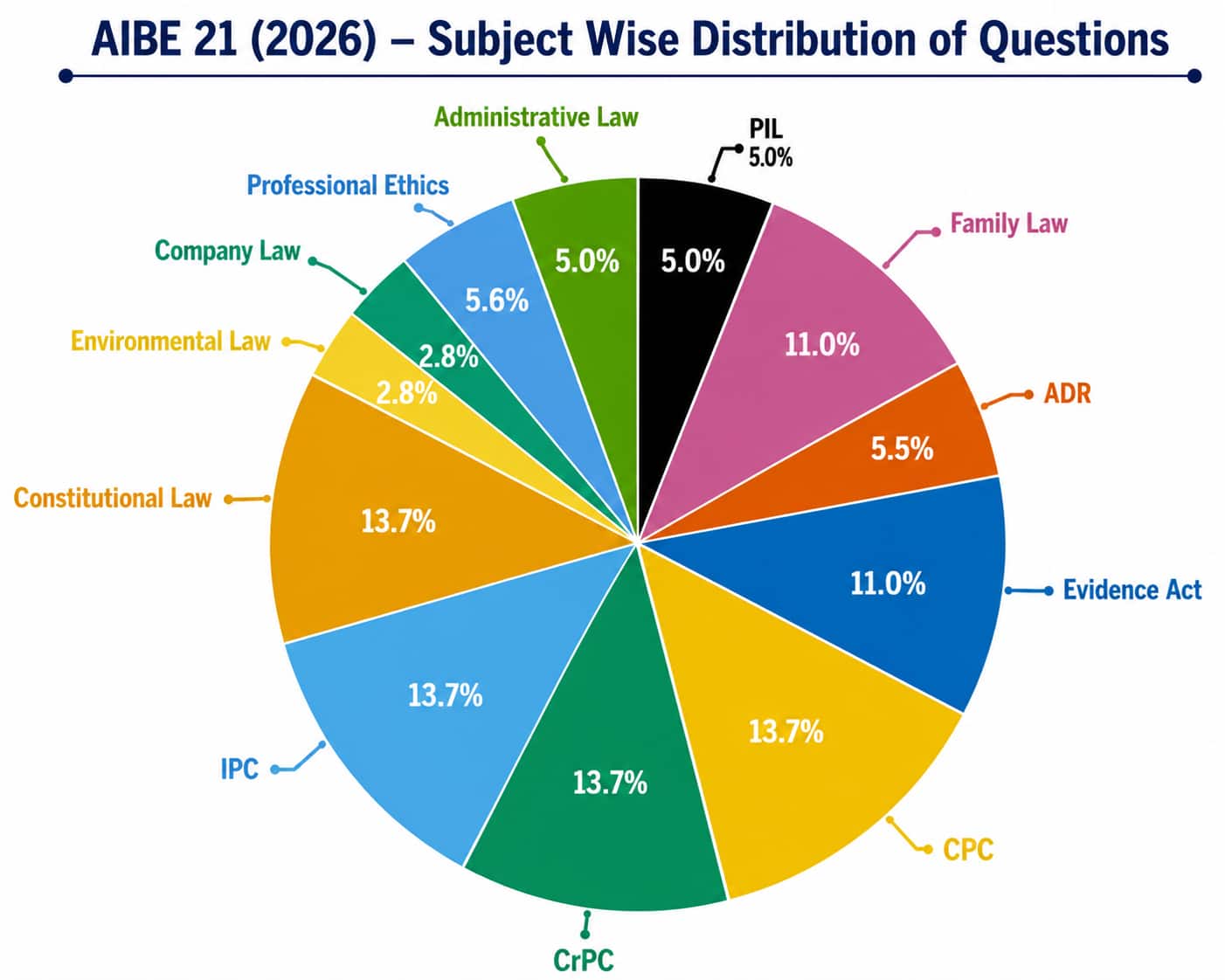
For the AIBE 21 Exam 2026, candidates must develop a strong understanding of important Bare Acts in the AIBE 2026 Syllabus, as they form the core of the legal concepts tested in the examination. The table below highlights the Top 10 Repeated Topics in AIBE Question Papers, their expected weightage, and the key topics candidates should focus on during preparation.
Bare Act | Weightage | Important Topics for AIBE 21 Exam 2026 |
AIBE Constitution Law | 10 Questions | Fundamental Rights, Directive Principles of State Policy (DPSP), Fundamental Duties, Writ Jurisdiction, Separation of Powers, Parliament & State Legislature, President & Governor Powers, Judiciary, Emergency Provisions, Important Constitutional Articles |
Code of Civil Procedure (CPC) in AIBE Criminal Law | 10 Questions | Jurisdiction of Civil Courts, Res Judicata, Stay of Suit, Plaint & Written Statement, Summons, Temporary Injunctions, Interlocutory Orders, Appeals, Review & Revision, Execution of Decrees, Order & Rule-based questions |
Code of Criminal Procedure (CrPC) / BNSS | 10 Questions | FIR, Arrest Procedures, Bail & Anticipatory Bail, Cognizable & Non-Cognizable Offences, Investigation Process, Charge Sheet, Trial Procedures, Powers of Police & Magistrates, Appeals, Limitation, Search & Seizure |
Indian Penal Code (IPC) / BNS | 8 Questions | General Exceptions, Joint Liability, Criminal Conspiracy, Abetment, Offences Against Human Body, Theft, Robbery, Cheating, Criminal Breach of Trust, Defamation, Forgery, Punishments and Important Definitions |
Indian Evidence Act / BSA | 8 Questions | Relevancy of Facts, Admissions & Confessions, Dying Declaration, Burden of Proof, Estoppel, Expert Opinion, Documentary Evidence, Oral Evidence, Presumptions, Competency of Witnesses, Examination of Witnesses |
Family Law | 8 Questions | Hindu Marriage, Divorce, Judicial Separation, Maintenance, Adoption, Guardianship, Succession & Inheritance, Muslim Law Principles, Custody of Child, Family Disputes and Rights of Women |
Frequently Asked Questions (FAQs)
The most important Bare Acts for AIBE 21 include Constitutional Law, CPC, CrPC/BNSS, IPC/BNS, Indian Evidence Act/BSA, and Family Law. These subjects consistently contribute the maximum number of questions in previous AIBE exams.
Constitutional Law is expected to contribute around 10 questions in the AIBE 21 Exam 2026. Topics like Fundamental Rights, Writs, DPSPs, Judiciary, and Emergency Provisions are highly important.
Yes, the Code of Civil Procedure (CPC) is one of the highest-weightage subjects in AIBE. Candidates should focus on jurisdiction, appeals, res judicata, injunctions, execution proceedings, and important orders & rules.
For AIBE 21, important criminal law topics include FIR, arrest, bail, investigation, trial procedure, general exceptions, criminal conspiracy, theft, cheating, and offences against the human body under CrPC/BNSS and IPC/BNS.
Yes, the Indian Evidence Act/Bharatiya Sakshya Adhiniyam is a highly scoring subject in AIBE. Frequently asked topics include admissions, confessions, burden of proof, dying declaration, presumptions, and examination of witnesses.
Professional Ethics, Family Law, and Evidence Law are generally considered scoring subjects because many questions are direct and theory-based. Regular revision of important sections can help candidates secure easy marks.

On Question asked by student community
Hello Student,
You can access the AIBE previous year question papers in Hindi by clicking on the relevant link given below.
https://law.careers360.com/hi/articles/aibe-previous-year-question-papers
Hey there,
No. If you are currently in the 5th semester of a 3-year LL.B., you generally cannot register for AIBE yet.
Under the current BCI rules, a 3-year LL.B. student must be in the final semester (6th semester) and have no backlogs from previous semesters to register for AIBE.
Hello Dear Student,
The All India Bar Examination (AIBE) covers 19 major legal subjects, carrying a high-weightage focus on Constitutional Law (8–12 questions) and Family Law including Hindu and Muslim law (6–8 questions)
You can check, find and access more information here:
Hello Dear Student,
Could you provide more information so that i could help you further!
Hello Venkataharanadh
Please check the link given below for the answer key:
https://law.careers360.com/articles/aibe-answer-key
Hope it helps.

Ranked 1 st among Top Law Schools of super Excellence in India - GHRDC | NAAC A+ Accredited | #36 by NIRF
Last Date to Apply: 17th August | QS I-Gauge Diamond Rated | NAAC A+ Accredited | 621 Recruitment Partners | INR 40 LPA Highest CTC | 4482 Job offers
NAAC A++ Accredited | Ranked #11 by NIRF
Bar Council of India (BCI) approved | Accredited by LAWASIA | Ranked 13th , among the Best Law Colleges (Private) in India by IIRF
60+ Years of Education Legacy | UGC & AICTE Approved | Prestigious Scholarship Worth 6 Crores
Free Ebook - CLAT 2025 English Language questions with detailed solutions