School of Law, UPES, Dehradun
Ranked #18 amongst Institutions in India by NIRF | Get Upto 100% Scholarships | Spot Admissions via CUET


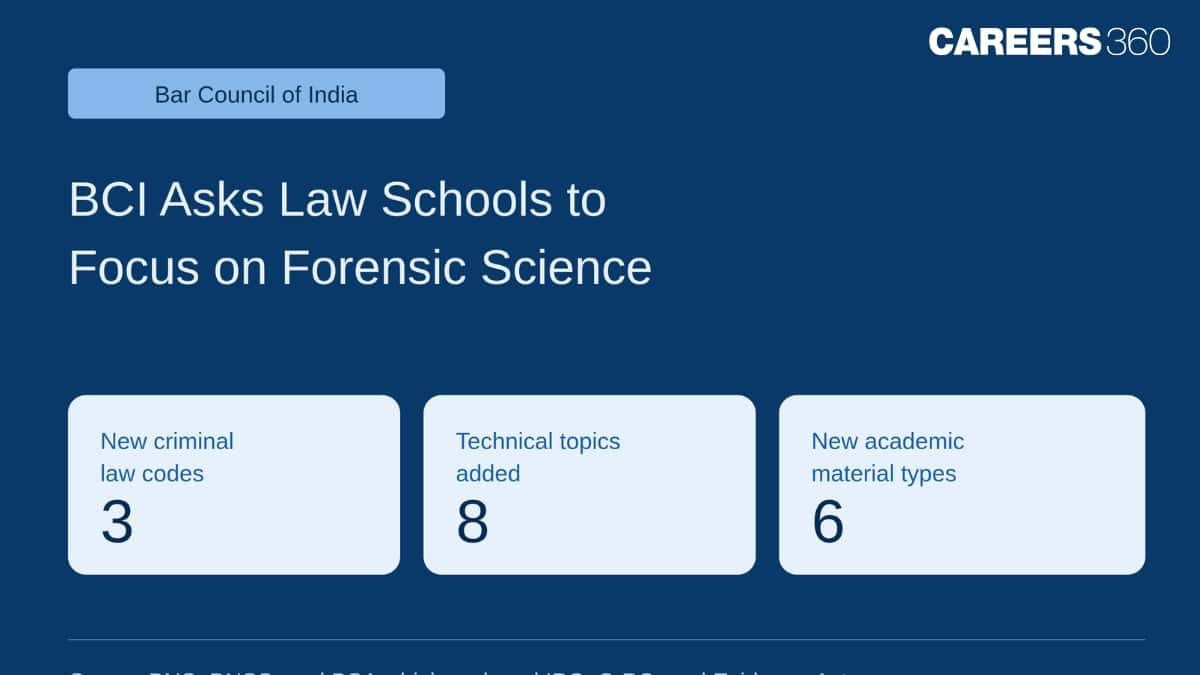
The Bar Council of India has written to Vice-Chancellors/Registrars of all universities imparting legal education regarding the implementation of new rules on the Bharatiya Nyaya Sanhita (BNS) 2023, Bharatiya Nagarik Suraksha Sanhita (BNSS) 2023, and Bharatiya Sakshya Adhiniyam (BSA) 2023. The letter seeks deep emphasis on forensic science, scientific investigation, and case-study-based teaching. The latest BCI circular is a follow-up of an earlier circular dating back to 2024, where it directed all law universities/colleges to integrate India's three new criminal law codes (BNS, BNSS, BSA — which replaced the IPC, CrPC, and Evidence Act) into the curriculum starting from the academic year 2024–25.
BCI says it received a formal communication from the Department of Legal Affairs, Ministry of Law and Justice, forwarding a recommendation from the DGsP/IGsP Conference, 2025, a conference of Directors General/Inspectors General of Police. The department has recommended that NLUs and premier law schools in India study the impact and practical implementation of new criminal laws. The communication also stresses the increased role of forensic science.
The BCI letter to the legal centres’ heads has asked for the implementation of the following directives:
Move beyond textbook teaching: The BCI circular has asked centres of legal education to ensure that teaching of the BNS, BNSS, and BSA is not confined to just textbook teaching. Law schools must also include the practical application of these new laws.
Emphasis on technical and forensic areas: The BCI has asked law colleges to include the topics given below in their curriculum
Scientific investigation
Electronic and digital evidence
Expert evidence
Preservation and collection of evidence
Chain of custody
Forensic examination
Use of technology in investigation and trial
Other emerging aspects of criminal justice administration under the new statutory framework
Develop new academic material: Apart from incorporating new concepts in the curriculum, BCI has also asked the centres of legal education to develop and use new academic material like:
Case studies
Research papers
Teaching modules
Clinical exercises
Simulations
Seminars and workshops
NLUs and other top institutes to lead research: The BCI in its circular, stressed that National Law Universities, Central/State University Departments of Law, and other institutions with adequate research facilities and academic expertise should work towards documented research and case studies toward greater use of forensic and scientific methods in criminal investigation and adjudication.
Ranked #18 amongst Institutions in India by NIRF | Get Upto 100% Scholarships | Spot Admissions via CUET
Scholars’ Round Deadline: 14th Nov’26 | Earn upto 50% merit Scholarship + 10% for top performers | EFMD Accredited | AACSB (USA) & AMDISA Member | Highest CTC 28 LPA
Apart from the above directives, BCI has also asked law schools to incorporate the new directives without diluting existing standards and to maintain academic accuracy and proper compliance. Specifically, the new additions must not affect mandatory subjects, minimum teaching hours, attendance requirements, or examination standards under the Rules of Legal Education, 2008.
Furthermore, BCI has asked all centres of legal education to maintain and produce compliance records with regard to the proposed implementations. The directive clearly maintained that any information on victims, witnesses, accused persons, pending investigations, confidential records, or pending proceedings cannot be disclosed except as per law, and real cases used academically must be anonymised.
The BCI circular explicitly states that, “Universities and Centres of Legal Education shall be required to maintain a brief record of the steps taken pursuant to this circular, including curriculum or teaching-module integration, seminars, workshops, research projects and case studies undertaken, so that the same may be furnished to the Bar Council of India whenever called for.” Centres of legal education must maintain a record of the steps taken regarding the circular and furnish the same whenever the BCI intends to audit.

On Question asked by student community
Hello Student,
You can check the relevant article below
https://law.careers360.com/download/ebooks/aibe-preparation-guide
Hope it helps!
Hello Student,
You can access the AIBE previous year question papers in Hindi by clicking on the relevant link given below.
https://law.careers360.com/hi/articles/aibe-previous-year-question-papers
Hey there,
No. If you are currently in the 5th semester of a 3-year LL.B., you generally cannot register for AIBE yet.
Under the current BCI rules, a 3-year LL.B. student must be in the final semester (6th semester) and have no backlogs from previous semesters to register for AIBE.
Hello Dear Student,
The All India Bar Examination (AIBE) covers 19 major legal subjects, carrying a high-weightage focus on Constitutional Law (8–12 questions) and Family Law including Hindu and Muslim law (6–8 questions)
You can check, find and access more information here:
Hello Dear Student,
Could you provide more information so that i could help you further!

Ranked #18 amongst Institutions in India by NIRF | Get Upto 100% Scholarships | Spot Admissions via CUET
Scholars’ Round Deadline: 14th Nov’26 | Earn upto 50% merit Scholarship + 10% for top performers | EFMD Accredited | AACSB (USA) & AMDISA Member | Highest CTC 28 LPA
Moot Court | Mock trials | Legal Aid Clinic | Recruiting Partners: FICCI, TCS, Adani, Trilegal, and many others
NAAC A+ Accredited University
Law Admissions 2026 Open | Avail Merit-Based Scholarships
NAAC A++ Accredited | Ranked #11 by NIRF