Amity Law School, Noida
Experiential Learning through Legal Aid Camps, Lok Adalats, Court Visits, Community Lawyering and regular Moot Court sessions


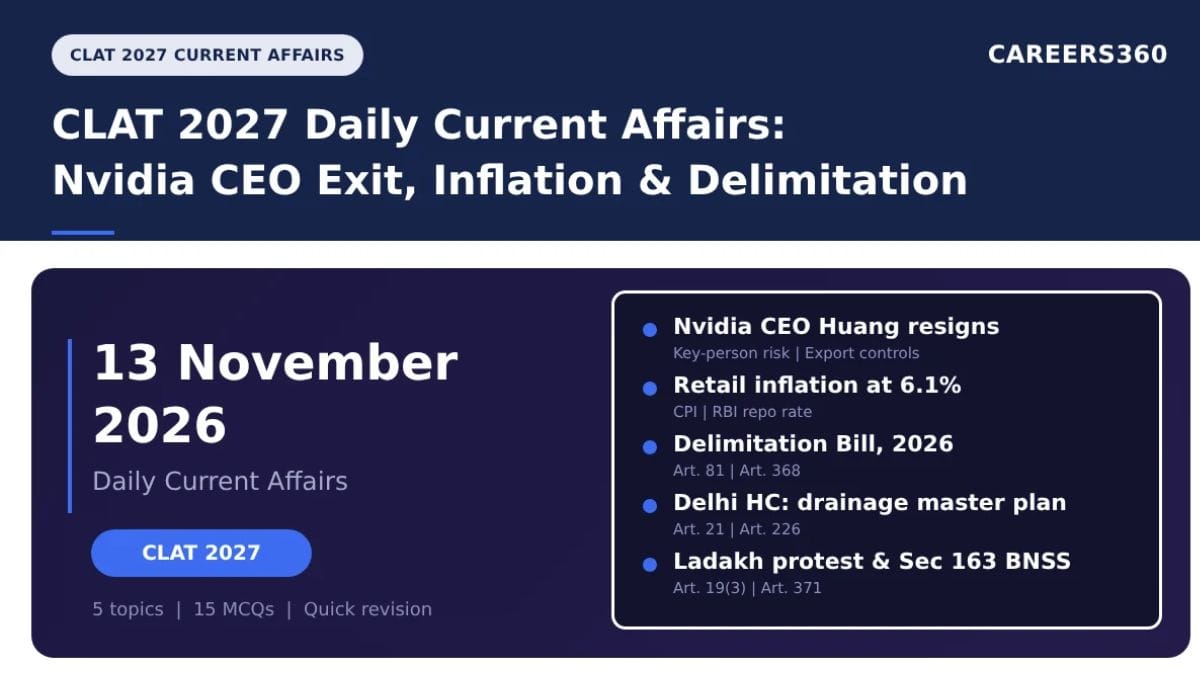
Today's CLAT 2027 current affairs cover five important topics from business, economy, law, national affairs and international relations. These include Nvidia CEO Jensen Huang's exit, rising retail inflation, the proposed Delimitation Bill, a Delhi High Court order on drainage and protests in Ladakh. These topics are important for the Common Law Admission Test, as they connect current events with legal, constitutional and economic concepts. Key facts, important terms and MCQs are included to help aspirants understand the news and prepare for the exam.
In the news: Jensen Huang resigned as CEO of Nvidia, the chipmaker at the centre of the AI boom, after an extramarital affair raised national security concerns. He had led the company for 33 years. CFO Colette Kress was named interim CEO, while Harvey C. Jones became the company's first-ever chairperson. Nvidia shares fell 14% at Thursday's opening, while the Nasdaq dropped 1.5%.
Reports linked Huang's relationship to a former executive of Singapore-based Megaspeed International, which faced allegations of illegally shipping advanced Nvidia chips to China. The company has denied the allegations and is cooperating with the US Bureau of Industry and Security. Nvidia said it had no reason to believe its secrets or national security were compromised and would examine all available information.
Share price: The price of a company's shares reflects what investors think about its future. Uncertainty after a CEO's exit can cause a fall.
Key-person risk: The risk that a company's performance depends heavily on one person.
Corporate governance: The system through which a company's board oversees its management, risks and leadership changes.
Export controls: Government restrictions on selling sensitive goods or technology, such as advanced chips, to certain countries or users.
Disclosure norms: In India, listed companies must inform stock exchanges about important developments, including changes in key managerial personnel, under SEBI's listing rules.
Q1. Why can the sudden exit of a long-serving CEO cause a company's share price to fall?
A. The company's assets disappear
B. Investors become uncertain about the company's future
C. The law forces share prices to fall
D. The stock exchange fixes a lower price
Answer: B
Q2. Which term describes the risk of a company depending heavily on one individual?
A. Key-person risk
B. Systemic risk
C. Exchange rate risk
D. Liquidity risk
Answer: A
Q3. Why do governments restrict the export of advanced chips?
A. To increase company profits
B. To protect national security and prevent sensitive technology from reaching unauthorised users
C. To fix chip prices worldwide
D. To stop all international trade in electronics
Answer: B
Attempt Free Official Practice Test & Solutions and Ace the CLAT Exam 2026
In the news: India's retail inflation rose to 6.1% in October, crossing the RBI's upper limit for the first time in two years. Food and fuel prices drove the increase, which spread across other categories. Inflation reached 8.5% for food and beverages, 5.8% for transport and 10.1% for restaurants and accommodation. These were record highs under the new Consumer Price Index (CPI) series, which uses 2024 as its base year.
The RBI targets inflation at 4%, with an acceptable range of 2% to 6%. An economist said festive demand may have added to price pressures. The RBI's Monetary Policy Committee (MPC) had raised the repo rate by 25 basis points to 5.50% in October. The report described the rise as mainly supply-driven. The Congress criticised the government over rising prices.
CPI: Consumer Price Index measures changes in the prices of goods and services commonly bought by households.
Inflation target: The RBI aims to keep inflation at 4%, within a range of 2% to 6%.
Repo rate: The rate at which the RBI lends money to banks. A higher rate makes loans costlier and can reduce spending.
Supply-driven inflation: Inflation caused by higher production costs or shortages. Demand-pull inflation occurs when demand rises faster than supply.
MPC: The Monetary Policy Committee decides the RBI's policy interest rate under the RBI Act, 1934.
Q1. What is the likely effect of an increase in the repo rate?
A. Loans become costlier, which can reduce demand and help control inflation
B. Loans become cheaper
C. Government spending automatically increases
D. Prices of all goods are fixed by law
Answer: A
Q2. Inflation caused by rising food and fuel costs is known as:
A. Demand-pull inflation
B. Supply-side or cost-push inflation
C. Deflation
D. Stagflation
Answer: B
Q3. The RBI's inflation target is 4%. What is its acceptable range?
A. 3% to 5%
B. 2% to 6%
C. 4% to 8%
D. 0% to 4%
Answer: B
In the news: The Centre is considering a Special Session of Parliament to pass the Delimitation Bill, 2026, which is linked to implementing the Women's Reservation Act, 2023. The proposed change would increase Lok Sabha strength from 543 to a maximum of 850 seats. The 33% women's quota would be based on the 2011 Census. Government sources expect 15-16 more votes than the 361 needed for a two-thirds majority. The House currently has three vacancies.
A similar Constitution Amendment Bill failed to secure enough votes on April 17. The Monsoon Session, adjourned on August 13, has not been prorogued and has continued for 91 days, breaking the 87-day record set in 2008. One proposal is to increase seats in every State by 50%, keeping their relative share based on the 1971 Census. The Congress has opposed the move.
Article 81: Sets the strength of the Lok Sabha. Increasing its maximum strength to 850 would require a constitutional amendment.
Article 368: Lays down the procedure for amending the Constitution. Most amendments need a majority of the total membership and two-thirds of members present and voting.
Delimitation: The process of redrawing constituency boundaries and deciding the number of seats based on population.
Women's Reservation Act, 2023: The 106th Constitutional Amendment provides 33% reservation for women in the Lok Sabha and State Legislative Assemblies.
Prorogation: The formal end of a session of Parliament. An unprorogued session can be recalled without summoning a fresh session.
Q1. Why would increasing the Lok Sabha's strength to 850 require a constitutional amendment?
A. The Speaker decides the House's strength
B. The Constitution sets a limit on the House's strength
C. The President approves every Lok Sabha seat
D. The Election Commission decides the limit
Answer: B
Q2. Which Article lays down the procedure for amending the Constitution?
A. Article 356
B. Article 352
C. Article 368
D. Article 370
Answer: C
Q3. What majority is generally required for a constitutional amendment under Article 368?
A. A simple majority of members present
B. A majority of the total membership and two-thirds of members present and voting
C. Three-fourths of the total membership
D. Unanimous approval
Answer: B
Get the CLAT UG previous year question papers here
In the news: The Delhi High Court has flagged the lack of a connected system for stormwater and sewage drains in the city. A Bench of Justices Prathiba M. Singh and Manmeet Pritam Singh Arora said waterlogging and sewage backflow cannot be fixed through separate measures for each colony. In its November 5 order, the Court asked the Delhi government to submit a status report on the proposed Drainage Master Plan and explain any hurdles to its implementation.
The case followed a petition by the Maharani Bagh Co-operative House Building and Welfare Society, which complained that sewage flowed back into the colony during recent rains. The Delhi Jal Board blamed illegal sewage connections from JJ camps. The Court also asked DUSIB to identify points where untreated sewage was being discharged.
Article 21: The right to life has been interpreted by courts to include the right to a clean and healthy environment.
Article 226: Gives High Courts the power to issue directions and orders to government authorities.
Systemic remedy: A solution that addresses the root of a problem across an entire system rather than fixing individual cases.
Status report: A report submitted to a court explaining the progress made by authorities and the steps taken to follow its directions.
Article 51A(g): Makes it a fundamental duty of citizens to protect and improve the natural environment.
Q1. Which Article has been interpreted to include the right to a clean and healthy environment?
A. Article 14
B. Article 19(1)(g)
C. Article 21
D. Article 300A
Answer: C
Q2. Why did the Delhi High Court seek a city-wide drainage plan instead of separate fixes for individual colonies?
A. Drainage problems are connected and need a coordinated solution
B. Colonies have no legal rights
C. Courts cannot direct government authorities
D. All drains are privately owned
Answer: A
Q3. Why does a court ask the government to submit a status report?
A. To transfer the case to another court
B. To punish officials immediately
C. To check progress and hold authorities accountable
D. To close the case without a hearing
Answer: C
In the news: Civil society groups in Ladakh began an indefinite dharna in Leh, demanding that the Centre resume talks and postpone hill council elections scheduled during peak winter. Their six demands include an independent Delimitation Commission, release of the judicial inquiry report into the September 2025 violence, withdrawal of cases and a rollback of the new liquor policy. Using Section 163(1) of the BNSS, the administration moved climate activist Sonam Wangchuk from the protest site to his residence. He called the restrictions arbitrary and disproportionate.
In May, the Centre proposed a customised special arrangement for Ladakh, including a provision under Article 371. On October 15, the Home Ministry presented a 32-page draft, which the Leh Apex Body (LAB) and Kargil Democratic Alliance (KDA) rejected. They said it went against earlier promises. A meeting scheduled for October 22 did not take place.
Section 163 of BNSS: Allows a magistrate to issue urgent orders to prevent danger or a disturbance of public order. It replaced Section 144 of the CrPC.
Reasonable restrictions: Article 19(3) allows restrictions on peaceful assembly in the interest of public order. Such restrictions must be reasonable and proportionate.
Article 371: Provides special arrangements for certain States under Articles 371A to 371J. A special arrangement for Ladakh would require a separate constitutional provision.
Union Territory: Ladakh is administered by the Centre through a Lieutenant Governor and does not have an elected legislature.
Judicial inquiry: An inquiry ordered to examine an incident or allegation. Its findings can help establish facts and accountability.
Q1. Section 163 of the BNSS replaced which provision of the old CrPC?
A. Section 144
B. Section 124A
C. Section 302
D. Section 41
Answer: A
Q2. A restriction on a person's movement is challenged as disproportionate. Which principle is being questioned?
A. Restrictions on rights must be reasonable and should not go beyond what is necessary
B. Orders under criminal law cannot be challenged
C. Fundamental rights apply only in States
D. Magistrates have unlimited powers
Answer: A
Q3. What is the main purpose of Article 371 of the Constitution?
A. To impose a National Emergency
B. To provide special provisions for certain States
C. To abolish the Sixth Schedule
D. To regulate elections to Parliament
Answer: B
The following points cover the important names, dates, figures and developments from today's news for a quick recap before the CLAT 2027 exam.
Nvidia: CEO Jensen Huang resigns; shares fall 14%; Colette Kress named interim CEO.
Retail inflation: Rises to 6.1% in October, crossing the RBI's 6% upper limit for the first time in two years.
Repo rate: RBI's MPC raised it by 25 basis points to 5.50% in October.
Delimitation Bill, 2026: Centre considers a Special Parliament Session; proposed Lok Sabha strength of up to 850 seats.
Constitution Amendment: 361 votes needed for a two-thirds majority, based on the figures provided.
Monsoon Session: Remains unprorogued for 91 days, breaking the earlier 87-day record.
Delhi High Court: Seeks an integrated Drainage Master Plan and a status report from the Delhi government.
NIA: Takes over two terror conspiracy cases in Punjab and Uttar Pradesh.
COP31: Begins in Antalya, Türkiye, with Australia presiding over negotiations.

On Question asked by student community
Hello Miruthula,
For CLAT PG 2027, you need to focus on the core subjects of your LLB curriculum, particularly the following:
Constitutional Law
Jurisprudence
Administrative Law
Law of Contract
Law of Torts
Family Law
Criminal Law
Property Law
Company Law
Public International Law
Tax Law
Environmental Law
Labour and Industrial
Hello Student,
The full form of the CLAT exam is the Common Law Admission Test. You can check the link related to the CLAT exam
https://law.careers360.com/articles/what-is-clat-full-form-all-about-nlus-entrance-exam
Hello Student,
Here are the Careers360 CLAT 2027 Mock Test Resources for your exam preparation.
1. Online CLAT Mock Test
2. CLAT Mock Tests and Solutions
Hello student,
CLAT 2027 aspirants can access these monthly current affairs compilations for regular revision. Use these resources to stay updated with important events and topics for CLAT 2027.
|
Particular |
Download PDF |
|
CLAT Current Affairs- August Month (2026) |
|
|
CLAT Current Affairs- |
If you have only two months, use a highly structured plan: daily current affairs, English reading, legal reasoning practice, logical reasoning sets, basic quantitative practice and regular full-length mocks. Spend as much time analysing incorrect questions as taking the mock itself. Consistency during these two months can make a substantial

Experiential Learning through Legal Aid Camps, Lok Adalats, Court Visits, Community Lawyering and regular Moot Court sessions
Ranked #18 amongst Institutions in India by NIRF | Get Upto 100% Scholarships | Spot Admissions via CUET
NAAC A++ Approved | Curriculum Aligned with BCI & UGC
Scholars’ Round Deadline: 14th Nov’26 | Earn upto 50% merit Scholarship + 10% for top performers | EFMD Accredited | AACSB (USA) & AMDISA Member | Highest CTC 28 LPA
BA LLB, BBA LLB, or BCom LLB and LLB | LLM 1 Year – 4 Specializations | Approved by BCI | Highest CTC 9 LPA
Grade 'A+' Accredited by NAAC | Ranked 33rd in India by NIRF