ICFAI University Sikkim Law Admissions 2026
Approved by BCI


Today's CLAT 2027 current affairs cover five topics from polity, law and economy. They are the Supreme Court's clarification on changes to Form 6, the removal of Jantar Mantar as a protest site, retail inflation rising to 5.5%, the Karnataka High Court striking down higher SC/ST reservation, and the Supreme Court's push for capping medicine prices. Each topic includes key facts and MCQs to help candidates revise important current affairs for CLAT 2027.
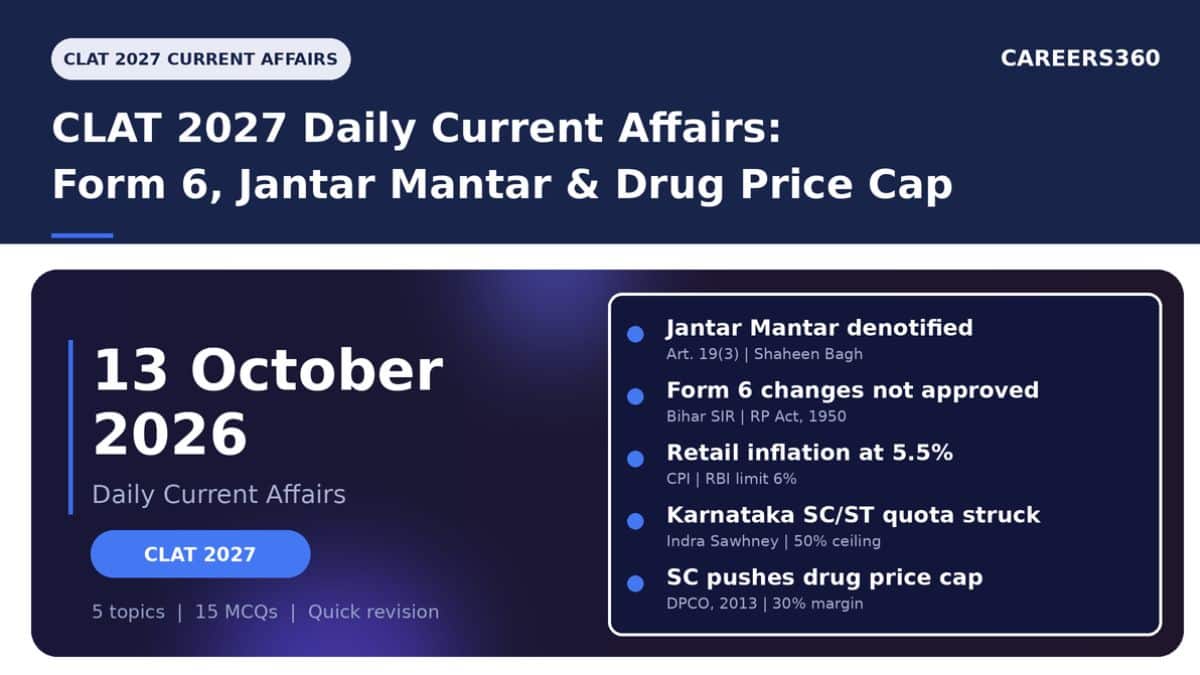
In the news: Delhi Police has removed Jantar Mantar from the list of designated protest sites in the national capital. Demonstrations will now be allowed at Ramlila Maidan, Burari Ground and CBD Ground in East Delhi, around 4 km, 15 km and 13 km away, respectively. Police Commissioner Anurag Kumar issued the order on the recommendation of a committee set up by the Union Home Ministry.
The decision changes a 2022 standing order that restricted protests to 10 am to 5 pm, for one day at a time. The move follows the Supreme Court's October 9 direction to find a spacious, open alternative for protests. Activists have objected to the new locations, arguing that the distance could make it harder to reach government offices and decision-makers. The Delhi High Court is scheduled to hear petitions challenging the decision.
What CLAT 2027 aspirants should know
Article 19(1)(a): Gives citizens the right to express their views and opinions.
Article 19(1)(b): Gives citizens the right to gather peacefully and without weapons.
Article 19(3): Allows the government to place reasonable limits on peaceful gatherings to maintain public order and protect India's sovereignty and integrity.
Shaheen Bagh case (2020): The Supreme Court said that people cannot occupy public roads indefinitely to protest. The right to protest must be balanced with the rights of other people who use those roads.
Section 163 of BNSS: Allows a magistrate to issue urgent orders when there is a risk to public safety or peace. It replaces Section 144 of the old CrPC.
Standing order: An official instruction that tells people or departments how certain activities must be carried out.
Q1. Which are the newly designated protest sites in Delhi?
A. India Gate, Red Fort and Connaught Place
B. Ramlila Maidan, Burari Ground and CBD Ground
C. Jantar Mantar, India Gate and Boat Club
D. Parliament House, Supreme Court and Red Fort
Answer: B
Q2. The right to peaceful assembly is a right that is reasonably restricted by the government under which Article of the Constitution?
A. Article 14
B. Article 19(3)
C. Article 21
D. Article 32
Answer: B
Q3. What did the Supreme Court say in the Shaheen Bagh case (2020)?
A. Protests can continue on public roads indefinitely
B. Parliament must approve public protests
C. Public roads cannot be occupied indefinitely for protests
D. Citizens do not have the right to protest
Answer: C
In the news: On Monday, the Supreme Court said it had neither approved nor disapproved the changes made to Form 6 in its May 27 judgment. That judgment was only about the legality of the pilot special intensive revision (SIR) in Bihar. Justice Joymalya Bagchi, part of the Bench headed by CJI Surya Kant, said the new Form 6 did not exist when the Bihar SIR was decided.
The changes were introduced in July. They required applicants to give ancestry details or linkage to previous SIR rolls on the ECINet portal. The remarks came on a petition by Priya Mishra against the Union government. On October 5, the CJI had also said the modifications were "not approved by us".
What CLAT 2027 aspirants should know
Form 6: The application for inclusion of a name in the electoral roll, used by first-time voters or those shifting constituencies.
Section 21(3), Representation of the People Act, 1950: Lets the Election Commission order a special revision of rolls for any constituency or part of one.
Section 28, Representation of the People Act, 1950: Only the Central government can make rules to carry out the Act.
Section 31, Representation of the People Act, 1950: False information in roll applications is punishable.
Article 326: Provides for elections to the Lok Sabha and Assemblies on the basis of adult suffrage.
Q1. Why did the Supreme Court explain that the changes to Form 6 were not approved?
A. The changes have been rolled out following its judgment on May 27.
B. The Election Commission had cancelled Form 6
C. This time, the Bihar SIR was cancelled.
D. The Centre had even amended the Representation of the People Act
Answer: A
Q2. What details did the revised Form 6 require applicants to provide?
A. Educational qualifications
B. Ancestry details or links to previous SIR electoral rolls
C. Property ownership details
D. A voter ID number from another state
Answer: B
Q3. Which law gives power to the Central Government to make rules under Section 28?
A. Rep. People Act 1950
B. Representation of the People Act, 1951
C. Election Commission Act, 1991
D. Citizenship Act, 1955
Answer: A
In the news: India's retail inflation, measured by the Consumer Price Index (CPI), rose to 5.5% in September 2026, its highest since October 2024, up from 4.8% in August. Food and beverage inflation increased from 5.7% to 7.4%, while transport inflation stood at 5% and restaurant and accommodation services inflation at 9.4%.
The RBI's upper comfort limit for retail inflation is 6%. ICRA chief economist Aditi Nayar said the MPC's recent rate hike "appears prescient" and expects inflation to cross 6% in October, with another rate hike possible in December.
What CLAT 2027 aspirants should know
Consumer Price Index (CPI): Tracks changes in the prices of goods and services people buy.
RBI inflation limit: The RBI's upper limit for retail inflation is 6%.
Monetary Policy Committee (MPC): Decides the repo rate to help control inflation.
Food inflation: Measures price rises in food and beverages. It was a major reason for September's inflation increase.
Monsoon and inflation: Poor rainfall and low water levels in reservoirs can reduce crop supplies and push food prices up.
Q1. What was India's retail inflation rate in September 2026?
A. 4.8%
B. 5.5%
C. 6%
D. 7.4%
Answer: B
Q2. What is the upper limit of the RBI's retail inflation target range?
A. 4%
B. 5%
C. 6%
D. 7%
Answer: C
Q3. Which index is used to measure retail inflation in India?
A. Wholesale Price Index (WPI)
B. Index of Industrial Production (IIP)
C. Consumer Price Index (CPI)
D. GDP deflator
Answer: C
In the news: On Monday, the Karnataka High Court struck down a law raising reservation beyond the 50% ceiling, calling the increase “constitutionally impermissible”. A Bench of Chief Justice Vibhu Bakhru and Justice K.S. Hemalekha declared Sections 3 and 4 of the Karnataka SC and ST (Reservation of Seats in Educational Institutions and of Appointments or Posts in the Services under the State) Act, 2022, ultra vires.
The Act raised SC reservation from 15% to 17% and ST reservation from 3% to 7%. With OBC reservation unchanged at 32%, the total rose from 50% to 56%. The 50% ceiling was set in Indra Sawhney v. Union of India (1992).
What CLAT 2027 aspirants should know
Indra Sawhney v. Union of India (1992): Set the 50% ceiling on total reservation.
Article 15(4): Allows special provisions for socially and educationally backward classes, SCs and STs.
Article 16(4): Allows reservation in public appointments for backward classes not adequately represented.
Ultra vires: Beyond the legal power of the authority that made the law.
Retrospective operation: The Act applied from November 1, 2022, though passed later.
Q1. Which Supreme Court judgment established the 50% ceiling on reservations?
A. Kesavananda Bharati v. State of Kerala
B. Indra Sawhney v. Union of India
C. Minerva Mills v. Union of India
D. Maneka Gandhi v. Union of India
Answer: B
Q2. To what percentage did the Karnataka Act raise reservation for Scheduled Tribes (STs)?
A. 5%
B. 6%
C. 7%
D. 10%
Answer: C
Q3. What was the total reservation proposed under Karnataka's 2022 Act for SCs, STs and OBCs?
A. 50%
B. 54%
C. 56%
D. 60%
Answer: C
In the news: The Centre told the Supreme Court on Monday that it would cap trade margins at 30% for patented and non-patented non-scheduled cancer drugs. A Bench of Justices Vikram Nath and Sandeep Mehta called the move commendable but inadequate, asking why other medicines and medical devices could not follow the 16% retailer margin under the Drugs (Prices Control) Order (DPCO), 2013.
Justice Mehta noted that hospitals sold an Indian-made cardiac stent costing about Rs 5,000 for over Rs 25,000, while mark-ups on some drugs reach 1,000%. The petitions were filed by advocate Kishan Chand Jain and paediatric surgeon Sanjay Kulshrestha. The Centre has until October 27 to work out the modalities.
What CLAT 2027 aspirants should know
Drugs (Prices Control) Order, 2013: Governs price control of scheduled medicines.
Essential Commodities Act, 1955: The law under which the DPCO is issued.
Trade margin: The difference between the price to retailer (PTR) and the maximum retail price (MRP).
Article 21: The right to life includes the right to health.
Scheduled and non-scheduled drugs: Scheduled drugs have ceiling prices set by the government; non-scheduled drugs do not.
Q1. What trade margin cap did the Centre propose for non-scheduled cancer drugs?
A. 10%
B. 16%
C. 30%
D. 50%
Answer: C
Q2. What is the deadline set by the Supreme Court for the Centre to work out the modalities for medicine price caps?
A. October 15
B. October 20
C. October 27
D. November 5
Answer: C
Q3. Which order provides for a 16% retailer margin on certain medicines and medical devices?
A. Drugs and Cosmetics Rules, 1945
B. Drugs (Prices Control) Order, 2013
C. Patents Act, 1970
D. Clinical Establishments Rules, 2012
Answer: B
Candidates can revise these key facts for quick CLAT 2027 current affairs revision:
Form 6: SC says May 27 Bihar SIR ruling pre-dated the July changes; neither approved nor disapproved
Section 21(3), RP Act, 1950: Special revision of electoral rolls
Section 28, RP Act, 1950: Only the Centre makes rules under the Act
Jantar Mantar denotified: Ramlila Maidan, Burari Ground, CBD Ground named as new venues
Section 163 BNSS: Prohibitory orders; replaced Section 144 CrPC
Shaheen Bagh (2020): Protester's right balanced with commuter's right
CPI inflation: 5.5% in September, highest since October 2024; RBI upper limit 6%
Food and beverage inflation: 7.4% in September
Karnataka HC: Sections 3 and 4 of the 2022 SC/ST reservation Act struck down
Indra Sawhney (1992): 50% ceiling on reservation
Karnataka quota: SC 17%, ST 7%, OBC 32%, total 56%
DPCO, 2013: 16% retailer margin; Centre proposes 30% trade margin cap on cancer drugs

On Question asked by student community
Hello Student,
Here are the Careers360 CLAT 2027 Mock Test Resources for your exam preparation.
1. Online CLAT Mock Test
2. CLAT Mock Tests and Solutions
Hello student,
CLAT 2027 aspirants can access these monthly current affairs compilations for regular revision. Use these resources to stay updated with important events and topics for CLAT 2027.
|
Particular |
Download PDF |
|
CLAT Current Affairs- August Month (2026) |
|
|
CLAT Current Affairs- |
If you have only two months, use a highly structured plan: daily current affairs, English reading, legal reasoning practice, logical reasoning sets, basic quantitative practice and regular full-length mocks. Spend as much time analysing incorrect questions as taking the mock itself. Consistency during these two months can make a substantial
You can download the CLAT previous years' question papers from here:
https://law.careers360.com/articles/clat-previous-year-question-papers
https://law.careers360.com/download/clat-sample-papers-previous-years
For CLAT 2027 UG, candidates need to have passed Class 12/equivalent with at least 45% marks, or 40% for SC/ST/PwD candidates.
In your situation, having an RT in an additional subject but subsequently passing the required qualification through an improvement examination does not automatically make you ineligible. However, the important

Ranked #18 amongst Institutions in India by NIRF | Get Upto 100% Scholarships | Spot Admissions via CUET
Ranked 1 st among Top Law Schools of super Excellence in India - GHRDC | NAAC A+ Accredited | #36 by NIRF
NAAC A++ Accredited | Ranked #11 by NIRF
Bar Council of India (BCI) approved | Accredited by LAWASIA | Ranked 13th , among the Best Law Colleges (Private) in India by IIRF
Free Ebook - CLAT 2025 English Language questions with detailed solutions
Stay updated with current affairs & check your preparation with the CLAT General Knowledge Mock Tests Ebook