School of Law, UPES, Dehradun
Ranked #18 amongst Institutions in India by NIRF | Get Upto 100% Scholarships | Spot Admissions via CUET


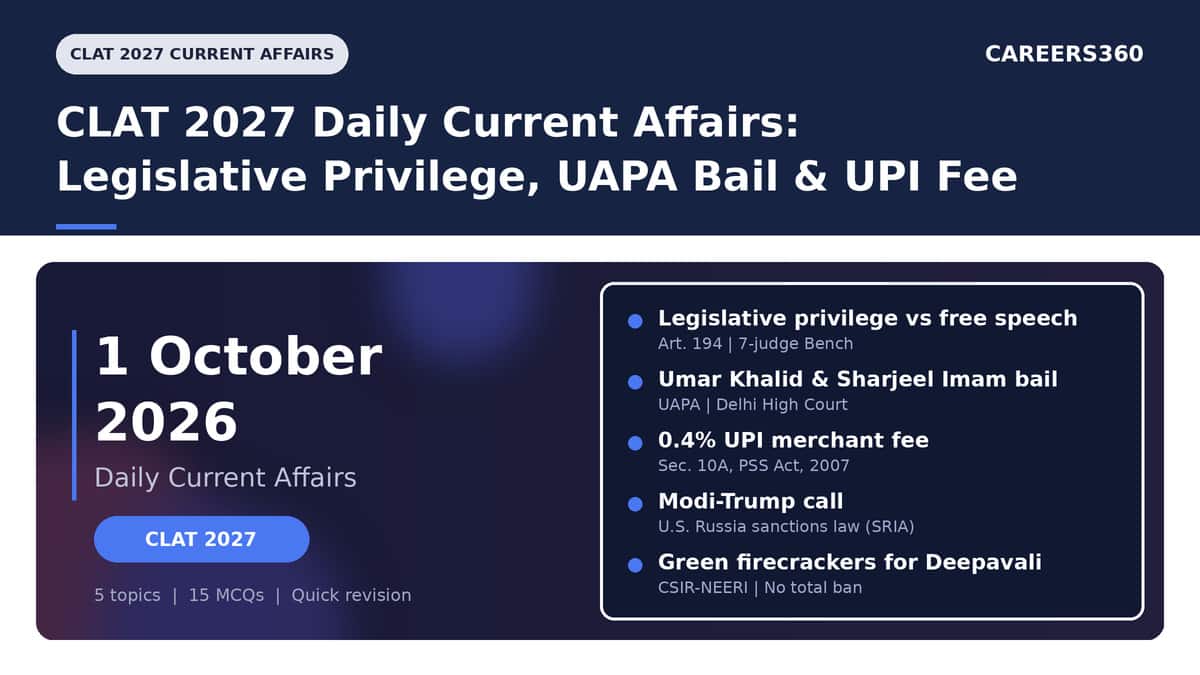
Today's CLAT 2027 current affairs cover the Supreme Court's free speech case on legislative privilege under Article 194, the Delhi High Court rejecting bail to Umar Khalid and Sharjeel Imam, UPI merchant fees, the first Modi-Trump call since the new U.S. Russia sanctions law, and the Supreme Court's order allowing green firecrackers instead of a total ban for Deepavali. These current affairs are useful for candidates preparing for the CLAT 2027 exam. The CLAT 2027 daily current affairs also include key facts with MCQs for quick revision.
In the news: Senior journalists Seema Chishti and Ajit Anjum, along with stand-up comedian Kunal Kamra, have asked the Supreme Court for permission to join a long-pending case on the limits of legislative privilege. The case asks whether a House of a Legislature can use its powers to override a citizen's fundamental right to free speech. A seven-judge Constitution Bench will hear the matter on October 6.
The case goes back to 2003, when The Hindu published an editorial criticising then Tamil Nadu Chief Minister J. Jayalalithaa. The Assembly Speaker passed a resolution accusing the paper of "breach of privilege" under Article 194 of the Constitution and ordered the arrest of the paper's editorial staff. Then Editor N. Ravi approached the Supreme Court, which stayed police action. Senior advocate Harish Salve had argued that using Article 194(3) to silence press freedom breaches Article 19(1)(a). Kunal Kamra says he is directly affected, since privilege proceedings are pending against him in the Maharashtra Assembly over his comedy act.
Ranked #18 amongst Institutions in India by NIRF | Get Upto 100% Scholarships | Spot Admissions via CUET
Scholars’ Round Deadline: 14th Nov’26 | Earn upto 50% merit Scholarship + 10% for top performers | EFMD Accredited | AACSB (USA) & AMDISA Member | Highest CTC 28 LPA
What CLAT 2027 aspirants should know
Article 194: Provides members of State Legislatures with freedom of speech and certain privileges and immunities inside the House.
Article 19(1)(a): Guarantees citizens the right to freedom of speech and expression.
Legislative privilege: These are special rights and immunities given to legislatures to ensure that the House can function without interference. The courts are examining how far these privileges can extend when they come into conflict with fundamental rights.
Constitution Bench: A Bench of at least five judges constituted under Article 145(3) to hear cases involving substantial questions of constitutional law.
Breach of privilege: An act that affects the dignity, authority or functioning of a legislative House and may invite action against the person responsible.
Q1. The dispute before the Supreme Court primarily concerns the relationship between legislative privilege and which fundamental right?
A. Right to education
B. Right to freedom of religion
C. Right to freedom of speech and expression
D. Right to property
Answer: C
Q2. How many judges will hear the legislative privilege case?
A. Three
B. Five
C. Seven
D. Nine
Answer: C
Q3. Which Article deals with the powers and privileges of State Legislatures and their members?
A. Article 19
B. Article 105
C. Article 194
D. Article 32
Answer: C
2. Delhi HC Rejects Bail to Umar Khalid and Sharjeel Imam in 2020 Delhi Riots UAPA Case
In the news: The Delhi High Court rejected the bail pleas of activists Umar Khalid and Sharjeel Imam in a case registered under the Unlawful Activities (Prevention) Act (UAPA) over the "larger conspiracy" behind the 2020 riots in north-east Delhi, which claimed 53 lives. A Bench of Justices Prathiba M. Singh and Dinesh Bhatt dismissed the duo's third bail applications, saying it could not alter the Supreme Court's January 5 order. That order had allowed them to seek bail only after the examination of protected witnesses is completed, or after one year from the order, whichever comes first.
What CLAT 2027 aspirants should know
UAPA (Unlawful Activities Prevention Act): India's main anti-terror law, under which bail conditions are stricter than ordinary criminal law.
Preventive detention vs criminal trial: UAPA cases involve a regular criminal trial, unlike preventive detention laws such as the NSA.
Protected witnesses: Witnesses whose identity and testimony are shielded during trial, often used in terrorism and conspiracy cases.
Bail jurisprudence: Courts generally require special grounds to grant bail under UAPA, unlike ordinary bail provisions in the CrPC/BNSS.
Q1. Under which law were Umar Khalid and Sharjeel Imam charged in this case?
A. National Security Act
B. Unlawful Activities (Prevention) Act
C. POCSO Act
D. PMLA
Answer: B
Q2. What did the Delhi High Court say it could not do?
A. Grant bail at all
B. Alter the Supreme Court's January 5 order
C. Change the trial court's verdict
D. Release the accused immediately
Answer: B
Q3. In which incident is the "larger conspiracy" case related?
A. The Sambhal violence
B. The 2020 riots in north-east Delhi
C. The Nandigram violence
D. The Gulmarg gondola accident
Answer: B
In the news: The Supreme Court questioned the government's legal authority to "expropriate" a 0.4% charge from merchants for UPI transactions above ₹2,000. A three-judge Bench headed by Chief Justice of India Surya Kant issued notice to the Union, RBI, and NPCI, but refused to stay the September 14, 2026 notification, which brings in the Merchant Discount Rate (MDR) charge from October 15, 2026. Justice Joymalya Bagchi asked, "If it is not a tax or fee, what is the executive scope of making this expropriation?" The petition also challenges the amended Section 10A of the Payment and Settlement Systems Act, 2007, saying it gives unguided powers to the Executive.
What CLAT 2027 aspirants should know
Merchant Discount Rate (MDR): The 0.4% charge on UPI person-to-merchant transactions above ₹2,000, capped at ₹300 for transactions of ₹75,000 and above.
Section 10A, Payment and Settlement Systems Act, 2007: The provision under challenge for allegedly giving the Executive unguided power over electronic payment charges.
Doctrine of excessive delegation: A law can be struck down if it gives the Executive unguided or arbitrary power without clear standards.
NPCI (National Payments Corporation of India): The body that operates UPI in India.
Interim stay: A temporary court order pausing the implementation of a law or notification; the Court refused one here.
Q1. What percentage MDR charge is at issue in the case?
A. 0.2%
B. 0.4%
C. 1%
D. 2%
Answer: B
Q2. Which provision's constitutional validity was challenged in the petition?
A. Section 10A of the Payment and Settlement Systems Act, 2007
B. Section 24(4) of the RTI Act
C. Article 329(b)
D. Section 33-A of the RPA
Answer: A
Q3. From which date does the MDR notification take effect?
A. 7 October 2026
B. 15 October 2026
C. 1 November 2026
D. 4 December 2026
Answer: B
In the news: Prime Minister Narendra Modi and U.S. President Donald Trump had their first telephone call since the U.S. Congress passed the new Russia sanctions law (SRIA). Mr Modi said the two leaders had a "productive conversation" and discussed India-U.S. cooperation in trade, defence, energy, and critical technologies, with no direct reference to the sanctions law. The call followed talks between External Affairs Minister S. Jaishankar and U.S. Secretary of State Marco Rubio, and between Foreign Secretary Vikram Misri and a U.S. Congressional delegation, on the sidelines of the UN General Assembly. Mr Modi is expected to travel to Florida in December for the G20 summit hosted by Mr Trump.
What CLAT 2027 aspirants should know
SRIA (Sanctions against Russia and Iran Act): A U.S. law that lets the President impose up to 100% tariffs on countries, including India, that import Russian oil.
Comprehensive Global Strategic Partnership: The term used by Mr Modi to describe the overall India-U.S. relationship.
Bilateral vs multilateral diplomacy: A call or meeting between two countries (bilateral) is distinct from engagement in forums like the UNGA or SCO (multilateral).
G20: The grouping of major economies; the U.S. will host the next summit in Florida.
Q1. What is SRIA, mentioned in the context of this call?
A. A trade agreement between India and the U.S.
B. A U.S. law allowing tariffs on countries importing Russian oil
C. An Indian sanctions law against Pakistan
D. A UN resolution on climate change
Answer: B
Q2. Where is the next G20 summit expected to be hosted?
A. New Delhi
B. Florida, U.S.
C. Geneva
D. Beijing
Answer: B
Q3. Which topics did Modi and Trump discuss, according to Modi's post?
A. Only agriculture
B. Trade, defence, energy and critical technologies
C. Only cricket diplomacy
D. Only immigration policy
Answer: B
In the news: The Supreme Court ruled out a nationwide ban on firecrackers for Deepavali and accepted suggestions from CSIR-NEERI (the Council of Scientific and Industrial Research-National Environmental Engineering Research Institute) for a "limited and conditional relaxation." The Court backed new-generation joined green crackers that use no barium, show 30% lower emissions than conventional joined crackers, and must stay within a noise limit of 125 dB(AI)/145 dB(C) peak. The Bench said, "Total ban will hurt certain sentiments... At the same time, we will not allow a 24-hour bursting anywhere, as it affects the sick, the elderly and children," and said it may order specific time windows for bursting crackers.
What CLAT 2027 aspirants should know
CSIR-NEERI: A government scientific body that researches environmental engineering solutions, including green crackers.
Green crackers: Crackers made without banned chemicals like barium, with lower noise, emissions, and solid waste compared to conventional crackers.
Balancing test: A judicial approach where the Court weighs competing interests (festival traditions vs public health) instead of imposing an absolute ban.
Right to health vs cultural practice: The case reflects the Court balancing Article 21 (right to life, including a healthy environment) against cultural and religious practices.
Q1. Which institute's recommendations did the Supreme Court accept for firecrackers?
A. ISRO
B. CSIR-NEERI
C. DRDO
D. NITI Aayog
Answer: B
Q2. What did the Supreme Court say about a total ban on firecrackers?
A. It imposed a total ban across the country
B. It refused to impose a total ban but also refused to allow 24-hour bursting
C. It left the decision entirely to State governments
D. It banned only electronic crackers
Answer: B
Q3. What is a key feature of the new-generation joined green crackers approved by CSIR-NEERI?
A. They use more barium than conventional crackers
B. They are developed without the use of barium and show lower emissions
C. They have no noise limit at all
D. They can only be used by licensed police officers
Answer: B
Here are the topics from today's CLAT 2027 current affairs that candidates should revise:
Article 194 - Legislative privilege and freedom of speech of legislators
Article 19(1)(a) - Freedom of speech and expression
Constitution Bench - Five or more judges, Article 145(3)
UAPA - Anti-terror law under which Khalid and Imam are charged
Section 10A, Payment and Settlement Systems Act, 2007 - Challenged in UPI fee case
Merchant Discount Rate (MDR) - 0.4% UPI charge from October 15
SRIA - U.S. Russia and Iran sanctions law
CSIR-NEERI - Recommended green crackers over a total ban
Date | Current affairs |
September 30, 2026 | |
September 29, 2026 | |
September 28, 2026 | |
September 26-27, 2026 | |
September 25, 2026 | |
September 24, 2026 | |
CLAT 2027 Monthly Current Affairs Questions PDF - September 2026 | Coming soon |

On Question asked by student community
Hello Student,
Here are the Careers360 CLAT 2027 Mock Test Resources for your exam preparation.
1. Online CLAT Mock Test
2. CLAT Mock Tests and Solutions
Hello student,
CLAT 2027 aspirants can access these monthly current affairs compilations for regular revision. Use these resources to stay updated with important events and topics for CLAT 2027.
|
Particular |
Download PDF |
|
CLAT Current Affairs- August Month (2026) |
|
|
CLAT Current Affairs- |
If you have only two months, use a highly structured plan: daily current affairs, English reading, legal reasoning practice, logical reasoning sets, basic quantitative practice and regular full-length mocks. Spend as much time analysing incorrect questions as taking the mock itself. Consistency during these two months can make a substantial
You can download the CLAT previous years' question papers from here:
https://law.careers360.com/articles/clat-previous-year-question-papers
https://law.careers360.com/download/clat-sample-papers-previous-years
For CLAT 2027 UG, candidates need to have passed Class 12/equivalent with at least 45% marks, or 40% for SC/ST/PwD candidates.
In your situation, having an RT in an additional subject but subsequently passing the required qualification through an improvement examination does not automatically make you ineligible. However, the important

Ranked #18 amongst Institutions in India by NIRF | Get Upto 100% Scholarships | Spot Admissions via CUET
Scholars’ Round Deadline: 14th Nov’26 | Earn upto 50% merit Scholarship + 10% for top performers | EFMD Accredited | AACSB (USA) & AMDISA Member | Highest CTC 28 LPA
Moot Court | Mock trials | Legal Aid Clinic | Recruiting Partners: FICCI, TCS, Adani, Trilegal, and many others
NAAC A+ Accredited University
BA LLB, BBA LLB, or BCom LLB and LLB | LLM 1 Year – 4 Specializations | Approved by BCI | Highest CTC 9 LPA
Grade 'A+' accredited by NAAC