Amity Law School, Noida
Experiential Learning through Legal Aid Camps, Lok Adalats, Court Visits, Community Lawyering and regular Moot Court sessions


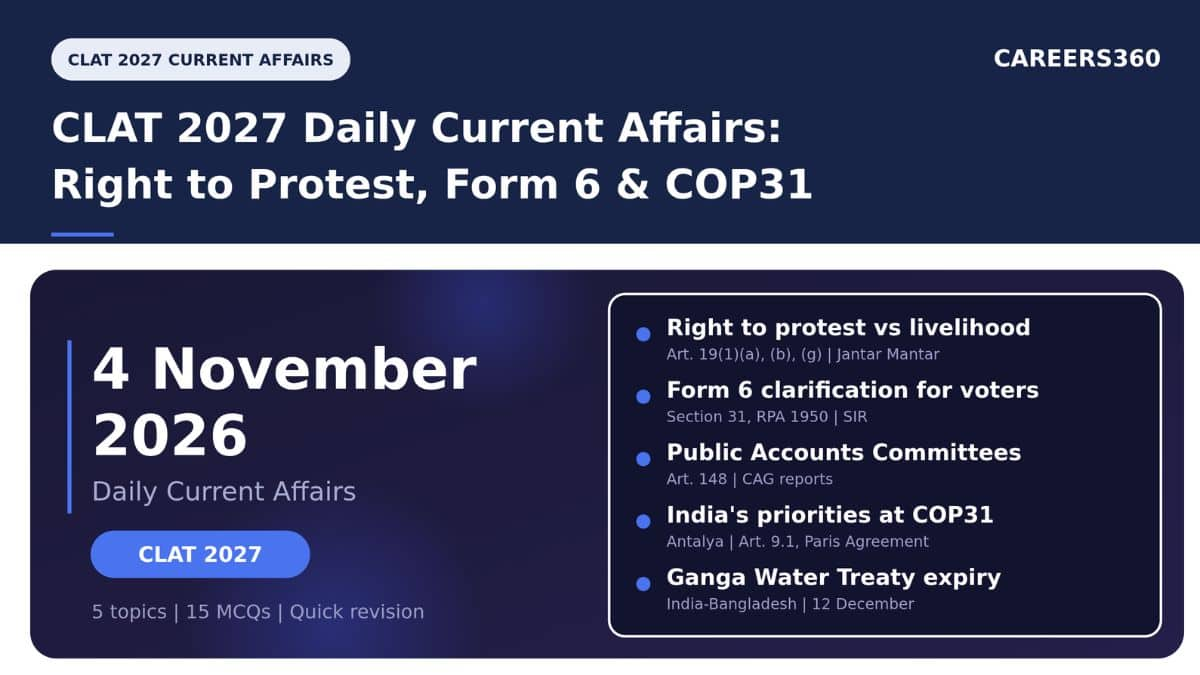
Today's CLAT 2027 current affairs cover five topics from polity, judiciary, environment and international affairs. These include the Supreme Court hearing on protests versus traders' livelihood and Delhi Police's stand on Jantar Mantar, the Election Commission's clarification on Form 6, the role of Public Accounts Committees, India's priorities at the COP31 climate summit, and the expiry of the Ganga Water Treaty. Read the key facts and practise the MCQs for CLAT preparation.
In the news: The Supreme Court heard a plea by Delhi traders who said protests were affecting festive-season business. A Bench led by CJI Surya Kant said the right to livelihood must be balanced with the right to protest. It also noted that protests support the income of hawkers and vendors. The Court issued notice but refused interim relief without hearing the protest organisers.
In a separate case on Jantar Mantar, the Delhi Police Commissioner told the Court that it is a public road, not a designated protest site. He said the right to protest does not give anyone the right to choose a particular location, and the State can shift protest venues.
What CLAT 2027 aspirants should know
Article 19(1)(a): Gives citizens the right to speak freely and express their views.
Article 19(1)(b): Allows citizens to gather peacefully without weapons.
Article 19(1)(g): Gives citizens the right to choose a profession or run a business.
Reasonable restrictions: These rights are not unlimited. The government can impose restrictions on certain grounds, including public order.
Q1. If a protest affects traders' business, how should the court deal with the conflict between these rights?
A. Always give priority to the right to protest
B. Always give priority to the right to do business
C. Balance both rights and consider reasonable restrictions
D. Leave the decision entirely to the police
Answer: C
Q2. Which Article gives citizens the right to gather peacefully without weapons?
A. Article 19(1)(a)
B. Article 19(1)(b)
C. Article 19(1)(g)
D. Article 21
Answer: B
Q3. What was Delhi Police's main argument about protests at Jantar Mantar?
A. Protests are not allowed in India
B. The right to protest does not include the right to choose any particular location
C. People can protest anywhere without restrictions
D. Only political parties can hold protests
Answer: B
In the news: The Election Commission of India (ECI) told Chief Electoral Officers that voters will not face action simply for filing Form 6 during or after the SIR, even if they were on an earlier electoral roll. This applies if they are not enrolled in another Lok Sabha or Assembly constituency. Voters missing from the draft roll must apply afresh.
The ECI said Electoral Registration Officers should not start action under Section 31 of the Representation of the People Act, 1950, only because of an earlier enrolment. The clarification follows an October 14 Delhi High Court ruling, which said the fear of a false declaration was misplaced. Form 6 asks applicants to declare that they are first-time voters.
What CLAT 2027 aspirants should know
Form 6: Used to apply for inclusion in the voter list.
Section 31 of the RPA, 1950: Provides punishment for making a false declaration in electoral matters.
Electoral Registration Officer (ERO): The official responsible for preparing the voter list and deciding claims and objections in a constituency.
Double enrolment: A person cannot be registered as a voter in more than one constituency at the same time.
Q1. Which law deals with punishment for making a false declaration in electoral matters?
A. Section 31 of the Representation of the People Act, 1950
B. Article 324
C. Section 8 of the Representation of the People Act, 1951
D. Article 326
Answer: A
Q2. Why were some previously registered voters worried about filing Form 6 again?
A. The form had been withdrawn
B. It asks applicants to declare that they are first-time voters
C. It requires permission from a court
D. It involves a registration fee
Answer: B
Q3. Who decides claims and objections relating to a constituency's voter list?
A. Booth Level Officer
B. Electoral Registration Officer
C. Rajya Sabha Returning Officer
D. State Governor
Answer: B
In the news: Lok Sabha Speaker Om Birla said Public Accounts Committees (PACs) examine whether the government spends money properly. He spoke at a two-day conference of PAC chairpersons from 25 states, hosted by the Kerala Assembly.
Birla called the practice of appointing an Opposition member as PAC chairperson a sign of a healthy democracy. He said some PAC reports remain pending for 15 to 20 years and suggested using technology, data analytics and AI to detect irregularities. Keralam's Chief Minister said legislatures cannot keep CAG reports out of PAC scrutiny.
What CLAT 2027 aspirants should know
Public Accounts Committee (PAC): A committee that checks government spending and examines audit reports.
Comptroller and Auditor General (CAG): The constitutional authority that audits government accounts.
Article 148: Provides for the office of the CAG of India.
Opposition chairperson: By convention, an Opposition member heads the PAC to ensure that government spending is independently examined.
Scholars’ Round Deadline: 14th Nov’26 | Earn upto 50% merit Scholarship + 10% for top performers | EFMD Accredited | AACSB (USA) & AMDISA Member | Highest CTC 28 LPA
BA LLB, BBA LLB, or BCom LLB and LLB | LLM 1 Year – 4 Specializations | Approved by BCI | Highest CTC 9 LPA
Q1. Which reports are mainly examined by the Public Accounts Committee?
A. Election Commission reports
B. Comptroller and Auditor General reports
C. Finance Commission reports
D. Law Commission reports
Answer: B
Q2. Why is an Opposition member traditionally appointed as PAC chairperson?
A. The Constitution makes it compulsory under Article 148
B. It helps ensure independent checks on government spending
C. The Speaker cannot head any committee
D. The ruling party has no members in the PAC
Answer: B
Q3. Which Article deals with the office of the CAG of India?
A. Article 76
B. Article 112
C. Article 148
D. Article 324
Answer: C
In the news: Union Environment Minister Bhupender Yadav said India will push for predictable climate finance, technology transfer and country-led climate action at COP31 in Antalya, Turkiye, from November 9 to 20. India will also demand that developed countries meet their financial commitments to developing nations.
India does not favour language calling for fossil fuel cuts or a phase-out. It will push for the continuation of the Just Transition Work Programme and a new Climate Finance Work Programme. Yadav said climate finance under Article 9.1 of the Paris Agreement should be predictable, mainly public and concessional, without adding to developing countries' debt.
What CLAT 2027 aspirants should know
COP: The annual meeting of countries that are part of the UN climate convention. Countries discuss ways to tackle climate change.
Article 9.1 of the Paris Agreement: Requires developed countries to provide financial support to developing countries for climate action.
Just Transition: Moving towards clean energy while protecting workers and communities affected by the shift.
Global Goal on Adaptation (GGA): A global target to help countries prepare for and deal with the effects of climate change.
Q1. What kind of climate funding is India seeking from developed countries?
A. Mostly private loans
B. Predictable funding, mainly from public sources and on easy terms
C. Voluntary funding with no fixed commitment
D. Funding only for technology transfer
Answer: B
Q2. Which principle supports India's demand that developed countries take greater responsibility for climate finance?
A. Polluter Pays Principle and Common but Differentiated Responsibilities
B. Sovereign Immunity
C. Doctrine of Lapse
D. Rule of Law
Answer: A
Q3. What does Article 9.1 of the Paris Agreement deal with?
A. Carbon markets
B. Financial support from developed countries to developing countries
C. Forest protection
D. Ocean pollution
Answer: B
In the news: The External Affairs Ministry said India and Bangladesh have a structured mechanism to discuss the Ganga Water Treaty, which expires on December 12. Spokesperson Randhir Jaiswal said there is no update on its renewal. India has invited Bangladesh Prime Minister Tarique Rahman to New Delhi, but no visit dates have been fixed.
Signed in 1996, the treaty sets out how the two countries share Ganga water. Its renewal requires expert-level and political talks through the Joint Rivers Commission. Bangladeshi diplomatic sources expect an automatic short-term extension, but India has not confirmed this.
What CLAT 2027 aspirants should know
Ganga Water Treaty, 1996: An agreement between India and Bangladesh on sharing the water of the Ganga river.
Joint Rivers Commission: A joint body where India and Bangladesh discuss issues related to rivers shared by the two countries.
Trans-boundary rivers: Rivers that flow through or between two or more countries.
Treaty renewal: Extending an agreement between countries through discussion and negotiation.
Q1. Which body helps India and Bangladesh discuss issues related to shared rivers?
A. Indus Commission
B. Joint Rivers Commission
C. SAARC Secretariat
D. BIMSTEC Council
Answer: B
Q2. What does it mean when a country agrees to extend a treaty for another period?
A. The treaty is terminated
B. The treaty is renewed
C. The treaty becomes void
D. The treaty is rejected
Answer: B
Q3. Why do countries sign agreements on rivers that flow across their borders?
A. To decide a common currency
B. To set rules for sharing and using river water
C. To decide visa policies
D. To merge their armed forces
Answer: B
Revise these important articles, laws and terms from today's five topics for CLAT 2027:
Article 19(1)(a): Freedom of speech and expression.
Article 19(1)(b): Right to peaceful assembly.
Article 19(1)(g): Right to practise a profession or run a business.
Form 6: Used to apply for inclusion in the voter list.
Section 31, RPA 1950: Deals with punishment for false declarations in electoral matters.
Public Accounts Committee: Examines government spending and CAG reports.
Article 148: Deals with the office of the CAG.
COP31: Scheduled in Antalya, Turkiye, from November 9 to 20.
Article 9.1, Paris Agreement: Climate finance from developed countries to developing countries.
Ganga Water Treaty, 1996: India-Bangladesh water-sharing agreement, due to expire on December 12.

On Question asked by student community
Hello Student,
The full form of the CLAT exam is the Common Law Admission Test. You can check the link related to the CLAT exam
https://law.careers360.com/articles/what-is-clat-full-form-all-about-nlus-entrance-exam
Hello Student,
Here are the Careers360 CLAT 2027 Mock Test Resources for your exam preparation.
1. Online CLAT Mock Test
2. CLAT Mock Tests and Solutions
Hello student,
CLAT 2027 aspirants can access these monthly current affairs compilations for regular revision. Use these resources to stay updated with important events and topics for CLAT 2027.
|
Particular |
Download PDF |
|
CLAT Current Affairs- August Month (2026) |
|
|
CLAT Current Affairs- |
If you have only two months, use a highly structured plan: daily current affairs, English reading, legal reasoning practice, logical reasoning sets, basic quantitative practice and regular full-length mocks. Spend as much time analysing incorrect questions as taking the mock itself. Consistency during these two months can make a substantial
You can download the CLAT previous years' question papers from here:
https://law.careers360.com/articles/clat-previous-year-question-papers
https://law.careers360.com/download/clat-sample-papers-previous-years

Experiential Learning through Legal Aid Camps, Lok Adalats, Court Visits, Community Lawyering and regular Moot Court sessions
Ranked #18 amongst Institutions in India by NIRF | Get Upto 100% Scholarships | Spot Admissions via CUET
Scholars’ Round Deadline: 14th Nov’26 | Earn upto 50% merit Scholarship + 10% for top performers | EFMD Accredited | AACSB (USA) & AMDISA Member | Highest CTC 28 LPA
BA LLB, BBA LLB, or BCom LLB and LLB | LLM 1 Year – 4 Specializations | Approved by BCI | Highest CTC 9 LPA
Grade 'A+' Accredited by NAAC | Ranked 33rd in India by NIRF
Moot Court | Mock trials | Legal Aid Clinic | Recruiting Partners: FICCI, TCS, Adani, Trilegal, and many others