SRM University, Chennai Law UG 2026
NAAC A++ Accredited | Ranked #11 by NIRF


Today’s current affairs cover important national, international and legal developments. The topics include a Delhi High Court ruling on foreign nationals entering India, the VISA Bill 2025, India’s participation in the SEO meeting in Pakistan, and the RBI Governor’s financial stability priorities. India's literacy progress, National Coastal Mission 2.0 and Jawahar Deep becoming India’s first plastic-free terminal.
This Story also Contains
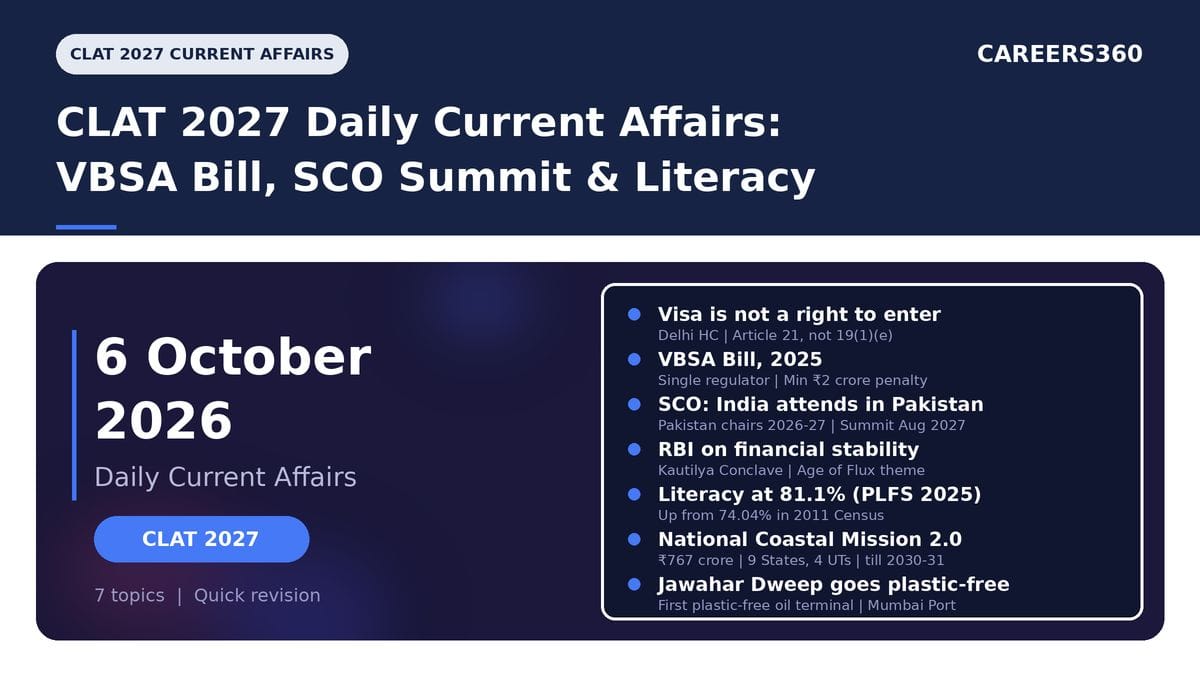
These topics will help CLAT 2027 aspirants strengthen General Knowledge and Current Affairs. The article includes important facts, case laws and MCQs for a quick and effective revision.
In the News: The Delhi High Court ruled that a valid Indian visa does not guarantee a foreign national the right to enter India. The case involved a Turkmenistan citizen who was denied entry due to adverse intelligence inputs. The Court held that visa and entry decisions are linked to national security and foreign policy. It relied on the Hans Muller (1955) and Louis De Raedt (1991) judgments and rejected her Article 14 claim as she and her husband were not in the same situation.
Visa: Allows travel to India, but entry is decided by immigration authorities.
Article 226: High Courts can issue writs, but foreigners have no fundamental right to enter India.
Article 21: Protects the life and personal liberty of foreigners.
Article 19(1)(e): Right to reside and settle in India is available only to citizens.
Immigration and Foreigners Act, 2025: Sections 3 and 7 allow the Centre to regulate or restrict foreigners' entry and stay.
Article 14: Ensures equality and allows reasonable classification.
Q1. Which fundamental right is available to foreigners in India, as affirmed in Louis De Raedt v. Union of India?
A. Article 19(1)(e)
B. Article 21
C. Article 15
D. Article 32
Answer: B. Article 21
Q2. Why did the Delhi High Court reject the Article 14 argument?
A. Article 14 applies only to citizens
B. Intelligence inputs cannot be examined by courts
C. The petitioner and her husband were not similarly situated
D. Article 14 does not apply to immigration matters
Answer: C. The petitioner and her husband were not similarly situated
In the News: The VBSA Bill, 2025 is under examination by a Joint Parliamentary Committee (JPC). It proposes replacing the existing higher education regulators with a single body called the Viksit Bharat Shiksha Adhishthan (VBSA). The VBSA Commission will have a Chairperson and not more than 12 members.
The Bill has led to a debate about whether higher education in India is already over-regulated. The VBSA would have three councils — Regulatory Council, Accreditation Council and Standards Council. However, it would not control the distribution of grants, which would remain with the Ministry of Education.
Medical and legal education would remain outside the VBSA's scope and continue to be regulated by their respective statutory bodies. Critics are also concerned that the proposed system could affect the autonomy of institutions such as IITs and IIMs and increase the Centre's role in higher education.
VBSA: Proposed single regulator for higher education under NEP 2020.
Three Councils: Regulatory, Accreditation and Standards Councils.
Funding: VBSA will regulate but not distribute grants; funding stays with the Ministry of Education.
Exclusion: Medical and legal education will remain under their existing regulators.
Concurrent List: Education is shared by the Centre and States, raising concerns about State autonomy.
Penalty: At least ₹2 crore for fraudulent or unauthorised degree-granting institutions.
Q1. Which of the following is excluded from the scope of the VBSA Bill, 2025?
A. Technical education
B. Teacher education
C. Medical and legal education
D. Open and distance learning
Answer: C. Medical and legal education
Q2. Why are some States concerned about the proposed single higher education regulator?
A. Education is only a State List subject
B. Education is in the Concurrent List, and States fear a loss of autonomy
C. Education is only a Union List subject
D. States have no role in education
Answer: B. Education is in the Concurrent List, and States fear a loss of autonomy
In the News: A senior Indian diplomat visited Pakistan to attend the Shanghai Cooperation Organisation (SCO) Council of National Coordinators meeting. It was the first official visit by an Indian delegation to Pakistan since Operation Sindoor.
Pakistan took over the SCO chairmanship at the Bishkek Summit and will host SCO meetings during 2026–27. The Heads of State Summit is scheduled in August 2027.
India participated in the meeting as a full member of the SCO. This allows India to remain part of the organisation's discussions and decision-making process.
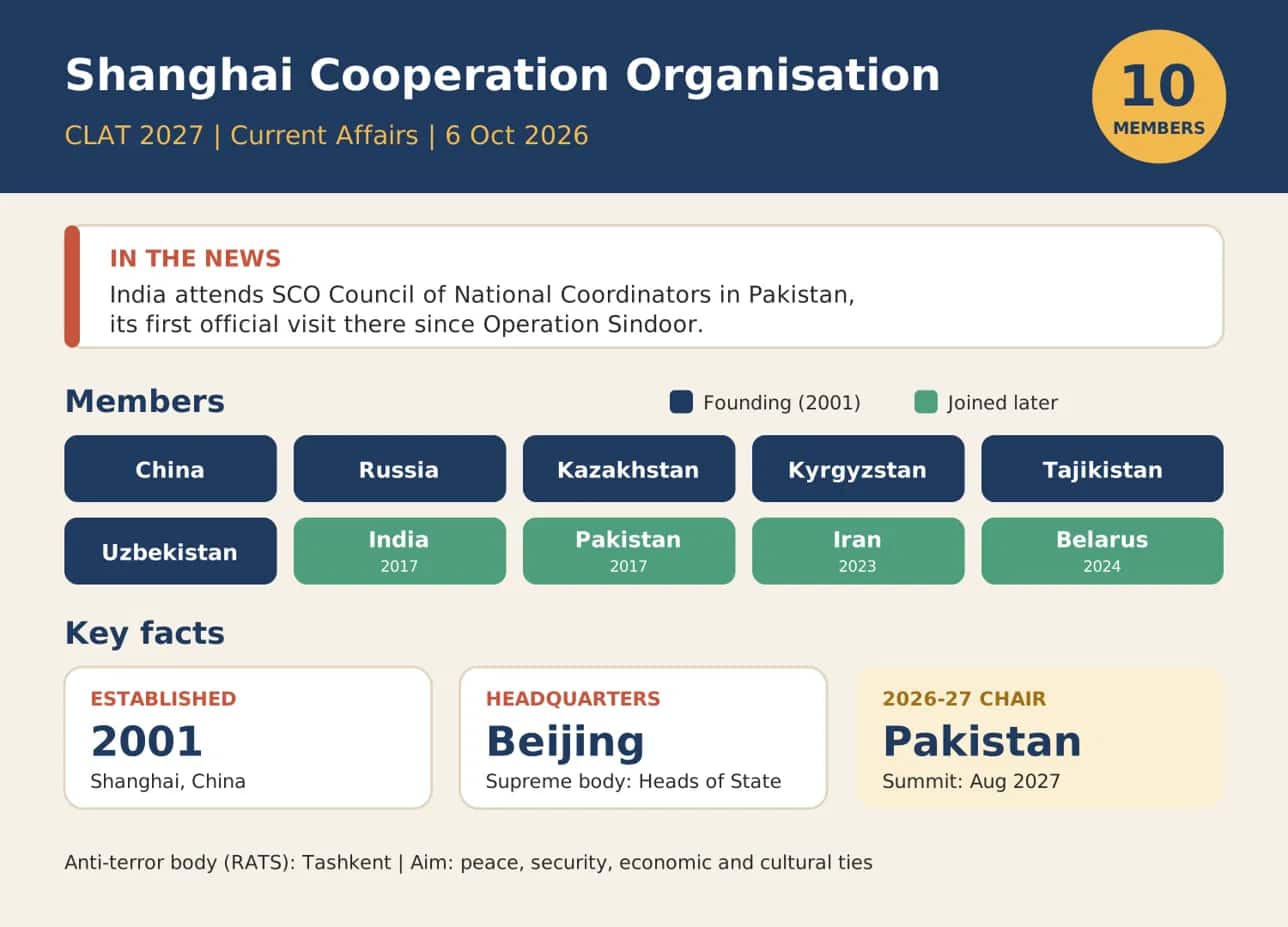
SCO: A 10-member Eurasian organisation comprising India, China, Russia, Pakistan, Iran, Belarus, Kazakhstan, Kyrgyzstan, Tajikistan and Uzbekistan.
Established: 2001 in Shanghai.
Headquarters: Beijing, China.
Highest body: Council of Heads of State.
Permanent bodies: SCO Secretariat in Beijing and Regional Anti-Terrorist Structure (RATS) in Tashkent.
Pakistan's theme: “Turning Vision into Action: Connectivity, Innovation and Shared Prosperity.”
Varanasi was the first-ever SCO Tourism and Cultural Capital for 2022–23.
SCO Tourism and Cultural Capital: Lahore, Pakistan, for 2026–27.
MCQs
Q1. Where is the headquarters of the Shanghai Cooperation Organisation located?
A. Moscow
B. Tashkent
C. Beijing
D. Islamabad
Answer: C. Beijing
Q2. Which country holds the SCO chairmanship for 2026–27?
A. India
B. Pakistan
C. Kyrgyzstan
D. Uzbekistan
Answer: B. Pakistan
In the News: The RBI Governor highlighted five key priorities for maintaining financial stability during a time of global uncertainty. He spoke at the 5th Kautilya Economic Conclave in New Delhi, which was held on the theme “Resilience in an Age of Flux.”
The priorities include strengthening the financial system, understanding new risks, using better data, improving resilience across the financial sector and maintaining public trust while using technologies such as AI and tokenisation.
For India, some of the major concerns include unsecured retail loans, speculation in Futures and Options (F&O), cyber risks, the decline in low-cost CASA deposits and the rapid growth of gold loans.
NBFI: Financial institutions that operate outside traditional banks.
Macroprudential regulation: Measures to control risks across the financial system.
CASA: Current and Savings Account deposits; a low-cost funding source for banks.
NPA: A loan where the borrower has stopped making payments.
MuleHunter.ai: A tool by RBI Innovation Hub to detect mule accounts linked to digital fraud.
Gold loans: Now the largest non-housing retail loan category.
Q1. Which measure can the RBI use to control excessive growth in unsecured retail lending?
A. Higher risk weights
B. Lower repo rate
C. Lower CRR
D. Higher subsidies
Answer: A. Higher risk weights
Q2. What does CASA stand for in banking?
A. Credit and Savings Account
B. Current Account and Savings Account
C. Capital and Securities Account
D. Cash and Securities Allocation
Answer: B. Current Account and Savings Account
In the News: India is continuing its efforts to achieve universal literacy and improve foundational education. According to the Periodic Labour Force Survey (PLFS) 2025, India's overall literacy rate was 81.1%, compared with 74.04% in the 2011 Census.
The government is working towards this goal through initiatives such as National Education Policy (NEP) 2020, ULLAS, NIPUN Bharat, Samagra Shiksha, PM SHRI, PM e-VIDYA and PM POSHAN. So far, 10 States and Union Territories have been declared fully literate under ULLAS.
Full literacy: A State or UT with a literacy rate of 95% or above is considered fully literate.
ULLAS: The New India Literacy Programme is a centrally sponsored scheme for people aged 15 years and above who could not receive formal schooling. Assessment is done through FLNAT.
NIPUN Bharat: Launched in July 2021 to achieve foundational literacy and numeracy for children aged 3–8 years by 2026–27.
Samagra Shiksha: Combines Sarva Shiksha Abhiyan, RMSA and Teacher Education and is aligned with SDG 4.
Fully literate States/UTs under ULLAS: Ladakh, Mizoram, Goa, Tripura, Himachal Pradesh, Chandigarh, Andaman and Nicobar Islands, Sikkim, Uttarakhand and Jammu & Kashmir.
NEP 2020 target: Increase the Gross Enrolment Ratio in higher education to 50% by 2035.
Q1. ULLAS is mainly meant for which group?
A. School children aged 3–8 years
B. Adults aged 15 years and above who missed formal schooling
C. Women above 40 years only
D. College students
Answer: B. Adults aged 15 years and above who missed formal schooling
Q2. What literacy rate is considered “full literacy” for a State or UT?
A. 75%
B. 85%
C. 90%
D. 95%
Answer: D. 95%
In the News: The Union Environment Minister launched the implementation guidelines for National Coastal Mission 2.0 (NCM 2.0) in New Delhi. The Central Sector Scheme has an outlay of ₹767 crore for 2025–26 to 2030–31 and replaces the earlier National Coastal Mission.
The mission covers 9 coastal States and 4 Union Territories. It aims to protect mangroves, coral reefs and wetlands, reduce coastal risks such as erosion, flooding and salinity, and support the Blue Economy through better coastal planning and community livelihoods.
Type: Central Sector Scheme with an outlay of ₹767 crore, running up to 2030–31.
Coverage: 9 coastal States and 4 Union Territories.
ICZMP and CMSP: Integrated Coastal Zone Management Plans and Coastal Marine Spatial Plans will focus on around 1,000 km of priority coastline.
Blue Economy: The mission is linked with India's Blue Economy Vision 2047.
Q1. National Coastal Mission 2.0 is a:
A. Centrally Sponsored Scheme
B. Central Sector Scheme
C. State Sector Scheme
D. Public-Private Partnership
Answer: B. Central Sector Scheme
Q2. How many coastal States and Union Territories are covered under NCM 2.0?
A. 7 States and 2 UTs
B. 8 States and 3 UTs
C. 9 States and 4 UTs
D. 10 States and 5 UTs
Answer: C. 9 States and 4 UTs
In the News: The Jawahar Dweep Marine Oil Terminal at Mumbai Port was declared India's first plastic-free oil terminal during Swachhata Abhiyan 2026. Oil Spill Response (OSR) facilities were also dedicated during the event.
The terminal handles crude oil and petroleum products. Its fifth jetty, JD5, was completed in December 2020 and can handle vessels carrying up to 1.5 lakh tonnes. The Mumbai Port Masterplan 2047 also proposes a sixth oil berth for large Suezmax-class vessels.
Jawahar Dweep: India's first plastic-free oil terminal.
Objective: Reduce single-use plastic and improve waste management around the port and coastal areas.
Oil Spill Response (OSR) facilities: Used to contain and clean up oil spills at sea.
Masterplan 2047: Proposes a sixth oil berth with a capacity of around 22 MTPA.
Q1. Which terminal was declared India's first plastic-free oil terminal?
A. Jawahar Dweep Marine Oil Terminal
B. Kandla Oil Jetty
C. Paradip Oil Terminal
D. Vadinar Terminal
Answer: A. Jawahar Dweep Marine Oil Terminal
Q2. The plastic-free declaration was made during which campaign?
A. Swachh Sagar Suraksha Abhiyan
B. Swachhata Abhiyan 2026
C. Clean Ganga Mission
D. Plastic Waste Rules Drive
Answer: B. Swachhata Abhiyan 2026
Here are the topics from today’s CLAT 2027 current affairs that aspirants should revise.
Article 226: High Courts' writ power; does not give foreigners a right to enter India.
Hans Muller Case (1955): Centre has power over the entry and expulsion of foreigners.
Louis De Raedt Case (1991): Foreigners are protected under Article 21.
Article 19(1)(e): Right to reside and settle in India is for citizens.
Immigration and Foreigners Act, 2025: Sections 3 and 7 regulate foreigners' entry and stay.
VBSA Bill, 2025: Proposes one higher education regulator with three councils.
Article 246: Education is in the Concurrent List, raising federalism concerns.
SCO: 10-member grouping; headquarters in Beijing; Pakistan holds the 2026–27 chair.
ULLAS: Adult literacy scheme for people aged 15 years and above.
NCM 2.0: ₹767-crore Central Sector Scheme covering 9 States and 4 UTs.

On Question asked by student community
Hello student,
CLAT 2027 aspirants can access these monthly current affairs compilations for regular revision. Use these resources to stay updated with important events and topics for CLAT 2027.
|
Particular |
Download PDF |
|
CLAT Current Affairs- August Month (2026) |
|
|
CLAT Current Affairs- |
If you have only two months, use a highly structured plan: daily current affairs, English reading, legal reasoning practice, logical reasoning sets, basic quantitative practice and regular full-length mocks. Spend as much time analysing incorrect questions as taking the mock itself. Consistency during these two months can make a substantial
You can download the CLAT previous years' question papers from here:
https://law.careers360.com/articles/clat-previous-year-question-papers
https://law.careers360.com/download/clat-sample-papers-previous-years
For CLAT 2027 UG, candidates need to have passed Class 12/equivalent with at least 45% marks, or 40% for SC/ST/PwD candidates.
In your situation, having an RT in an additional subject but subsequently passing the required qualification through an improvement examination does not automatically make you ineligible. However, the important
Here's the link to download the CLAT mock test:

Approved by BCI | Ranked #4 among Law Institutes in UP | NAAC A+ Accredited
Ranked 1 st among Top Law Schools of super Excellence in India - GHRDC | NAAC A+ Accredited | #36 by NIRF
Admission Against Cancellation/Lapsed Seats | Pay 500 Application Fee instead of ₹1500 | NIRF Ranked 87 | NAAC A+ Grade | Upto 100% scholarship
Application Closing on 30th Jul'26 | Approved by Bar Council of India | 100% Scholarship | Accepts CLAT Scores | Few Seats Left!
NAAC A+ Accredited | Students | Moot Court Session | Legal Aid Clinics | | Scholarships to Meritorious
Last Date to Apply: 17th August | QS I-Gauge Diamond Rated | NAAC A+ Accredited | 621 Recruitment Partners | INR 40 LPA Highest CTC | 4482 Job offers