School of Law, UPES, Dehradun
Ranked #18 amongst Institutions in India by NIRF | Get Upto 100% Scholarships | Spot Admissions via CUET


Just ahead of CLAT 2027, the Election Commission of India is in the news amid a controversy over the Special Intensive Revision (SIR). The topic is part of both the CLAT current affairs and legal aptitude sections of the syllabus. At the centre of the controversy lie the Special Intensive Revision (SIR) and the decision-making framework within the ECI. Besides the news headlines, CLAT students preparing for the December exam should focus on the structure of the ECI, the appointment process, its powers and the decision-making process.
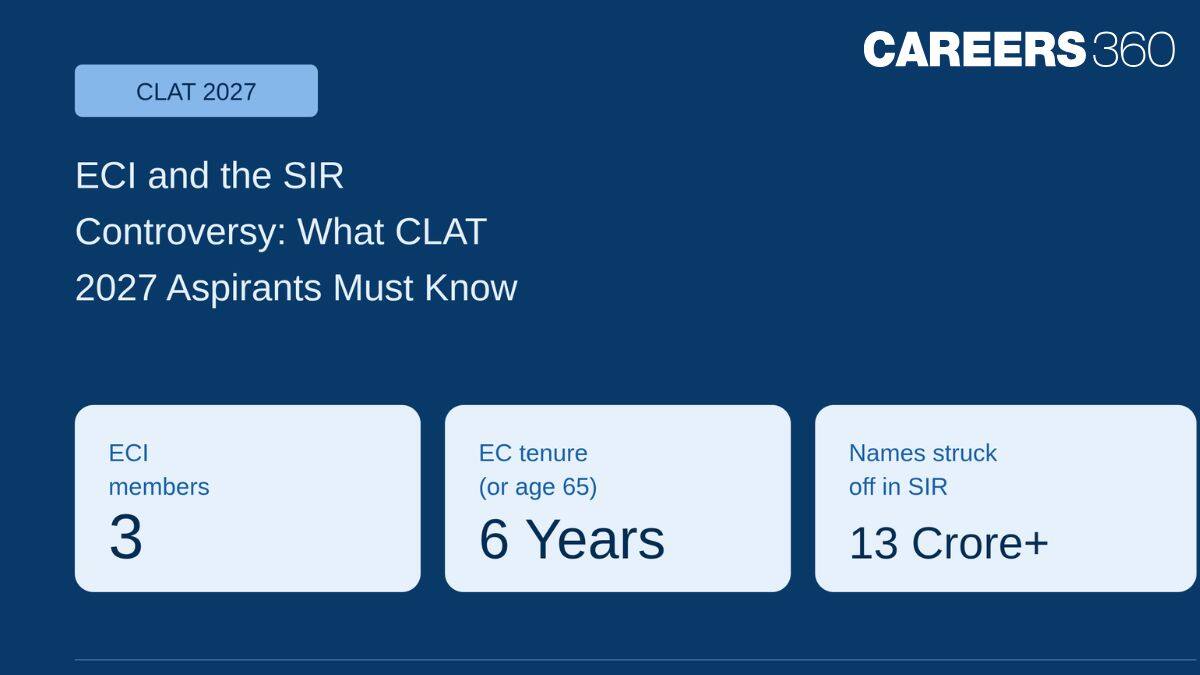
ECI, a constitutional body also known as the guardian of India's electoral democracy, is responsible for administering Union and State election processes in India. From its inception in 1950 to 1989, the ECI has functioned as a single-member body, headed solely by the Chief Election Commissioner of India.
In 1989, two new positions were added to the ECI, making it a three-member body. This structure remained only for a year, and the two new positions were abolished in 1990. Eventually, the same three-member structure was restored in 1993.
Constitutional Provision: Article 324 establishes the ECI. The Chief Election Commissioner is appointed by the President of India. ECI held its first general elections in 1952.
Members: ECI consists of a Chief Election Commissioner and other members as the President of India may appoint.
Ranked #18 amongst Institutions in India by NIRF | Get Upto 100% Scholarships | Spot Admissions via CUET
Scholars’ Round Deadline: 14th Nov’26 | Earn upto 50% merit Scholarship + 10% for top performers | EFMD Accredited | AACSB (USA) & AMDISA Member | Highest CTC 28 LPA
In case of multiple members, the CEC acts as chairperson
Equality of status: All members of the ECI enjoy equal pay, allowances and service conditions. Their salary and service conditions are on par with those of a judge in the Supreme Court of India.
Tenure: The term of an election commissioner is six years or 65 years of age, whichever is earlier. However, they can also resign at any time by writing to the President.
Decision-making: In case of a difference, the matter is decided by majority. This is particularly important in the current controversy around the functioning of the ECI.
Removal of ECI: The election commissioners enjoy security of tenure. The process of removal of the CEC is similar to that of a judge in the Supreme Court of India. The other members of the ECI cannot be removed from office unless there is a recommendation from the CEC. To ensure further independence, the service conditions of election commissioners cannot be changed to their disadvantage.
In the current appointment system, the President appoints the Chief Election Commissioner on the recommendation of a committee comprising the Prime Minister of India, a Union Cabinet member nominated by the PM and the Leader of the Opposition in the Lok Sabha. Gyanesh Kumar is the first CEC to be appointed under this mechanism in February 2025. The two other members are Sukhbir Singh Sandhu and Vivek Joshi.
The new mechanism came after the Supreme Court, hearing the Anoop Baranwal case (2023), proposed a panel with the Chief Justice of India as one of the three members of the committee. Following this, the Parliament passed the CEC and Other ECs (Appointment, Conditions of Service and Term of Office) Act, 2023 in December 2023. However, it replaced the CJI with a Union Cabinet Minister nominated by the PM. This arrangement left the government with two of three seats on the committee, effectively giving it a majority in case of a difference of opinion with the leader of the opposition.
CLAT aspirants should also be aware of the SIR process, which led to the current controversy around the ECI. The ECI is empowered to prepare and revise Electoral Rolls under Article 324 and Section 21 of the Representation of the People Act, 1950. The objective of revision is to maintain the integrity of the electoral roll before every election as per requirement. The SIR is also conducted to update the electoral roll to address many problems which may have occurred in the existing electoral roll due to frequent migration, resulting in voters getting registered in more than one place or non-removal of dead voters.
The current controversy around the ECI is related to the SIR process started in the Bihar elections in 2025 and later conducted in other states. It struck more than 13 crore names off the draft voter rolls across 30 states and union territories.
As per reports from The Indian Express, the two election commissioners, Sandhu and Joshi, recorded at least 14 objections over 10 months. This connects back to the majority decision framework of the ECI.

On Question asked by student community
Hello Student,
Here are the Careers360 CLAT 2027 Mock Test Resources for your exam preparation.
1. Online CLAT Mock Test
2. CLAT Mock Tests and Solutions
Hello student,
CLAT 2027 aspirants can access these monthly current affairs compilations for regular revision. Use these resources to stay updated with important events and topics for CLAT 2027.
|
Particular |
Download PDF |
|
CLAT Current Affairs- August Month (2026) |
|
|
CLAT Current Affairs- |
If you have only two months, use a highly structured plan: daily current affairs, English reading, legal reasoning practice, logical reasoning sets, basic quantitative practice and regular full-length mocks. Spend as much time analysing incorrect questions as taking the mock itself. Consistency during these two months can make a substantial
You can download the CLAT previous years' question papers from here:
https://law.careers360.com/articles/clat-previous-year-question-papers
https://law.careers360.com/download/clat-sample-papers-previous-years
For CLAT 2027 UG, candidates need to have passed Class 12/equivalent with at least 45% marks, or 40% for SC/ST/PwD candidates.
In your situation, having an RT in an additional subject but subsequently passing the required qualification through an improvement examination does not automatically make you ineligible. However, the important

Ranked #18 amongst Institutions in India by NIRF | Get Upto 100% Scholarships | Spot Admissions via CUET
Scholars’ Round Deadline: 14th Nov’26 | Earn upto 50% merit Scholarship + 10% for top performers | EFMD Accredited | AACSB (USA) & AMDISA Member | Highest CTC 28 LPA
Law Admissions 2026 Open | Avail Merit-Based Scholarships
NAAC A++ Accredited | Ranked #11 by NIRF
Law Admissions Open 2026 | #2nd in India by The World University Rankings for Innovation | 200+ Collaborations | 700+ Industry Recruiters
Law Application Open 2027 | International Students from 30 countries | Merit-Based Scholarship worth Rs. 50 Crores | 100,000+ Alumni Globally.