Amity Law School, Noida
Experiential Learning through Legal Aid Camps, Lok Adalats, Court Visits, Community Lawyering and regular Moot Court sessions


The Common Law Admission Test (CLAT) 2027 is just around the corner. While the syllabus and pattern remain consistent with previous years, CLAT 2027 questions may differ slightly from those asked in previous years. In this regard, the CLAT Expert Committee’s report and the Consortium’s July 21 notification, which says some reform suggestions can be adopted in CLAT 2027, are particularly important. The two official mock tests the consortium recently released also offer useful clues about the upcoming CLAT 2027. This article discusses how CLAT 2027 questions may be framed differently from previous years, the key areas students should prepare before entering the exam hall, and themes likely to repeat.
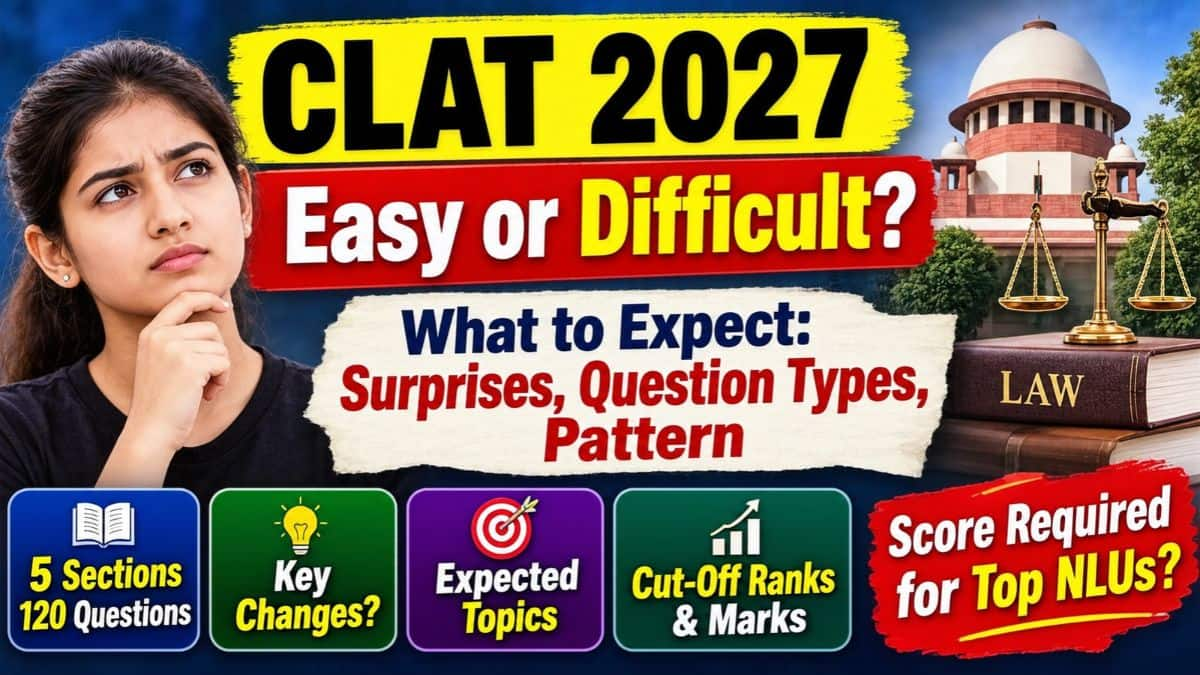
The CLAT 2027 pattern broadly remains consistent with previous years since the changes suggested by the Expert Committee are not applicable for this year. The CLAT 2027 question paper will have five sections, as it was last year. Questions will continue to be based on paragraphs, so quick reading and comprehension skills remain crucial.
As per the consortium’s own notification, the Convenor of CLAT 2027 and paper setters will consider some suggestions given by the CLAT Expert Committee’s report and will incorporate those in the question paper in a feasible manner.
Attempt Free Official Practice Test & Solutions and Ace the CLAT Exam 2026
Here are some observations from the CLAT Expert Committee’s report that students should keep in mind -
Less technical reading
CLAT’s heavy reliance on the English language was flagged as a barrier for students who study in regional languages. While the English language remains an important part of CLAT, remaining sections may have paragraphs in functional language suitable for understanding the content and answering questions. The logical reasoning and maths are expected to have less reading load compared to the question papers of previous years.
Legal reasoning without prior knowledge
Despite the CLAT consortium repeatedly ruling out legal knowledge as a prerequisite for this section, some questions have been framed around static law, polity and the Constitution. The questions asked last year were a mix of legal current affairs, judgments, and their application. The prior knowledge of judgments, laws and regulations would have helped the students answer questions on GST rates, one nation one election or same-sex marriage. This section is likely to remain consistent with more questions around principles and cases.
Diversified skill testing in quantitative techniques
The CLAT maths or quantitative section has been least disputed in recent years. The reasoning behind this is the clarity and objectivity in testing certain skills. However, the expert committee has noted that this section doesn’t go beyond testing certain skills, and it recommends adding more varied problems, something which the convenor of CLAT 2027 may consider. CLAT maths also requires reading of texts and interpretation. While data interpretation questions will continue to be part of CLAT 2027, the reading load can be managed. The best approach will be to practice previous year questions and sample questions created around those.
Look beyond analytical reasoning
The logical reasoning section of previous years’ CLAT was based on analytical reasoning. It surprised several students. This year, the logical reasoning can be more balanced, with questions drawn from both critical reasoning and analytical reasoning.
Static GK can be trimmed
Static GK has promoted rote memorisation, and it has been flagged by the expert committee. The new proposed pattern recommends removing the GK and current affairs section from the question paper format. This suggestion can be adopted next year. However, this year’s question paper setters may take cues from the recommendations and can reduce the static GK without altering the structure. In this scenario, CLAT current affairs of the last five to six months become more important than static GK.
The NLU Consortium recently conducted two CLAT mock tests. While it said that the question papers are not indicative of the actual test and are only for the purpose of practice, they offer crucial insights. Here are some key takeaways from the official CLAT mock tests.
| CLAT 2027 Official Mock Test 1 with Answer Key | Download Free PDF Here |
| CLAT 2027 Official Mock Test 2 with Answer Key | Download Free PDF Here |
Get the CLAT UG previous year question papers here
Both official mocks follow the same structure & exam pattern: 120 questions, five sections, and every question is passage-based. There are 24 passages in total, each followed by five questions. Here’s how the questions are split:
Verdict: moderate. The concepts are easy, but reading 24 passages makes the paper tiring.
Speed is the real exam. At about 1 minute per question (if the paper stays at 2 hours), slow readers lose marks even when they know the answers.
Everything is passage-based. All 120 questions come in sets of 5, even in Current Affairs and Quant, so practise sets, not isolated questions.
Puzzles and vocab are out. Reasoning means judging arguments (strengthen, weaken, assumption), no question was asked from seating arrangement.
Current Affairs rewards understanding. The passage explains the topic (RBI, G20, RTI, ECI), so students should know how institutions work rather than memorising headlines.
Legal answers hide in limited words. Watch for phrases like "not unlimited" or "not automatically invalid," and use only the principle given in the passage.
Quant is small but risky. With 10 questions on percentages, averages and ratios, one careless slip costs marks.
Close options are the trap. When two options look alike, pick the one nearest the passage wording.

On Question asked by student community
Hello Student,
You can refer to the following Careers360 resources to study Law of Contracts for CLAT Legal Reasoning:
Contract Law – Chapter-wise Study Material:
https://www.careers360.com/legal-studies/contract-law-chapter-pge
Contract Law and Tort Basics for CLAT 2027:
https://law.careers360.com/articles/contract-law-and-tort-basics-for-clat-2027-legal-reasoning
Hello Lavina,
For CLAT 2028 preparation, students should choose an online coaching programme that offers comprehensive study material, regular mock tests, current affairs updates, doubt-solving sessions and expert guidance. Compare course features, faculty experience and student reviews before selecting a coaching programme.
Hello Miruthula,
For CLAT PG 2027, you need to focus on the core subjects of your LLB curriculum, particularly the following:
Constitutional Law
Jurisprudence
Administrative Law
Law of Contract
Law of Torts
Family Law
Criminal Law
Property Law
Company Law
Public International Law
Tax Law
Environmental Law
Labour and Industrial
Hello Student,
The full form of the CLAT exam is the Common Law Admission Test. You can check the link related to the CLAT exam
https://law.careers360.com/articles/what-is-clat-full-form-all-about-nlus-entrance-exam
Hello Student,
Here are the Careers360 CLAT 2027 Mock Test Resources for your exam preparation.
1. Online CLAT Mock Test
2. CLAT Mock Tests and Solutions

Experiential Learning through Legal Aid Camps, Lok Adalats, Court Visits, Community Lawyering and regular Moot Court sessions
Ranked #18 amongst Institutions in India by NIRF | Get Upto 100% Scholarships | Spot Admissions via CUET
NAAC A++ Accredited | Avail up to 100% scholarship via MRNAT-Manav Rachna National Aptitude Test
NAAC A++ Approved | Curriculum Aligned with BCI & UGC
UG Scholar's Round Deadline: 1st Dec'26 | Earn upto 50% merit Scholarship + 10% for top performers | Highest CTC 18 LPA
Grade 'A+' Accredited by NAAC | Ranked 33rd in India by NIRF